Pose Estimation Datasets: How to Annotate 2D and 3D Motion for Sports and Biomechanics AI
.jpeg)

This article explains how pose estimation datasets are created and annotated for sports, biomechanics and human performance AI. It covers 2D and 3D keypoint labeling, multi-view calibration, temporal consistency, body landmarks, edge cases and data structuring. You will also learn how pose annotations support action recognition, player tracking, technique analysis and injury prevention.
- This article explains how pose estimation datasets are created and annotated for sports, biomechanics and human performance AI.
- It covers 2D and 3D keypoint labeling, multi-view calibration, temporal consistency, body landmarks, edge cases and data structuring.
- In sports analytics, biomechanics, fitness technology and rehabilitation, pose estimation datasets allow AI models to understand movement patterns with precision.
- Studies from the Stanford CVGL Human Motion Research highlight that pose-based metrics predict performance efficiency and injury risk across various sports.
Pose estimation is the process of identifying human joint positions in images or video. In sports analytics, biomechanics, fitness technology and rehabilitation, pose estimation datasets allow AI models to understand movement patterns with precision. Research from the Max Planck Institute for Intelligent Systems (MPI-IS) shows that models trained on high-quality keypoint annotations significantly outperform those trained on noisy or inconsistent datasets. Pose annotation is therefore fundamental for any application involving motion analysis.
Why Pose Estimation Matters in Sports and Biomechanics
Pose estimation enables systems to evaluate technique, analyze movement quality and detect risky patterns. Coaches and analysts use pose data to understand posture, joint angles, balance and coordination. Studies from the Stanford CVGL Human Motion Research highlight that pose-based metrics predict performance efficiency and injury risk across various sports. Accurate annotation ensures the model learns meaningful biomechanical cues rather than superficial pixel patterns.
Preparing Data for Pose Annotation
Pose datasets rely on clean, consistent and calibrated visuals. Before annotating, teams must standardize footage, align timestamps and validate camera geometry.
Normalizing image quality
Resolution, lighting and camera exposure influence keypoint clarity. Annotators must ensure normalized frames before labeling. Stable visual conditions improve downstream model accuracy.
Ensuring correct body orientation
Frames must be aligned so that body direction is consistent across sequences. Misaligned orientation distorts joint estimation and makes annotation harder. Orientation rules help maintain clarity in diverse sports actions.
Removing visual obstructions
Equipment, shadows, other players or environment props may conceal joints. Annotators must follow rules for labeling partial visibility and flagging fully occluded regions. Consistent treatment prevents annotation drift.
Annotating 2D Keypoints for Pose Estimation
2D annotation involves marking joints in single images or video frames. It forms the foundation of human motion understanding.
Defining a clear keypoint schema
A schema specifies which joints to label: head, shoulders, elbows, wrists, hips, knees, ankles and sometimes hands or feet. Clear diagrams help annotators recognize anatomical positions. Schema consistency improves model generalization.
Labeling joints with pixel-level accuracy
Annotators must mark joint coordinates precisely. Even small deviations can distort biomechanical metrics such as angles or stride length. Annotators must zoom in and use consistent judgment across frames.
Handling foreshortening and perspective distortions
Sports footage frequently includes angled views or intense perspective compression. Annotators must rely on expected anatomical positions when exact joints are not visible. This prevents unnatural skeleton shapes.
Temporal Consistency in Pose Annotations
Pose estimation in video is not about single frames: it requires smooth trajectories across time. Temporal annotation ensures that poses remain consistent across motion sequences.
Maintaining consistent keypoint positions across frames
Joints must move logically from frame to frame. Annotators must correct jitter or inconsistent placement. Smooth trajectories improve model tracking and action interpretation.
Labeling fast movements
Rapid movements such as kicks, swings or sprints create motion blur. Annotators must label blurred joints using contextual understanding. This ensures realistic pose reconstruction.
Handling transitional phases
Posture changes occur gradually during sports actions. Annotators must capture these transitions accurately. The temporal smoothness reinforces model stability.
Annotating 3D Pose Estimation Data
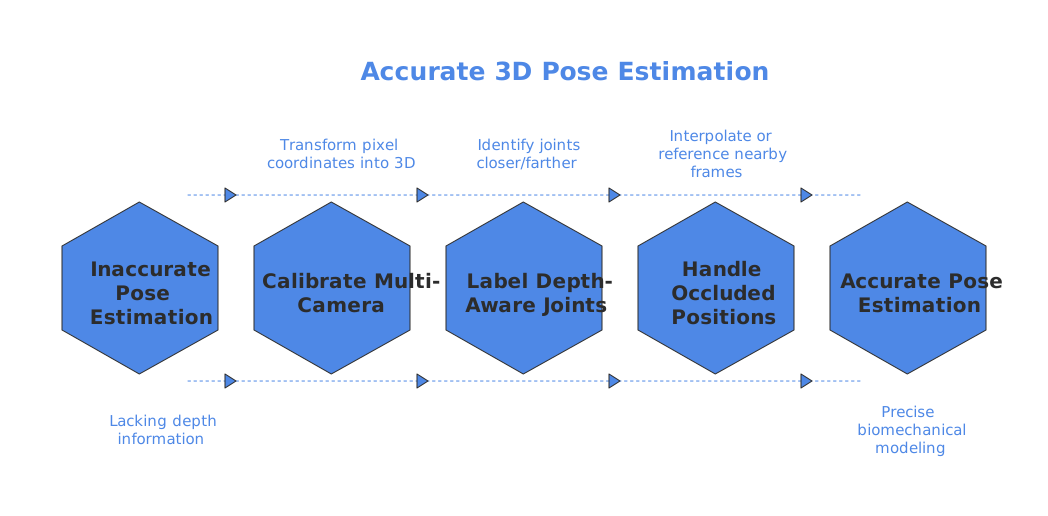
3D pose estimation adds depth information, enabling precise biomechanical modeling. Labeling 3D data requires multi-view systems or depth sensors.
Calibrating multi-camera setups
Multi-view calibration transforms pixel coordinates into 3D space. Annotators must follow calibration protocols to ensure geometric accuracy. Correct calibration supports reliable 3D reconstruction.
Labeling depth-aware joints
Annotators must identify which joints are closer or farther from the camera. Depth cues such as occlusion and size help maintain accurate interpretation. Depth consistency is crucial for biomechanics applications.
Handling occluded 3D positions
Some joints cannot be derived directly from visuals. Annotators must use interpolation rules or reference nearby frames when appropriate. These rules prevent distorted 3D skeleton estimation.
Domain-Specific Pose Annotation in Sports
Different sports have unique movement signatures, equipment and body postures. Pose annotation must capture sport-specific mechanics.
Tennis: rotational mechanics and hip-shoulder separation
Annotators must capture rotation angles, trunk orientation and wrist position during swings. These details matter for technique evaluation.
Basketball: verticality and landing mechanics
Jump mechanics require accurate labeling of takeoff, peak height and landing. Annotators must capture subtle knee and ankle positions.
Track & Field: stride cycles and acceleration phases
Sprinters’ movements must be labeled across distinct stride phases. Annotators must identify consistent knee drive, foot strikes and transition steps.
Handling Edge Cases in Pose Annotation
Pose estimation often struggles with rare or unusual body positions. Annotators must follow consistent rules to maintain reliability.
Labelling twisted or extreme poses
Certain sports movements create atypical limb positions. Annotators must apply anatomical understanding to maintain realistic skeletal configuration.
Addressing clothing or equipment interference
Team uniforms, protective gear or loose clothing can obscure joints. Annotators must interpret likely joint positions without adding unrealistic estimates.
Differentiating between similar limb positions
Ambiguity often occurs when limbs overlap or cross. Annotators must use context and surrounding frames to determine correct placement.
Designing Guidelines for Pose Annotation
Pose annotation guidelines must explain anatomical rules and provide examples for each joint, scenario and sport type.
Providing anatomical references
Guidelines must include diagrams and explanations of joint positions. Annotators rely on anatomical cues to place keypoints accurately.
Documenting edge-case decisions
Unusual poses require documented handling rules. This documentation helps new annotators avoid inconsistent interpretations.
Updating rules as datasets expand
As new movements and sports are added, guidelines must evolve. Version control ensures all annotators follow the same standards.
Quality Control for Pose Estimation Datasets
Pose datasets contain thousands of frames requiring tight consistency. Quality control ensures that annotations remain accurate and biomechanically meaningful.
Running frame-to-frame consistency checks
Reviewers must ensure that joints move smoothly across sequences. Sudden jumps indicate annotation errors. Smooth trajectories support realistic pose modeling.
Sampling high-intensity actions
Fast movements produce most errors. Reviewing these sequences reveals common annotation weaknesses. Corrections improve dataset reliability.
Using automated skeleton validation
Automated tools detect unnatural joint angles or impossible positions. These checks flag errors early, reducing long-term inconsistencies.
Integrating Pose Data Into AI Pipelines
Pose datasets must integrate cleanly into training workflows for sports, biomechanics and motion intelligence models.
Creating strong evaluation sets
Evaluation sequences must include fast, slow, occluded and multi-view situations. This variety offers realistic performance benchmarks.
Tracking domain drift
New sports environments or camera setups can shift pose distributions. Teams must update datasets regularly to avoid model degradation.
Supporting continuous dataset expansion
Pose datasets grow as new sports, movements and perspectives are added. Ongoing updates require stable rules and high-quality examples.
If you’re building 2D or 3D pose estimation datasets and want support with keypoint labeling, sport-specific motion analysis or biomechanical annotation workflows, we can explore how DataVLab helps teams develop precise and scalable pose datasets for sports and performance AI.
What are Pose estimation datasets?
This article explains how pose estimation datasets are created and annotated for sports, biomechanics and human performance AI. It covers 2D and 3D keypoint labeling, multi-view calibration, temporal consistency, body landmarks, edge cases and data structuring.
Why does pose estimation matter in sports and biomechanics?
Pose estimation enables systems to evaluate technique, analyze movement quality and detect risky patterns. Coaches and analysts use pose data to understand posture, joint angles, balance and coordination. Studies from the Stanford CVGL Human Motion Research highlight that pose-based metrics predict performance efficiency and injury risk across various sports.
What is involved in annotating 2d keypoints for pose estimation?
2D annotation involves marking joints in single images or video frames. It forms the foundation of human motion understanding. A schema specifies which joints to label: head, shoulders, elbows, wrists, hips, knees, ankles and sometimes hands or feet.
What does the section on “Domain-Specific pose annotation in sports” explain?
Different sports have unique movement signatures, equipment and body postures. Annotators must capture rotation angles, trunk orientation and wrist position during swings. Jump mechanics require accurate labeling of takeoff, peak height and landing.
What is involved in designing guidelines for pose annotation?
Pose annotation guidelines must explain anatomical rules and provide examples for each joint, scenario and sport type. Guidelines must include diagrams and explanations of joint positions. Annotators rely on anatomical cues to place keypoints accurately.
How can teams ensure quality in Pose estimation datasets?
Pose datasets contain thousands of frames requiring tight consistency. Quality control ensures that annotations remain accurate and biomechanically meaningful. Reviewers must ensure that joints move smoothly across sequences.