Infrared and Thermal Face Datasets: Training Facial Recognition for Low-Light Conditions
.jpeg)
Infrared and thermal face datasets are essential for building biometric systems that operate in low-light, night-time, or high-glare environments where standard RGB cameras fail. These datasets capture facial appearance through infrared reflectivity or thermal emission, producing features that remain stable even when lighting is inconsistent. They support applications in security, access control, surveillance, automotive safety, military operations, and disaster response. This article explains how infrared and thermal face datasets are collected, what types of annotations they require, how ground-truth thermal signatures are calibrated, and why environmental consistency is critical for accurate model training. It also covers the challenges of low-light imaging, occlusion, sensor variability, privacy considerations, and the quality assurance processes required to build reliable low-light biometric models.
- Infrared and thermal face datasets are essential for building biometric systems that operate in low-light, night-time, or high-glare environments where standard RGB cameras fail.
- These datasets capture facial appearance through infrared reflectivity or thermal emission, producing features that remain stable even when lighting is inconsistent.
- This article explains how infrared and thermal face datasets are collected, what types of annotations they require, how ground-truth thermal signatures are calibrated, and why environmental consistency is critical for accurate model training.
- It also covers the challenges of low-light imaging, occlusion, sensor variability, privacy considerations, and the quality assurance processes required to build reliable low-light biometric models.
Why Infrared and Thermal Face Data Is Essential
Overcoming the Limitations of RGB Cameras
RGB imagery loses reliability under poor lighting, harsh shadows, or nighttime conditions. Infrared and thermal sensors capture facial characteristics that remain visible even in darkness, making them indispensable for security or outdoor biometric tasks. MIT’s Computer Science and Artificial Intelligence Laboratory demonstrates how IR and thermal imaging reveal details that RGB cameras cannot under low illumination. These modalities allow AI models to extract consistent features regardless of lighting variation.
Supporting Night-Time and Zero-Light Biometric Recognition
Infrared datasets capture reflected light from the near-infrared spectrum, while thermal datasets record emitted heat patterns from the face. Both modalities allow identification systems to function in zero-light conditions. This is especially useful for transportation hubs, border monitoring, and perimeter security. Thermal imaging provides additional robustness because temperature patterns are difficult to manipulate and remain stable across lighting conditions.
Powering Advanced Security and Industrial Applications
Organizations use infrared and thermal face datasets for access control, surveillance, remote identification, and mission-critical monitoring. Government and defense sectors often rely on thermal biometrics for nighttime operations. The U.S. Department of Energy highlights thermal imaging as a reliable tool for low-light monitoring scenarios. When combined with structured annotation and sensor calibration, these datasets train models capable of high-stakes biometric performance.
Core Components of Infrared and Thermal Face Datasets
Sensor-Specific Image Capture
Each infrared or thermal dataset is tied to the characteristics of the sensor used to collect it. Near-infrared cameras capture reflected light, while thermal sensors capture radiated heat. Proper calibration ensures the dataset reflects actual facial characteristics rather than sensor noise. This sensor dependency makes metadata essential for dataset integrity.
Temperature and Reflectivity Signatures
Thermal datasets contain heat distribution patterns across facial regions, while infrared data captures reflectivity that differs between skin types and material surfaces. These signatures must be labeled with clarity to help models separate identity-specific patterns from environmental effects. High-quality thermal datasets include stable temperature ranges to preserve consistent signatures.
Multi-Condition Capture Sessions
Infrared and thermal datasets must be collected across multiple environmental conditions such as different temperatures, indoor versus outdoor settings, mild wind exposure, or varied humidity levels. These conditions affect heat dissipation and reflectivity. Capturing diverse scenarios improves generalization and operational reliability.
Variability That Strengthens Low-Light Facial Models
Environmental Temperature Fluctuations
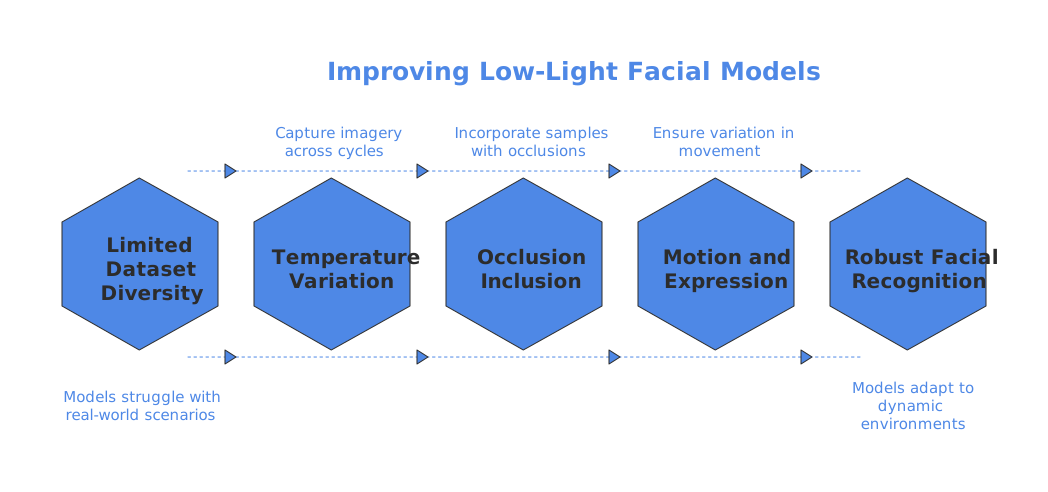
Thermal signatures vary with environmental temperature and humidity. A high-quality dataset includes imagery captured across day and night cycles, seasonal variation, and a range of ambient temperatures. These conditions teach models to separate stable identity patterns from temporary thermal changes.
Occlusion From Clothing and Accessories
Scarves, hats, glasses, and masks affect both infrared reflection and heat emission. Rather than excluding these samples, datasets must incorporate them to train models for real-world use. Annotators must correctly interpret occluded regions and avoid mislabeling them as anomalies.
Motion, Orientation, and Expression Diversity
Movement affects heat distribution patterns, while angle variation alters reflectivity in IR imagery. Expression changes subtly distort thermal patterns in the face. Including motion and expression variation ensures that low-light models adapt well to dynamic environments.
Techniques Used to Build Infrared and Thermal Face Datasets
Multi-Sensor Capture Rigs
Some datasets are captured using synchronized IR, thermal, and RGB cameras. Multi-sensor rigs provide aligned modalities that help models learn cross-spectrum relationships. This is valuable when deploying hybrid biometric systems that operate in both daylight and nighttime.
Controlled Thermal Calibration
Thermal datasets often require calibration using controlled temperature references or blackbody emitters to ensure consistency across sessions. Calibration ensures that heat signatures are comparable across sensors and environmental conditions. This technique is standard in thermal imaging research, as documented by the Infrared Training Center.
Near-Infrared Structured Illumination
Some IR datasets use structured illumination to enhance facial contrast. By projecting near-infrared patterns onto the face, cameras capture more detailed reflectivity features. This technique increases facial landmark clarity and improves model accuracy under low-light conditions.
Annotation and QA for Low-Light Biometrics
Landmark and Region Annotation
Infrared and thermal datasets benefit from annotated facial landmarks, eye regions, nose regions, and contour boundaries. These annotations allow models to map thermal or IR signatures to known facial geometry. Temporal consistency is required when annotating video sequences.
For thermal sequences, DataVLab’s video annotation services can maintain landmark and identity consistency across frames.
Quality Control Across Temperature and Lighting States
Thermal datasets require the verification of stable heat signatures across frames. QA teams must check for drift, anomalies in thermal readings, or unexpected sensor artifacts. Infrared datasets require checks for reflectivity anomalies, lens flare, or false reflections from surrounding objects.
Multi-Session Identity Review
Low-light biometric datasets often include multiple recording sessions per identity. QA must confirm that identities remain stable across sessions, climates, and temperatures. Detecting identity mix-ups early prevents significant model degradation.
Applications Enabled by Infrared and Thermal Face Datasets
Security and Access Control
Infrared and thermal face datasets support security systems in low-light environments, enabling identification at night or in poorly lit indoor locations. Facilities that operate 24 hours rely heavily on these modalities.
Driver Monitoring and Automotive Safety
Thermal and IR imaging are widely used to detect driver drowsiness, distraction, and gaze direction in nighttime driving. These datasets help train models that remain accurate even when the cabin lighting is minimal.
Emergency and Search Applications
Thermal facial data helps detect individuals in smoke, darkness, or disaster environments. Fire services and search teams benefit from systems that recognize heat patterns when visibility is compromised.
Supporting Infrared and Thermal Dataset Development
Infrared and thermal face datasets are essential for building biometric systems that work reliably in low-light environments. Their quality depends on sensor calibration, environmental diversity, precise annotation, and rigorous QA workflows. If your team needs help creating infrared or thermal facial datasets, designing annotation pipelines, or validating multi-condition biometric data, we can explore how DataVLab supports advanced low-light AI projects across industries.
What are Infrared and thermal face datasets?
Infrared and thermal face datasets are essential for building biometric systems that operate in low-light, night-time, or high-glare environments where standard RGB cameras fail. These datasets capture facial appearance through infrared reflectivity or thermal emission, producing features that remain stable even when lighting is inconsistent.
Why is Infrared and thermal face data Essential?
RGB imagery loses reliability under poor lighting, harsh shadows, or nighttime conditions. Infrared and thermal sensors capture facial characteristics that remain visible even in darkness, making them indispensable for security or outdoor biometric tasks. MIT’s Computer Science and Artificial Intelligence Laboratory demonstrates how IR and thermal imaging reveal details that RGB cameras cannot under low illumination.
What does the section on “Core components of infrared and thermal face datasets” explain?
Each infrared or thermal dataset is tied to the characteristics of the sensor used to collect it. Near-infrared cameras capture reflected light, while thermal sensors capture radiated heat. Proper calibration ensures the dataset reflects actual facial characteristics rather than sensor noise.
What does the section on “Variability that strengthens Low-Light facial models” explain?
Thermal signatures vary with environmental temperature and humidity. A high-quality dataset includes imagery captured across day and night cycles, seasonal variation, and a range of ambient temperatures. These conditions teach models to separate stable identity patterns from temporary thermal changes.
What does the section on “Techniques used to build infrared and thermal face datasets” explain?
Some datasets are captured using synchronized IR, thermal, and RGB cameras. Multi-sensor rigs provide aligned modalities that help models learn cross-spectrum relationships. This is valuable when deploying hybrid biometric systems that operate in both daylight and nighttime.
What are the main use cases for Infrared and thermal face datasets?
Infrared and thermal face datasets support security systems in low-light environments, enabling identification at night or in poorly lit indoor locations. Facilities that operate 24 hours rely heavily on these modalities. Thermal and IR imaging are widely used to detect driver drowsiness, distraction, and gaze direction in nighttime driving.