Health Data Classification : How Structured Medical Information Enables Clinical AI and Healthcare Analytics
.jpeg)

Health data classification organizes medical information into structured categories that allow AI systems, clinical workflows, and analytics platforms to understand and process healthcare data. This article explains what health data classification means, why it matters for clinical AI, and how taxonomies and labeling systems structure complex medical information. It explores frameworks such as medical concept hierarchies, healthcare ontologies, and epidemiological classifications, alongside the challenges of working with diverse clinical data sources. Readers will learn how classification supports interoperability, decision support, and clinical NLP applications. The article concludes with a detailed look at future directions in multimodal and AI-assisted health data classification.
- Health data classification organizes medical information into structured categories that allow AI systems, clinical workflows, and analytics platforms to understand and process healthcare data.
- This article explains what health data classification means, why it matters for clinical AI, and how taxonomies and labeling systems structure complex medical information.
- It explores frameworks such as medical concept hierarchies, healthcare ontologies, and epidemiological classifications, alongside the challenges of working with diverse clinical data sources.
- The article concludes with a detailed look at future directions in multimodal and AI-assisted health data classification.
What Is Health Data Classification? Understanding the Foundations of Structured Medical Information
Defining Health Data Classification
Health data classification refers to the process of organizing medical information into structured categories that reflect clinical meaning, context, and relationships between concepts. This structured approach helps healthcare systems standardize the representation of symptoms, diagnoses, procedures, medications, laboratory observations, and other clinical attributes. Classification ensures that disparate forms of clinical information can be compared, analyzed, and interpreted reliably by both humans and AI systems. Resources such as the Unified Medical Language System maintained by the U.S. National Library of Medicine demonstrate how clinical concepts and vocabularies can be integrated into a cohesive framework that supports medical data organization.
Why Classification Matters in Healthcare
Healthcare data is inherently diverse, spanning everything from electronic health records to imaging reports, laboratory results, and public health records. Without classification, these data sources cannot be reliably analyzed or shared across systems. Classification provides the semantic structure that allows systems to interpret medical content accurately. It supports interoperability, facilitates clinical decision-making, and enables large-scale analytics. For machine learning applications, classification creates predictable data patterns that allow models to learn from labeled medical information effectively.
Health Data Classification vs. Clinical NLP Classification
Health data classification is broader and more fundamental than the classification tasks seen in clinical NLP. While clinical NLP models classify text segments into categories such as diagnoses or procedure types, health data classification defines the underlying frameworks and meaning of these categories. Health data classification forms a conceptual foundation that guides how annotations, models, and analytics interpret clinical information. This distinction ensures that the article remains conceptually broad and avoids overlap with dataset-focused content developed later in the cluster.
Dimensions of Health Data Classification
Health data classification encompasses multiple dimensions that reflect different aspects of clinical information. Each dimension serves specific analytical or operational purposes.
Clinical Content Categories
Clinical content categories organize information such as symptoms, conditions, and treatments. These categories help clinicians record and interpret patient data consistently. Classification systems group related concepts together based on clinical meaning and use-case requirements. These categories support downstream tasks such as risk stratification, population-level analysis, and clinical decision support. Clear categorization ensures that data accurately reflects clinical reality and aligns with established medical knowledge.
Administrative and Operational Categories
In addition to clinical content, classification must address administrative processes such as billing, reimbursement, and healthcare operations. These categories reflect how healthcare services are delivered, coded, and recorded. Administrative classification systems help healthcare providers maintain accurate records that align with regulatory requirements. They also support standardized reporting for insurance claims and public health mandates.
Public Health and Epidemiological Classifications
Public health classification focuses on population-level disease patterns, surveillance metrics, and outbreak reporting structures. This dimension helps healthcare organizations track trends in disease prevalence, transmission, and outcomes. Public health agencies rely on classification systems to represent and analyze epidemiological information. Standards published by organizations such as the Centers for Disease Control and Prevention illustrate how public health data classification supports national and global health monitoring.
Health Data Taxonomies and Ontologies
Taxonomies and ontologies play a central role in health data classification by organizing medical concepts into structured hierarchies and relationships.
Taxonomy Structures in Healthcare
A taxonomy provides a hierarchical structure that groups medical concepts according to shared characteristics. This structure helps categorize conditions, procedures, and observations so that related information can be indexed and retrieved efficiently. Taxonomies promote consistency in clinical documentation and enhance interoperability across systems. Hierarchical categorization allows users to navigate broad categories and drill down into specific subcategories as needed.
Ontologies and Semantic Relationships
Ontologies extend taxonomies by defining relationships between concepts beyond hierarchical structure. Ontologies represent relationships such as equivalence, causal associations, temporal connections, and attribute dependencies. These relationships help AI systems interpret clinical data with greater nuance. Ontologies support context-aware applications that require understanding of how medical concepts interact. By incorporating semantic relationships, ontologies enable advanced reasoning and more accurate clinical interpretation.
Classification Frameworks in Healthcare
Healthcare organizations rely on established classification frameworks to structure clinical information. These frameworks are designed to support interoperability, analytics, and global data exchange.
Global Health Classifications
The World Health Organization maintains multiple classification systems that standardize the representation of diseases, procedures, and health-related observations. These systems ensure that healthcare providers worldwide use consistent terminology and categorizations for recording clinical data. WHO’s classifications serve as foundational references for many national health systems and help support international public health reporting.
National and Regional Standards
National healthcare systems may adopt or adapt classification standards that align with regional needs. These standards govern how healthcare organizations document, code, and share medical information. Standards published by the U.S. Office of the National Coordinator for Health IT describe how health information exchange relies on structured data to support clinical workflows and improve patient outcomes. Regional standards play a critical role in supporting interoperability between providers within a given healthcare system.
International Standards Organizations
International Standards Organization publications define guidelines for healthcare data representation, classification, and exchange. These guidelines support data quality and interoperability across clinical, administrative, and research domains. Healthcare providers use these standards to ensure that their data structures align with global best practices and comply with international reporting requirements.
Implementing Health Data Classification in Healthcare Systems
Implementing health data classification requires aligning clinical workflows, data structures, and technology infrastructure to support standardized information.
Structuring Clinical Documentation
Clinicians must document patient encounters in ways that reflect structured classifications. Electronic health record systems incorporate classification codes and controlled vocabularies that guide documentation. Structured documentation ensures that clinical information is represented accurately and consistently across providers. Clear documentation structures also support downstream analytics and clinical decision support.
Integrating Classification Into Clinical Workflows
Healthcare organizations integrate classification systems into workflows such as coding, billing, and quality reporting. Classification ensures that clinical actions and observations are recorded in standardized formats. This integration supports clinical decision support, improves care coordination, and enables accurate reporting. Incorporating classification systems into workflows also enhances data quality and ensures that information is available for analytics and machine learning applications.
Challenges in Health Data Classification
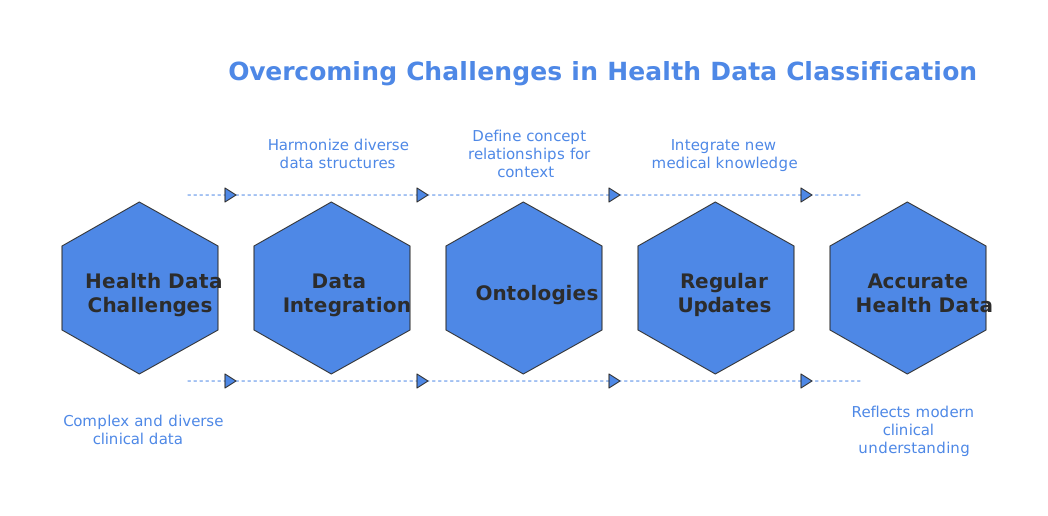
Despite its importance, health data classification presents several challenges due to the complexity and diversity of clinical information.
Data Diversity and Heterogeneity
Healthcare data comes from diverse sources and formats, ranging from structured fields to free-text notes. Classification systems must accommodate this diversity while maintaining consistency. Clinical narratives, imaging reports, wearable device data, and laboratory systems use different structures that require harmonization to support effective classification. Handling this variety requires robust classification frameworks and careful data integration.
Ambiguity and Context Dependence
Clinical information often contains ambiguity due to variations in terminology, context, or interpretation. A symptom may have multiple underlying causes, and a clinical action may vary based on patient context. Classification systems must account for these complexities to avoid misinterpretation. Ontologies help address ambiguity by defining concept relationships that provide context for classification decisions.
Evolving Medical Knowledge
Medical knowledge evolves rapidly, requiring classification systems to be updated regularly. New procedures, conditions, and research findings must be integrated into existing frameworks. Maintaining current classification systems ensures that healthcare data reflects modern clinical understanding. Frequent updates also support accurate analytics and reliable model training.
Evaluating Health Data Classification Systems
Evaluation ensures that classification systems accurately represent clinical information and support intended applications.
Assessing Completeness and Coverage
Evaluators examine whether classification systems include all relevant concepts and represent them comprehensively. Gaps in coverage can affect clinical decision support and limit the usefulness of analytics. Evaluators compare classification frameworks to clinical practice patterns to identify areas requiring expansion or revision.
Ensuring Alignment With Clinical Requirements
Classification systems must align with clinical needs and workflows. Evaluators assess whether classification categories support documentation requirements, care delivery, and reporting obligations. Alignment ensures that classification enhances care quality and supports clinical efficiency rather than hindering workflows.
Applications of Health Data Classification
Health data classification supports numerous applications across clinical care, research, public health, and AI development.
Clinical Decision Support
Structured classification helps decision support systems interpret patient data and generate relevant recommendations. These systems rely on accurate classifications to provide context-aware alerts, reminders, and insights. Classification enhances decision-making by improving the accuracy of clinical information available to support clinical actions.
Public Health Monitoring
Classification systems support the aggregation and analysis of population health data. Public health agencies use structured data to track disease trends, monitor outbreaks, and evaluate the impact of health interventions. Accurate classification is essential for reliable public health analysis and response planning.
Future Directions in Health Data Classification
Health data classification continues to evolve as healthcare systems adopt advanced analytics and AI technologies. Future developments include multimodal integration, AI-assisted classification, and improved interoperability frameworks.
AI-Assisted Classification
AI can support the classification process by identifying patterns in clinical data and suggesting appropriate categories. Assisted classification reduces manual effort and improves accuracy. These systems require careful oversight to ensure that AI suggestions align with clinical standards and domain requirements. Ongoing research continues to explore how AI can improve classification efficiency while maintaining data quality.
Multimodal Classification Frameworks
Future classification systems may integrate structured data, text, images, and sensor outputs into unified representations. Multimodal integration supports more comprehensive patient analysis and improves the accuracy of predictive models. Developing such frameworks requires new classification schemas and expanded ontology structures capable of representing varied data types.
If You Are Designing Health Data Classification Workflows
DataVLab’s medical annotation services support domain-aware labeling and quality review for structured clinical datasets.
High-quality health data classification is foundational for building reliable clinical AI systems, improving interoperability, and enabling accurate healthcare analytics. If you are structuring medical information, preparing annotated datasets, or implementing classification frameworks, the DataVLab team can help design workflows that meet clinical and technical requirements. Share your objectives, and we can support your efforts to develop structured, high-integrity healthcare data.
How does Structured medical information enable Clinical AI and healthcare analytics?
Health data classification organizes medical information into structured categories that allow AI systems, clinical workflows, and analytics platforms to understand and process healthcare data. This article explains what health data classification means, why it matters for clinical AI, and how taxonomies and labeling systems structure complex medical information.
Why does classification matter in healthcare?
Healthcare data is inherently diverse, spanning everything from electronic health records to imaging reports, laboratory results, and public health records. Without classification, these data sources cannot be reliably analyzed or shared across systems. Classification provides the semantic structure that allows systems to interpret medical content accurately.
What does the section on “Health data taxonomies and ontologies” explain?
Taxonomies and ontologies play a central role in health data classification by organizing medical concepts into structured hierarchies and relationships. A taxonomy provides a hierarchical structure that groups medical concepts according to shared characteristics. This structure helps categorize conditions, procedures, and observations so that related information can be indexed and retrieved efficiently.
What does the section on “Implementing health data classification in healthcare systems” explain?
Implementing health data classification requires aligning clinical workflows, data structures, and technology infrastructure to support standardized information. Clinicians must document patient encounters in ways that reflect structured classifications. Electronic health record systems incorporate classification codes and controlled vocabularies that guide documentation.
What are the main challenges of Health data classification?
Despite its importance, health data classification presents several challenges due to the complexity and diversity of clinical information. Healthcare data comes from diverse sources and formats, ranging from structured fields to free-text notes. Classification systems must accommodate this diversity while maintaining consistency.
What is the future of Health data classification?
Health data classification continues to evolve as healthcare systems adopt advanced analytics and AI technologies. Future developments include multimodal integration, AI-assisted classification, and improved interoperability frameworks. AI can support the classification process by identifying patterns in clinical data and suggesting appropriate categories.