NLP Clinical Trials : Annotating Protocols and Eligibility Criteria for Clinical Research Automation
.jpeg)

Natural language processing plays an increasingly important role in clinical research by helping organizations analyze trial protocols, extract eligibility criteria, and automate key components of study planning. This article explains how NLP is applied to clinical trial documentation, how annotated datasets are constructed, and how structured trial information supports feasibility, study matching, and evidence synthesis. It examines the challenges of annotating trial protocols and clinical research documents, from handling regulatory language to capturing complex eligibility conditions. The article also explores tools, evaluation strategies, and emerging trends such as multimodal trial analysis and large-scale protocol repositories.
- Natural language processing plays an increasingly important role in clinical research by helping organizations analyze trial protocols, extract eligibility criteria, and automate key components of study planning.
- This article explains how NLP is applied to clinical trial documentation, how annotated datasets are constructed, and how structured trial information supports feasibility, study matching, and evidence synthesis.
- It examines the challenges of annotating trial protocols and clinical research documents, from handling regulatory language to capturing complex eligibility conditions.
- The article also explores tools, evaluation strategies, and emerging trends such as multimodal trial analysis and large-scale protocol repositories.
Understanding NLP in Clinical Trials
NLP in clinical trials refers to the use of natural language processing methods to analyze, structure, and extract information from clinical research documents. These documents include trial protocols, amendments, investigator brochures, eligibility criteria, outcome measures, and regulatory submissions. Because clinical trial documentation is lengthy, variable, and written in specialized regulatory language, NLP models help research teams quickly interpret and organize essential content. Large public registries such as ClinicalTrials.gov demonstrate the scale of data available for NLP analysis, with thousands of protocols published in standard formats.
Why NLP Is Transforming Clinical Research
Clinical research involves extensive review of lengthy documents that contain complex inclusion criteria, procedural details, dosing schedules, and analytical frameworks. Manual review is time consuming and prone to inconsistencies. NLP accelerates document analysis by converting unstructured text into structured representations required for trial feasibility, study comparison, and cohort identification. NLP helps streamline research workflows, reduce operational burden, and improve the accuracy of trial planning. These benefits make NLP a growing component of clinical research infrastructure.
Types of Clinical Research Documents Processed by NLP
NLP systems process a wide range of trial-related documents, each with unique characteristics. Protocols contain detailed descriptions of study design and methodology. Eligibility criteria document the medical and demographic conditions required for trial participation. Regulatory documents provide clinical justification, safety considerations, and compliance requirements. Annotators label these documents to help models understand trial structure and extract key information. Because each document type serves a different purpose, annotation strategies must reflect the document's role within the trial lifecycle.
The Structure of Clinical Trial Protocols
A clinical trial protocol outlines the scientific rationale, methodology, and operational details of a study. Understanding protocol structure is essential for designing annotation strategies and NLP workflows.
Core Components of Trial Protocols
Trial protocols include background information, study objectives, research hypotheses, eligibility criteria, intervention descriptions, outcome definitions, and statistical analysis plans. Each component contains domain-specific language that requires specialized annotation. The structured format helps NLP models identify the locations of key sections and extract relevant information. Protocols published through regulatory bodies, such as the FDA, provide consistent templates that guide annotation design.
Variability in Protocol Writing
Although protocols follow general guidelines, writing styles vary across research organizations, therapeutic areas, and regulatory requirements. Some protocols emphasize scientific justification, while others prioritize operational details or regulatory compliance. Annotators must handle these differences by applying consistent labels across diverse document styles. Variability influences NLP model performance and increases the need for representative training datasets.
Importance of Protocol Annotation
Annotated protocols help NLP models learn to identify clinical trial components automatically. Annotation categories may include intervention details, study arms, primary endpoints, secondary endpoints, eligibility rules, and follow-up schedules. Structured protocol representations support downstream tasks such as trial comparison, feasibility analysis, and automated reporting. Annotation also helps models detect modifications introduced through protocol amendments.
Eligibility Criteria and NLP
Eligibility criteria determine which patients can participate in a clinical trial. These criteria are a major focus of NLP because they are central to feasibility assessments and patient matching.
Structure of Eligibility Criteria
Eligibility criteria typically consist of two sets of conditions: inclusion criteria, which describe the characteristics that qualify participants, and exclusion criteria, which describe conditions that disqualify them. These conditions span medical history, laboratory values, disease staging, demographic factors, and medication use. Annotating eligibility criteria requires careful reading to distinguish between similar but distinct requirements.
Annotation of Eligibility Rules
Annotators label eligibility criteria according to clinical concepts, logical operators, and numerical thresholds. These labels help models interpret eligibility rules accurately and convert them into structured representations suitable for computation. Some conditions require interpreting medical context, such as distinguishing between acute and chronic conditions or identifying dependencies between criteria. Annotators also capture whether a condition refers to current status, medical history, or contraindications.
Applications of Eligibility Extraction
Extracted eligibility criteria help systems match patients to trials using clinical data from electronic health records or research databases. Hospitals and research networks use NLP-assisted matching tools to identify potential participants more efficiently. Structured eligibility criteria also support meta-analysis and systematic reviews. Regulatory agencies such as the European Medicines Agency emphasize clearly defined eligibility structures because they influence patient safety and study integrity.
Annotating Clinical Trial Outcomes
Outcome definitions describe how a trial measures treatment effects. These definitions often appear across multiple sections of a protocol and require careful annotation to ensure consistency.
Primary and Secondary Outcomes
Primary outcomes define the main endpoints used to determine the trial's success. Secondary outcomes measure additional effects or exploratory endpoints. Annotators label these outcomes according to clinical domain, measurement type, time frame, and assessment method. Outcome definitions must be clear and consistent to ensure accurate interpretation during analysis.
Temporal and Quantitative Information
Outcome definitions often include time frames, measurement intervals, and thresholds. Annotators capture this temporal information to help models interpret when and how outcomes are measured. Quantitative details may include laboratory values, clinical score thresholds, or imaging-based measurements. Structured temporal and quantitative labels support advanced modeling tasks.
Annotation Workflows for Clinical Trial Documents
Annotation workflows ensure that trial documents are reviewed consistently and structured appropriately for NLP model training.
Document Segmentation
Annotators begin by segmenting documents into functional units such as introduction, design, methods, and safety. Segmentation helps models navigate large documents and understand structural relationships. Segmentation also improves annotation efficiency by dividing lengthy protocols into manageable components.
Section and Concept Labeling
Annotators label sections according to their functional roles and assign concept-level labels within each section. This multilevel annotation helps models interpret trial structure and extract information at different granularities. Labels may include study design terms, eligibility rules, intervention types, and outcome definitions. Because trial documents contain redundant or cross-referenced content, annotators must track consistency across sections.
Iterative Review and Expert Input
Clinical trial annotation often requires domain experts who understand regulatory terminology and study design. Annotation workflows include iterative review cycles where experts verify annotations and resolve ambiguities. These cycles ensure that labels align with regulatory definitions and clinical research standards. Review by experts familiar with NIH trial requirements helps maintain alignment with national research policies.
Challenges in NLP for Clinical Trials
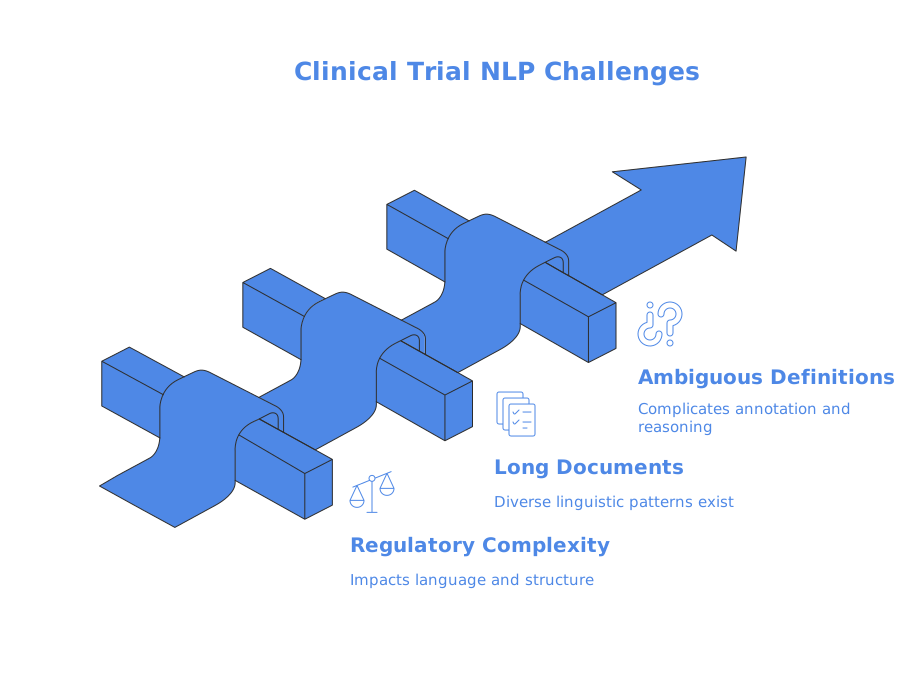
Clinical trial NLP presents several technical, linguistic, and operational challenges that influence dataset quality and model performance.
Regulatory Complexity
Clinical trial documentation is governed by strict regulatory requirements that influence language, structure, and interpretation. Annotators must understand how regulatory terminology affects meaning. Compliance requires attention to detail and clear differentiation between mandated content and narrative elaboration. Regulatory complexity increases annotation difficulty and influences model robustness.
Long and Heterogeneous Documents
Trial protocols are long, multi-section documents that contain diverse linguistic patterns. Annotators must navigate scientific justification, operational details, statistical considerations, and regulatory language within the same document. Document heterogeneity requires flexible annotation strategies that can accommodate different writing styles and content types.
Ambiguity in Eligibility Definitions
Eligibility criteria often contain ambiguous phrasing, partial conditions, or implied logical relationships. Ambiguity complicates annotation and requires annotators to interpret clinical reasoning carefully. Logical operators and thresholds may be omitted or implied, making criteria difficult to annotate consistently. Addressing ambiguity requires detailed guidelines and iterative refinement.
Evaluating NLP Models for Clinical Trials
Evaluation ensures that NLP models trained on annotated clinical trial documents produce reliable and consistent outputs.
Accuracy of Extracted Trial Components
Evaluators assess how accurately models extract study components such as endpoints, interventions, and eligibility criteria. They compare model outputs with high-quality annotations to compute precision and recall. These evaluations provide insights into model strengths and highlight areas requiring refinement.
Robustness Across Therapeutic Areas
Clinical trials span a wide range of therapeutic areas, from oncology to cardiology to infectious disease. Evaluators examine model performance across these domains to ensure generalizability. Performance variation across specialties may indicate insufficient dataset diversity or a need for domain-specific tuning.
Applications of NLP in Clinical Trial Processes
NLP enhances multiple aspects of clinical trial planning, execution, and analysis. These applications demonstrate how structured trial documents can improve research efficiency.
Trial Feasibility Assessment
NLP models help assess feasibility by analyzing trial requirements, available patient populations, and operational constraints. Structured eligibility criteria support feasibility simulations that help researchers determine whether a site can recruit suitable participants. NLP-based feasibility analysis reduces manual workload and improves planning accuracy.
Protocol Comparison and Harmonization
NLP models compare trial protocols by analyzing similarities in design, intervention, eligibility criteria, and outcomes. This comparison helps organizations harmonize protocols across studies and identify inconsistencies. Harmonization reduces redundancy and improves scientific rigor in research networks.
Evidence Synthesis and Systematic Review Support
NLP helps extract trial outcomes, study designs, and methodological details for evidence synthesis. Organizations such as Cochrane examine structured trial information to support systematic reviews that evaluate the effectiveness of medical interventions. Structured extraction accelerates review preparation and improves accuracy.
Future Directions in NLP for Clinical Trials
NLP in clinical trials continues to advance as models integrate new data modalities, regulatory frameworks evolve, and trial complexity increases.
Multimodal Trial Document Analysis
Future NLP systems may combine text with clinical images, structured data, real-world evidence, or trial results. Multimodal datasets support deeper interpretation of trial designs and outcomes. Integrating multiple data types requires refined annotation strategies and expanded dataset infrastructure.
Scaling Trial Document Repositories
Growing trial registries expand opportunities for large-scale training of models. As more protocols, amendments, and regulatory documents become publicly accessible, NLP systems can develop richer representations of trial structures. Scalable datasets help models generalize across therapeutic areas and reflect evolving research standards.
If You Are Structuring Clinical Trial Documents
NLP for clinical trials requires high-quality annotated documents that reflect the complexity of study protocols and regulatory requirements. If you are preparing datasets for eligibility extraction, protocol analysis, or feasibility workflows, the DataVLab team can help design annotation strategies that support accurate and reliable model performance. Share your needs, and we can help transform your clinical trial documentation into structured, actionable datasets.
What is NLP clinical trials?
Natural language processing plays an increasingly important role in clinical research by helping organizations analyze trial protocols, extract eligibility criteria, and automate key components of study planning. This article explains how NLP is applied to clinical trial documentation, how annotated datasets are constructed, and how structured trial information supports feasibility, study matching, and evidence synthesis.
Why is NLP Transforming clinical research?
Clinical research involves extensive review of lengthy documents that contain complex inclusion criteria, procedural details, dosing schedules, and analytical frameworks. Manual review is time consuming and prone to inconsistencies. NLP accelerates document analysis by converting unstructured text into structured representations required for trial feasibility, study comparison, and cohort identification.
What does the section on “Types of clinical research documents processed by NLP” explain?
NLP systems process a wide range of trial-related documents, each with unique characteristics. Protocols contain detailed descriptions of study design and methodology. Eligibility criteria document the medical and demographic conditions required for trial participation.
What does the section on “Eligibility criteria and NLP” explain?
Eligibility criteria determine which patients can participate in a clinical trial. These criteria are a major focus of NLP because they are central to feasibility assessments and patient matching. Eligibility criteria typically consist of two sets of conditions: inclusion criteria, which describe the characteristics that qualify participants, and exclusion criteria, which describe conditions that disqualify them.
What are the main challenges of NLP clinical trials?
Clinical trial NLP presents several technical, linguistic, and operational challenges that influence dataset quality and model performance. Clinical trial documentation is governed by strict regulatory requirements that influence language, structure, and interpretation. Annotators must understand how regulatory terminology affects meaning.
What is the future of NLP clinical trials?
NLP in clinical trials continues to advance as models integrate new data modalities, regulatory frameworks evolve, and trial complexity increases. Future NLP systems may combine text with clinical images, structured data, real-world evidence, or trial results.