Fashion AI: How Computer Vision Transforms Apparel, Styling and E-Commerce
.jpeg)
This article explains how Fashion AI technologies work and why modern apparel, retail and e-commerce systems rely on high-quality training datasets. It covers garment recognition, human parsing, outfit analysis, virtual try-on, metadata structures, trend modeling, and quality control. You will also learn how computer vision supports fashion recommendation engines, visual search, catalog automation and interactive shopping experiences.
- This article explains how Fashion AI technologies work and why modern apparel, retail and e-commerce systems rely on high-quality training datasets.
- It covers garment recognition, human parsing, outfit analysis, virtual try-on, metadata structures, trend modeling, and quality control.
- When trained with high-quality datasets, virtual try-on offers a more immersive shopping experience.
- Once annotated, fashion datasets integrate into catalog systems, recommendation engines and visual retrieval tools.
Fashion AI applies computer vision and machine learning to recognize clothing, understand style patterns and support digital shopping experiences. Models can detect garments, classify attributes, segment clothing layers and generate recommendations grounded in visual cues. Research from the MIT CSAIL Vision Group shows that fashion-specific datasets improve recognition accuracy significantly compared with general-purpose image models. These models interpret fabric, textures, silhouettes and accessories that standard datasets fail to capture. As digital retail accelerates, Fashion AI plays a vital role in efficiency, personalization and new consumer interactions.
DataVLab’s image annotation services can structure garment, attribute, and segmentation labels for these fashion AI workflows.
Understanding the Foundations of Fashion AI
Fashion AI builds on core computer vision principles, but apparel introduces unique visual challenges. Garments deform with movement, vary widely in color and pattern, and often appear layered or partially occluded. Annotators must prepare datasets that capture these complexities so models learn to interpret real-world outfits accurately. Robust data curation helps ensure that garment recognition generalizes across body shapes, environments and camera angles. These fundamentals create the basis for more advanced fashion applications that rely on high-quality visual understanding.
Garment variability and deformation
Clothing shapes change significantly depending on pose, movement and fabric type. This makes garment recognition harder than generic object detection, which typically deals with rigid shapes. Annotators must capture variations in thickness, stretch, drape and orientation. These variations teach models to handle realistic wardrobe scenarios. Ensuring broad coverage improves performance in retail catalog environments.
Lighting, texture and color distinctions
Fashion imagery often depends on subtle differences in texture or color. Lighting can change how patterns appear or how fabric reflects. Annotators must include diverse lighting conditions so models do not overfit to studio-perfect imagery. This visual diversity improves performance in mobile photos taken in inconsistent environments. Fine-grained color and texture recognition supports downstream fashion tasks.
Human-centric complexity
Garments appear on people with different poses, proportions and accessories. Annotators must ensure fashion datasets include a wide range of body types and postures. This helps models interpret clothing accurately even when partially hidden or distorted. Human-centric variability is central to high-quality fashion datasets. Without it, models fail in real-world retail applications.
Fashion AI in E-Commerce and Retail Systems
Fashion AI powers many of the digital experiences that consumers now expect when browsing online. These range from personalized recommendations to automated tagging of catalog images. Companies rely on visual intelligence to manage large product databases and offer interactive tools that improve decision-making. Studies from the Hong Kong Polytechnic University’s Fashion Intelligence Research Group highlight how computer vision boosts conversion rates by improving product relevance. Fashion AI is therefore a strategic investment for retail brands seeking competitive advantage.
Automated catalog tagging
Large retailers often receive thousands of new product images each week. Manually tagging attributes such as sleeve length, neckline, fabric or color is slow and error prone. Fashion AI automates this process by learning consistent visual patterns. This automation maintains catalog quality and speeds up product onboarding. High-quality annotation ensures strong performance across attributes.
Visual search and retrieval
Consumers increasingly search using images rather than keywords. Fashion AI enables systems to match a user’s photo with similar garments in the catalog. This requires robust recognition of patterns, textures and silhouettes. Annotators must provide detailed examples so models distinguish between near-identical items. Visual search enhances ease of use and drives customer engagement.
Personalized styling and recommendations
Recommendation engines benefit from understanding finer stylistic cues. Fashion AI analyzes outfit composition, color harmony and garment compatibility. Annotators must train models with datasets that include realistic styling combinations. This helps AI systems propose outfits that align with personal taste. Personalized styling is a key differentiator in modern e-commerce.
Virtual Try-On and Fit Technologies
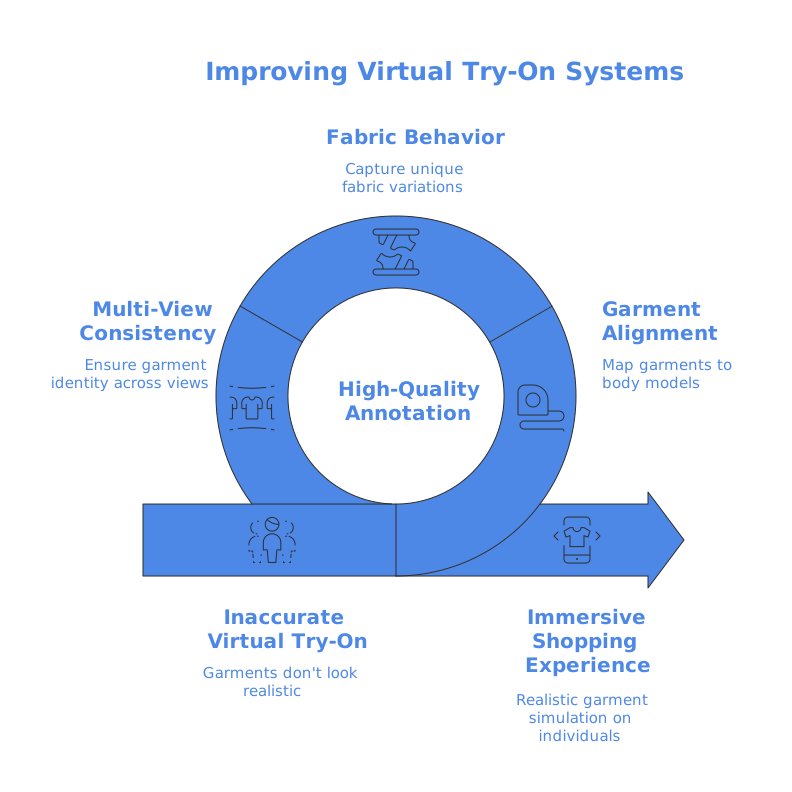
Virtual try-on systems represent one of the most advanced applications of Fashion AI. They aim to simulate how garments would look on different individuals. These systems rely on garment segmentation, body modeling and texture transfer. When trained with high-quality datasets, virtual try-on offers a more immersive shopping experience. Accurate annotation supports realistic deformation and alignment between garments and body shapes.
Aligning garments with body models
Virtual try-on requires mapping flat garment images to 3D or semi-3D body models. Annotators must identify garment silhouettes, keypoints and boundaries to support this mapping. Proper alignment reduces visual artifacts during simulation. It also improves garment realism during motion. Consistent alignment is essential for user trust in virtual try-on tools.
Capturing fabric behavior
Different fabrics drape, stretch or fold in unique ways. Virtual try-on systems must interpret these variations from example images. Annotators should ensure datasets include fabrics that behave differently when worn. This variation enables more accurate simulation of movement. High-quality annotation improves perceived authenticity.
Multi-view garment consistency
Some try-on systems rely on multiple views of the same garment. Annotators must ensure garment identity remains consistent across angles. This supports stable texture mapping and silhouette interpretation. Multi-view annotation strengthens the fidelity of virtual try-on models. Consistent labeling ensures interoperability across views.
Human Parsing and Clothing Layer Segmentation
Human parsing decomposes a person into fine-grained regions such as arms, legs, face and individual garments. It is essential for applications that require clothing-specific understanding. Parsing datasets contain pixel-level annotations that allow models to learn garment boundaries and spatial relationships. These datasets support numerous fashion tasks by offering rich structural detail. Parsing remains one of the most technically demanding areas in Fashion AI.
Segmenting garment layers
Outfits often consist of multiple overlapping garments. Annotators must separate shirts, jackets, skirts and accessories at the pixel level. Layer-aware segmentation teaches models to interpret wardrobe complexity accurately. This segmentation supports applications like styling analysis and outfit generation. Detailed layers improve garment localization in downstream tasks.
Handling occlusions caused by posture
Garments frequently hide behind arms, bags or hair. Annotators must identify visible boundaries without guessing hidden regions. This consistency avoids introducing inaccurate spatial signals. Reliable occlusion handling supports segmentation models in varied real-world conditions. Pixel-level precision is critical for accurate parsing.
Ensuring fine-grained detail across categories
Human parsing often includes dozens of classes representing clothing types and body parts. Annotators must maintain clarity across all categories. Detailed annotation ensures that models recognize subtle distinctions. This granularity enhances performance in fashion-specific applications. Comprehensive parsing datasets support downstream technical work.
Clothes Recognition and Apparel Classification
Clothes recognition focuses on identifying garment categories, styles, colors and patterns. Unlike parsing, which focuses on segmenting regions, recognition focuses on classification and attribute tagging. Retail systems rely heavily on accurate recognition to organize catalogs and power search tools. Models trained on diverse datasets perform better in cluttered consumer images. Strong annotation enables classification that mirrors human perception.
Designing a clear fashion taxonomy
A structured taxonomy defines how garments are categorized. Annotators must ensure categories are mutually exclusive and clear. A well-designed taxonomy helps models interpret apparel consistently. This clarity supports e-commerce workflows such as filtering. Clean category boundaries improve training outcomes.
Labeling complex patterns and materials
Fashion imagery includes intricate designs such as stripes, floral prints or embroidered textures. Annotators must label these details consistently. Pattern recognition helps systems provide better product recommendations. Accurate material labeling supports shoppers seeking specific fabrics. Detailed attributes improve model granularity.
Handling multiple garments worn together
People often wear several overlapping items. Annotators must capture all relevant garment types, even when partially visible. This thoroughness supports accurate outfit interpretation. Multi-garment labeling ensures completeness. Strong annotation reduces misclassification in real-world images.
Building Datasets for Fashion AI Systems
Fashion AI models rely on well-structured datasets that capture the full range of wardrobe scenarios. Dataset design requires planning, domain knowledge and consistent annotation workflows. High-quality data ensures that models learn meaningful patterns. Robust structure also supports long-term scalability as fashion trends evolve. Good dataset design is foundational for successful Fashion AI projects.
Curating diverse wardrobe examples
Datasets must include different garment categories, seasonal styles, cultural variations and body types. This diversity helps models avoid narrow biases. Annotators must ensure that all relevant combinations appear throughout the dataset. Comprehensive coverage improves generalization. Diversity strengthens fashion-specific reasoning.
Ensuring attribute and category balance
Uneven distribution creates bias toward overrepresented styles or colors. Annotators must monitor balance across categories and attributes. Balanced datasets produce more reliable model outputs. This balance supports fairness in fashion recommendations. Distribution tracking is essential for dataset quality.
Maintaining consistent annotation rules
Guidelines must state how garments are labeled, how occlusions are treated and how ambiguous elements are handled. This consistency ensures that all annotators follow the same logic. Stable rules preserve dataset coherence across expansions. Clear documentation supports large-scale annotation. Strong guidelines reduce variation.
Quality Control for Fashion AI Datasets
Quality control ensures that annotations remain accurate and consistent across thousands of images. Reviewers must verify garment labels, region boundaries and attribute correctness. Quality control cycles reduce noise and improve training signals. This reliability enhances the performance of Fashion AI systems. Quality control is essential for maintaining professionalism in dataset development.
Reviewing attribute accuracy
Attributes such as color and pattern must match visible evidence. Reviewers must correct errors before dataset finalization. Accurate attributes improve classification and styling models. This step strengthens downstream fashion applications. Consistency across reviewers improves overall quality.
Checking garment segmentation
Parsing-based tasks require pixel-level accuracy. Reviewers must inspect boundaries for precision. Even small mistakes can mislead segmentation models. High-resolution review improves consistency. Segmentation correctness supports realistic virtual try-on.
Running automated visual validations
Automated checks detect inconsistent labels, missing categories or formatting issues. Automation accelerates large-scale review cycles. These tools complement human expertise. Automated validation helps maintain annotation quality during expansion. Combined workflows increase dataset reliability.
Integrating Fashion AI Data Into Retail Pipelines
Once annotated, fashion datasets integrate into catalog systems, recommendation engines and visual retrieval tools. Clean integration ensures smooth model training and efficient deployment. Alignment with downstream systems supports practical retail uses. This integration determines how effectively Fashion AI scales. Well-organized data supports long-term growth.
Aligning datasets with product catalogs
Datasets must reflect the structure of retail databases. Alignment ensures predictable mapping between visual categories and catalog metadata. This mapping improves search accuracy. Consistency supports automated tagging workflows. Close alignment enhances operational efficiency.
Building strong evaluation benchmarks
QA benchmarks must test classification, segmentation and retrieval performance. Comprehensive evaluation helps identify weaknesses. Strong benchmarks support ongoing model improvement. They also show how well models generalize across fashion contexts. Evaluation is a cornerstone of reliable Fashion AI development.
Supporting continual dataset expansion
Fashion evolves quickly, and datasets must evolve with it. New garments, styles and trends require updated examples. Annotators must maintain consistent rules as new visuals are added. Scalable workflows support this continuous evolution. Structured updates maintain dataset stability.
If you want support designing, annotating or scaling datasets for Fashion AI applications, we can explore how DataVLab helps teams build accurate and domain-rich training data for apparel recognition, styling systems and virtual try-on technologies.
How does Computer vision transform Apparel, styling and E-Commerce?
This article explains how Fashion AI technologies work and why modern apparel, retail and e-commerce systems rely on high-quality training datasets. It covers garment recognition, human parsing, outfit analysis, virtual try-on, metadata structures, trend modeling, and quality control.
What does the section on “Understanding the foundations of fashion AI” explain?
Fashion AI builds on core computer vision principles, but apparel introduces unique visual challenges. Garments deform with movement, vary widely in color and pattern, and often appear layered or partially occluded. Annotators must prepare datasets that capture these complexities so models learn to interpret real-world outfits accurately.
What does the section on “Fashion AI in E-Commerce and retail systems” explain?
Fashion AI powers many of the digital experiences that consumers now expect when browsing online. These range from personalized recommendations to automated tagging of catalog images. Companies rely on visual intelligence to manage large product databases and offer interactive tools that improve decision-making.
What are the best practices for Fashion AI?
Recommendation engines benefit from understanding finer stylistic cues. Fashion AI analyzes outfit composition, color harmony and garment compatibility. Annotators must train models with datasets that include realistic styling combinations.
What does the section on “Clothes recognition and apparel classification” explain?
Clothes recognition focuses on identifying garment categories, styles, colors and patterns. Unlike parsing, which focuses on segmenting regions, recognition focuses on classification and attribute tagging. Retail systems rely heavily on accurate recognition to organize catalogs and power search tools.
How can teams ensure quality in Fashion AI?
Quality control ensures that annotations remain accurate and consistent across thousands of images. Reviewers must verify garment labels, region boundaries and attribute correctness. Quality control cycles reduce noise and improve training signals.