Virtual Try-On Datasets: How to Annotate Garments and Body Models for Digital Fit and Styling AI
.jpeg)
This article explains how virtual try-on datasets are created and annotated for apparel simulation and digital fitting. It covers garment segmentation, body modeling, pose alignment, fabric behavior, multi-view consistency, occlusion handling, metadata structures and quality control. You will also learn how virtual try-on datasets support next-generation retail experiences, personalized styling and immersive e-commerce.
- This article explains how virtual try-on datasets are created and annotated for apparel simulation and digital fitting.
- It covers garment segmentation, body modeling, pose alignment, fabric behavior, multi-view consistency, occlusion handling, metadata structures and quality control.
- Virtual try-on datasets must capture both the intrinsic structure of garments and the interactions between fabric and body shape.
- Evaluation sets must test garment fit, texture realism, deformation accuracy and multi-view consistency.
Virtual try-on systems allow users to visualize how clothes might look on their body using AI-driven simulations. These systems rely on datasets containing well-annotated garments, detailed body models and examples of how fabrics behave across poses. Research from the EPFL Visual Intelligence Lab shows that accurate garment annotations significantly increase realism in try-on outputs by improving texture fidelity and silhouette alignment. Virtual try-on datasets must capture both the intrinsic structure of garments and the interactions between fabric and body shape. Building these datasets requires precise workflows and domain knowledge to support high-quality simulation.
Understanding the Core Components of Virtual Try-On Data
Virtual try-on involves aligning garment properties with human models so that textures, shapes and boundaries behave realistically. Unlike generic fashion datasets, try-on data requires detailed annotations for both clothing and human body representations. Annotators must consider how garments stretch, fold, overlap and respond to different poses. These interactions define the authenticity of virtual outfits. Good dataset structure ensures smooth performance across diverse body types and environments.
Virtual try-on datasets can use DataVLab’s image annotation services to label garments, body regions, occlusions, and pose-dependent details.
Static and dynamic garment behavior
Garments behave differently when stationary versus when worn. Annotators must include examples of flat garments as well as garments draped on bodies. This pairing helps models learn how fabric transforms under realistic conditions. Research from the MPI Human Shape Body Lab highlights that dynamic garment samples improve deformation realism. Capturing both states creates a more versatile dataset. Comprehensive behavior coverage improves simulation accuracy.
Body pose variety
Virtual try-on often uses body poses to simulate how garments look during movement. Annotators must include diverse poses across walking, standing or rotational positions. This variation ensures that garments align correctly in real usage scenarios. Pose diversity also helps models handle body proportions and orientation changes. These examples support generalization across users.
Multi-identity representation
Try-on systems must function across different body types and sizes. Annotators must gather examples spanning a wide range of identities, silhouettes and proportions. This improves fairness and usability. Body diversity ensures the model does not overfit to narrow physical characteristics. Comprehensive identity coverage strengthens real-world reliability.
Preparing Garment Images for Virtual Try-On Annotation
Garments must be prepared and cleaned so annotators can identify boundaries, textures and structure accurately. Preprocessing ensures that surface details remain visible, which supports realistic texture transfer and deformation. High-quality garment images also help the model infer how clothing appears when worn. Good preparation prevents noise and reduces downstream annotation errors.
Ensuring clean, unobstructed garment views
Garments must be photographed or extracted without obstructions such as hands, hangers or accessories. Clean views support accurate silhouette extraction. Annotators must avoid images where edges are blurred or where fabric distortions prevent clear interpretation. This clarity improves annotation consistency. Clean data supports stable training outcomes.
Capturing texture and pattern details
Virtual try-on relies heavily on surface patterns such as stripes, prints or stitching. Annotators must include high-resolution garment images so the model can replicate these details accurately. Fine-grained texture differences play a role in user perception. High-quality imagery strengthens downstream texture mapping. Detailed inputs improve realism significantly.
Standardizing garment orientation
Images should follow consistent orientation rules, such as front-facing, back-facing or flat-lay positioning. Standardization reduces misalignment errors during segmentation or keypoint labeling. Annotators must ensure garments appear consistently across categories. This helps the model interpret garment geometry precisely. Orientation rules stabilize dataset structure.
Segmenting Garment Silhouettes for Try-On Pipelines
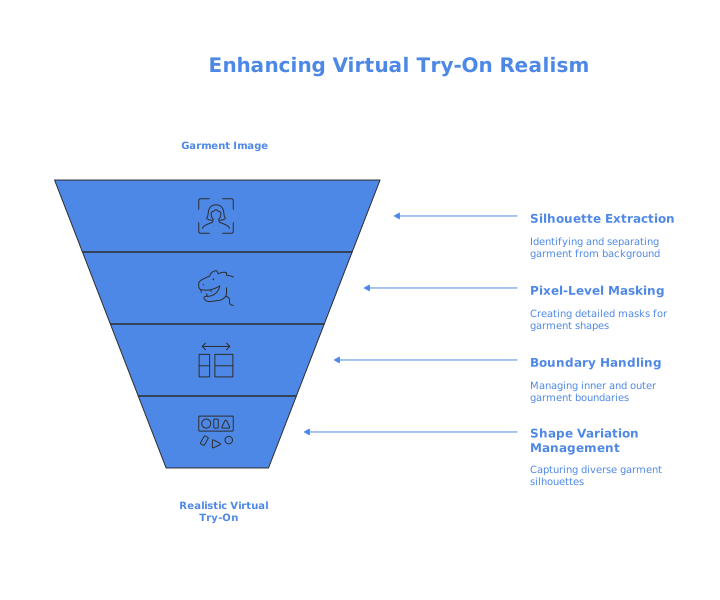
Garment silhouette extraction is a foundational step in virtual try-on annotation. Models require clean boundaries to overlay clothing onto body models without artifacts. Annotators must separate garments from backgrounds and identify shape edges precisely. This segmentation supports garment transfer and alignment. Accurate silhouettes strengthen the visual realism of simulated outfits.
Pixel-level garment masks
Garment masks outline exact shape boundaries and allow models to isolate clothing layers. Annotators must draw precise masks even when fabrics have irregular edges. Pixel-level precision reduces alignment errors during try-on. Clean masks support texture projection and deformation modeling. Thorough mask annotation improves the quality of simulation.
Handling inner and outer garment boundaries
Some garments include inner linings or multi-layer constructions. Annotators must label these boundaries consistently. This detail helps models simulate fabric thickness and layering effects. Internal structures influence how garments fit the body. Consistent boundary annotation improves 3D reconstruction.
Managing garment shape variation
Garments come in different silhouettes such as fitted, oversized or asymmetrical cuts. Annotators must capture these variations without forcing uniform boundaries. This flexibility helps the model recognize shape differences accurately. Variation-aware labeling supports personalized styling. Strong silhouette annotation enriches the dataset.
Annotating Garment Keypoints and Structural Markers
Keypoints represent structural anchors such as shoulder points, sleeve tips or waist positions. These markers help try-on models align garment geometry with body landmarks. Annotators must choose keypoints that remain consistent across garment categories. These anchors guide deformation patterns during simulation. Structured keypoints improve garment-body alignment.
Choosing category-specific keypoints
Different garments require different sets of keypoints. Annotators must identify which anchors matter for tops, bottoms, dresses or outerwear. Consistent keypoint selection helps models learn stable deformation rules. Category-awareness improves downstream garment mapping. Detailed keypoints enhance alignment accuracy.
Ensuring symmetrical landmark placement
Garments often require symmetrical keypoints on left and right sides. Annotators must ensure landmarks mirror each other correctly. Symmetry helps models adjust garment alignment without distortion. Correct placement strengthens deformation stability. Symmetrical consistency improves overall visual coherence.
Capturing optional structural elements
Certain garments include zippers, buttons or seams. Annotators may label these elements when they influence garment behavior. These features help the model interpret shape, tension and wearability. Optional structural annotation enhances realism. Detailed labeling supports complex garment categories.
Aligning Garments With Body Models
Virtual try-on requires mapping garment geometry onto human body representations. Annotators must ensure alignment reflects real-world fitting patterns. This process includes matching silhouettes, adjusting garment drape and preserving proportions. Alignment quality directly affects how believable the final simulation looks. Proper alignment workflows form the core of try-on datasets.
Using body keypoints for correspondence
Body models often include keypoints on shoulders, hips, knees and other landmarks. Annotators must align garment keypoints with these body markers. Consistent correspondence reduces fit inconsistencies. This alignment teaches models to project garments naturally. Stable mapping supports accuracy across body types.
Handling occlusions and overlapping regions
When garments overlap with body parts, annotators must ensure boundaries remain accurate. They must avoid cutting or merging garment regions incorrectly. Proper handling prevents artifacts during try-on simulation. Clear treatment of overlaps enhances visual fidelity. Precision is essential for realistic fitting.
Ensuring fit calibration across body sizes
Try-on systems must adapt garments to different shapes. Annotators must include examples across size ranges to support correct draping. Balanced size representation strengthens generalization. Fit calibration ensures consistent performance across users. Size diversity improves fairness and usability.
Modeling Fabric Behavior and Texture Transfer
Fabric behavior influences how garments move and appear. Annotators must consider deformation patterns such as stretching, folding or flow. This behavior helps models simulate realism rather than rigid overlays. Texture transfer depends on clean structural annotation and visibility. Proper handling of these details enhances try-on visual quality.
Capturing fabric-specific deformation
Soft fabrics behave differently from stiff materials. Annotators must include examples across fabric categories so models learn realistic deformation. This variation aids in rendering natural movement. Quality datasets reflect these material differences. Detailed examples enhance simulation accuracy.
Preserving texture integrity
Texture alignment must remain consistent when a garment is worn. Annotators must ensure texture mapping follows correct proportions. Misaligned patterns create visual artifacts. Preserving texture improves perceived realism. High-fidelity mapping strengthens user trust.
Documenting crease and fold variations
Creases help the model understand tension and movement. Annotators must capture fold patterns when visible. These details influence realistic rendering. Fold-aware datasets provide better fitting outputs. Documented variation improves model behavior.
Ensuring Multi-View and Multi-Pose Consistency
Some try-on systems use multiple views of garments or people. Annotators must ensure consistent garment identity across all angles. This supports 3D reconstruction and robust simulation. Multi-view consistency improves the dataset’s utility across advanced try-on pipelines. Stability across views enhances garment realism.
Aligning front, side and back views
Garments may be photographed from several perspectives. Annotators must confirm alignment across views for silhouette and keypoint placement. This consistency enables smooth transitions between angles. Multi-view alignment strengthens reconstruction accuracy. Coherent annotation supports advanced models.
Maintaining pose consistency
When garments are shown on models, body pose must stay consistent across sequences. Annotators must flag pose shifts that could distort garment interpretation. Stable poses improve mapping accuracy. Consistency matters for layered garment behavior. Reliable alignment ensures stable try-on outputs.
Handling partial views
Some views may contain cropped garment sections. Annotators must handle these carefully without making assumptions. Clear boundaries improve reconstruction. Proper treatment prevents incorrect shape inference. Partial view handling contributes to dataset robustness.
Quality Control for Virtual Try-On Datasets
Quality control ensures that annotations remain precise across segmentation, keypoint placement and alignment tasks. Reviewers must check garment boundaries, anchors and mapping accuracy. Clean workflows reduce training noise. Detailed review cycles help catch inconsistencies early. Strong quality control improves final try-on realism.
Reviewing garment mask quality
Masks must be inspected for smoothness and accuracy. Jagged edges or missing regions reduce simulation quality. Reviewers ensure masks follow true garment boundaries. Clean edges support natural deformation. Consistent masks improve model outputs.
Validating keypoints and anchor consistency
Keypoints must align with garment geometry. Reviewers check for misplaced or inconsistent anchors. Stable keypoints improve fitting accuracy. Consistency across garments strengthens dataset uniformity. Thorough validation enhances downstream performance.
Running automated alignment checks
Automated tools can detect misaligned masks, faulty correspondences or inconsistent garment identities. Automation accelerates the review process. These checks complement human oversight. Automated validation improves large-scale reliability. Combined QA yields the best results.
Integrating Try-On Data Into Apparel Simulation Pipelines
Once the dataset is complete, it must integrate seamlessly into try-on systems. Clean integration supports model training, evaluation and production deployment. Alignment with retail workflows enhances usability. Flexible dataset structure supports long-term scaling. Organized integration is essential for reliable real-world performance.
Building strong evaluation benchmarks
Evaluation sets must test garment fit, texture realism, deformation accuracy and multi-view consistency. Benchmarks help identify weaknesses and guide improvements. Strong evaluation supports continuous refinement. Stable benchmarking enhances simulation quality. Comprehensive tests ensure robust performance.
Supporting model retraining and updates
As trends and garment types change, datasets must evolve. Annotators must maintain consistent style guidelines across updates. Stable data supports retraining without loss of quality. Continuous updates enhance future adaptability. Reliable dataset growth supports production systems.
Aligning datasets with e-commerce platforms
Garment IDs, attributes and metadata must match retail catalogs. Accurate alignment improves automation and retrieval. Structured integration ensures smooth workflows. Retail alignment strengthens real-world utility. Strategic dataset design supports business goals.
If you are developing a virtual try-on dataset or need support designing garment annotation workflows, we can explore how DataVLab helps teams build precise and scalable training data for digital fitting and styling AI.
What are Virtual Try-On datasets?
This article explains how virtual try-on datasets are created and annotated for apparel simulation and digital fitting. It covers garment segmentation, body modeling, pose alignment, fabric behavior, multi-view consistency, occlusion handling, metadata structures and quality control.
What does the section on “Understanding the core components of virtual Try-On data” explain?
Virtual try-on involves aligning garment properties with human models so that textures, shapes and boundaries behave realistically. Unlike generic fashion datasets, try-on data requires detailed annotations for both clothing and human body representations. Annotators must consider how garments stretch, fold, overlap and respond to different poses.
What is involved in preparing garment images for virtual Try-On annotation?
Garments must be prepared and cleaned so annotators can identify boundaries, textures and structure accurately. Preprocessing ensures that surface details remain visible, which supports realistic texture transfer and deformation. High-quality garment images also help the model infer how clothing appears when worn.
What does the section on “Aligning garments with body models” explain?
Virtual try-on requires mapping garment geometry onto human body representations. Annotators must ensure alignment reflects real-world fitting patterns. This process includes matching silhouettes, adjusting garment drape and preserving proportions.
How can teams ensure quality in Virtual Try-On datasets?
Quality control ensures that annotations remain precise across segmentation, keypoint placement and alignment tasks. Reviewers must check garment boundaries, anchors and mapping accuracy. Masks must be inspected for smoothness and accuracy.
What is involved in integrating Try-On data into apparel simulation pipelines?
Once the dataset is complete, it must integrate seamlessly into try-on systems. Clean integration supports model training, evaluation and production deployment. Organized integration is essential for reliable real-world performance.