Fashion AI Datasets: How to Build High-Quality Training Data for Apparel Recognition, Styling and Retrieval
.jpeg)

This article explains how Fashion AI datasets are planned, structured and annotated for clothing recognition, apparel retrieval, outfit analysis and recommendation systems. It covers dataset architecture, taxonomy definitions, attribute schemas, sampling diversity, annotation guidelines, metadata alignment, quality validation and integration into training pipelines. It helps teams design scalable, reliable and domain-rich datasets for modern fashion applications.
- This article explains how Fashion AI datasets are planned, structured and annotated for clothing recognition, apparel retrieval, outfit analysis and recommendation systems.
- It covers dataset architecture, taxonomy definitions, attribute schemas, sampling diversity, annotation guidelines, metadata alignment, quality validation and integration into training pipelines.
- It helps teams design scalable, reliable and domain-rich datasets for modern fashion applications.
- Dataset integration ensures that Fashion AI systems can use annotated data efficiently.
Fashion AI datasets provide the training material that allows computer vision systems to interpret garments, analyze outfits and understand style relationships. These datasets must capture a wide range of wardrobe examples, body types, lighting conditions and fabric variations. Research from the Stanford Vision Lab shows that diverse and balanced datasets dramatically improve model generalization, especially in fine-grained clothing classification tasks. Fashion datasets must include detailed labels and well-structured metadata so models learn consistent visual representations. High-quality dataset architecture becomes a strategic foundation for building scalable fashion AI solutions.
Designing a Strong Dataset Architecture for Fashion AI
Fashion datasets must follow structured planning so that annotations, categories, metadata and sampling remain aligned with the desired AI tasks. A strong architecture ensures that data collection, labeling and review processes operate consistently across thousands of images. Clear design principles reduce ambiguity and help maintain long-term dataset health. This foundational planning influences all downstream modeling performance.
Defining dataset purpose and scope
Teams must identify the target use case, such as classification, retrieval, compatibility modeling or attribute tagging. The dataset scope then determines which categories, attributes and garment varieties to include. This clarity ensures efficient data collection and annotation. Without a defined purpose, datasets risk becoming inconsistent. Purpose-driven planning improves dataset stability.
Mapping data requirements to model goals
Different Fashion AI tasks require different types of data. Retrieval tasks may demand richer attribute detail, while classification tasks may require clearer hierarchical categories. Annotators must collect examples matching these requirements. Mapping goals early prevents unnecessary complexity. Correct alignment supports stronger model outcomes.
Structuring dataset components
Datasets must include components such as raw images, labels, attributes, bounding boxes, metadata and documentation. Consistent structure simplifies integration with training pipelines. Teams must decide which formats and conventions to use. Structured organization enhances dataset reliability. Clear structure supports long-term scalability.
Building a Clear and Scalable Fashion Taxonomy
A well-designed taxonomy organizes garments into mutually exclusive and clearly defined categories. Taxonomy structure influences how annotators interpret garments and how models learn classification patterns. Strong taxonomies help maintain consistency throughout the dataset.
Creating top-level garment families
Garments must be grouped into major families such as tops, bottoms, dresses, outerwear, footwear and accessories. These families create the highest layer of category structure. Clear top-level definitions prevent mislabeling. Solid foundations improve downstream category coherence. Well-defined families enhance dataset usability.
Designing fine-grained garment categories
Fine-grained categories such as cardigans, blouses, chinos or parkas enable more detailed recognition. Annotators must follow consistent definitions and examples. Fine granularity improves model accuracy for search and recommendation. These distinctions reflect how consumers perceive garments. High-resolution categorization enhances dataset value.
Handling ambiguous or hybrid categories
Some garments do not fit neatly into one class. Teams must document rules for hybrid items such as tunic tops or shirt-dresses. Consistent handling prevents category drift. Clear decision criteria support training stability. Structured ambiguity management improves dataset integrity.
Incorporating Clothing Attributes and Style Metadata
Attributes describe properties such as color, pattern, style, fabric, neckline or silhouette. Fashion AI relies heavily on attribute metadata to provide detailed and interpretable outputs. Attribute labeling must follow a structured schema to avoid inconsistency.
Defining a standardized attribute schema
A unified schema ensures attributes appear in consistent formats. Annotators must follow precise definitions for each attribute type. A strong schema improves model reliability. Structured attribute rules support interoperability across datasets. Consistency strengthens attribute learning.
Capturing detailed garment features
Detailed attributes such as sleeve shape, material texture or collar structure enrich model representations. Annotators must label these features accurately and consistently. Granular detail improves classification and retrieval performance. Rich metadata enhances fashion reasoning. These features deepen dataset quality.
Documenting optional and conditional attributes
Some attributes apply only to certain garments. Annotators must document when attributes should be included or excluded. Conditional rules prevent unnecessary noise. This clarity supports efficient annotation. Well-documented rules improve dataset consistency.
Sampling Diversity Across Garments and People
Fashion AI must handle diverse real-world scenarios. Dataset sampling must reflect this diversity so models learn generalizable representations. Sampling strategies influence fairness, robustness and downstream usability.
Ensuring garment style diversity
Datasets must include different fashion styles, seasonal collections, cultural garments and trend variations. Diverse sampling helps models avoid bias toward outdated or narrow style types. Broad representation supports global usability. Style diversity improves retrieval and classification outcomes.
Representing body shapes and identities
Clothing appears differently on different body types. Annotators must collect images across varied proportions, silhouettes and demographics. Balanced body representation reduces bias. This inclusivity strengthens fashion AI reliability. Comprehensive identity coverage enhances fairness.
Capturing varied environments and lighting
Real-world fashion images include indoor, outdoor and mobile-photography scenarios. Lighting conditions affect pattern visibility and color accuracy. Sampling across diverse environments improves model resilience. Environmental diversity strengthens generalization. Comprehensive coverage supports downstream performance.
Defining Annotation Guidelines for Fashion AI Datasets
Annotation guidelines define how garments, attributes and metadata are labeled. Strong guidelines maintain consistency across annotators and across dataset expansions. Clear rules prevent misinterpretation and reduce labeling noise.
Documenting category definitions
Each category must have an explicit definition supported by visual examples. Annotators must follow these definitions precisely. Clear documentation reduces subjective labeling. Strong category clarity improves dataset consistency. Reliable definitions enhance modeling accuracy.
Formalizing attribute labeling rules
Guidelines must specify how to treat complicated attributes such as multicolor garments or hybrid patterns. Annotators must apply these rules consistently. Structured rules minimize ambiguity. Stable attribute labeling supports robust classification. Well-defined rules strengthen dataset quality.
Handling edge cases systematically
Edge cases often reveal weaknesses in category structure. Teams must document how to treat unusual garments or hard-to-interpret features. Consistent treatment reduces drift. Documented exceptions improve long-term dataset health. Systematic handling enhances clarity.
Metadata Structures for Fashion AI Pipelines
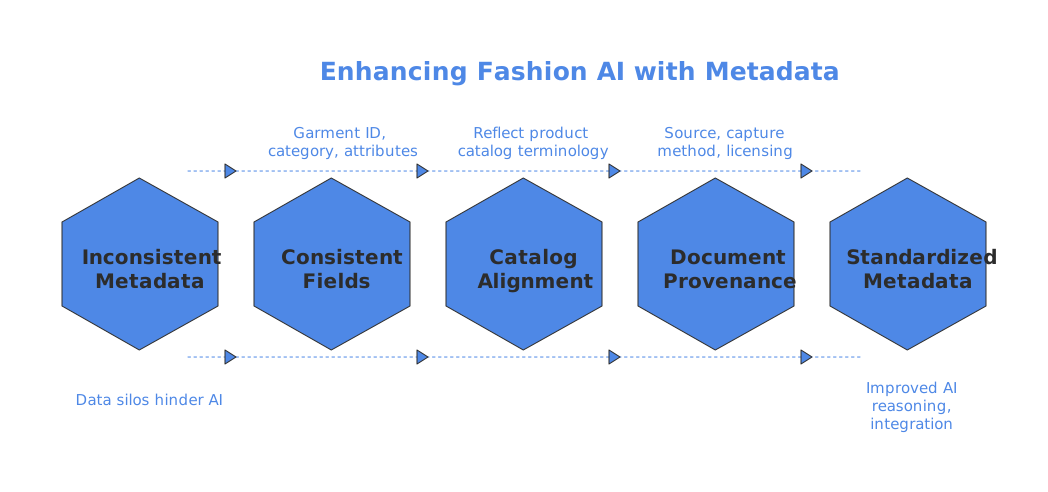
Metadata organizes information that models rely on for reasoning, such as garment identifiers, color codes, materials or hierarchy information. Structured metadata supports integration with retail catalogs and recommendation engines.
Using standardized metadata fields
Metadata must include consistent fields such as garment ID, category, attributes and source. This consistency improves usability across systems. Standardized structures simplify downstream processing. Uniform metadata enhances pipeline compatibility. Clear structure supports scalable dataset growth.
Linking visual data with product catalogs
Garment metadata should reflect product catalog terminology to ensure downstream alignment. This alignment improves tagging accuracy. It also enhances compatibility across e-commerce workflows. Consistent catalog alignment supports automation. Proper mapping strengthens operational efficiency.
Documenting data provenance
Each image must include details such as source, capture method and licensing. Provenance ensures legal compliance and transparency. Accurate documentation reduces risk. Provenance tracking strengthens dataset governance. Thorough metadata improves dataset trustworthiness.
Quality Control for Fashion AI Datasets
Quality control ensures annotation accuracy, attribute consistency and structural coherence. QC cycles detect noise early and help maintain long-term dataset quality.
Reviewing annotation consistency
QC reviewers must check whether labels follow taxonomy and attribute rules. Inconsistent labels weaken model performance. Review cycles identify areas needing clarification. Consistency review strengthens dataset reliability. Detailed checks improve training stability.
Validating attribute correctness
Attributes must match visible garment properties. QC teams must verify color, pattern and structural details. Attribute correctness enhances model interpretability. Clear review improves data accuracy. Stable attribute quality supports strong embeddings.
Running automated validation checks
Automated tools detect missing fields, label conflicts or schema violations. These checks scale well for large datasets. Automation complements human oversight. Efficient validation improves dataset scalability. Combined workflows yield high-quality data.
Integrating Fashion AI Datasets Into Model Training Pipelines
Dataset integration ensures that Fashion AI systems can use annotated data efficiently. Clean integration supports training, evaluation and model deployment with minimal friction.
Structuring training and evaluation splits
Splits must reflect garment variety, lighting conditions and attribute diversity. Balanced splits support robust evaluation. Structured partitioning enhances reproducibility. Careful design improves performance testing. Reliable splits strengthen deployment confidence.
Preparing datasets for continual updates
Fashion trends evolve rapidly, requiring ongoing dataset expansion. Teams must maintain consistent rules during updates. Stable expansion supports model retraining. Continuous improvement keeps datasets relevant. Scalable processes support long-term dataset growth.
Aligning datasets with recommendation and search engines
Recognition outputs must match the metadata expectations of downstream systems. Proper alignment improves search relevance. Structured connections support efficient operations. Integration ensures the dataset remains practically useful. Alignment enhances business impact.
If you are planning to build a Fashion AI dataset or want support designing scalable annotation workflows, we can explore how DataVLab helps teams create consistent and domain-rich training data for fashion classification, retrieval and styling AI.
What are Fashion AI datasets?
This article explains how Fashion AI datasets are planned, structured and annotated for clothing recognition, apparel retrieval, outfit analysis and recommendation systems. It covers dataset architecture, taxonomy definitions, attribute schemas, sampling diversity, annotation guidelines, metadata alignment, quality validation and integration into training pipelines.
What is involved in designing a strong dataset architecture for fashion AI?
Fashion datasets must follow structured planning so that annotations, categories, metadata and sampling remain aligned with the desired AI tasks. A strong architecture ensures that data collection, labeling and review processes operate consistently across thousands of images.
What is involved in building a clear and scalable fashion taxonomy?
A well-designed taxonomy organizes garments into mutually exclusive and clearly defined categories. Taxonomy structure influences how annotators interpret garments and how models learn classification patterns. Strong taxonomies help maintain consistency throughout the dataset.
What is involved in defining annotation guidelines for fashion AI datasets?
Annotation guidelines define how garments, attributes and metadata are labeled. Strong guidelines maintain consistency across annotators and across dataset expansions. Clear rules prevent misinterpretation and reduce labeling noise.
How can teams ensure quality in Fashion AI datasets?
Quality control ensures annotation accuracy, attribute consistency and structural coherence. QC cycles detect noise early and help maintain long-term dataset quality. QC reviewers must check whether labels follow taxonomy and attribute rules.
What is involved in integrating fashion AI datasets into model training pipelines?
Dataset integration ensures that Fashion AI systems can use annotated data efficiently. Clean integration supports training, evaluation and model deployment with minimal friction. Splits must reflect garment variety, lighting conditions and attribute diversity.