Clothes Recognition Datasets: How to Annotate Apparel Categories, Attributes and Visual Features for Fashion AI
.jpeg)
This article explains how to build and annotate clothes recognition datasets for fashion AI systems. It covers garment taxonomy design, attribute labeling, color models, pattern recognition, multi-garment scenarios, metadata structures, class balancing and quality control. You will also learn how classification datasets support search, tagging, recommendations and retail catalog automation.
- This article explains how to build and annotate clothes recognition datasets for fashion AI systems.
- It covers garment taxonomy design, attribute labeling, color models, pattern recognition, multi-garment scenarios, metadata structures, class balancing and quality control.
- Clothes recognition datasets enable fashion AI systems to classify garments, identify attributes, analyze outfit components and support retail automation.
- Clothes recognition powers many essential tasks in fashion technology, from automated catalog tagging to visual search and recommendation engines.
Clothes recognition datasets enable fashion AI systems to classify garments, identify attributes, analyze outfit components and support retail automation. Unlike human parsing or try-on datasets, clothes recognition focuses on categorizing garments based on visible characteristics rather than segmenting them at the pixel level. Research from the Georgia Tech Computational Perception Lab shows that fine-grained apparel classification improves retrieval accuracy and recommendation quality when garments are labeled with consistent categories and attributes. Building a reliable dataset requires clear taxonomy definitions, attribute rules and garment representations that reflect real-world fashion variability. These elements form the backbone of high-performance classification models.
Why Clothes Recognition Matters for Fashion AI
Clothes recognition powers many essential tasks in fashion technology, from automated catalog tagging to visual search and recommendation engines. Models require clear supervision to differentiate between garment types, styles, fits and visual features. High-quality datasets ensure that classification outputs align with retail workflows and consumer expectations. Studies published by the DeepFashion initiative at CUHK highlight the importance of consistent labeling for enabling robust apparel retrieval and attribute prediction. Recognizing garments accurately improves the usability and reliability of fashion AI applications.
For visual-search and catalog models, DataVLab’s image annotation services can turn garment attributes into consistent training labels.
Supporting automated product tagging
Retailers handle large volumes of new apparel items that require detailed categorization. Clothes recognition datasets automate this process by training models to classify garments consistently. Automated tagging accelerates catalog onboarding and reduces manual labor. This supports large-scale product operations. High-quality data improves tagging accuracy.
Enhancing visual search and retrieval
Consumers increasingly upload photos to find visually similar items. Clothes recognition datasets train models to interpret garment features that define similarity. Good attribute coverage improves retrieval relevance. Accurate recognition enhances consumer engagement. Strong classification supports intuitive shopping experiences.
Improving recommendation engines
Recommendation systems depend on robust garment embeddings derived from visual signals. Clothes recognition datasets ensure these embeddings capture meaningful patterns. Better embeddings improve personalized suggestions. Attribute-aware recognition strengthens compatibility modeling. Reliable training data drives recommendation accuracy.
Building a Clear Fashion Taxonomy
A garment taxonomy defines how items are categorized across tops, bottoms, dresses, outerwear, footwear and accessories. This structure ensures that annotations remain consistent and interpretable. A clear taxonomy prevents category overlap and supports downstream classification reliability. Good taxonomy design is the foundation of any clothes recognition dataset.
Choosing mutually exclusive categories
Annotators must ensure categories do not overlap and that each garment belongs to only one top-level class. Mutual exclusivity reduces confusion and improves model confidence. Structured definitions prevent misclassification. Category stability supports long-term dataset maintenance. Clear classification boundaries enhance label precision.
Defining granular subcategories
Clothes recognition often requires subcategories such as T-shirts, blouses, hoodies or jackets. Subcategories help models understand fine-grained differences. Annotators must provide clear examples for each. Consistent subcategory definitions strengthen recognition performance. Granularity improves retrieval effectiveness.
Handling cross-category garments
Some garments blur the line between categories, such as tunics or hybrid items. Annotators must choose consistent rules for these edge cases. Clear decision criteria prevent inconsistent labeling. Stable handling supports robust classification. Documented exceptions improve interpretability.
Annotating Apparel Attributes
Attributes describe properties of garments such as color, pattern, neckline, sleeve length, fit or material. These attributes enrich model understanding and support downstream functionality. Attribute labeling requires consistency, high detail and careful documentation to avoid subjective interpretation.
Creating a standardized attribute schema
A standardized schema defines which attributes to annotate and how they are applied. Annotators must follow these definitions strictly. Schema consistency strengthens attribute learning. Structured annotation supports interoperability across datasets. Clear attribute rules reduce subjective variation.
Labeling color with consistent rules
Color identification must follow predefined color models. Annotators should reference controlled color lists to avoid ambiguity. Consistent color labeling improves search accuracy. It also supports trend analysis and styling models. Stable color representation strengthens dataset coherence.
Tagging garment patterns
Patterns such as stripes, plaid, floral or polka dots influence fashion retrieval. Annotators must label patterns consistently using clear definitions. Pattern awareness improves embedding quality. This detail enhances retrieval and styling applications. Good pattern annotation supports visual similarity modeling.
Representing Garments Across Different Conditions
Garments appear in varied environments, lighting conditions and viewpoints. Dataset construction must ensure sufficient variation to support generalization. Clothing recognition models perform better with diverse and realistic examples that reflect consumer-generated imagery.
Including multiple poses and perspectives
Clothes recognition is sensitive to pose and orientation changes. Annotators must include garments shown on different models or mannequins. Multiple viewpoints support robust classification. Variation improves generalization in real-world photos. Diverse perspectives strengthen dataset utility.
Accounting for lighting variability
Lighting affects color perception and pattern visibility. Annotators must ensure datasets include varied lighting scenarios so models learn robust features. This avoids overfitting to studio environments. Lighting diversity enhances classification resilience. Balanced examples support real-world performance.
Handling occlusions and partial visibility
Garments may appear only partially due to accessories, movement or camera cropping. Annotators must label visible garment portions accurately without guessing hidden areas. Correct handling improves classification robustness. Partial visibility examples strengthen downstream retrieval. Consistent treatment improves model flexibility.
Multi-Garment Scenarios in Classification Datasets
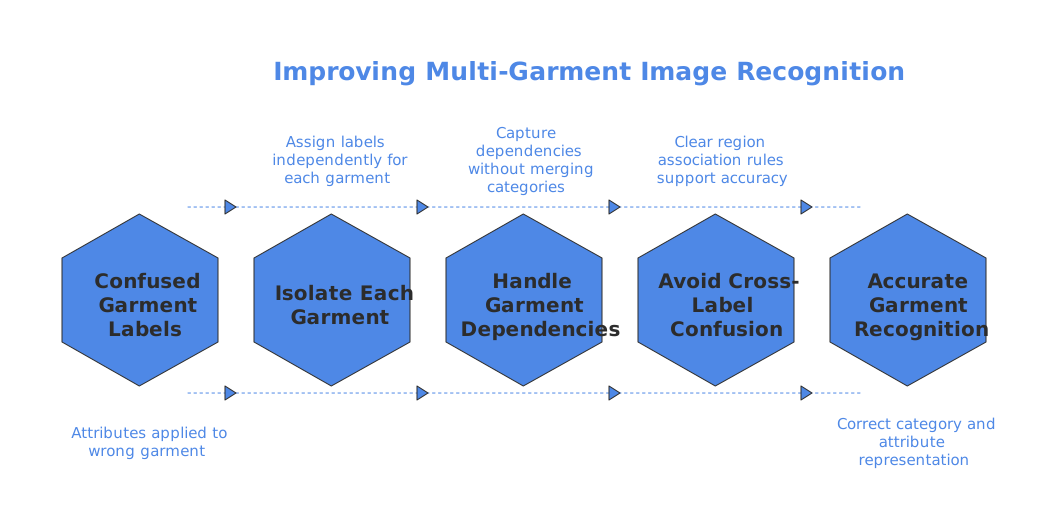
Real-world images often contain multiple garments worn simultaneously. Clothes recognition datasets must include scenarios where tops, bottoms and outerwear appear together. Annotators must ensure that each visible garment receives its appropriate labels.
Isolating each garment independently
Annotators must assign labels independently for each garment, even when several appear in the same image. This ensures correct category and attribute representation. Independent labeling improves multi-garment retrieval. Consistent rules support structured dataset creation. Stability enhances classification reliability.
Handling garment dependencies
Some garments appear together frequently, such as shirt-and-jacket combinations. Annotators must capture these dependencies without merging categories. Attribute alignment improves dataset value. Dependent garment recognition reflects real outfit complexity. Interpretable rules improve consistency.
Avoiding cross-label confusion
Annotators must avoid applying attributes to the wrong garment, especially in cluttered scenes. Clear region association rules support attribute accuracy. Proper handling improves system usability. Precise label application strengthens training data. This reduces confusion in multi-garment imagery.
Clothing Attribute Complexity and Fine-Grained Features
Attributes in fashion datasets may include subtle distinctions such as ribbed material, asymmetric hems or unique embellishments. Annotators must understand when to label these features and when to rely on coarse categories to maintain consistency.
Distinguishing essential vs optional attributes
Not all attributes need to be labeled for every garment. Annotators must know which attributes are essential for dataset goals. Prioritizing essential attributes improves labeling efficiency. Optional attributes can be added when they significantly enhance classification detail. Structured prioritization improves workflow quality.
Labeling structural garment details
Structural details influence garment classification because they define silhouette and use-case. Annotators should label details such as collars, lapels, plackets or stitching. These cues help models identify style variations. Structural annotation enhances fine-grained recognition. Detail consistency improves dataset richness.
Documenting ambiguous features
Garments may include ambiguous or borderline features such as mixed materials or hybrid designs. Annotators must follow documented rules for these cases. Clear documentation reduces subjective interpretation. Stable handling helps models learn consistent patterns. Ambiguity management supports structured dataset growth.
Quality Control for Clothes Recognition Datasets
Quality control ensures that labels, attributes and categories remain consistent across large datasets. Classification datasets require rigorous review to avoid annotation drift. Review cycles identify inconsistencies early and maintain long-term stability.
Conducting attribute consistency checks
Reviewers must verify that attributes follow schema rules. Inconsistencies reduce model accuracy. Attribute consistency supports strong classification embeddings. Clear documentation aids in review. Thorough checking enhances dataset coherence.
Validating category correctness
A review must ensure that each garment is assigned the correct top-level and subcategory labels. Category validation prevents misclassification. Strong category accuracy improves downstream usability. Validation workflows strengthen dataset reliability. Regular audits maintain long-term quality.
Running automated label verification
Automated tools detect label conflicts, missing fields and schema violations. These checks accelerate quality control for large datasets. Automated verification complements human review. Automated workflows improve scalability. Combined QA ensures dataset stability.
Integrating Clothes Recognition Data Into Fashion AI Pipelines
Once annotated, clothes recognition datasets must integrate seamlessly into model training and catalog workflows. Clear integration supports reliable system performance and efficient retail operations.
Aligning annotations with retail catalog structures
Recognition labels must match the taxonomy used by product catalogs. Alignment improves tagging and search performance. Structured integration supports inventory workflows. This connection strengthens practical usability. Catalog alignment maintains consistency across systems.
Creating detailed evaluation benchmarks
Evaluation sets must include diverse garment types, lighting conditions and attribute variations. Strong benchmarks reveal classification weaknesses. Comprehensive evaluation guides model improvements. Well-designed tests improve deployment robustness. Benchmark quality influences long-term performance.
Supporting dataset updates as fashion evolves
As trends change, datasets must expand with new garment types and attributes. Annotators must maintain consistent rules across updates. Stable practices ensure long-term dataset health. Continuous expansion supports business adaptability. Structured updates strengthen classification performance.
If you are building a clothes recognition dataset or need help designing apparel classification workflows, we can explore how DataVLab supports teams that require detailed, consistent and scalable training data for retail and fashion AI.
What are Clothes recognition datasets?
This article explains how to build and annotate clothes recognition datasets for fashion AI systems. It covers garment taxonomy design, attribute labeling, color models, pattern recognition, multi-garment scenarios, metadata structures, class balancing and quality control. Clothes recognition datasets enable fashion AI systems to classify garments, identify attributes, analyze outfit components and support retail automation.
Why does clothes recognition matter for fashion AI?
Clothes recognition powers many essential tasks in fashion technology, from automated catalog tagging to visual search and recommendation engines. Models require clear supervision to differentiate between garment types, styles, fits and visual features. High-quality datasets ensure that classification outputs align with retail workflows and consumer expectations.
What is involved in building a clear fashion taxonomy?
A garment taxonomy defines how items are categorized across tops, bottoms, dresses, outerwear, footwear and accessories. This structure ensures that annotations remain consistent and interpretable. A clear taxonomy prevents category overlap and supports downstream classification reliability.
What is involved in annotating apparel attributes?
Attributes describe properties of garments such as color, pattern, neckline, sleeve length, fit or material. These attributes enrich model understanding and support downstream functionality. Attribute labeling requires consistency, high detail and careful documentation to avoid subjective interpretation.
How can teams ensure quality in Clothes recognition datasets?
Quality control ensures that labels, attributes and categories remain consistent across large datasets. Classification datasets require rigorous review to avoid annotation drift. Review cycles identify inconsistencies early and maintain long-term stability.
What is involved in integrating clothes recognition data into fashion AI pipelines?
Once annotated, clothes recognition datasets must integrate seamlessly into model training and catalog workflows. Clear integration supports reliable system performance and efficient retail operations. Recognition labels must match the taxonomy used by product catalogs.