Human Parsing Datasets: How to Annotate Fine-Grained Clothing and Body Segmentation for Fashion AI
.jpeg)

This article explains how human parsing datasets are created for fashion, retail and computer vision systems. It covers pixel-level segmentation, garment layering, region consistency, attribute mapping, occlusion handling, pose variation, quality control and integration into training pipelines. You will also learn how parsing datasets support outfit analysis, virtual try-on, apparel retrieval and multimodal fashion applications.
- This article explains how human parsing datasets are created for fashion, retail and computer vision systems.
- It covers pixel-level segmentation, garment layering, region consistency, attribute mapping, occlusion handling, pose variation, quality control and integration into training pipelines.
- Human parsing is the process of segmenting people into fine-grained regions such as body parts and distinct garment layers.
- Research from the Chinese Academy of Sciences’ Human-Centric Vision Lab shows that fine-grained segmentation dramatically improves fashion models that rely on garment boundaries, spatial cues and region-level understanding.
Human parsing is the process of segmenting people into fine-grained regions such as body parts and distinct garment layers. It is one of the most technically demanding tasks in fashion computer vision because clothing often overlaps, deforms and interacts with the body in complex ways. Research from the Chinese Academy of Sciences’ Human-Centric Vision Lab shows that fine-grained segmentation dramatically improves fashion models that rely on garment boundaries, spatial cues and region-level understanding. Parsing datasets provide the granular pixel-level supervision that enables models to separate shirts from jackets, coats from scarves, and accessories from the background. High-quality annotation therefore plays a central role in enabling accurate apparel analysis.
Why Human Parsing Is Essential for Fashion AI
Fashion AI models must interpret clothing structure, layering and silhouette variations across diverse human poses. Parsing datasets allow systems to understand how garments sit on the body and how different pieces interact spatially. This enables advanced applications such as outfit composition, detailed garment detection and pixel-accurate try-on alignment. Studies from the KAIST Vision and Learning Lab highlight that parsing accuracy strongly influences performance in virtual try-on, garment retrieval and styling models. The ability to segment clothing precisely provides foundational structure for downstream reasoning.
Supporting pixel-level garment understanding
Human parsing helps models identify exact garment shapes and boundaries. These shapes influence garment extraction, draping simulation and compatibility predictions. Accurate segmentation improves garment-body interactions. Pixel-level detail ensures the model interprets subtle elements such as sleeves, cuffs or hems. Parsing supports highly structured fashion intelligence.
Handling complex wardrobe layering
Outfits often include multiple overlapping garments. Parsing identifies which layer is outermost and how underlying items appear when partially visible. This helps models handle real-world complexity. Clear layering also improves quality for try-on and retrieval systems. Strong layering annotation creates accurate hierarchical scene representation.
Enhancing body-region segmentation
Human parsing also deals with body regions such as arms, legs and torso. Models use these boundaries to interpret posture, positioning and fit. Correct region labeling strengthens garment alignment across poses. Accurate body segmentation supports broader vision tasks beyond fashion. It also helps systems reason about human silhouettes.
Preparing Images for Parsing Annotation
Before segmentation begins, images must be prepared so annotators can work with sufficient clarity and consistency. Preprocessing reduces noise that could affect label accuracy. Fashion datasets often include varied environments, lighting conditions and camera perspectives. Ensuring standardized visual quality helps maintain consistency across large-scale annotation projects.
Ensuring high-resolution, clear visibility
Pixel-level annotation requires clear, high-resolution images. Annotators must be able to distinguish garment edges, accessories, seams and junctions. Images lacking clarity introduce uncertainty in region boundaries. Preparing high-quality inputs supports accurate labeling. Visual clarity improves downstream segmentation performance.
Stabilizing lighting and exposure
Lighting variations alter garment color and texture interpretation. Annotators must review images for extreme brightness, shadows or glare that might distort visibility. Stabilized exposure speeds annotation by reducing ambiguity. Consistent lighting helps maintain uniform boundary interpretation. More stable visual inputs yield more reliable segmentation.
Standardizing framing and orientation
Human parsing often requires the person to be centered and fully visible. Cropped or rotated images complicate segmentation. Annotators must ensure the subject appears clearly within the frame. This stability aids in region recognition and garment hierarchy analysis. Standard formatting contributes to structured dataset organization.
Segmenting Clothing and Body at Pixel Level
Human parsing requires annotators to draw pixel-level masks that correspond to predefined categories. These categories may include tops, bottoms, outerwear, shoes, hair, skin and accessories. Models trained on precise masks learn how to understand complex clothing structures. Consistent segmentation supports fine-grained garment recognition and retrieval.
Defining consistent category boundaries
Each garment or body part must belong to one clearly defined category. Annotators must avoid overlapping or contradictory labels. Consistent boundaries establish predictable shapes for learning. Detailed documentation helps maintain category clarity. Stable boundaries support accurate segmentation maps.
Capturing subtle garment features
Garments often include intricate details such as collars, straps, cuffs or pockets. Annotators must segment these elements when relevant. These details influence how models interpret garment structure. Capturing them enhances visual precision. Rich detail supports advanced fashion applications.
Handling texture-based transitions
Some garments do not have sharp visual boundaries. Texture, pattern or fabric changes may serve as boundary cues. Annotators must interpret these transitions carefully. Confidence-based guidelines reduce over-interpretation. Proper handling of subtle boundaries improves segmentation consistency.
Handling Occlusions, Overlaps and Layering
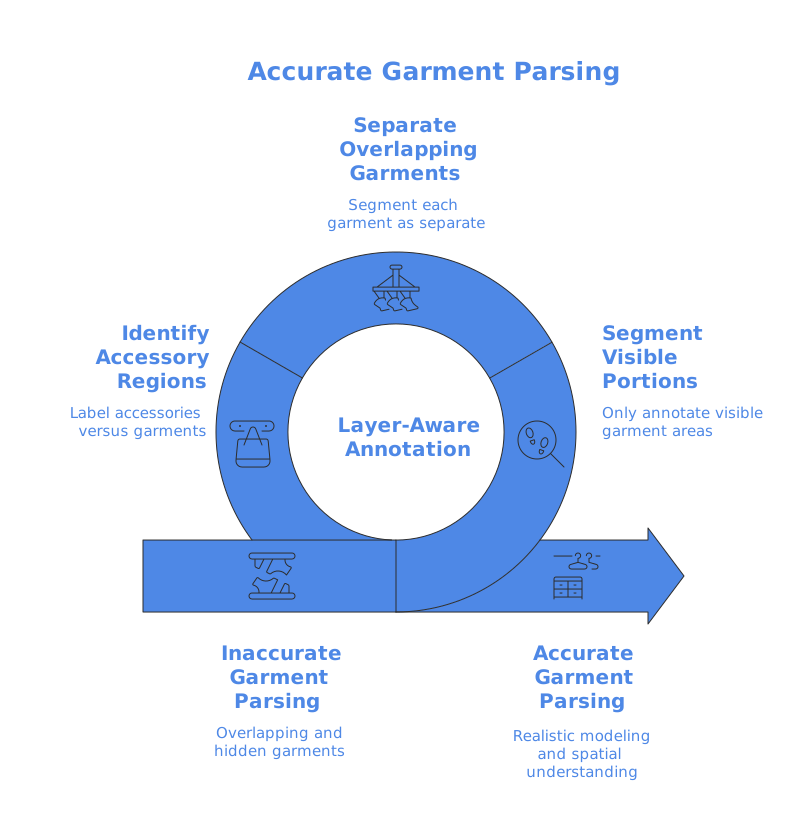
Clothing often overlaps or hides behind body parts, accessories or other garments. Parsing requires annotators to represent layers accurately without imagining hidden regions. Handling occlusions correctly is critical for realistic modeling and spatial understanding.
Distinguishing visible and hidden garment areas
Annotators must segment only the visible portions of each garment. Hidden areas should not be filled in or assumed. This avoids introducing unrealistic shapes. Accurate visibility rules maintain dataset integrity. Proper handling ensures the segmentation remains grounded.
Separating overlapping garments
Different garment layers may overlap, such as a jacket over a sweater. Annotators must segment each garment as a separate class even when partially obscured. This supports hierarchical understanding. Layer-aware annotation improves reasoning for multi-garment outfits. Accurate overlap labeling enhances retrieval performance.
Managing occlusions from accessories
Accessories such as bags, scarves or hats may hide garment areas. Annotators must identify which regions belong to accessories versus garments. Proper labeling prevents misclassification. Accessory-aware parsing supports robust scene interpretation. Clear annotation strengthens model resilience.
Ensuring Pose Diversity and Body Variation
Human parsing must work across multiple poses, shapes and body structures. Annotators must prepare datasets that reflect natural human diversity. Pose variation helps models handle distorted silhouettes, bending limbs and non-upright positions. Body variation supports broader demographic representation.
Labeling garments across dynamic poses
Garment shapes change dramatically when arms raise, legs bend or bodies rotate. Annotators must capture these variations accurately. Dynamic poses help models understand garment deformation. Pose diversity supports flexible reasoning. Comprehensive examples strengthen robustness.
Annotating multiple body types
Fashion AI must perform well across different body shapes and sizes. Annotators must ensure representation across diverse proportions. This reduces bias and supports fairer try-on or styling applications. Body variation is essential for inclusivity. Balanced representation improves overall model stability.
Handling non-standard viewpoints
Some images may include angled, seated or partially rotated subjects. Annotators must label these views consistently using the same category definitions. Consistent interpretation supports reliable training. Non-standard viewpoints enhance model generalization. These examples enrich dataset depth.
Attribute and Region Metadata for Human Parsing
Beyond pixel masks, parsing datasets often include metadata describing attributes or garment properties. These annotations help models reason about clothing style, structure and relationships. Metadata provides additional structure that complements pixel segmentation.
Annotating garment attributes
Attributes such as sleeve length, neckline type, fabric type or fit help extend parsing outputs into richer fashion understanding. Annotators must label these details consistently. Attribute metadata improves classification performance. It also supports styling and retrieval applications. Accurate attribute coverage deepens dataset value.
Mapping body-pose information
Body landmarks or pose annotations can be linked to parsing masks. This alignment helps models understand spatial relationships. Body-pose metadata improves garment alignment in downstream tasks. Consistent landmark mapping strengthens reasoning about body structure. Pose-aware parsing supports advanced AI applications.
Identifying garment hierarchy
Metadata can indicate which garment layer sits above or below others. This hierarchy aids reasoning and simulation. Clear hierarchy annotation supports try-on workflows. It also enhances outfit analysis. Structured hierarchy metadata improves dataset richness.
Quality Control for Human Parsing Datasets
Quality control ensures mask accuracy, attribute consistency and category coherence. Parsing requires high attention to detail because errors propagate strongly in downstream tasks. Review cycles help maintain stable performance across the entire dataset. Robust QC helps build professional-grade segmentation datasets.
Inspecting boundary precision
Reviewers must examine mask boundaries carefully. Even slight inaccuracies affect model learning. Clean contours improve segmentation stability. Boundary inspection ensures visual correctness. Precision supports realistic try-on and retrieval.
Confirming category label correctness
Each region must correspond to the correct garment or body part. Mislabeling reduces dataset reliability. Reviewers correct category mistakes during validation. Consistent labeling strengthens dataset structure. Rigorous checks enhance downstream accuracy.
Running automated mask validation
Automated tools detect structural issues such as stray pixels, mislabeled regions or invalid boundary shapes. Automation speeds up the QC process. It complements human inspection effectively. Automated validation improves scalability. Combined workflows ensure dataset robustness.
Integrating Parsing Data Into Fashion AI Pipelines
Parsing datasets must integrate seamlessly into model training and evaluation workflows. Proper integration ensures that segmentation outputs align with downstream systems such as try-on engines, garment recognition or styling tools. Clean datasets help accelerate development cycles.
Building balanced evaluation sets
Evaluation sets must include diverse poses, clothing categories and layering complexity. Balanced evaluation helps identify segmentation weaknesses. Strong benchmarks support model refinement. Robust testing improves deployment stability. Evaluation quality is essential for long-term performance.
Supporting retraining and dataset expansion
As fashion categories evolve, datasets must grow. Annotators must maintain consistent rules when adding new images. This stability supports long-term retraining. Expanded datasets enable models to adapt to new styles. Continuous growth supports evolving business needs.
Aligning dataset classes with retail workflows
Parsing classes must reflect real-world garment taxonomies used by retailers. Proper alignment improves the usability of segmentation outputs. It also strengthens catalog automation and attribute tagging. Dataset alignment enhances operational efficiency. Structured integration supports scalable applications.
If you are building a human parsing dataset or need support designing pixel-level garment segmentation workflows, we can explore how DataVLab helps teams create accurate and scalable data for high-performance fashion AI systems.
What are Human parsing datasets?
This article explains how human parsing datasets are created for fashion, retail and computer vision systems. It covers pixel-level segmentation, garment layering, region consistency, attribute mapping, occlusion handling, pose variation, quality control and integration into training pipelines.
Why is Human parsing Essential for fashion AI?
Fashion AI models must interpret clothing structure, layering and silhouette variations across diverse human poses. Parsing datasets allow systems to understand how garments sit on the body and how different pieces interact spatially. This enables advanced applications such as outfit composition, detailed garment detection and pixel-accurate try-on alignment.
What is involved in preparing images for parsing annotation?
Before segmentation begins, images must be prepared so annotators can work with sufficient clarity and consistency. Preprocessing reduces noise that could affect label accuracy. Fashion datasets often include varied environments, lighting conditions and camera perspectives.
What does the section on “Segmenting clothing and body at pixel level” explain?
Human parsing requires annotators to draw pixel-level masks that correspond to predefined categories. These categories may include tops, bottoms, outerwear, shoes, hair, skin and accessories. Models trained on precise masks learn how to understand complex clothing structures.
What does the section on “Attribute and region metadata for human parsing” explain?
Beyond pixel masks, parsing datasets often include metadata describing attributes or garment properties. These annotations help models reason about clothing style, structure and relationships. Metadata provides additional structure that complements pixel segmentation.
How can teams ensure quality in Human parsing datasets?
Quality control ensures mask accuracy, attribute consistency and category coherence. Parsing requires high attention to detail because errors propagate strongly in downstream tasks. Review cycles help maintain stable performance across the entire dataset.