What is Dataset Cleaning in Machine Learning ?
.jpeg)
Dataset quality determines how well machine learning systems learn, generalize, and perform in real-world conditions. Clean, accurate, and consistent data reduces variance, limits bias, and gives models the structure they need to identify patterns with confidence. This article explores what dataset cleaning means in machine learning, why it matters for clinical and technical AI projects, and how organizations can build robust pipelines that detect and correct errors before they reach training. Real examples from medical imaging and computer vision illustrate how small impurities can cascade into large-scale model failures. Finally, the article outlines a practical, high-quality dataset cleaning workflow that teams can adopt to strengthen model reproducibility and operational reliability.
- Dataset quality determines how well machine learning systems learn, generalize, and perform in real-world conditions.
- Clean, accurate, and consistent data reduces variance, limits bias, and gives models the structure they need to identify patterns with confidence.
- This article explores what dataset cleaning means in machine learning, why it matters for clinical and technical AI projects, and how organizations can build robust pipelines that detect and correct errors before they reach training.
- Finally, the article outlines a practical, high-quality dataset cleaning workflow that teams can adopt to strengthen model reproducibility and operational reliability.
Machine learning models reflect the quality of the data used to train them. When datasets contain noise, duplicated entries, mislabeled samples, or missing values, models struggle to learn meaningful patterns and often latch onto irrelevant correlations. The first occurrence of dataset cleaning in any AI workflow helps prevent these failures by identifying and correcting inconsistencies before training begins. In domains like medical imaging or industrial inspection, where errors carry real-world consequences, maintaining clean data becomes an essential part of responsible AI development. Teams that take the time to build rigorous cleaning processes see gains in stability, interpretability, and long-term model performance.
Dataset cleaning is also critical for understanding what is data cleaning in ML in a broader sense: it is not simply removing flaws but building structured, reliable datasets that enable fair and generalizable model training. When data engineers and annotators work closely to identify systematic issues, they uncover deeper insights into the data’s shape, distribution, and embedded noise. This deeper understanding leads to better decisions about sampling, class balancing, augmentation, and continuous quality control. Ultimately, clean data strengthens every downstream stage in the machine learning lifecycle.
Understanding the Foundations of Clean Data
Clean data is not a single property but a combination of completeness, accuracy, consistency, and contextual richness. In practice, this means that each sample must carry enough information to support meaningful learning without introducing misleading patterns. Teams working on healthcare imaging must ensure that annotations reflect clinically valid regions and that metadata aligns with real patient conditions. In robotics and autonomous systems, sensor noise, motion blur, and environmental variations must be corrected or classified before model ingestion. Each domain introduces its own challenges, and each makes the case for why clean data is essential for real-world AI performance.
Clinically focused teams, in particular, rely on radiologists, pathologists, and quality control specialists to validate that datasets contain trustworthy medical context. A mislabeled tumor boundary or incorrect diagnosis can propagate errors through thousands of training iterations. For this reason, medical organizations often pair domain expertise with structured quality assurance procedures to maintain the integrity of segmentation masks, bounding boxes, or classification labels. With the increasing use of AI in regulated environments, quality standards for dataset cleaning are becoming a core part of compliance and reproducibility.
What Dataset Cleaning Involves in Practical AI Workflows
Dataset cleaning involves a series of structured steps designed to eliminate errors and reinforce dataset integrity. These steps vary depending on the modality, domain, and project stage, but most workflows include duplicate detection, metadata fixing, formatting alignment, error correction, and label validation. Each of these contributes to a dataset that is cohesive enough for training and traceable enough for auditing. Rather than treating dataset cleaning as a single event, high performing teams integrate it into continuous data governance cycles that evolve with the dataset.
A critical part of dataset cleaning is identifying mislabeled samples and class imbalances. When working with complex domains such as radiology, cytology, or surgical video, annotations must be validated not only for pixel accuracy but also for medical correctness. Such reviews often reveal systemic errors, such as regions missed by multiple annotators or inconsistencies in how edge cases were handled. Structured reviews bring clarity to these issues and reduce the probability of model drift during later stages of training. When applied consistently, dataset cleaning builds resilience, protects against bias, and supports fair and transparent model behavior.
Key Challenges Teams Face When Cleaning Data
Dataset cleaning is conceptually simple but operationally difficult. Large datasets often contain millions of entries across diverse formats, sources, and labeling protocols. Variations in lighting, resolution, acquisition device, patient demographics, and annotation methods introduce noise that is challenging to detect automatically. Teams must balance automated screening with careful manual review to ensure high precision. Automation helps identify obvious errors quickly, but clinical accuracy still requires expert oversight.
Another major challenge is differentiating between noise that should be removed and signal that should be preserved. For example, rare cases in oncology imaging or unusual artifacts in surgical video may appear as anomalies during automated cleaning. Yet these cases can be clinically valuable and essential for improving model generalization. Expert reviewers must decide whether to keep such samples, correct their metadata, or label them as out-of-distribution. This complex decision making reinforces why dataset cleaning must involve cross functional collaboration between technical experts and clinical domain specialists.
The Relationship Between Dataset Cleaning and Model Performance
Clean data enhances the reliability of the entire machine learning stack. Models trained on consistent and error free datasets tend to learn faster, generalize better, and exhibit higher stability during inference. In contrast, models exposed to noisy or inconsistent data develop brittle patterns that fail under real-world conditions. The benefits of clean data are especially strong in healthcare, where small variations in pixel intensity or incorrect segmentation masks can drastically change model predictions.
Studies across medical research institutions such as Harvard Medical School and Mayo Clinic research highlight how reducing noise and improving annotation consistency significantly improves diagnostic AI accuracy. Clean datasets help models focus on clinically relevant features rather than artifacts, compression noise, or annotation inaccuracies. This strengthens both sensitivity and specificity, two metrics widely used in medical and more generally computer vision research to evaluate diagnostic performance. Clean data is essential for maintaining reproducibility across institutions as models are deployed beyond their original training environment.
Understanding What Is Data Cleaning in ML
A common question in machine learning projects is what is data cleaning in ML and how it differs from general data preprocessing. Data cleaning specifically targets errors, structural inconsistencies, and label problems that compromise the logic of the dataset. Preprocessing, on the other hand, focuses on shaping datasets for model consumption through normalization, augmentation, or resizing. Dataset cleaning always comes first, because preprocessing cannot correct mislabeled tumors, wrong metadata, duplicate surgical frames, or class assignment errors.
Researchers at Stanford University’s AI Lab and other major academic institutions have repeatedly emphasized the importance of dataset quality in machine learning. Their studies show that models trained on datasets cleaned through systematic validation loops outperform those that rely only on preprocessing or augmentation. Clean data provides the foundation on which well structured preprocessing pipelines can operate. Without careful dataset cleaning, even highly sophisticated deep learning models fail to reach clinically meaningful performance benchmarks.
Why Clean Data Drives Better Clinical and Industrial AI
Many organizations underestimate why clean data matters until they encounter recurring model failures in production. Noise-induced errors are often subtle, difficult to trace, and capable of compounding over long training cycles. In hospital settings, this can delay diagnoses or reduce confidence in AI-guided workflows. In industrial inspection, incorrect predictions can increase false positives or allow defects to pass undetected. Clean data helps models recognize the right patterns in diverse real-world conditions.
In clinical imaging, for example, removing low quality slices or correcting inconsistent mask boundaries can significantly change a model’s ability to detect lesions or classify tumors. In manufacturing or logistics, eliminating mislabeled images prevents models from learning contradictory patterns. Clean data supports consistent behavior, reduces inference volatility, and enhances trust among professional stakeholders. When organizations prioritize dataset cleaning, they reduce their need for constant model retraining and improve long term ROI on their AI initiatives.
Common Sources of Noise and Errors in Real Datasets
Noise comes from many sources, and identifying them early is a form of clinical and technical risk management. Imperfect camera systems introduce blur, glare, or focus inconsistencies. Medical scanners produce slices with motion artifacts or varying reconstruction parameters. Annotation guidelines shift over time, creating inconsistencies across annotators or across historical dataset versions. Metadata may be incomplete, contradictory, or extracted using incompatible systems.
Studies from Johns Hopkins Medicine show that even small metadata errors in clinical imaging can lead to incorrect case grouping during model development. A model may learn to differentiate based on acquisition device instead of pathology patterns. Dataset cleaning ensures that teams maintain control over the variables that influence model outcomes. By systematically inspecting samples and metadata fields, they can eliminate spurious correlations and reinforce clinically meaningful signal.
Methods for Detecting and Fixing Noisy Data
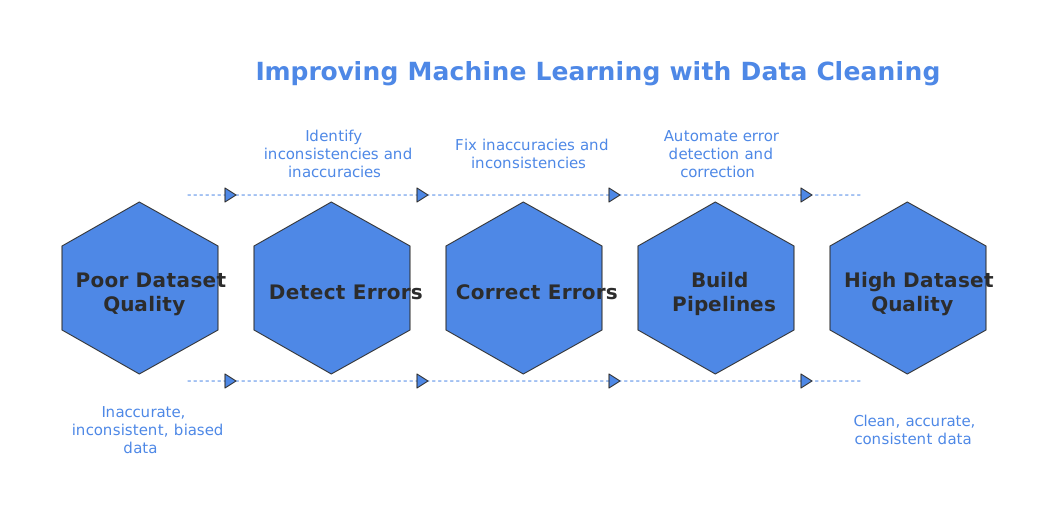
Detecting noise requires both automated systems and human judgment. Automated pipelines can scan for obvious irregularities such as empty masks, out of range pixel values, or mismatched dimensions. Duplicate detection algorithms flag repeated frames in video datasets or identical slices in CT studies. Quality assurance teams manually inspect borderline cases to distinguish true anomalies from low frequency but clinically valid patterns. This combination of automation and expert review is essential for preserving rare but important cases.
A key method for strengthening dataset quality is structured disagreement analysis. When multiple annotators disagree on a region or classification, reviewers investigate the sources of divergence. This helps uncover ambiguous cases, unclear guidelines, or systematic bias in specific segments of the dataset. Quality control reviewers take a leading role in resolving these issues, improving consistency, and aligning annotations with clinical standards. Each iteration refines the dataset and strengthens the model’s training foundation.
Building a Dataset Cleaning Workflow That Scales
Scale is one of the biggest challenges for dataset preparation. As datasets reach millions of samples, manual review becomes too slow and expensive to operate alone. Successful teams design hybrid workflows that combine algorithmic screening, automated labeling checks, and tiered human review. For example, image similarity search can immediately flag clusters of redundant samples, while automated metadata consistency checks identify misaligned or missing fields. High priority cases move to expert review, ensuring that clinical accuracy remains at the center of the pipeline.
Clean data policies must also extend beyond the initial training dataset. As new data enters the pipeline, continuous screening prevents dataset drift and preserves the quality of the underlying training corpus. Organizations that build persistent dataset cleaning workflows enjoy long term benefits: more stable models, fewer unexpected degradations, and smoother multi institution deployment. Clean datasets also help teams meet regulatory expectations by providing clear audit trails for reviews and corrections at every stage.
Clinical and Industrial Use Cases That Depend on Clean Data
Clean data is essential in domains where errors carry significant consequences. In radiology, segmentation masks must reflect true anatomical borders and align with clinical measurements. In pathology, the detection of cell nuclei, inflammation patterns, or tumor markers is highly sensitive to labeling variations. A single incorrect pixel in a segmentation mask can alter downstream quantitative metrics used for clinical decision support.
Industrial use cases face similar challenges. Assembly line inspection models must differentiate between acceptable variations and true defects. If noisy or mislabeled samples are introduced during training, models can overfit to irrelevant background patterns. Autonomous vehicle datasets also rely on clean data to identify pedestrians, road signs, traffic lights, and environmental hazards. Poor quality data can lead to missed detections or unsafe behavior during inference. Clean data reduces these risks and supports safe high performance AI systems.
The Role of Expert Reviewers in Maintaining Dataset Quality
Human expertise remains irreplaceable in dataset cleaning workflows, especially in high stakes environments. Radiologists, pathologists, senior annotators, and quality control reviewers bring a depth of clinical understanding that automated checks cannot replicate. Their reviews help validate edge cases, correct ambiguous labels, and ensure that annotations align with domain specific standards. Their expertise becomes especially valuable during disagreement resolution, multi annotator validation, and complex segmentation corrections.
Organizations that rely solely on automated cleaning risk overlooking subtle but clinically meaningful patterns. Conversely, teams that integrate expert review into pipeline design consistently achieve higher annotation consistency, cleaner datasets, and stronger model performance. Expert oversight is one of the most effective safeguards against systemic dataset errors, bias propagation, and silent inaccuracies that could lead to model drift.
How Dataset Cleaning Supports Fairness and Generalizability
Bias in datasets often emerges from uncontrolled noise or inconsistencies. For example, imaging datasets collected from one demographic group may not generalize to others because of differences in acquisition devices or clinical practices. Without dataset cleaning that actively examines demographic and technical distributions, models may unintentionally favor certain groups or conditions. Cleaning helps identify these weaknesses and preserves fairness across patient populations.
Generalization is also improved when dataset curation removes spurious correlations and preserves clinically relevant patterns. Removing noisy or mislabeled samples prevents models from learning shortcuts, such as associating a pathology with a specific acquisition device, hospital site, or imaging artifact. Clean datasets allow models to learn the true underlying clinical signal, strengthening their performance in new environments, institutions, or patient populations.
Continuous Dataset Cleaning for Evolving AI Pipelines
Modern AI systems operate in dynamic environments where new data arrives continually. As the dataset grows, the risk of drift increases if incoming samples differ significantly from earlier distributions. Continuous dataset cleaning helps teams monitor these changes and correct label inconsistencies, metadata shifts, or new types of noise. This ongoing maintenance protects the integrity of the training dataset and ensures that updated models continue to perform reliably.
Continuous dataset cleaning is also part of responsible AI governance. Institutions that build regulated medical AI systems must maintain traceable correction logs, annotation histories, and metadata versioning. Clean data operations help teams meet these expectations and support regulatory submissions. They also enable collaboration across healthcare institutions, where variations in acquisition protocols require rigorous data harmonization.
Bringing It All Together: Why Clean Data Shapes Successful AI
Dataset cleaning is foundational to building useful and trustworthy AI systems. Clean data strengthens every part of the pipeline, from annotation and preprocessing to model training and deployment. Teams that invest in cleaning early and consistently avoid many of the pitfalls that plague machine learning projects, including bias, instability, overfitting, and domain shift. In domains such as radiology, pathology, manufacturing, and autonomous navigation, clean data is not just a best practice but a safety imperative.
Organizations that prioritize dataset cleaning build more resilient AI systems that clinicians, engineers, and end users can trust. They gain clarity into the structure of their datasets, uncover hidden issues, and reduce the long-term cost of maintaining complex machine learning pipelines. Clean data is one of the strongest competitive advantages in modern AI development and a core requirement for high performance models.
If You Are Working on an AI or Medical Imaging Project
If you are working on an AI or medical imaging project, our team at DataVLab would be glad to support you. We can help you refine dataset cleaning workflows, strengthen your annotation pipeline, and ensure that your datasets meet clinical and technical rigor from the start.
What is dataset cleaning in machine learning?
Dataset quality determines how well machine learning systems learn, generalize, and perform in real-world conditions. Clean, accurate, and consistent data reduces variance, limits bias, and gives models the structure they need to identify patterns with confidence.
What does the article explain about what dataset cleaning involves in practical AI workflows?
Dataset cleaning involves a series of structured steps designed to eliminate errors and reinforce dataset integrity. These steps vary depending on the modality, domain, and project stage, but most workflows include duplicate detection, metadata fixing, formatting alignment, error correction, and label validation.
What are the main challenges of Dataset cleaning in machine learning?
Dataset cleaning is conceptually simple but operationally difficult. Large datasets often contain millions of entries across diverse formats, sources, and labeling protocols. Variations in lighting, resolution, acquisition device, patient demographics, and annotation methods introduce noise that is challenging to detect automatically.
What does the article explain about why clean data drives better clinical and industrial AI?
Many organizations underestimate why clean data matters until they encounter recurring model failures in production. Noise-induced errors are often subtle, difficult to trace, and capable of compounding over long training cycles. In hospital settings, this can delay diagnoses or reduce confidence in AI-guided workflows.
What is involved in building a dataset cleaning workflow that scales?
Scale is one of the biggest challenges for dataset preparation. As datasets reach millions of samples, manual review becomes too slow and expensive to operate alone. Successful teams design hybrid workflows that combine algorithmic screening, automated labeling checks, and tiered human review.
How does Dataset cleaning support Fairness and generalizability?
Bias in datasets often emerges from uncontrolled noise or inconsistencies. For example, imaging datasets collected from one demographic group may not generalize to others because of differences in acquisition devices or clinical practices. Without dataset cleaning that actively examines demographic and technical distributions, models may unintentionally favor certain groups or conditions.