Dataset Preparation for High-Performance AI Models
.jpeg)

Effective dataset preparation shapes every stage of an AI project, from initial prototyping to real-world deployment. Without a structured preparation workflow, computer vision and machine learning models struggle to learn reliable patterns and generalize across environments, devices, and edge cases. This guide explains how to create consistent and production-ready datasets through preprocessing, format handling, augmentation, metadata structuring, and quality workflows. You will learn how to design predictable pipelines that support training stability and long-term scalability across industries like robotics, retail, geospatial AI, manufacturing, logistics, and autonomous systems.
- Effective dataset preparation shapes every stage of an AI project, from initial prototyping to real-world deployment.
- Without a structured preparation workflow, computer vision and machine learning models struggle to learn reliable patterns and generalize across environments, devices, and edge cases.
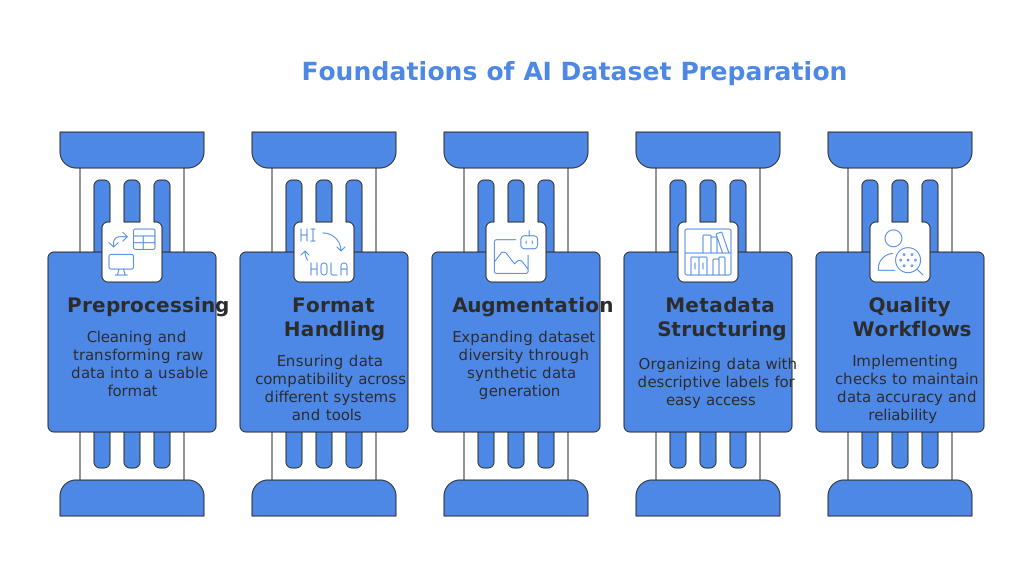
- This guide explains how to create consistent and production-ready datasets through preprocessing, format handling, augmentation, metadata structuring, and quality workflows.
- Preprocessing is the central component of dataset preparation, responsible for transforming raw files into consistent, model-ready samples.
Every successful AI system begins with dataset preparation, the foundational step that determines how well a model can learn, adapt, and generalize. When teams approach data collection without a structured preparation strategy, they often run into challenges such as inconsistent samples, device-dependent variability, missing metadata, misaligned formats, or label quality issues. By contrast, a robust preparation process creates cohesion across thousands or millions of files, reducing friction during annotation and enabling models to converge more efficiently. Dataset preparation aligns data with the requirements of the learning task, the architecture, and the operational environment where the model will eventually be deployed.
In data annotation workflows, preparation serves as the bridge between raw data acquisition and the annotator’s workspace. It helps ensure that annotators, reviewers, and automation systems see files that are consistent in resolution, orientation, color profile, structure, and metadata availability. This reduces cognitive load, increases labeling precision, and improves quality control outcomes across the project lifecycle. Proper preparation is not about modifying the meaning of the data but about presenting it in a stable and predictable form.
Across industries, dataset preparation directly influences downstream model accuracy. In retail analytics, inconsistent lighting or color distribution can cause classification drift. In autonomous driving, misaligned sensor frames can break object tracking. In geospatial imaging, variations in altitude or sensor type can influence feature visibility. Preparation builds the uniformity required for models to learn meaningful and durable patterns across varied conditions.
Why Dataset Preparation Determines AI Success
Dataset preparation is often underestimated because it occurs before the more visible phases of annotation and model training. Yet, this early step impacts nearly every technical and operational dimension of a machine learning system’s performance. Models trained on inconsistent or poorly prepared data frequently develop unstable representations that fail under real-world variability. This leads to brittle predictions, irregular training curves, rising annotation error rates, and inefficient debugging cycles.
Proper preparation helps eliminate noise that does not contribute to the target task. For example, slight changes in exposure between camera sensors can cause a model to overfit to irrelevant brightness cues. Stabilizing these factors improves training efficiency and boosts generalization. Similarly, preparation prevents structural issues such as corrupted files, incorrect aspect ratios, or misaligned temporal frames. Each of these issues can significantly affect the quality of annotations and model predictions.
In large-scale projects, preparation also supports traceability. Complex workflows spanning multiple teams, regions, and time zones require predictable pipelines. Strong dataset preparation provides auditability, allowing teams to understand exactly how each file was transformed. Leading research groups at the Carnegie Mellon Robotics Institute emphasize that reproducible data transformations are essential for trustworthy AI research and deployment.
Finally, preparation directly affects annotation cost. When files arrive in consistent formats and resolutions, annotators spend less time navigating irregularities, and tools perform automated checks more effectively. Reduced noise results in faster labeling, fewer corrections, and higher throughput across the project.
Core Principles of an Effective Dataset Preparation Strategy
The strongest dataset preparation strategies share several principles that apply across industries and data types. These principles guide teams as they convert raw data into a structured, high-quality dataset ready for annotation and training.
The first principle is consistency. Consistency ensures that the distribution of samples remains stable across the dataset. This is particularly important for computer vision because neural networks rely on statistical regularities in images. When variations do not reflect meaningful real-world differences, they corrupt learning signals. Whether the raw data comes from multiple cameras, drones, factory sensors, or smartphones, the preparation pipeline must normalize essential properties so the model can focus on true patterns.
A second principle is preservation of information. Preparation must never distort or erase meaningful content. The goal is to standardize data without compromising the visual or structural cues on which the model relies. For example, resizing must preserve aspect ratios when the shape of objects conveys important context. Clipping, filtering, or denoising must be calibrated to avoid suppressing low-intensity details that matter in detection or segmentation tasks.
A third principle is traceability. Every transformation, from clipping borders to adjusting gamma values, must be logged. As the Princeton Visual AI Lab researchers note, traceable data transformations improve reproducibility and help teams diagnose unexpected model behaviors.
Finally, preparation must be aligned with the intended application. A dataset intended for real-time embedded inference may require stricter resolution constraints than one intended for offline experimentation. A tracking model demands different preparation from a classification model. Understanding the end-use environment helps guide technical decisions during preparation.
Understanding Variability in Real-World Data
Raw data from real environments contains many sources of variability that can degrade model performance if left unmanaged. Cameras, sensors, lighting conditions, environmental parameters, and device settings all influence the appearance or structure of data. Dataset preparation helps reduce these inconsistencies through controlled transformations.
Device variability is one of the most common issues. Camera sensors differ in dynamic range, white balance behavior, noise patterns, and color spaces. Without normalization, models may inadvertently learn to classify based on device signatures rather than object characteristics. In robotics and manufacturing, different imaging sensors may capture the same object with subtle texture or sharpness differences that require harmonization.
Environmental variability is another major factor. Outdoor datasets involve changes in weather, sunlight angles, shadows, or surface reflectivity. Indoor datasets vary with fluorescent lights, reflections on polished surfaces, or window-generated brightness gradients. Preparation pipelines often include color consistency checks, brightness adjustments, and normalization techniques to mitigate these differences.
Structural variability is common in geospatial and drone imagery. Differences in altitude, camera tilt, or terrain slope affect how objects are projected into the image frame. Without preparation, these irregularities create confusion for annotators and models.
Leading research from UC San Diego’s Computer Vision Group shows that addressing variability early in the process significantly reduces annotation ambiguity and improves downstream model stability.
Preprocessing Techniques That Build Strong Foundations
Preprocessing is the central component of dataset preparation, responsible for transforming raw files into consistent, model-ready samples. The preprocessing stage directly affects annotation consistency and model interpretability.
Image normalization ensures that pixel value distributions remain stable across samples. This is essential in datasets collected from different cameras or environments. Normalization techniques may include min-max scaling, channel-wise normalization, or histogram matching. These transformations help reduce unnecessary variability while preserving important texture and structural cues.
Resizing is another critical step. Models require uniform input dimensions, yet resizing must preserve aspect ratios whenever object shapes matter. Distorted objects can mislead both annotators and models, especially when the task involves precise localization or measurement. Where necessary, padding can be used to preserve shape integrity.
Cropping helps remove irrelevant borders, logos, timestamps, or sensor metadata that would otherwise add noise. Smart cropping strategies also increase uniformity while preserving the central content. Cropping is particularly helpful in manufacturing or robotics datasets where camera installation introduces static background regions.
Noise reduction is relevant in low-light, high-motion, or high-ISO environments. However, excessive filtering can erase meaningful edges or textures that models rely on. Preprocessing pipelines must strike a balance between reducing noise and preserving important signals.
Preprocessing for video includes frame sampling, shot segmentation, and temporal alignment. For multi-camera systems, preprocessing might include camera calibration and geometric alignment so that annotators can track sequences more effectively.
Managing Formats in AI Datasets
One of the most overlooked parts of dataset preparation is handling formats. Consistent and well-managed formats make datasets easier to annotate, store, process, and validate.
JPEG, PNG, and WebP are common in computer vision. PNG preserves high-fidelity information but can result in larger storage footprints. JPEG is efficient but introduces compression artifacts that must be considered during preparation. WebP offers a compromise between compression and quality for web-scale datasets.
TIFF is common in scientific imaging and manufacturing environments due to its lossless compression and support for high bit depths. For drone or geospatial datasets, GeoTIFF files may embed coordinate systems that need to be extracted and referenced during annotation.
Video formats such as MP4, MOV, and AVI require consistent frame rates and codecs. Changes in frame rate can cause annotation tools to misinterpret timestamps, leading to misaligned bounding boxes or tracking failures.
Specialized sensors, such as depth cameras, LiDAR, or infrared devices, may use proprietary formats. Dataset preparation involves converting these files into interoperable representations while preserving metadata such as depth scales or intrinsic camera parameters.
The Caltech Visual Computing research group emphasizes the importance of format standardization for scalable computer vision pipelines, noting that inconsistent formats lead to annotation bottlenecks and model errors.
Metadata and Structure: The Backbone of Organized Datasets
Metadata acts as the descriptive backbone of dataset preparation. It includes information about device parameters, environmental context, sample provenance, and any preprocessing transformations applied.
Organized metadata enables structured analysis and improves dataset governance. It helps annotators understand scenes more clearly and supports model debugging. For example, metadata about lighting conditions or camera positions can help teams analyze model performance under difficult scenarios.
In large datasets, metadata enables efficient querying. Teams can filter subsets of data for annotation, testing, or specialized model training. For example, if objects appear differently at night, metadata can help isolate nighttime samples for controlled evaluation.
Metadata must remain tightly synchronized with the images or sequences they describe. Whenever transformations occur, such as resizing or cropping, the metadata must be updated so that bounding boxes, segmentation masks, or time codes remain accurate.
Folder structure also plays a vital role. Predictable hierarchies help separate raw, processed, annotated, and exported versions of the dataset. A well-structured dataset reduces errors and enables cross-team collaboration. Research from the University of Toronto Machine Learning Group highlights the importance of consistent dataset organization for reproducibility in large-scale ML projects.
Augmentation for Diversity and Generalization
Augmentation expands the diversity of the dataset by artificially creating variations that reflect real-world unpredictability. Applying augmentation during preparation helps models become robust to changes in environment, perspective, scale, or illumination.
Spatial augmentations include rotating, flipping, cropping, and perspective transformations. These are especially valuable for tasks like object detection or segmentation, where orientation should not dictate class identity. Augmentations must remain realistic; extreme warping can confuse annotators and models.
Color augmentations modify brightness, saturation, contrast, and gamma levels. These techniques help models adapt to varying lighting conditions. However, they must be calibrated to avoid creating unrealistic artifacts that distort object appearance.
Noise-based augmentations add blur, motion streaks, or synthetic noise. These are common in robotics or autonomous driving datasets because they simulate real-world motion and environmental conditions. Synthetic noise should be applied carefully to avoid obscuring important boundaries.
Temporal augmentations benefit video datasets. Methods such as frame dropping, speed variation, or temporal jitter help models generalize across unpredictable motion patterns. Augmentations must remain synchronized with audio or metadata when handling multimodal data.
Leading research from the Carnegie Mellon Robotics Institute shows that augmentation can significantly improve robustness in cluttered, dynamic, or low-light environments.
Quality Control in Dataset Preparation
Quality control during dataset cleaning safeguards against inconsistencies that can undermine annotation accuracy and model performance. QC involves structured reviews by annotators, managers, technical reviewers, and quality auditors.
Early QC checks include verifying file integrity, checking for corrupted frames, ensuring consistent image dimensions, and validating metadata consistency. These steps prevent flawed data from entering the annotation workflow.
Mid-stage QC focuses on verifying the results of preprocessing, such as ensuring crops are centered, resizing preserves aspect ratios, and color normalization is consistent. This stage often identifies mismatches introduced by device variability.
Late-stage QC examines augmented data, ensuring transformations remain realistic and do not distort the underlying semantics. For example, an augmentation that flips a road scene must maintain lane geometry so that labels remain valid.
QC is iterative and should be embedded throughout the pipeline. It helps teams catch subtle issues that become problematic later in the project. Strong QC reduces rework, enhances labeling precision, and improves training stability across the dataset lifecycle.
Ethical, Operational, and Security Considerations
Dataset curation must also consider ethical and operational risks unrelated to clinical or personal data environments. These considerations apply to general AI use cases in public spaces, industrial environments, or consumer interactions.
Privacy rules may apply when datasets contain individuals, license plates, or identifiable assets. In such cases, preparation may include blurring faces or masking identifiers. These operations must be performed carefully to avoid removing contextual information needed for certain tasks.
Security involves controlling access to raw and processed files, especially when datasets come from internal company sources or proprietary hardware. Consistent hashing, encryption, and access management help maintain integrity and traceability.
Ethical considerations include ensuring datasets represent diverse environments. For example, datasets for smart city applications should reflect different lighting conditions, demographic distributions, and weather patterns. Addressing imbalances early prevents representational bias downstream.
Operational constraints, such as storage limits or processing budgets, also influence preparation choices. Efficient formats and streamlined workflows help reduce computational overhead.
Version Control, Change Tracking, and Reproducibility
As datasets evolve, teams need systems for version control that track all transformations applied during preparation. Version control enables reproducibility and clear documentation, allowing teams to retrace steps when models behave unexpectedly.
Change logs should document updates to preprocessing pipelines, adjustments to augmentation strategies, modifications to metadata fields, and reorganizations of folder structures. This creates transparency across teams, reduces confusion, and supports audit requirements in enterprise environments.
Reproducibility is vital for debugging and long-term maintenance. As research from the Princeton Visual AI Lab emphasizes, reproducible datasets help teams build reliable pipelines that evolve predictably over time.
End-to-End Workflow Integration
Dataset preparation does not occur in isolation. It must blend seamlessly with data ingestion, annotation tooling, quality control, model training, and deployment workflows. A well-orchestrated pipeline includes:
• raw data ingestion
• preprocessing
• format conversions
• metadata enrichment
• augmentation
• quality control
• export to annotation tools
• reprocessing during model iteration
Each stage must maintain clarity, reproducibility, and consistency. Automation helps reduce manual error, improve efficiency, and scale preparation for large-volume projects.
Integrated workflows reduce friction between annotators, reviewers, engineers, and researchers. When preparation is predictable, each stakeholder can rely on the integrity of the dataset at every stage.
How Strong Dataset Preparation Improves Model Performance
Good preparation creates models that converge faster, generalize better, and withstand real-world variability. Conversely, poor preparation leads to unstable training, confused models, and unpredictable outputs.
Prepared datasets allow neural networks to learn true signal rather than noise. When preprocessing harmonizes exposure, aspect ratios, and device variability, models focus on the structural and semantic cues that matter.
Well-structured metadata improves model interpretability. When teams can trace dependencies, understand context, and isolate failure cases, they can diagnose issues more efficiently. Better interpretability leads to more trustworthy deployments.
Finally, strong preparation reduces annotation cost and increases throughput. Annotators spend less time navigating irregularities, and quality control catches fewer issues downstream.
If you are working on an AI or computer vision project, our team at DataVLab would be glad to support you.
What are Dataset preparation for High-Performance AI models?
Effective dataset preparation shapes every stage of an AI project, from initial prototyping to real-world deployment. Without a structured preparation workflow, computer vision and machine learning models struggle to learn reliable patterns and generalize across environments, devices, and edge cases.
What does the article explain about why dataset preparation determines AI success?
Dataset preparation is often underestimated because it occurs before the more visible phases of annotation and model training. Yet, this early step impacts nearly every technical and operational dimension of a machine learning system’s performance. Models trained on inconsistent or poorly prepared data frequently develop unstable representations that fail under real-world variability.
What does the section on “Preprocessing techniques that build strong foundations” explain?
Preprocessing is the central component of dataset preparation, responsible for transforming raw files into consistent, model-ready samples. The preprocessing stage directly affects annotation consistency and model interpretability. Image normalization ensures that pixel value distributions remain stable across samples.
How can teams ensure quality in Dataset preparation for High-Performance AI models?
Quality control during dataset cleaning safeguards against inconsistencies that can undermine annotation accuracy and model performance. QC involves structured reviews by annotators, managers, technical reviewers, and quality auditors. Early QC checks include verifying file integrity, checking for corrupted frames, ensuring consistent image dimensions, and validating metadata consistency.
What does the section on “Version control, change tracking, and reproducibility” explain?
As datasets evolve, teams need systems for version control that track all transformations applied during preparation. Version control enables reproducibility and clear documentation, allowing teams to retrace steps when models behave unexpectedly. Change logs should document updates to preprocessing pipelines, adjustments to augmentation strategies, modifications to metadata fields, and reorganizations of folder structures.
How does Strong dataset preparation improve Model performance?
Good preparation creates models that converge faster, generalize better, and withstand real-world variability. Conversely, poor preparation leads to unstable training, confused models, and unpredictable outputs. Prepared datasets allow neural networks to learn true signal rather than noise.