Computer Vision Research
.jpeg)

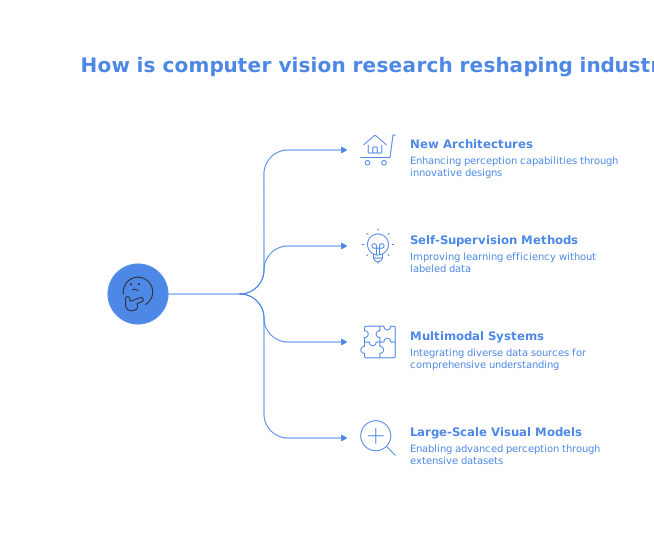
Computer vision research is advancing faster than any other field in artificial intelligence. New architectures, self-supervision methods, multimodal systems, and large-scale visual models are redefining perception capabilities across industries. This article explores the current landscape of computer vision research, highlighting foundational trends, scientific breakthroughs, evolving benchmarks, and future research directions. It provides a clear and accessible overview for AI leaders, researchers, and technical founders seeking to understand how modern vision research is reshaping automation, robotics, and machine intelligence.
- Computer vision research is advancing faster than any other field in artificial intelligence.
- New architectures, self-supervision methods, multimodal systems, and large-scale visual models are redefining perception capabilities across industries.
- This article explores the current landscape of computer vision research, highlighting foundational trends, scientific breakthroughs, evolving benchmarks, and future research directions.
- It provides a clear and accessible overview for AI leaders, researchers, and technical founders seeking to understand how modern vision research is reshaping automation, robotics, and machine intelligence.
Modern computer vision research now sits at the center of AI innovation, powering advances in robotics, autonomous navigation, geospatial intelligence, augmented reality, industrial automation, and next-generation consumer technologies. Over the past decade, vision research has evolved from handcrafted features to deep learning architectures, and now to multimodal systems capable of reasoning about images, video, and text jointly. The complexity of modern workloads, combined with unprecedented computational scale, has pushed research in computer vision to new heights.
Unlike traditional engineering tasks, research in computer vision focuses on discovering new representational methods, new learning paradigms, and new pathways toward generalizable perception. The latest advancements aim not only to improve accuracy on benchmarks but to build models that understand visual environments with context, causality, robustness, and real-world reasoning. Understanding the direction of this research helps companies anticipate what will be possible in the next 2–5 years.
How Computer Vision Research Has Evolved
The evolution of computer vision mirrors the evolution of AI itself. Early research relied on handcrafted descriptors such as SIFT, HOG, and SURF, where researchers manually defined features for tasks like detection or recognition. While pioneering, these methods lacked scalability.
The introduction of deep learning initiated a paradigm shift. Convolutional neural networks (CNNs) like AlexNet, VGG, and ResNet demonstrated that learned representations outperformed human-engineered features across nearly every benchmark. CNNs became the backbone of visual understanding for almost a decade.
More recently, transformer-based architectures have reshaped computer vision research. Vision Transformers (ViTs) and their derivatives replace convolutions with global self-attention, enabling models to capture long-range dependencies and scale more effectively with data. The shift toward transformers has also made vision architectures more compatible with NLP models, accelerating the rise of multimodal AI.
This shift has also been reinforced by academic work from leading groups such as the MIT Computer Science & Artificial Intelligence Laboratory, which continues to explore scalable architectures and unified perception models.
Finally, research is now moving toward foundational vision models, trained on massive unlabeled datasets and adapted to downstream tasks with lightweight fine-tuning. Computer vision is no longer a collection of siloed tasks but part of a unified perception-language ecosystem.
Self-Supervised Learning and Foundation Models
One of the most transformative developments in modern research is the rise of self-supervised learning (SSL). Instead of relying on annotated datasets, SSL models learn from the structure of raw visual data. This shift is crucial because annotation is expensive, subjective, and hard to scale for rare or complex concepts.
SSL approaches include:
• contrastive learning
• masked image modeling
• teacher–student distillation
• multi-view consistency learning
• cross-modal alignment (vision–language learning)
These methods allow models to acquire semantic understanding before ever seeing a labeled example. This dramatically reduces the need for human supervision and improves generalization across tasks.
Current vision research is heavily focused on foundation models, where massive SSL-trained models become universal feature extractors for classification, segmentation, depth estimation, retrieval, tracking, and video understanding. Large vision models enable downstream tasks with minimal labeled data and unlock higher-quality perception for robotics, manufacturing, and geospatial intelligence.
Much of today’s progress in contrastive learning and large-scale representation learning is driven by open research from groups like the Berkeley Artificial Intelligence Research Lab, whose work continues to push the boundaries of self-supervised vision systems.
Research in Computer Vision for Multimodal AI
One of the strongest trends in research in computer vision is the integration of vision, language, and sometimes audio or action control into unified systems.
Multimodal research investigates:
• visual grounding
• vision–language reasoning
• zero-shot recognition
• captioning and visual QA
• open vocabulary detection
• visual dialogue
• image-to-text and text-to-image generation
Models such as contrastively trained vision–language systems and multimodal transformers demonstrate a new capability: they can connect what they see with what they read or understand linguistically. This creates models that can answer questions about scenes, follow textual instructions, and detect objects never seen during supervised training.
In multimodal learning, research teams such as the Stanford Vision and Learning Lab have shown how joint training across images, video, and text can produce models with stronger generalization and cross-domain reasoning.
Multimodal computer vision research expands applications into:
• robotics task planning
• geospatial analysis
• industrial monitoring
• retail automation
• augmented reality
• safety monitoring
• consumer AI assistants
As vision research becomes increasingly multimodal, the boundary between perception and reasoning grows thinner.
The Rising Importance of Video Understanding
While image models dominated the last decade, the next era of computer vision research is shifting toward video understanding. Video includes motion, temporal structure, causality, and interactions between objects that static images cannot capture.
Key areas of research include:
Temporal transformers
Models that process video frames as sequences, capturing motion and causal dependencies.
Long-horizon reasoning
Models that understand extended activities rather than short clips.
Action detection and anticipation
Systems that predict future behavior or identify ongoing tasks.
3D perception
Understanding depth, movement pathways, and object-to-object relationships through video.
Video understanding research is critical for robots, autonomous vehicles, smart city analytics, industrial automation, and sports analysis. As compute capacity grows, video will become the main driver of next-generation perception models.
3D, Novel View Synthesis, and Spatial Understanding
A major research frontier in computer vision is the transition from 2D perception to 3D spatial understanding. Models must interpret geometry, structure, surfaces, and physical relationships to operate effectively in real environments.
Major research directions include:
• 3D reconstruction
• implicit neural representations
• NeRFs and large-scale radiance fields
• multi-view learning
• depth-from-motion
• SLAM and visual mapping
• 3D object understanding
• differentiable rendering
Neural Radiance Fields (NeRFs) have particularly accelerated research. They enable high-fidelity view synthesis and scene reconstruction from only a few input images. Real-time NeRFs are emerging in robotics, digital twins, virtual environments, and simulation.
Advances in 3D reconstruction and scene understanding are also driven by long-term academic contributions from the Oxford Visual Geometry Group, whose work in geometry-aware learning and large-scale visual mapping continues to influence modern architectures.
Research is expanding beyond reconstructing scenes to reasoning about them. Spatial AI systems aim to combine mapping, geometry, object understanding, and semantic reasoning into a unified perception backbone.
Benchmarking and Evaluation in Computer Vision Research
As models grow larger and training scales up, evaluating them becomes more complex. Traditional benchmarks like ImageNet, COCO, and Pascal VOC are no longer sufficient to capture real-world behavior. Modern research emphasizes benchmarks that test robustness, compositionality, reasoning, distribution shift, and multimodal alignment.
Current evaluation challenges focus on:
Domain shift
How models behave on different devices, lighting conditions, or environments.
Compositional generalization
Understanding novel combinations of familiar concepts.
Zero-shot and open-vocabulary performance
Handling object categories unseen during training.
Multimodal alignment accuracy
Ensuring text and vision representations align correctly.
Robustness to perturbations
Testing resilience to occlusion, blur, noise, and weather.
Modern research also embraces continual evaluation, recognizing that model performance must be audited across time, data sources, and downstream tasks.
Computer Vision Research for Robotics and Embodied AI
Robotics introduces challenges beyond static perception. Embodied AI research focuses on how vision systems interact with motion, planning, manipulation, and physical feedback.
Key research topics include:
• vision-based navigation
• scene affordance understanding
• manipulation through visual servoing
• object permanence
• tactile–visual sensor fusion
• closed-loop perception–action systems
Vision researchers increasingly collaborate with robotics groups to explore how visual representations affect real-world performance. Embodied AI emphasizes real-time perception, active sensing, and physically grounded learning.
This type of research is foundational for autonomous delivery systems, warehouse automation, humanoid robots, home-assistive robotics, and industrial inspection.
Ethics and Bias in Computer Vision Research
As vision models become more powerful, research communities are examining questions of fairness, safety, transparency, and real-world impact.
Current ethical research explores:
• dataset bias and representational imbalance
• privacy-preserving computer vision
• consent in public-space data collection
• explainability of visual decisions
• safety in high-stakes domains
• energy consumption and sustainable training
Bias is particularly challenging because visual datasets often contain imbalanced demographic or environmental representation. Research emphasizes developing techniques for balancing distributions, auditing model behavior, and identifying harmful failure modes.
The Future of Computer Vision Research
Over the next five years, several emerging directions are expected to define the trajectory of the field:
Generalist perception models
Models that unify 2D, 3D, video, and multimodal reasoning into a single architecture.
Self-training with synthetic data
Large-scale generative models producing synthetic datasets that improve downstream accuracy.
Ultra-efficient CV models
Architectures optimized for edge devices, drones, robots, and embedded hardware.
Neural fields for everything
NeRF-like representations for scenes, objects, environments, and digital twins.
Vision × robotics × language
Deeply integrated systems capable of reasoning, planning, and acting autonomously.
Decision-first perception
Models that align perception directly with downstream goals rather than generic representation learning.
The future of computer vision research is moving toward generalizable, multimodal, physically grounded intelligence. Companies that understand these trends today will lead the next wave of AI adoption.
If you are working on computer vision models or research-driven AI projects, our team at DataVLab would be glad to support you.
What is Computer vision research?
Computer vision research is advancing faster than any other field in artificial intelligence. New architectures, self-supervision methods, multimodal systems, and large-scale visual models are redefining perception capabilities across industries. This article explores the current landscape of computer vision research, highlighting foundational trends, scientific breakthroughs, evolving benchmarks, and future research directions.
What does the article explain about how computer vision research has evolved?
The evolution of computer vision mirrors the evolution of AI itself. Early research relied on handcrafted descriptors such as SIFT, HOG, and SURF, where researchers manually defined features for tasks like detection or recognition. The introduction of deep learning initiated a paradigm shift.
What does the section on “Research in computer vision for multimodal AI” explain?
One of the strongest trends in research in computer vision is the integration of vision, language, and sometimes audio or action control into unified systems. visual grounding• vision–language reasoning• zero-shot recognition• captioning and visual QA• open vocabulary detection• visual dialogue• image-to-text and text-to-image generation.
What are the main benefits of Computer vision research?
While image models dominated the last decade, the next era of computer vision research is shifting toward video understanding. Video includes motion, temporal structure, causality, and interactions between objects that static images cannot capture. Temporal transformersModels that process video frames as sequences, capturing motion and causal dependencies.
How can teams ensure quality in Computer vision research?
As models grow larger and training scales up, evaluating them becomes more complex. Traditional benchmarks like ImageNet, COCO, and Pascal VOC are no longer sufficient to capture real-world behavior. Modern research emphasizes benchmarks that test robustness, compositionality, reasoning, distribution shift, and multimodal alignment.
What is the future of Computer vision research?
Generalist perception modelsModels that unify 2D, 3D, video, and multimodal reasoning into a single architecture. Self-training with synthetic dataLarge-scale generative models producing synthetic datasets that improve downstream accuracy. Ultra-efficient CV modelsArchitectures optimized for edge devices, drones, robots, and embedded hardware.