Anomaly and Violence Detection Datasets for Public Safety AI in Smart Cities
.jpeg)

Anomaly and violence detection datasets are essential for building public safety AI systems that monitor urban environments and identify events requiring rapid intervention. These datasets include annotated video sequences representing diverse behaviors such as sudden motion changes, crowd disturbances, aggressive actions, unattended objects, and irregular movement patterns. This article explains how anomaly detection works, how datasets are constructed, what annotation workflows are required, and why building reliable models demands significant scenario diversity. It also explores challenges such as class imbalance, ambiguity in human behavior, privacy constraints, and real world variability. By understanding how anomaly detection datasets function, cities and technology providers can design safer, more resilient environments supported by AI driven public safety systems.
- Anomaly and violence detection datasets are essential for building public safety AI systems that monitor urban environments and identify events requiring rapid intervention.
- These datasets include annotated video sequences representing diverse behaviors such as sudden motion changes, crowd disturbances, aggressive actions, unattended objects, and irregular movement patterns.
- This article explains how anomaly detection works, how datasets are constructed, what annotation workflows are required, and why building reliable models demands significant scenario diversity.
- By understanding how anomaly detection datasets function, cities and technology providers can design safer, more resilient environments supported by AI driven public safety systems.
Anomaly detection is the process of identifying events or behaviors that deviate from expected patterns. In the context of smart cities, anomalies often indicate safety risks, operational issues, or unusual activity that requires attention. These include sudden crowd surges, erratic movement, fights, assaults, vandalism, abandoned objects, and environmental hazards. Public safety agencies use anomaly detection systems to improve situational awareness and accelerate emergency response.
Anomaly detection is particularly valuable because many urban safety events are unpredictable. Unlike traffic violations or vehicle behaviors that follow structured rules, human behavior is highly variable and context dependent. Research from the International Journal of Information and Security highlights the importance of anomaly detection in bridging the gap between passive surveillance systems and proactive incident detection. AI systems trained on diverse datasets can interpret behaviors that human operators may overlook when monitoring large camera networks.
Anomaly detection adds an essential layer of intelligence to smart city security frameworks by enabling automated, real time detection of unusual events.
Why Anomaly Detection Matters for Public Safety
Early detection of hazardous situations
Many safety incidents escalate quickly. Detecting anomalies such as aggressive movements, crowd panic, or erratic pedestrian behavior helps authorities intervene before situations deteriorate.
Monitoring high risk locations
Public transit hubs, stadiums, nightlife districts, and large public spaces require constant oversight. Anomaly detection systems provide continuous monitoring and alert operators to irregular behaviors or movements.
Reducing surveillance fatigue
Human operators struggle to monitor multiple camera feeds simultaneously. Automated anomaly detection reduces cognitive load and enables faster identification of relevant events.
Enhancing emergency response
Real time alerts help emergency teams respond quickly to violence, accidents, or suspicious activities. Faster response times significantly improve safety outcomes.
Supporting crime prevention
AI systems identify patterns that correlate with risky behavior or emerging threats. These insights support preventive measures and help allocate resources more effectively.
Public safety AI relies heavily on anomaly detection datasets that capture diverse, realistic scenarios across various urban environments.
How Anomaly Detection Works
Understanding normal behavior
Anomaly detection models first learn what normal movement patterns look like. This includes typical walking behavior, crowd flow, and interactions that occur regularly within the environment. Models must capture a broad range of normal behaviors to avoid false positives.
Detecting deviations
When behavior deviates from established patterns, the model flags it as an anomaly. Deviations may include sudden acceleration, erratic motion, unusual group dynamics, or irregular object placement.
Motion and trajectory analysis
Models analyze the velocities, directions, and trajectories of objects across frames. Irregular trajectories often indicate that something unexpected is happening. These deviations form the basis for many anomaly alerts.
Spatiotemporal modeling
Anomaly detection requires understanding both spatial information and temporal evolution. Deep learning models combine convolutional layers with sequence modeling architectures to interpret events across time.
Contextual interpretation
Many anomalies depend on context. Running inside a subway tunnel is unusual, while running in a park is normal. Context based modeling helps reduce false positives by interpreting behaviors according to location, time, and environmental norms.
These systems depend on diverse, well annotated datasets that represent a wide range of real world scenarios.
Violence Detection in Smart Cities
Violence detection is a subset of anomaly detection focused specifically on aggressive interactions, physical assaults, and confrontational behavior. Violence detection models interpret body movements, group dynamics, motion acceleration, and proximity patterns to identify fights or aggressive acts.
Identifying aggressive motion
Violence often involves sudden movements, rapid limb motion, or irregular physical interactions. Models analyze these motion signatures to classify violent behavior.
Group behavior analysis
Violence detection also evaluates group interactions. Signals such as crowd agitation, confrontational stances, or clustering behaviors may indicate emerging conflict.
Detecting escalating situations
Not all violence begins abruptly. Escalation patterns such as aggressive postures, pushing, or verbal confrontation can precede physical violence. Models that identify early signs enable faster intervention.
Multiclass event classification
Some datasets include classes such as fight, robbery, vandalism, harassment, or assault. Multiclass modeling requires highly detailed annotation and clearly defined class boundaries.
Integration with emergency systems
Violence detection models provide alerts to operators, security personnel, or first responders. Integration with dispatch systems accelerates response time.
Violence detection requires extremely precise annotation due to the sensitive and safety critical nature of the task.
Anomaly Detection Datasets
Behavioral anomaly datasets
These datasets include various forms of unusual behavior such as loitering, trespassing, running in restricted areas, or climbing over barriers. They help models understand irregular human actions.
Crowd anomaly datasets
Crowd anomaly datasets capture unusual crowd behavior such as sudden surges, chaotic movement, or panic. These datasets are crucial for stadiums, festivals, and public transit hubs.
Environmental anomaly datasets
These include anomalies such as smoke, water leaks, fallen objects, or infrastructure failures. Environmental anomalies help operators maintain urban safety and resilience.
Object based anomaly datasets
Unattended bags, abandoned bicycles, or suspicious objects are labeled in object based anomaly datasets. Model performance relies on consistent annotation of object placement, duration, and context.
Organizations such as the Security Industry Association (SIA) publish research demonstrating how anomaly datasets contribute to more reliable security systems.
Each dataset provides critical components for building comprehensive public safety AI systems.
Violence Detection Datasets
Aggression datasets
These datasets include sequences of aggressive actions, pushing, shoving, and pre fight behaviors. They are used for early stage violence detection.
Fight detection datasets
Fight datasets include detailed video footage of physical altercations. High quality examples must capture various angles, speeds, and environmental contexts.
Surveillance based violence datasets
These datasets contain violence sequences recorded in public spaces such as streets, transit stations, and commercial areas. Surveillance datasets are especially valuable because they reflect realistic camera angles and environmental variability.
Synthetic violence datasets
Synthetic datasets generate simulated violence sequences in controlled environments. They help augment rare scenarios and reduce annotation time, although they must be blended with real data for balanced training.
The European Crime Prevention Network highlights the need for standardized violence datasets to support interoperable safety systems.
Violence datasets must be diverse, balanced, and ethically sourced to ensure reliable model performance.
Annotation Workflows for Anomaly Detection
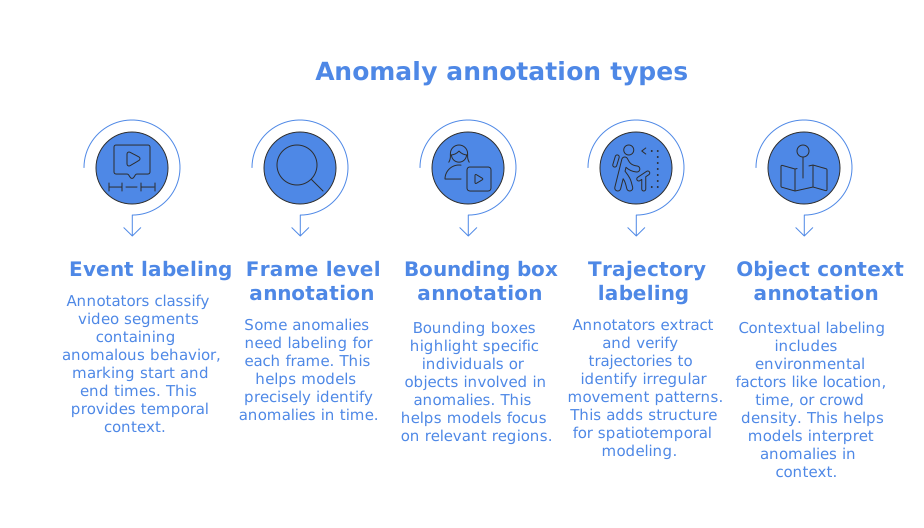
Event labeling
Annotators classify segments of video that contain anomalous behavior. They mark the start and end of events to provide temporal context.
Frame level annotation
Some anomalies require frame specific labeling. Frame level annotation helps models identify anomalies with temporal precision.
Bounding box annotation
Bounding boxes are used when anomalies involve specific individuals or objects. They help models focus on relevant regions.
Trajectory labeling
Annotators extract and verify trajectories to identify irregular movement patterns. Trajectory annotation adds valuable structure for spatiotemporal modeling.
Object context annotation
Contextual labeling includes noting environmental factors such as location type, time of day, or crowd density. This helps models interpret anomalies in context.
Annotation quality plays a crucial role in reducing false positives and improving overall system reliability.
Annotation Workflows for Violence Detection
Action segmentation
Annotators identify specific actions within violence sequences. These may include punching, pushing, grappling, or kicking.
Actor identification
Annotators track individuals involved in the violent event. Actor IDs help models understand interactions and involvement.
Body pose labeling
Some datasets use pose estimation to capture limb movement and body alignment. Pose based annotation enhances fine grained action recognition.
Scene classification
Annotators categorize scenes based on location type or environmental variables. Scene labeling provides context that influences model interpretation.
Quality assurance
Violence detection requires stringent QA processes. Multi reviewer workflows ensure that annotations are accurate, especially for subtle or ambiguous behaviors.
Violence annotation is one of the most complex tasks in computer vision due to the nuanced and varied nature of human behavior.
Challenges in Anomaly and Violence Detection
Ambiguity in human behavior
Not all unusual behavior is dangerous. Distinguishing harmless irregularities from genuine threats is difficult and requires nuanced modeling.
Rare event scarcity
Anomalies and violent incidents occur infrequently. This creates class imbalance in datasets and makes training more difficult.
Occlusions and crowd density
Dense environments create occlusions that hide critical actions. Models must infer actions even when visibility is limited.
Lighting and weather variation
Environmental variability affects both detection and tracking accuracy. Models must generalize across diverse real world conditions.
Privacy constraints
Public safety systems must balance security with privacy. Datasets must be anonymized to protect identities while still preserving behavioral signals.
Diverse camera angles
Different installations capture scenes from overhead, eye level, or wide angle perspectives. Models must generalize across all angles.
These challenges highlight the need for carefully designed datasets and rigorous annotation standards.
Applications of Anomaly and Violence Detection
Public transit safety
Transit authorities use anomaly detection to identify fights, dangerous behavior, and overcrowding in stations and vehicles.
Urban security monitoring
City operators rely on real time alerts to monitor streets, plazas, and nightlife districts. Automated alerts enhance situational awareness.
Crowd management
High density events such as concerts and festivals require constant monitoring. Crowd anomaly detection prevents stampedes, panic, and unsafe clustering.
Facility and perimeter security
Commercial sites, stadiums, and government buildings use anomaly detection to identify suspicious behavior near restricted areas.
Retail and commercial safety
Shopping malls and retail districts use violence detection to mitigate theft, vandalism, and aggressive incidents.
Infrastructure hazard detection
Environmental anomalies such as smoke or structural damage help maintenance teams address issues promptly.
Studies from the Urban Security and Resilience Institute demonstrate the value of anomaly detection in improving security outcomes across public spaces.
Applications span both public and private sectors, making anomaly detection a versatile component of smart city systems.
Future of Anomaly and Violence Detection
Transformer based video modeling
Transformers provide powerful spatiotemporal understanding and capture long range dependencies in video sequences.
Multimodal anomaly detection
Combining video with audio, thermal sensors, and IoT data enhances detection capabilities. Multimodal systems offer stronger reliability under challenging conditions.
Self supervised video learning
Self supervised methods reduce reliance on annotated data by learning patterns from large volumes of unlabeled footage.
Predictive anomaly analytics
Models will increasingly predict anomalies before they occur by analyzing behavioral trends and environmental factors.
Privacy preserving surveillance
Techniques such as on device anonymization, federated learning, and encrypted inference help balance performance with ethical compliance.
These trends signal a shift toward more proactive and privacy conscious public safety AI systems.
Conclusion
Anomaly and violence detection datasets are essential building blocks of public safety AI. They support real time incident monitoring, early warning systems, situational awareness, and rapid emergency response in smart cities. Building these datasets requires precise annotation, diverse scenario coverage, and robust oversight to accurately capture the complexity of human behavior. As urban environments become more dynamic and interconnected, anomaly detection will play an increasingly significant role in keeping cities safe.
If your organization needs high quality anomaly detection or violence detection datasets, or if you require expert annotation and QA for public safety AI, DataVLab can help.
We specialize in complex video annotation for smart city and security applications.
👉 Contact us at DataVLab and start your project.
What is Anomaly and violence detection datasets for public safety AI in smart cities?
Anomaly and violence detection datasets are essential for building public safety AI systems that monitor urban environments and identify events requiring rapid intervention. These datasets include annotated video sequences representing diverse behaviors such as sudden motion changes, crowd disturbances, aggressive actions, unattended objects, and irregular movement patterns.
Why does anomaly detection matter for public safety?
Detecting anomalies such as aggressive movements, crowd panic, or erratic pedestrian behavior helps authorities intervene before situations deteriorate. Public transit hubs, stadiums, nightlife districts, and large public spaces require constant oversight. Anomaly detection systems provide continuous monitoring and alert operators to irregular behaviors or movements.
How does Anomaly detection work?
Anomaly detection models first learn what normal movement patterns look like. This includes typical walking behavior, crowd flow, and interactions that occur regularly within the environment. Models must capture a broad range of normal behaviors to avoid false positives.
What does the section on “Violence detection in smart cities” explain?
Violence detection is a subset of anomaly detection focused specifically on aggressive interactions, physical assaults, and confrontational behavior. Violence detection models interpret body movements, group dynamics, motion acceleration, and proximity patterns to identify fights or aggressive acts.
What does the section on “Annotation workflows for anomaly detection” explain?
Annotators classify segments of video that contain anomalous behavior. They mark the start and end of events to provide temporal context. Frame level annotation helps models identify anomalies with temporal precision.
What are the main use cases for Anomaly and violence detection datasets for public safety AI in smart cities?
Transit authorities use anomaly detection to identify fights, dangerous behavior, and overcrowding in stations and vehicles. City operators rely on real time alerts to monitor streets, plazas, and nightlife districts. High density events such as concerts and festivals require constant monitoring.