Crowd Counting Datasets: How Computer Vision Measures Urban Density in Smart Cities
.jpeg)
Crowd counting datasets provide the foundation for AI systems that estimate pedestrian density, monitor crowd movement, and analyze behavior in public spaces. These datasets include annotated images or videos with head points, density maps, or segmentation masks that help computer vision models understand how people move through urban environments. This article explains how crowd counting works, how datasets are created, what annotation workflows are required, and why accurate data is essential for safety, planning, and mobility analytics. It also discusses the challenges of tracking crowds in real city conditions and outlines the most impactful applications for governments, transportation authorities, and event operators. As smart city infrastructures expand, crowd counting datasets are becoming crucial for designing safer, more efficient public spaces.
- Crowd counting datasets provide the foundation for AI systems that estimate pedestrian density, monitor crowd movement, and analyze behavior in public spaces.
- These datasets include annotated images or videos with head points, density maps, or segmentation masks that help computer vision models understand how people move through urban environments.
- This article explains how crowd counting works, how datasets are created, what annotation workflows are required, and why accurate data is essential for safety, planning, and mobility analytics.
- As smart city infrastructures expand, crowd counting datasets are becoming crucial for designing safer, more efficient public spaces.
Crowd counting refers to the automated estimation of the number of people in an image or video frame. Smart cities rely on crowd counting models to measure pedestrian density, understand movement patterns, and detect unusual crowd behavior. Traditional manual counting is labor intensive, subjective, and impractical for large scale environments. Computer vision transforms this process by providing consistent, real time crowd data across transportation hubs, commercial districts, public plazas, and event venues.
Crowd counting supports both operational decision making and strategic urban planning. For example, transportation agencies track crowd density to avoid dangerous overcrowding in subway stations. Planners analyze foot traffic patterns to design safer intersections and pedestrian zones. Research from the Centre for Urban Mobility Research shows that crowd analytics significantly improve walkability, accessibility, and public space utilization. This depends on robust datasets that train models to understand complex, real world crowd scenarios.
Crowd counting offers a critical layer of spatial intelligence for modern urban environments.
Why Crowd Counting Matters for Smart Cities
Public safety and risk prevention
Crowded spaces can become hazardous quickly. Real time crowd density monitoring helps prevent stampedes, crushing incidents, and overcrowding in transportation stations or event venues. Early detection of high risk crowd formations supports proactive intervention.
Urban planning and pedestrian design
Cities analyze pedestrian movement to improve crossings, widen sidewalks, and redesign streets. Crowd data helps planners understand where people gather, how they move, and which routes experience the greatest demand.
Transit management
Public transit operators monitor crowd levels to balance train frequencies, adjust boarding protocols, and minimize platform congestion. Density monitoring helps reduce delays and improve service efficiency.
Event management
Large events such as concerts, festivals, and parades require precise monitoring. Crowd analytics help organizers prevent dangerous clustering, manage entrances and exits, and optimize emergency response.
Commercial and economic insights
Retail districts use crowd density maps to track foot traffic patterns across time. These insights support retail portfolio planning, marketing analysis, and economic forecasting.
Crowd counting datasets provide the data backbone for these high impact applications.
How Crowd Counting Works
Detection based approaches
Models detect individuals using bounding boxes or segmentation masks. This works well for sparse or moderately crowded environments where people are fully visible. Detection models struggle when density is high or when significant occlusion occurs.
Regression based models
Regression models estimate crowd density using global or local features. They predict the number of people in a region without explicitly detecting individuals. This approach handles dense crowds more effectively.
Density map estimation
Models generate a density map that assigns a density value to each pixel. Integrating the map yields an estimated count. Density based methods handle occlusions and irregular crowd distributions better than detection based methods.
Deep learning architectures
Modern crowd counting uses convolutional neural networks, multi column networks, and transformer based architectures. These models can capture multi scale features and complex spatial relationships. Research from the Visual Computing Lab at UC Irvine demonstrates how multi scale architectures improve accuracy in high density environments.
Tracking and flow analysis
Crowd data is often combined with tracking models to estimate movement direction, velocity, and congestion trends. Tracking helps detect abnormal behavior or sudden crowd surges.
Crowd counting requires both spatial and temporal modeling to interpret dynamic urban environments.
Crowd Counting Datasets
Crowd counting datasets vary in density, scene type, annotation style, and image resolution. These datasets must represent a broad range of urban scenarios to ensure robust model performance.
Low density datasets
These datasets capture environments where individuals are easily distinguishable. They are useful for detection based models but insufficient for very dense crowds.
Medium and high density datasets
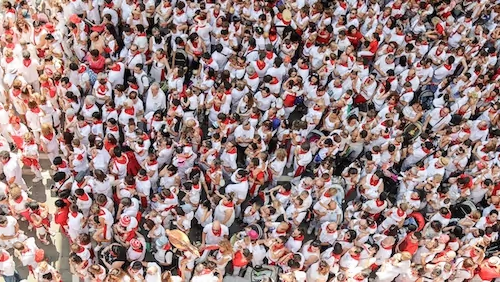
High density datasets include thousands of people per frame. They train models to handle severe occlusion and compact arrangements, common in transit stations and public events.
Surveillance based datasets
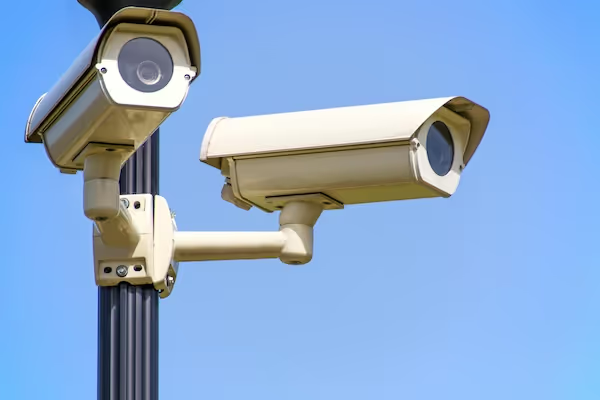
These datasets use fixed city cameras. They include overhead, angled, and wide area views. Surveillance datasets are essential for smart city applications because they reflect realistic camera perspectives.
Event specific datasets
Datasets capturing concerts, marathons, protests, or festivals help models understand large scale crowd behavior in dynamic environments.
Aerial and drone datasets
Drone based datasets provide top down views for large crowd analysis. These datasets support emergency planning and wide area monitoring.
Crowd datasets must be diverse in scene type, density, lighting, and perspective.
Annotation for Crowd Counting
Annotation quality is critical for training accurate crowd counting models. Crowd scenes vary dramatically, and annotation must handle high density regions with care.
Head point annotation
Annotators place a point above each visible head. Head point labeling is the most common annotation style for crowd counting datasets. It supports density map generation and regression based models.
Bounding box annotation
Bounding boxes are used in sparse crowds where individuals are clearly visible. This supports detection based crowd counting.
Instance segmentation
Instance segmentation provides precise pixel level boundaries for each person. It is useful for mixed density crowds where some individuals are visible and others are partially occluded.
Density map annotation
Annotators create density maps using Gaussian kernels centered on head points. Density maps produce smooth representations of crowd distribution.
Occlusion and crowd grouping labels
Some datasets include occlusion levels and grouping behaviors. These labels help models interpret challenging scenes where visibility is limited.
Annotation workflows must include robust quality control due to the high density and complexity of crowd scenes.
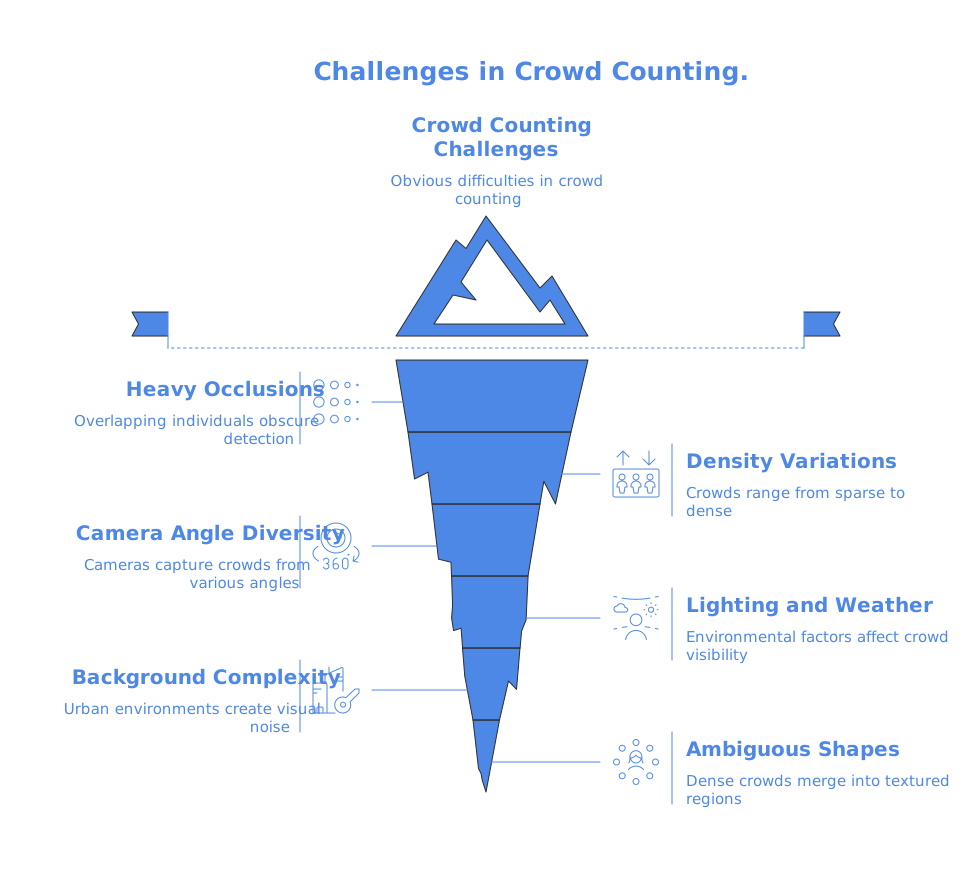
Challenges in Crowd Counting Datasets
Heavy occlusions
Crowds often include overlapping individuals. Occlusion makes it difficult to detect or annotate distinct people. Models must handle partial visibility and ambiguous shapes.
Varying density levels
Crowds shift from sparse to extremely dense within the same scene. Multi scale modeling is required for consistent performance.
Diverse camera angles
Smart city cameras capture crowds from overhead, diagonal, or side views. These angles affect appearance, scale, and cluster formation. Models must generalize across perspectives.
Lighting and weather changes
Crowds in outdoor environments are subject to shadows, glare, rain, fog, and nighttime conditions. Weather variability affects visibility and image clarity.
Background complexity
Urban backgrounds include buildings, signs, vehicles, and dynamic objects. Complex backgrounds create visual noise that models must filter.
Ambiguous human shapes
Dense crowds can merge visually into textured regions that resemble patterns rather than individuals. Models must infer density based on subtle cues.
These challenges require datasets that prioritize diversity and annotation precision.
Applications of Crowd Counting in Smart Cities
Transit station safety
Crowd monitoring prevents dangerous overcrowding on platforms and in waiting areas. Real time alerts help operators adjust train frequency or redirect passenger flow.
Urban planning and pedestrian design
Crowd density data helps urban designers evaluate sidewalk widths, crossing safety, and walking patterns. Planners use crowd analytics to support long term mobility strategies.
Event management and safety
Large events require careful monitoring. Crowd data helps organizers avoid bottlenecks, optimize entry procedures, and coordinate emergency response teams.
Smart retail and tourism analytics
Business districts use crowd data to measure economic activity, evaluate foot traffic, and support retail planning.
Emergency evacuation modeling
Crowd flow analysis helps predict how people will move during emergencies. This data supports evacuation planning and drills.
Public health applications
During public health crises, crowd density monitoring helps enforce distancing guidelines and assess compliance.
Studies from the Urban Dynamics Lab at Carnegie Mellon University show that crowd analytics support safer, more efficient city operations.
Crowd counting delivers insights that drive decision making across many sectors.
Crowd Behavior and Anomaly Detection
Crowd counting data becomes even more powerful when combined with anomaly detection. Models can detect unusual or risky crowd behavior such as:
- sudden surges
- irregular flow patterns
- panic behavior
- abrupt direction changes
- stationary clustering in high risk zones
By analyzing crowd density and movement, AI systems identify events that require operational intervention. Integrating crowd data with anomaly detection strengthens citywide safety systems.
Building Crowd Counting Models
Multi scale feature extraction
Crowd counting models must learn features at different scales because individuals may appear very small or very large depending on camera placement. Multi column and pyramid networks help handle scale variation effectively.
Context aware modeling
Context improves accuracy, especially in dense or visually ambiguous scenes. Contextual cues help models understand spatial relationships and crowd distribution patterns.
Density map generation
Density maps represent crowd distribution continuously across the scene. Models learn to predict these maps from inputs and derive final counts through integration.
Transformer based architectures
Transformers capture long range dependencies and complex spatial relationships in crowd scenes. They improve performance in environments with uneven density and complex backgrounds.
Attention mechanisms
Attention modules help models focus on high density areas or important regions. This improves both count accuracy and localization quality.
Building accurate models requires diverse datasets and careful training strategies.
Future of Crowd Counting and Urban Density AI
City scale density estimation
Future systems will integrate multiple camera streams to create unified citywide density maps. These maps support large scale mobility planning and safety management.
Real time adaptive crowd control
Models will analyze density patterns in real time and trigger automated interventions such as temporary closures, route adjustments, or signage updates.
Multimodal crowd analysis
Combining video with audio, mobile device data, and IoT sensors produces more reliable crowd insights. Multimodal analysis enhances situational awareness.
Self supervised crowd modeling
Self supervised models learn from vast quantities of unlabeled video, reducing the need for expensive annotation.
Privacy enhancing crowd analytics
Techniques such as on device anonymization and synthetic density maps help protect privacy while maintaining analytical value.
Advances in modeling, hardware, and privacy technologies will shape the next generation of crowd analytics systems.
Conclusion
Crowd counting datasets enable AI systems to analyze pedestrian density, movement patterns, and behavior in complex urban environments. These datasets support essential smart city functions including public safety, transit management, event oversight, and urban planning. Building reliable models requires diverse datasets, precise annotation, and advanced architectures capable of handling multi scale and high density challenges. As smart cities continue to expand their reliance on data driven solutions, crowd counting will remain a core component of urban intelligence frameworks.
If your team needs expertly annotated crowd counting datasets, head point labeling, density map annotation, or video based crowd analytics datasets, DataVLab can help.
We deliver high accuracy annotation and QA for smart city and public safety applications.
👉 Contact us DataVLab
What are Crowd counting datasets?
Crowd counting datasets provide the foundation for AI systems that estimate pedestrian density, monitor crowd movement, and analyze behavior in public spaces. These datasets include annotated images or videos with head points, density maps, or segmentation masks that help computer vision models understand how people move through urban environments.
Why does crowd counting matter for smart cities?
Real time crowd density monitoring helps prevent stampedes, crushing incidents, and overcrowding in transportation stations or event venues. Early detection of high risk crowd formations supports proactive intervention. Cities analyze pedestrian movement to improve crossings, widen sidewalks, and redesign streets.
How does Crowd counting work?
Models detect individuals using bounding boxes or segmentation masks. This works well for sparse or moderately crowded environments where people are fully visible. Detection models struggle when density is high or when significant occlusion occurs.
What are the main challenges of Crowd counting datasets?
Occlusion makes it difficult to detect or annotate distinct people. Models must handle partial visibility and ambiguous shapes. Crowds shift from sparse to extremely dense within the same scene.
What are the main use cases for Crowd counting datasets?
Crowd monitoring prevents dangerous overcrowding on platforms and in waiting areas. Real time alerts help operators adjust train frequency or redirect passenger flow. Crowd density data helps urban designers evaluate sidewalk widths, crossing safety, and walking patterns.
What is the future of Crowd counting datasets?
Future systems will integrate multiple camera streams to create unified citywide density maps. These maps support large scale mobility planning and safety management. Models will analyze density patterns in real time and trigger automated interventions such as temporary closures, route adjustments, or signage updates.