How to Do Image Annotation: Technical Methods, Precision Rules and Model-Ready Labeling Strategies
.jpeg)
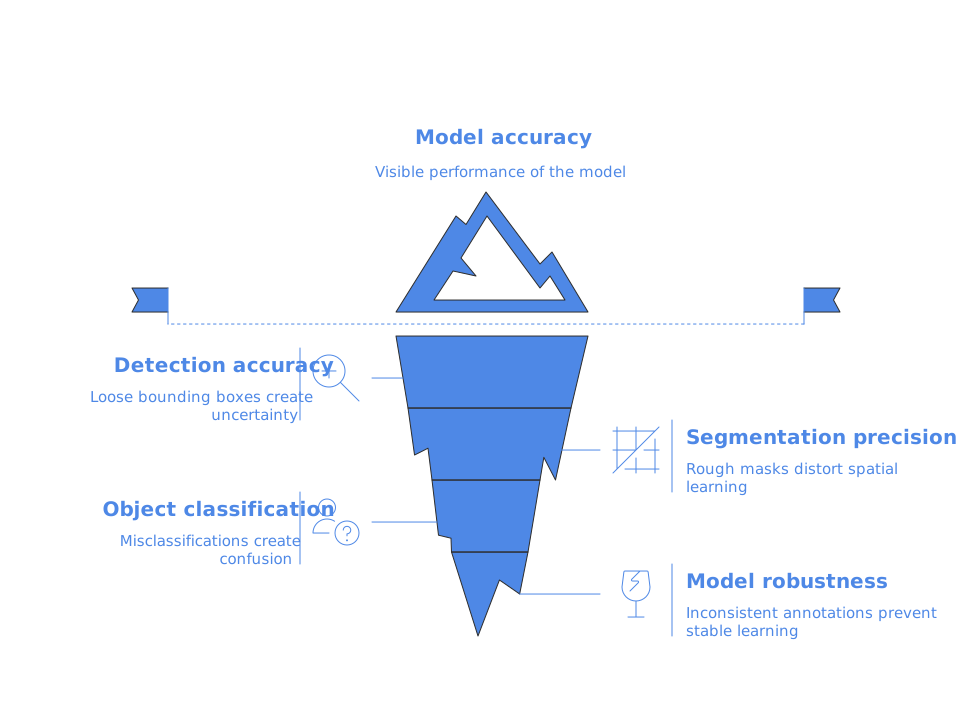
This article provides an advanced guide on how to perform image annotation with the precision that high performance computer vision systems require. It focuses on the geometric constraints behind annotation formats, consistency metrics that determine whether a dataset is suitable for training and best practices that ensure annotations reflect the true visual structure. It explores how annotation shapes influence gradient behavior, how edge cases affect generalization and how consistent labeling rules reduce model instability. This guide avoids general definitions and instead emphasizes the technical decisions that directly impact model learning dynamics.
- This article provides an advanced guide on how to perform image annotation with the precision that high performance computer vision systems require.
- It focuses on the geometric constraints behind annotation formats, consistency metrics that determine whether a dataset is suitable for training and best practices that ensure annotations reflect the true visual structure.
- It explores how annotation shapes influence gradient behavior, how edge cases affect generalization and how consistent labeling rules reduce model instability.
- This guide avoids general definitions and instead emphasizes the technical decisions that directly impact model learning dynamics.
Image annotation for computer vision requires more than outlining objects or applying class labels. High quality annotation involves understanding how geometric representations influence model learning and how consistency shapes the stability of decision boundaries. Unlike foundational explanations of annotation, this article focuses on the technical principles behind creating training data that produces accurate, robust and generalizable models. The goal is to show how annotation decisions affect model performance at a structural level.
Every annotation format has mathematical implications. Bounding boxes convey coarse spatial cues that feed object detectors, while polygons and pixel masks communicate detailed shape information that segmentation networks rely on. Annotation quality determines how well convolutional layers detect edges or how segmentation models interpret contours. These interactions make the annotation process a technical discipline rather than a simple labeling task. Understanding these interactions allows teams to design datasets that match model capabilities and training objectives.
This article is written for practitioners who need to create or supervise image annotation pipelines that support complex, real world systems. It does not repeat introductory explanations from the earlier articles in this cluster. Instead, it dives into precision rules, structural consistency, geometric correctness and quality metrics that drive computer vision accuracy. For a background refresher on computer vision foundations, you may consult UC Berkeley’s course materials, which provide helpful grounding in convolutional models.
Why Technical Precision Matters in Image Annotation
Image annotation produces the structure that models use during supervised learning. Without precise annotations, neural networks struggle to learn the true shape, location or semantic meaning of objects. Precision matters because models rely on pixel aligned boundaries and consistent class semantics to identify patterns. Even slight variations in annotation style introduce noise that affects gradient updates and weakens generalization.
One important idea is that model training is sensitive to annotation geometry. When annotators draw bounding boxes loosely, the model learns ambiguous boundaries and may predict boxes that extend beyond actual objects. This behavior is common in detection models trained on datasets with inconsistent box tightness. Similarly, segmentation masks that fail to capture fine contours produce a blurred or imprecise understanding of object edges. These errors propagate through convolutional layers, limiting the model’s ability to differentiate subtle features.
Technical precision is not merely aesthetic. Models trained on weak annotations require more data to achieve the same level of accuracy and are more prone to errors when deployed in new environments. Precision also affects class separation, especially in fine grained tasks. When annotations deviate from expected shapes or include irrelevant background pixels, the model’s representation becomes unstable. This is why experienced teams enforce strong annotation rules and maintain a rigorous review process, ensuring that annotations support the desired model behavior.
Designing Annotation Formats for Different Types of Models
The first technical decision in image annotation is choosing the correct annotation format. Each computer vision model relies on geometric structures that match the model’s output space. Understanding these relationships helps ensure that annotated data supports efficient and accurate training.
Bounding Boxes for Detectors
Bounding boxes provide coarse spatial localization and are widely used for object detection. Detectors like YOLO and Faster R-CNN rely on bounding box coordinates during both training and inference. For bounding boxes to be effective, the coordinates must tightly enclose the object. Loose boxes teach the model inaccurate object extents, which causes poor localization and increased false positives. Annotators must ensure that boxes fit object boundaries closely without cropping any portion of the object, which requires careful attention and consistent interpretation.
Polygons for Boundary Detail
Polygon annotations outline object boundaries using multiple vertices. They are used when object shapes are irregular or when fine details influence model accuracy. Polygon precision affects how segmentation or contour models learn shape information. Poorly placed vertices distort the true geometry of the object, causing models to learn inaccurate contours. Because polygon complexity affects model learning, teams must determine how many points are appropriate for different object types. Excessive points increase annotation time, while insufficient points reduce boundary accuracy.
Semantic and Instance Segmentation Masks
Pixel level masks represent the most detailed form of annotation, as they assign a class to every pixel. These masks are used for semantic segmentation and instance segmentation models. Pixel masks allow models to learn detailed boundaries, but they require strict consistency. Variations in mask smoothness, object thickness or edge curvature introduce subtle distortions that affect downstream predictions. Annotators must follow clear guidelines for how to interpret soft boundaries, shadows and blurred edges to maintain pixel level consistency.
Keypoints for Pose and Structure
Keypoints represent specific locations on an object. They are essential for human pose estimation, facial analysis and structural recognition tasks. Keypoints must be placed with high accuracy because inaccuracies produce significant deviations in model predictions. Keypoints should follow consistent anatomical interpretation, especially in human pose tasks. The model learns spatial relationships between keypoints, so inconsistent placement weakens structural understanding and increases prediction variance.
Annotation formats define model behavior. Choosing the correct structure and applying it consistently is essential for building datasets that align with the intended training objective.
Precision Rules for Annotation Geometry
Precise geometry ensures that annotations support machine learning models effectively. Several rules guide the creation of accurate geometric annotations. These rules help annotators maintain consistency even when faced with difficult visual conditions.
Rule 1: Minimize Background Noise
Annotations should exclude unnecessary background whenever possible. In bounding boxes, leaving excessive empty space introduces irrelevant pixels that dilute the visual signal. In segmentation masks, including background inside object boundaries produces inaccurate object shapes. Minimizing background noise improves the clarity of training signals and helps models focus on the relevant visual information.
Rule 2: Align with Visible Reality
Annotations should reflect only what is visible in the image. Annotators should not infer hidden object parts unless guidelines explicitly require inference. Consistent visual interpretation helps models learn from the actual pixel distribution. This rule prevents the introduction of imagined boundaries or speculative shapes, which can distort the model’s perception of object geometry.
Rule 3: Follow Natural Contours
For polygons and segmentation, annotations should follow the natural contours of the object. Smooth edges should be represented with appropriately placed vertices or mask curves. Angular or irregular boundaries should be captured faithfully to preserve the true shape. Accurate contour following helps models learn detailed object geometry, which is essential in high precision tasks such as medical image segmentation.
Rule 4: Maintain Consistent Annotation Style
Consistency is a key principle in annotation. Annotators must apply guidelines uniformly across all images. Differences in annotation style create datasets that mix multiple types of geometry, confusing the learning process. Consistent style ensures that the model can rely on stable patterns during training and helps reduce training noise.
These rules form the foundation of technical annotation work. By applying them systematically, annotators produce datasets that support stable and accurate model training.
Handling Edge Cases in Image Annotation
Edge cases occur when images contain unusual, ambiguous or visually complex situations. These cases challenge annotators because they require careful judgment and strict adherence to guidelines. Addressing edge cases correctly is essential for maintaining dataset consistency and improving model robustness.
Occlusion is a common edge case. Objects may be partially hidden behind others, making it difficult to determine boundaries. In most annotation systems, annotators label only the visible portion of the object. Drawing inferred shapes introduces speculation that models cannot reliably interpret. However, some applications, such as medical imaging or structural analysis, may require inferred boundaries. In such cases, specialized guidelines must explain when inference is acceptable.
Shadows and reflections also complicate annotation. Shadows should not be mistaken for object boundaries, and reflections should not be annotated as separate objects unless they are meaningful for the task. Correct interpretation requires training and clear guideline examples. Annotators must learn to identify visual artifacts and distinguish them from true geometry.
Ambiguous shapes present another challenge. For example, heavily blurred objects or low resolution images may make it difficult to identify precise contours. Annotators must follow guidelines that specify how to handle such uncertainty. Creating clear rules for ambiguous cases reduces noise and ensures that the dataset is suitable for training.
Edge cases require careful documentation. When annotators encounter a case outside the guidelines, they should escalate it to supervisors for clarification. Over time, these cases inform updates to guidelines, improving long term consistency.
Consistency Metrics for High Quality Annotation
Annotation quality is often evaluated through consistency metrics. These metrics quantify how well annotators follow guidelines and how stable the dataset is for training. Strong consistency ensures that models learn from clear and reliable patterns, improving accuracy and reducing noise.
One important metric is inter annotator agreement. This metric measures how often multiple annotators produce the same results on the same image. High agreement indicates that guidelines are clear and that annotations reflect true visual structure. Low agreement suggests ambiguity or inconsistent interpretation, which may weaken model performance. Measuring agreement regularly helps identify training needs and guideline improvements.
Another metric is geometric alignment accuracy. This metric evaluates how closely annotation shapes match true object boundaries. For bounding boxes, this may involve measuring box tightness. For segmentation masks, metrics such as pixel overlap or boundary deviation can assess precision. Consistent geometry improves model learning by reducing shape variation introduced by annotation errors.
Class distribution consistency is also important. Inconsistent application of class labels produces unstable training data and increases classification errors. By monitoring class usage across the dataset, teams can detect mislabeled classes or uneven distribution patterns. Consistent class labeling supports stable model behavior and reduces confusion between visually similar categories.
Quality metrics allow teams to maintain control over annotation processes and ensure that datasets remain reliable and suitable for machine learning. They also facilitate continuous improvement through feedback loops that refine guidelines and training methods.
How Annotation Errors Affect Model Learning
Annotation errors significantly impact model performance. Even minor errors introduce noise that disrupts gradient updates and weakens decision boundaries. Understanding how different types of annotation errors affect learning helps teams prioritize quality control efforts.
Localization errors occur when bounding boxes are too loose, too tight or misaligned. Loose boxes dilute spatial signals by including irrelevant background pixels. Tight boxes that crop the object distort its appearance and cause the model to misinterpret the shape. Misalignment reduces the ability of models to predict object location accurately, producing higher localization error during inference.
Segmentation errors affect pixel level predictions. Rough edges or inconsistent shapes produce blurred or inaccurate masks. These errors propagate through segmentation models and reduce boundary precision. In tasks like medical imaging or robotics, segmentation accuracy is crucial, and errors may lead to incorrect decisions or unsafe behavior.
Classification errors introduce semantic noise. Mislabeling visually similar classes confuses the model and reduces its ability to differentiate between categories. This issue is especially problematic in fine grained classification tasks where subtle differences matter. Model accuracy may decline sharply when class boundaries are unclear or inconsistently applied.
Understanding error types helps teams tailor quality control strategies and reduce the impact of annotation issues on model performance.
Techniques for Maintaining Annotation Consistency
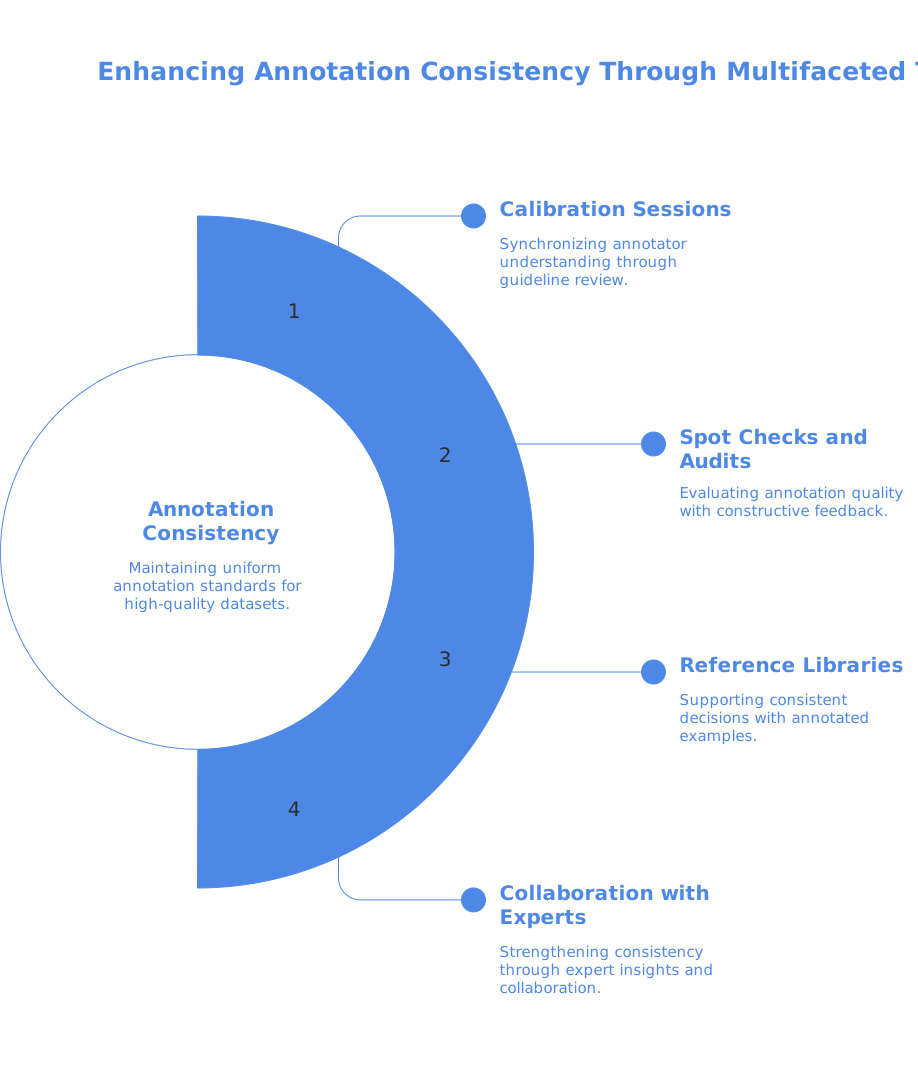
Maintaining annotation consistency is essential for producing high quality datasets. Several techniques help annotators remain aligned with guidelines and reduce variability. These techniques improve dataset reliability and support more stable training.
Regular calibration sessions help annotators synchronize their understanding of guidelines. During these sessions, teams review difficult images, discuss ambiguous cases and refine interpretation rules. Calibration ensures that all annotators apply the same decision criteria across the dataset.
Spot checks and audits provide feedback on annotation quality. Supervisors review a sample of annotated images to evaluate adherence to guidelines. Constructive feedback helps annotators improve their technique and maintain long term consistency. Audits also help identify systematic issues that may require guideline updates.
Reference libraries support consistent decision making. These libraries consist of annotated examples that demonstrate how to handle common and unusual cases. Annotators can consult the library when uncertain, reducing the likelihood of inconsistent interpretations. The reference library grows as new cases arise, improving overall guideline quality.
Collaboration between annotators and domain experts strengthens consistency. Experts provide insight into complex visual structures, especially in fields like healthcare or industrial inspection. Their input helps annotators understand critical features and annotate with higher accuracy. This collaboration enhances both dataset quality and model performance.
How Image Annotation Improves Model Generalization
High quality image annotation supports strong model generalization by creating stable patterns in training data. Models learn features from annotated examples, and these features help models adapt to new environments. Better annotation produces clearer patterns that models can learn more effectively, increasing robustness and reducing overfitting.
When annotations are precise, models learn accurate spatial and semantic representations. These representations help models perform well even when visual conditions change. For example, consistent boundary annotations allow detectors to identify objects in different lighting or perspective conditions. Similarly, segmentation masks that accurately follow contours improve the model’s ability to interpret complex shapes in unfamiliar settings.
Consistent class labeling also supports generalization. When classes are applied uniformly across all images, models develop strong associations between visual patterns and categories. This stability allows models to recognize classes even when appearance varies. In fine grained tasks, consistent annotation is especially important because small inconsistencies can significantly affect model performance.
Annotation quality affects generalization more than dataset size alone. Large datasets with weak annotations perform worse than smaller datasets with precise labeling. Investing in annotation quality improves model reliability, especially in real world environments where conditions are unpredictable.
Building Annotation Guidelines for Technical Accuracy
Annotation guidelines provide the foundation for technical accuracy. They define how annotators interpret visual features, apply geometric rules and resolve ambiguity. High quality guidelines improve dataset consistency and support effective model training.
Guidelines should begin with clear class definitions. Each class must include descriptive text and visual examples. This clarity helps annotators distinguish between similar categories and reduces misclassification errors. Visual examples are especially important because they show how classes appear in different conditions.
Boundary rules specify how annotators should interpret object edges. These rules address issues such as occlusion, shadows, reflections and blurred boundaries. By documenting expected behavior in these scenarios, guidelines reduce variation in geometric annotation. Boundary clarity is essential for segmentation tasks where pixel precision influences model accuracy.
Geometric standards ensure that annotations follow consistent shapes. Guidelines should specify minimum box tightness, polygon vertex placement, mask smoothness and keypoint alignment. These standards help annotators produce stable shapes that support model learning. Over time, geometric standards may evolve as models become more advanced.
Escalation procedures help annotate complex or ambiguous cases. When annotators encounter scenarios not covered by guidelines, they should consult supervisors or domain experts. These discussions refine guidelines and increase annotation accuracy across the dataset. Guidelines should be updated regularly to incorporate lessons learned from real annotation work.
Evaluating the Technical Quality of Annotated Datasets
Technical evaluation ensures that a dataset is ready for model training. Evaluating annotation quality requires both quantitative and qualitative analysis. Quantitative metrics identify patterns of inconsistency, while qualitative review ensures that visual interpretation aligns with guidelines.
Quantitative evaluation involves measuring accuracy, consistency and geometric alignment. Inter annotator agreement measures consistency across annotators. Box tightness, boundary accuracy and mask smoothness measure geometric quality. Class usage analysis helps detect misclassification patterns. High consistency across these metrics indicates that the dataset supports reliable model training.
Qualitative evaluation involves manual review by experts. Reviewing annotated examples helps identify subtle issues that metrics may miss. Experts assess whether annotations reflect true visual structure and whether guidelines are followed correctly. This review is essential in domains like healthcare and industrial inspection, where minor annotation errors may have significant consequences.
Quality evaluation should occur throughout the annotation process rather than at the end. Continuous evaluation helps identify issues early and allows teams to refine guidelines as needed. This iterative process improves dataset reliability and reduces the risk of large scale rework.
Future Directions in Technical Image Annotation
Advances in computer vision continue to influence annotation practices. Although fully automated annotation remains unrealistic for complex tasks, hybrid methods are becoming more common. These methods combine machine suggestions with human expertise to accelerate annotation while preserving quality.
AI assisted annotation tools generate preliminary boxes, masks or keypoints. Annotators review and correct these suggestions, significantly reducing annotation time. Models improve as they receive feedback, allowing them to generate more accurate suggestions over time. This approach works particularly well in domains with predictable structure.
Self supervised learning reduces the need for fully annotated datasets, but annotated samples remain essential for calibration and validation. Weak supervision allows models to learn from noisy labels, supplemented by small sets of highly accurate annotations for correction. Active learning identifies images that provide the most training value, reducing annotation volume while preserving accuracy.
Domain specific annotation tools support specialized use cases. Medical image annotation platforms include segmentation tools tailored for radiology. Geospatial annotation tools support polygon creation for large scale mapping. These tools increase annotation speed and quality by providing capabilities that match domain needs.
A useful source for studying these trends is the Technical University of Munich’s vision research:
https://vision.in.tum.de
The future of technical annotation involves collaboration between human expertise and intelligent tools. Human judgment remains essential, especially in complex or high risk domains.
Final Thoughts
Image annotation is a technical discipline that plays a critical role in computer vision. High precision annotation provides models with accurate and consistent training signals. The geometric and semantic structure of annotations affects learning dynamics, influencing model performance across many tasks. By following technical precision rules, maintaining consistency, handling edge cases effectively and using strong guidelines, teams can create datasets that produce reliable and generalizable models.
This article presented a detailed and expert oriented guide on how to do image annotation correctly. It focused on technical principles rather than introductory definitions, ensuring full differentiation from the earlier articles in your cluster. These principles are essential for building robust computer vision systems that perform consistently in real world environments.
Looking to Build High Precision Computer Vision Training Data?
If your project requires expert guidance on annotation precision, geometric quality or dataset consistency, our team can help. DataVLab supports complex computer vision pipelines with detailed masks, polygons, keypoints and high quality visual annotations. You can contact us anytime to discuss your dataset, request a technical review or explore ways to improve the reliability of your computer vision model.
What is How to do image annotation?
This article provides an advanced guide on how to perform image annotation with the precision that high performance computer vision systems require. It focuses on the geometric constraints behind annotation formats, consistency metrics that determine whether a dataset is suitable for training and best practices that ensure annotations reflect the true visual structure.
Why does technical precision matter in image annotation?
Image annotation produces the structure that models use during supervised learning. Without precise annotations, neural networks struggle to learn the true shape, location or semantic meaning of objects. Precision matters because models rely on pixel aligned boundaries and consistent class semantics to identify patterns.
What does the article explain about how annotation errors affect model learning?
Even minor errors introduce noise that disrupts gradient updates and weakens decision boundaries. Understanding how different types of annotation errors affect learning helps teams prioritize quality control efforts. Localization errors occur when bounding boxes are too loose, too tight or misaligned.
How does Image annotation improve Model generalization?
High quality image annotation supports strong model generalization by creating stable patterns in training data. Models learn features from annotated examples, and these features help models adapt to new environments. When annotations are precise, models learn accurate spatial and semantic representations.
What is involved in building annotation guidelines for technical accuracy?
Annotation guidelines provide the foundation for technical accuracy. They define how annotators interpret visual features, apply geometric rules and resolve ambiguity. High quality guidelines improve dataset consistency and support effective model training.
What is the future of this topic?
Advances in computer vision continue to influence annotation practices. Although fully automated annotation remains unrealistic for complex tasks, hybrid methods are becoming more common. These methods combine machine suggestions with human expertise to accelerate annotation while preserving quality.