What Is Data Annotation? A Complete Guide for 2026
.jpeg)
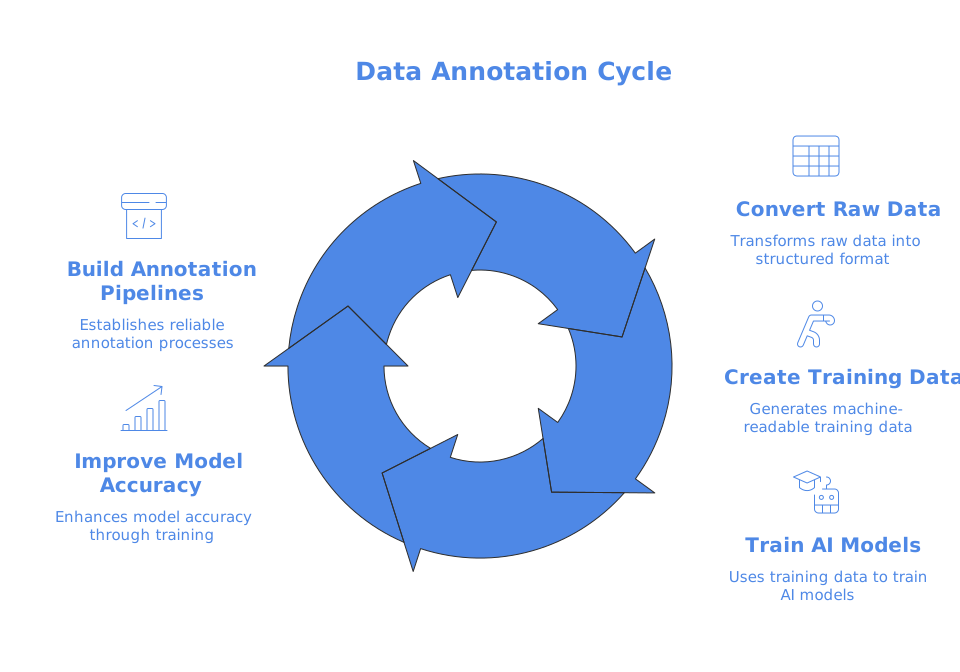
Data annotation is the foundation of every supervised AI system. It converts raw images, text, audio or sensor signals into structured, machine-readable training data that models can learn from. This article explains what data annotation means, how it works, why it matters for model accuracy, and how organizations build reliable annotation pipelines. You will also learn where annotation fits in the machine learning lifecycle, which industries rely on it most, and how human expertise remains essential even as automation improves.
- It converts raw images, text, audio or sensor signals into structured, machine-readable training data that models can learn from.
- This article explains what data annotation means, how it works, why it matters for model accuracy, and how organizations build reliable annotation pipelines.
- Without annotation, raw images, text, audio and video are meaningless to a supervised learning system.
- Data annotation is the process of attaching labels to raw data (images, text, audio or video) so that machine learning models can learn to recognize patterns from those examples.
TL;DR
- Data annotation is the process of attaching labels, tags or structured metadata to raw data so that supervised machine learning models can learn from it.
- Annotation quality directly determines model accuracy. Inconsistent labels produce inconsistent models, regardless of how sophisticated the architecture is.
- Every modality requires a different annotation approach: images use bounding boxes and segmentation, text uses entity recognition and sentiment tags, audio uses transcription and event labels, video adds temporal continuity, and 3D data uses point cloud annotation.
- The hardest part of annotation is not the labeling itself but the workflow around it: clear guidelines, qualified annotators, multi-stage quality control, and a feedback loop with the model team.
- In 2026, the field is shifting toward LLM-assisted pre-labeling, RLHF for generative models, and synthetic data, but human-in-the-loop review remains essential for production AI.
What Is Data Annotation?
Data annotation is the process of adding structured labels, tags or metadata to raw data so that machine learning models can learn from it. Without annotation, raw images, text, audio and video are meaningless to a supervised learning system. With annotation, each piece of data carries a label that tells the model what it is looking at, what category it belongs to, or what relationship exists between its components.
The quality and consistency of annotation directly determine the quality of the model trained on it. Every supervised AI application depends on annotated training data. Image recognition models learn from labeled images. Natural language processing models learn from labeled text. Speech recognition models learn from transcribed and labeled audio. Autonomous vehicle perception systems learn from annotated sensor data. The annotation that created those labels is the invisible foundation of all production AI.
Although the terms are often used interchangeably, there are subtle distinctions worth understanding between annotation, labeling and tagging, we cover them in detail in our guide on data annotation vs data labeling.
Why Data Annotation Matters for AI
Machine learning models do not learn from observations the way humans do. They learn by finding statistical patterns in large quantities of labeled examples. The label tells the model the correct interpretation of each example. When the model makes a prediction, it is applying the patterns it found in labeled training data to a new, unlabeled input.
This means that if the training labels are wrong, the model learns the wrong patterns. If the labels are inconsistent, the model learns inconsistent patterns. If labels are missing for certain categories or conditions, the model cannot learn to handle those conditions. The model is only as good as its training data, and training data is only as good as its annotation.
This relationship between annotation quality and model performance explains why leading AI organizations treat annotation as a core competency rather than a commodity task. The difference between a well-annotated dataset and a poorly annotated one shows up directly in model accuracy, reliability and safety. For a deeper look at how annotated data feeds the broader machine learning pipeline, see our companion article on what AI training data is.
The Main Types of Data Annotation
Annotation takes different forms depending on the data modality and the learning task. The type of annotation determines what the model can learn from the data. Below is a high-level map of the main categories. Our complete reference is in types of data annotation.
Image Annotation
Image annotation covers all the techniques used to label visual data for computer vision models. Common formats include image classification (assigning a category to the entire image), bounding box annotation (drawing a rectangle around each object of interest), polygon annotation (tracing the precise boundary of each object), semantic segmentation (assigning a class label to every pixel), instance segmentation (separating each individual instance of an object class) and keypoint annotation (marking specific points such as facial landmarks or body joints). Each format unlocks a different family of computer vision tasks. We dive into the visual modality specifically in what is image annotation.
Text Annotation
Text annotation prepares natural language data for NLP models. The most common types are named entity recognition (identifying and classifying people, places, organizations and other entities in text), sentiment labeling (assigning emotional polarity), intent classification (labeling the purpose behind a query), part-of-speech tagging, coreference resolution and relation extraction. Text annotation also powers more recent tasks like instruction tuning and preference labeling for large language models.
Audio Annotation
Audio annotation transforms sound into structured training signal. The most common task is transcription, which converts speech into written text aligned with timestamps. Other tasks include speaker diarization (segmenting who spoke when), audio event detection (labeling sounds like sirens, glass breaking or machinery faults), emotion tagging and acoustic scene classification. Audio annotation is the foundation of voice assistants, call analytics platforms and acoustic monitoring systems.
Video Annotation
Video annotation extends image annotation across time. In addition to identifying and outlining objects in each frame, annotators must track those objects as they move, appear and disappear. Common tasks include object tracking, action recognition, temporal event segmentation and video classification. Video annotation is fundamental to surveillance analytics, sports tech, content moderation and autonomous driving.
3D and Point Cloud Annotation
3D annotation labels data captured by depth sensors, lidar and stereoscopic cameras. The output is typically a set of cuboids, segmentation masks or semantic classes attached to points in a 3D point cloud. This modality is essential for autonomous vehicles, robotics, drone navigation and any system that has to reason about geometry rather than pixels alone.
LLM and Generative AI Annotation
A new family of annotation tasks has emerged with large language models and generative AI. These include preference labeling (which of two model outputs is better), instruction writing (creating high-quality prompt-response pairs for instruction tuning), red-teaming (probing models for unsafe behavior) and rubric-based evaluation. This is one of the fastest-growing annotation categories in 2026 and a critical input to RLHF and DPO training pipelines.
How Data Annotation Works in Practice
A serious annotation project follows a repeatable workflow. Skipping any step usually shows up later as inconsistent labels and degraded model performance.
Step 1: Define the task and label schema. Before a single example is labeled, the team must agree on what is being labeled and how. The label schema defines the categories, their definitions, the edge cases and the rules for handling ambiguity. A weak schema is the single most common cause of failed annotation projects.
Step 2: Build the annotation guidelines. Guidelines translate the schema into instructions that annotators can apply consistently. They include positive examples, negative examples, decision trees for ambiguous cases and explicit conventions for occlusion, partial visibility and overlap. Good guidelines are living documents that evolve as edge cases are discovered.
Step 3: Select the right tool. Different modalities require different annotation interfaces. Image projects benefit from polygon and segmentation tools, video projects need timeline-based interpolation, NLP projects need span-based selection. Tool choice is also driven by team size, integration with the ML pipeline and security requirements.
Step 4: Train and calibrate the annotators. Annotators need domain context and tool training before producing usable labels. A calibration round on a small set of gold-standard examples surfaces inconsistencies early. Inter-annotator agreement (IAA) is measured at this stage and used as a baseline for quality control.
Step 5: Annotate at scale. Once the workflow is calibrated, the bulk of the labeling happens. Production annotation typically uses a combination of human annotators, model-assisted pre-labeling and quality reviewers working in parallel.
Step 6: Quality assurance. Multi-stage QA is non-negotiable. A common pattern is first-pass annotation, peer review of a sample, expert adjudication of disagreements and statistical sampling of the final dataset. Quality metrics include IAA, label accuracy against gold standards and downstream model impact.
Step 7: Feedback loop. Once the model is trained, errors and edge cases discovered in evaluation feed back into the guidelines, the schema and additional rounds of annotation. This loop is what keeps annotated datasets aligned with real-world model performance over time. We cover the operational side of this loop in human-in-the-loop AI.
Current Challenges in Data Annotation
Even with mature tooling, annotation remains hard. The bottlenecks have shifted over time but they have not disappeared.
Scaling Without Losing Quality
A small annotation project with one experienced annotator can deliver near-perfect labels. Scaling to dozens or hundreds of annotators introduces variance. Maintaining quality at scale requires robust calibration, transparent guidelines, redundancy on difficult examples and continuous QA. Many projects fail not because they cannot recruit annotators but because they cannot keep their outputs consistent across the team.
Balancing Speed and Quality
Faster annotation almost always reduces quality unless the workflow has been engineered for it. Pre-annotation with a model and active learning to focus human effort on the most informative examples can compress timelines without degrading labels, but only when the QA process is strong enough to catch model-induced errors that propagate silently into the dataset.
Domain-Specific Knowledge
Generic crowdworkers can label common objects in everyday scenes. They cannot reliably annotate radiology scans, legal contracts, satellite imagery or chemical structures. Specialized annotation projects need annotators with subject-matter expertise, which is a much smaller talent pool and a much higher cost. The cost-quality tradeoff in domain annotation is one of the central planning decisions in any serious AI project.
Cost Management
Annotation is one of the largest line items in most ML budgets. Cost is driven by modality (3D and segmentation are expensive, classification is cheap), required expertise, dataset size, QA depth and the geographic distribution of the workforce. Pricing transparency varies widely between vendors. We break down what actually drives the numbers in data annotation pricing.
Integrating LLMs Into the Annotation Loop
Large language models can pre-label text, summarize documents, classify intents and even propose bounding boxes. Used carelessly they introduce systematic biases that humans then anchor to during review. Used well, they multiply human throughput several times over. Building annotation pipelines that exploit LLMs without losing human judgment is one of the defining engineering problems of 2026.
Best Practices for Data Annotation
The teams that consistently produce high-quality annotated datasets share a small number of habits. Our deep dive on this is in data labeling best practices; here are the essentials.
Build a solid annotation workflow. Treat the workflow as a product, not a checklist. Map every step, identify the handoffs, define the SLAs and instrument the metrics that tell you when something is going wrong.
Write guidelines that survive contact with reality. The first version of any guideline is wrong. Plan for several iterations driven by real annotator questions and real edge cases discovered in the data.
Use the right tools for each modality. Generic tools handle generic tasks. Specialized projects (medical imaging, lidar, multilingual NLP) usually justify specialized tooling.
Automate carefully. Pre-annotation, active learning and model-assisted review are powerful. They can also embed model errors into your dataset if QA is not designed to catch them.
Build a robust quality control system. A single pass is never enough. Mature projects layer peer review, expert adjudication, gold-standard sampling and IAA tracking on top of the first annotation.
Keep datasets secure. Annotated data often contains personal, medical or commercially sensitive information. Access control, encryption, GDPR or HIPAA compliance and clear data retention policies are part of the workflow, not an afterthought.
For teams that require EU-based delivery and GDPR-aligned workflows, DataVLab provides data annotation services in Europe.
Hire and train the right annotators. The best annotators are not the fastest, they are the most consistent. Selecting for attention to detail and willingness to ask questions pays back many times over the project lifetime.
Plan for scalability from day one. A workflow that works for 1,000 examples often breaks at 100,000. Designing for scale early (with templates, automation, and tiered QA) prevents painful re-engineering later.
In-House vs. Outsourced Annotation
Every team building an AI product faces the same question: do we annotate internally or work with a vendor? Both models have legitimate use cases.
In-house annotation gives the most control over quality, the tightest feedback loop with the modeling team and full ownership of sensitive data. It also requires building an entire operational capability (recruiting, training, tooling, QA, management) that is unrelated to the core ML product. For most teams, this only pays off when annotation is a continuous activity at significant volume.
Outsourced annotation delegates that operational burden to a specialist vendor. It scales faster, costs less per label at volume and gives access to specialized annotator pools that would be impossible to build in-house. The tradeoffs are coordination overhead, less direct visibility into the workflow and the importance of vendor selection. Most teams use a hybrid model: outsource the bulk of annotation and keep a small in-house team for QA, edge cases and feedback to the vendor.
If you are evaluating vendors, our guide to choosing a data annotation company walks through the criteria that actually matter, and the 2026 buyer's guide profiles the leading providers in the space.
Data Annotation Use Cases by Industry
Annotation looks different in every industry because the data, the failure modes and the regulatory environment all differ. Here are some of the domains where annotated datasets are reshaping production AI.
Healthcare and Medical Imaging
Medical imaging models (for radiology, pathology, dermatology, ophthalmology) depend on expert-annotated datasets with extreme precision requirements. Annotators are usually clinicians, and quality control involves multiple specialists adjudicating disagreements. We cover this domain in our articles on dermatology AI and synthetic data for medical imaging.
Automotive and Autonomous Vehicles
Self-driving systems need annotation across modalities (camera, lidar, radar) at massive scale. Annotation tasks include lane segmentation, object detection, behavior prediction and 3D bounding boxes around every other road user. Our articles on lane detection and semantic road segmentation dig into the specifics.
Agriculture
Precision agriculture uses computer vision for crop monitoring, disease detection, yield estimation and livestock tracking. Annotation here often involves drone or satellite imagery and requires agronomic expertise.
Finance and Insurance
Financial AI uses text annotation for document understanding, fraud detection and compliance, plus image annotation for claims processing. Our piece on image annotation for insurance fraud detection shows what this looks like in practice.
Retail and E-Commerce
Visual search, recommendation systems, fashion attribute extraction and inventory tracking all depend on annotated product imagery. Our article on fashion attribute labeling covers a representative use case.
Legal and Document AI
Legal AI relies on heavily annotated text: clause classification, entity extraction, citation linking. The combination of OCR and structured annotation enables document automation at scale, as we discuss in labeling legal documents for AI.
Geospatial and Drone
Satellite and drone imagery powers everything from environmental monitoring to defense. Annotation tasks include land cover classification, building footprint extraction and 3D reconstruction. See satellite image annotation and drone mapping for more.
Future Trends in Data Annotation
The annotation field is evolving fast. Five trends are shaping where the discipline is going in 2026 and beyond.
LLM-assisted pre-annotation. Large language models are now routinely used to draft labels for text classification, NER and document understanding tasks. The human role shifts from labeling to reviewing and correcting model outputs, which can multiply throughput by three to five times when QA is well designed.
Synthetic data generation. For rare classes, sensitive data and physically dangerous scenarios, synthetic data is increasingly mixed with real annotated data. Diffusion models and GANs generate plausible images, and large language models generate plausible text. Synthetic data does not eliminate the need for real annotation but it changes the ratio.
Reinforcement learning with human feedback (RLHF). Modern LLMs are tuned with annotated preference pairs that teach them which responses humans prefer. RLHF and its successors (DPO, RLAIF) have created an entirely new annotation discipline focused on subjective judgment rather than factual labeling.
Domain-specific annotation as a service. Generic annotation is increasingly commoditized; specialized annotation (medical, legal, scientific, defense) is where margins and differentiation are concentrated. Vendors and in-house teams are investing heavily in expert annotator pools.
Real-time and streaming annotation. For applications like content moderation, fraud detection and live captioning, annotation increasingly happens in production rather than as an upfront batch. The line between annotation, monitoring and active learning is blurring.
Getting Started With Data Annotation
Whether you are building a new AI application that needs a training dataset, scaling an existing annotation program or evaluating annotation providers for the first time, the fundamentals are the same. Define the task clearly. Write guidelines that handle edge cases. Pick the right tool for the modality. Hire annotators with the right expertise. Build a multi-stage QA process. Close the loop between annotation and model performance.
DataVLab provides data annotation services across image, text, audio, video and 3D modalities, with specialist teams for healthcare, automotive, geospatial, legal and other regulated domains. If you are scoping a new annotation project or rethinking your current program, contact us to discuss your requirements.
FAQ
What is data annotation in simple terms?
Data annotation is the process of attaching labels to raw data (images, text, audio or video) so that machine learning models can learn to recognize patterns from those examples. It is what turns raw data into training data.
What is the difference between data annotation and data labeling?
In practice the two terms are used interchangeably. When a distinction is drawn, "labeling" usually refers to the simple act of attaching a tag, while "annotation" refers to the broader process that includes guidelines, QA and workflow management. We unpack this in data annotation vs data labeling.
How long does a data annotation project take?
Timelines depend on dataset size, modality and complexity. A small classification project with a few thousand examples can be delivered in days. A large multimodal project with custom guidelines and expert annotators can run for several months. The defining factor is usually QA depth, not raw labeling speed.
How much does data annotation cost?
Cost is driven by modality, expertise required, QA depth and volume. Simple bounding boxes can be a few cents each; expert medical segmentation can be several dollars per image. We break down the cost drivers in data annotation pricing.
Should I annotate data in-house or outsource it?
Annotate in-house when you need maximum control, your data is highly sensitive, and annotation is a continuous activity at significant volume. Outsource when you need to scale fast, access specialized expertise or keep operational complexity low. Most teams use a hybrid model.
What tools are used for data annotation?
Tool choice depends on the modality. Common platforms include CVAT and Roboflow for images, Label Studio for multimodal projects, V7 and Labelbox for production-grade workflows, and specialized tools for medical imaging and 3D point clouds. The right tool depends on team size, integration needs and security requirements.
Is data annotation being replaced by AI?
Not replaced, transformed. LLMs and generative models can pre-label or accelerate annotation, but human judgment remains essential for QA, edge cases, subjective tasks and any high-stakes domain. The role of the annotator is shifting from manual labeling to reviewing, correcting and supervising model outputs.
What is data annotation?
Data annotation is the foundation of every supervised AI system. It converts raw images, text, audio or sensor signals into structured, machine-readable training data that models can learn from. This article explains what data annotation means, how it works, why it matters for model accuracy, and how organizations build reliable annotation pipelines.
Why does data annotation matter for AI?
Machine learning models do not learn from observations the way humans do. They learn by finding statistical patterns in large quantities of labeled examples. The label tells the model the correct interpretation of each example.
What does the article explain about how data annotation works in practice?
A serious annotation project follows a repeatable workflow. Skipping any step usually shows up later as inconsistent labels and degraded model performance. Before a single example is labeled, the team must agree on what is being labeled and how.
What are the best practices for Data annotation?
The teams that consistently produce high-quality annotated datasets share a small number of habits. Our deep dive on this is in data labeling best practices; here are the essentials. Treat the workflow as a product, not a checklist.
What are the main use cases for Data annotation?
Annotation looks different in every industry because the data, the failure modes and the regulatory environment all differ. Here are some of the domains where annotated datasets are reshaping production AI. Medical imaging models (for radiology, pathology, dermatology, ophthalmology) depend on expert-annotated datasets with extreme precision requirements.
What is the future of Data annotation?
Five trends are shaping where the discipline is going in 2026 and beyond. Large language models are now routinely used to draft labels for text classification, NER and document understanding tasks. The human role shifts from labeling to reviewing and correcting model outputs, which can multiply throughput by three to five times when QA is well designed.