How to Annotate Livestream Content for AI-Powered Moderation in Sports and eSports
.jpeg)
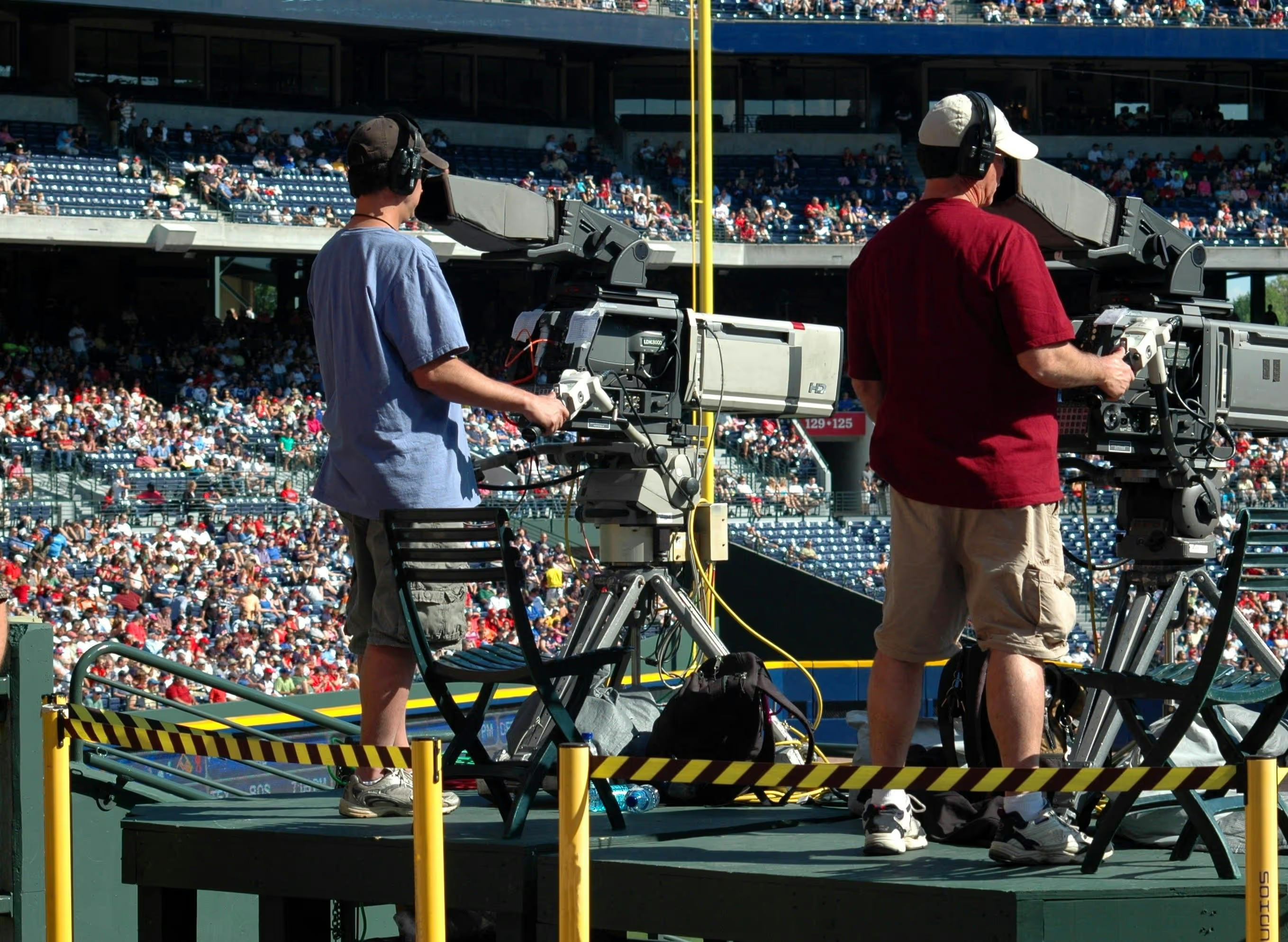
Livestreaming is no longer just a medium—it's a global phenomenon. From stadium-packed football matches to millions tuning into League of Legends championships, sports and eSports alike now depend on real-time broadcasting. But as viewership grows, so does the need for real-time moderation—to filter out inappropriate content, hate speech, nudity, cheating, or violent behavior. The key to unlocking reliable AI moderation lies in one foundational step: accurate, context-aware annotation of livestream footage.
- From stadium-packed football matches to millions tuning into League of Legends championships, sports and eSports alike now depend on real-time broadcasting.
- But as viewership grows, so does the need for real-time moderation—to filter out inappropriate content, hate speech, nudity, cheating, or violent behavior.
- The key to unlocking reliable AI moderation lies in one foundational step: accurate, context-aware annotation of livestream footage.
- Annotation isn’t just a theoretical best practice—it’s powering some of the most effective real-time moderation systems in global sports and eSports.
In this article, we’ll explore the intricacies of annotating livestreams for AI-powered moderation systems, particularly for sports and eSports. You'll learn how to handle real-time content, define moderation labels, manage temporal dynamics, and build scalable annotation pipelines to support AI models trained for real-time decision-making.
Why AI Moderation Is Essential in Sports and eSports Livestreams
Sports and eSports platforms face intense scrutiny. From offensive gestures in a stadium to toxic chats on Twitch, real-time events present unpredictable risks. AI moderation allows broadcasters and platforms to flag and act on such incidents instantly.
The stakes are high:
- Audience safety: Youth and minors make up a large portion of eSports audiences.
- Brand protection: Sponsors expect clean, brand-safe streams.
- Regulatory compliance: Inappropriate or unmoderated content can breach broadcasting laws in various regions.
- Community health: Toxicity, harassment, and unsportsmanlike conduct can degrade user experience and engagement.
But AI can’t function without the data that teaches it to recognize such behaviors—and that’s where annotation plays its vital role.
What Makes Livestream Annotation Unique?
Unlike static image or even typical Video Annotation, livestream annotation deals with real-time, dynamic, and often chaotic footage. Sports and eSports amplify this challenge due to:
- Fast-paced motion (e.g., football tackles, sudden character moves)
- Multimodal signals (audio + video + overlayed text)
- Unpredictable behavior (emotional reactions, crowd interactions)
- Compressed or low-light visuals, especially in eSports arenas
- Long durations of uninterrupted content (3–5 hours per stream)
This means annotators (and the pipelines that support them) must be trained and tooled to handle temporal context, rapid labeling, and multiple data channels at once.
What Are We Annotating for Moderation? 👁️🗨️
Before diving into the process, it’s critical to define what AI moderators need to detect.
Here are some common classes/labels:
- Offensive gestures (e.g., middle finger, taunting)
- Violent incidents (e.g., on-pitch fights, throwing objects)
- Cheating behaviors (e.g., stream sniping, collusion in eSports)
- Toxic chat overlays (e.g., hate speech, racism, slurs)
- Inappropriate clothing or nudity
- Crowd behavior (e.g., pitch invasions, chanting banned slogans)
- Player misconduct (e.g., rage quitting, verbal abuse)
Some classes, like offensive language or cheating, may require multimodal annotation—such as timestamped transcripts or overlayed telemetry (e.g., FPS coordinates or actions).
The Role of Time in Livestream Annotation ⏱️
Unlike labeling a single frame, livestream annotation is about moments and context. A punch thrown in frustration could look like a wave in a single frame. So:
- Temporal segmentation is key: Annotators mark the start and end time of an event.
- Labels often span multiple seconds, sometimes even minutes.
- The AI models trained from this need to detect sequences and transitions, not just objects.
To annotate effectively:
- Use play-pause-annotate workflows with clear event boundaries.
- Combine video, audio, and UI overlays to confirm intent and context.
- Employ rolling windows when using AI assistance—models can pre-flag moments of interest for human review.
Key Annotation Strategies for Sports vs eSports 🎮⚽
While both domains need moderation, the nature of content differs:
Sports (Physical)
- Physical gestures and on-field behavior are primary targets.
- Crowd reactions, signage, and streaking fans must be annotated.
- Use camera zone tracking (e.g., crowd vs pitch vs bench) to categorize regions for moderation.
- Gesture recognition is critical: e.g., obscene signs, aggressive pushes, referee abuse.
eSports (Virtual)
- Focus on chat overlays, game HUDs, and camera switches.
- Toxic behavior may appear in:
- Player webcam feeds
- On-screen usernames or chats
- Verbal communication via in-game voice
- Annotation may require pausing to read fast-scrolling content.
- Some teams integrate telemetry logs (from APIs like Riot's or Valve’s) to correlate in-game cheating signals with footage.
Workflow for Annotating Livestream Content
Here’s how a robust moderation annotation pipeline typically works:
1. Ingest & Sync Livestreams
- Stream segments are chunked (e.g., 5-minute segments) and paired with chat logs, game data, and audio transcripts.
- Tools like ffmpeg or OBS can help pre-process raw video/audio into usable formats.
2. Define Annotation Schema
- Clear label taxonomy (with definitions, examples, severity levels).
- Ensure schema accounts for temporal boundaries and multi-label overlap (e.g., offensive gesture + crowd reaction).
3. Multi-layer Annotation
- Annotate video (gestures, fights), audio (slurs, shouting), and text (chat, usernames).
- Use color-coded tracks in your tool for easy distinction.
4. Human-in-the-loop Validation
- Real-time annotation is noisy. Human QA ensures precision.
- Use second-pass reviewers for sensitive classes.
5. AI Feedback Loop
- Feed annotated samples into real-time inference models.
- Track false positives/negatives → improve annotation guidelines.
Scaling the Annotation Process: People + Tech
Human Annotation Teams
- Train annotators in sports/eSports context (rules, behavior norms).
- Provide visual SOPs with clips and edge cases.
- Use dual-language teams when chat overlays are multilingual (e.g., Korean or Russian eSports matches).
AI-Enhanced Pre-Annotation
- Deploy pretrained moderation models to flag suspect segments.
- Annotators can then focus on reviewing rather than raw discovery.
- Example: Use OpenAI’s Whisper for transcribing audio for toxicity detection.
Automation with Metadata
- Leverage game metadata (e.g., match timer, player actions) to automate annotation triggers.
- If a goal is scored and there's crowd unrest, jump to that timestamp for review.
Annotation Challenges in Real-Time Moderation
Despite tech advances, several challenges persist:
- Ambiguity in gestures: Not all hand movements are offensive.
- Chat velocity: Hard to capture every offensive message during high-traffic moments.
- Audio overlaps: Crowd noise can mask verbal abuse or slurs.
- Latency in AI response: Live moderation needs detection + action in under 1 second.
- Scalability: Thousands of livestreams, each with terabytes of data.
To overcome these:
- Focus annotation efforts on high-risk windows (e.g., penalties, wins, rival matches).
- Use semi-supervised learning to scale model training with minimal data.
- Establish a feedback loop between moderators and annotation teams.
Moderation Annotation Success Stories 🏆
Annotation isn’t just a theoretical best practice—it’s powering some of the most effective real-time moderation systems in global sports and eSports. Here’s how some of the leading platforms are leveraging annotated data to create safer, smarter livestream environments.
🎥 Twitch: Annotated Streams Fueling Real-Time Shielding
Twitch, the world’s largest livestreaming platform for gamers, has been under fire for years over toxic chat, hate raids, and offensive content. In response, Twitch has launched a suite of AI-moderation tools that rely on deep annotation of past streams.
- Hate Raids and Shield Mode: In 2022, Twitch introduced Shield Mode, a moderation system that uses annotated training data to instantly suppress spam and hate raids. By studying patterns in user behavior, chat velocity, and message content, their models now pre-flag malicious bot activity before it overwhelms channels.
- AI chat filters: Leveraging annotated examples of slurs, slang, and evolving hate symbols, Twitch allows streamers to deploy automated chat filters that adapt in real-time. These systems are refined through continuous annotation and human moderation feedback loops.
- Gesture and webcam moderation: While not yet fully public, Twitch has explored AI-driven systems that monitor webcam feeds for inappropriate gestures or exposure—trained using time-synced annotations of past incidents.
The takeaway: Twitch annotates not just for content detection, but pattern recognition and behavior modeling, enabling proactive moderation at scale.
🎮 Riot Games: Multimodal Toxicity Detection in eSports
Riot Games, the developer behind League of Legends and Valorant, is a pioneer in building AI models for multimodal player behavior monitoring—all thanks to annotated game footage, chat logs, and voice recordings.
- In-game voice toxicity: In 2023, Riot began recording and analyzing in-game voice comms in Valorant to detect toxic behavior. This initiative was backed by manual annotation of verbal abuse, tone of voice, and emotional escalation, helping train AI that can differentiate between friendly banter and harassment.
- Toxic chat detection: Riot annotates chat logs from millions of matches using internal moderation teams. They label messages with categories like hate speech, disruptive behavior, sexism, threats, and more—then use this corpus to power real-time toxicity filters and post-match ban systems.
- Replay review AI: Using annotated match footage, Riot's internal tools can analyze camera views, mouse movement, kill patterns, and even idle time to detect intentional feeding, griefing, or collusion in competitive matches.
What makes Riot’s approach unique is its granularity: annotations are not just about flagging events, but understanding intent and context, making their AI systems smarter and fairer.
📘 Learn more: Riot Games Privacy & Moderation Policies
⚽ FIFA & UEFA: Annotating the Crowd, Not Just the Game
Professional sports broadcasters and federations have begun to annotate not just players and play, but the audience itself, to detect unsafe behaviors during live events.
- Crowd Behavior Detection: Multiple European football clubs, in collaboration with UEFA and national police, have deployed AI systems trained on annotated security footage. These models detect:
- Pitch invasions
- Flares or smoke bombs
- Racist chants or banners
- Fights or mob behavior
- Real-time alerting: Annotation helps train computer vision models to identify abnormal crowd densities, object throwing motions, or people entering restricted zones.
- Post-incident review: Annotated footage also allows forensic review of incidents, identifying individual actors within a crowd using facial recognition (when allowed) and motion tracking—significantly enhancing safety measures for future events.
Clubs like Borussia Dortmund and Juventus have piloted systems where stadium surveillance footage is constantly annotated and fed into AI models that alert security teams in under 3 seconds when suspicious behavior is detected.
📰 Related reading: BBC on Racism Detection in Football
🕹️ YouTube Gaming: Training AI with Time-Synced Annotation
YouTube has taken a strong stance on automated content moderation, especially for its vast library of livestreamed gaming content.
- Policy Violations in Real Time: Through annotated examples of nudity, violence, copyright violations, and hate symbols, YouTube’s moderation systems can flag and temporarily suspend livestreams in real time.
- Smart Escalation: Time-synced annotation helps human moderators understand why a stream was flagged, increasing transparency and appeal fairness. By anchoring the violation to an exact second, moderators can confirm if the AI’s flag was valid.
- Sports-specific moderation: YouTube’s AI has been trained to detect match footage that violates broadcast rights—based on annotations that map logos, watermarks, or camera angles associated with official streams.
🔍 Source: YouTube’s AI moderation blog
🏟️ Olympics & Major Events: Annotation for Broadcast Safety
In events like the Olympic Games, where multiple international broadcasters share live feeds, moderation becomes a coordinated global task.
- Pre-annotated zones: Cameras are trained on annotated maps—zones where nudity (e.g., swimming locker rooms), medical emergencies, or protests are more likely. AI systems trained on these annotations help automatically blur feeds or switch cameras instantly.
- Cultural sensitivity: Annotation teams label footage not only based on offensive content but regional cultural guidelines—ensuring moderation AI meets the standards of every country’s broadcaster.
During Tokyo 2020, live broadcast moderation AI—powered by multilingual annotation of past Olympic footage—helped prevent the accidental airing of sensitive footage on dozens of global networks.
Annotation Is the Invisible Backbone of Moderation Wins
Across these examples, one pattern is clear: the accuracy, scale, and context of annotations directly influence the effectiveness of AI moderation. Whether it's a fast-moving Twitch chat or a rowdy football crowd, annotation provides the AI with its roadmap.
These success stories show that when annotation is taken seriously—as a core infrastructure investment, not a checkbox—it transforms reactive moderation into proactive, intelligent community protection.
How to Future-Proof Your Annotation Strategy
As AI grows more capable, your annotation pipeline should adapt:
- Design with multimodality in mind: Audio, video, chat, telemetry.
- Continuously update your label set: New slang, gestures, or moderation trends.
- Invest in explainable annotations: Clear logs help resolve AI-moderated bans or user complaints.
- Test across cultural contexts: What’s offensive in one region may not be in another.
And above all, align your annotation efforts with your platform’s values: is your AI designed to be strict, permissive, or context-sensitive?
Don’t Just Moderate—Understand Your Audience 🎯
AI moderation isn’t just about keeping content clean—it’s about protecting community spaces and reinforcing trust between creators, viewers, and platforms.
Annotation is the first—and most vital—step toward training that AI. Done right, it empowers platforms to act fast, fairly, and at scale.
So whether you’re building the next moderation system for the UEFA finals or a global eSports tournament, remember: every second of footage you annotate makes your AI smarter, safer, and more aligned with what your audience expects.
Let’s Make Livestreams Safer—Together 💡
Feeling overwhelmed by the scale of annotating livestream content for AI? You’re not alone. But with the right strategy, tools, and partnerships, it becomes manageable—and even transformative.
👉 Need expert help building or scaling your moderation dataset? Reach out to DataVLab — we specialize in high-volume, high-context annotation for sports, eSports, and beyond. Let’s collaborate to build AI that sees, hears, and understands what really matters.
What is How to annotate livestream content for AI-Powered moderation in sports and eSports?
Livestreaming is no longer just a medium—it's a global phenomenon. From stadium-packed football matches to millions tuning into League of Legends championships, sports and eSports alike now depend on real-time broadcasting. But as viewership grows, so does the need for real-time moderation—to filter out inappropriate content, hate speech, nudity, cheating, or violent behavior.
Why is AI moderation Essential in sports and eSports livestreams?
From offensive gestures in a stadium to toxic chats on Twitch, real-time events present unpredictable risks. AI moderation allows broadcasters and platforms to flag and act on such incidents instantly. Audience safety: Youth and minors make up a large portion of eSports audiences.
What makes livestream annotation unique?
Unlike static image or even typical Video Annotation, livestream annotation deals with real-time, dynamic, and often chaotic footage. Fast-paced motion (e.g., football tackles, sudden character moves). Multimodal signals (audio + video + overlayed text).
What are we annotating for moderation?
Before diving into the process, it’s critical to define what AI moderators need to detect. Cheating behaviors (e.g., stream sniping, collusion in eSports). Toxic chat overlays (e.g., hate speech, racism, slurs).
How does this topic work in practice?
Stream segments are chunked (e.g., 5-minute segments) and paired with chat logs, game data, and audio transcripts. Tools like ffmpeg or OBS can help pre-process raw video/audio into usable formats. Clear label taxonomy (with definitions, examples, severity levels).
What does the article explain about how to Future-Proof your annotation strategy?
Design with multimodality in mind: Audio, video, chat, telemetry. Invest in explainable annotations: Clear logs help resolve AI-moderated bans or user complaints. Test across cultural contexts: What’s offensive in one region may not be in another.