Drone Detection Methods: How AI Identifies Objects From Aerial Footage
.jpeg)

Drone detection methods form the backbone of aerial perception, enabling drones to identify objects in varied environments and at different altitudes. This article explains the major detection approaches used in drone AI, from classic deep learning architectures to multi scale feature hierarchies, sensor fusion, and advanced contextual modeling. It also examines the specific challenges that emerge when detecting objects from the air, including scale variance, motion blur, terrain variability, and environmental noise. The goal is to show how modern detection methods depend critically on high quality datasets, specialized annotation strategies, and domain aware workflows to function reliably in real world conditions.
- Drone detection methods form the backbone of aerial perception, enabling drones to identify objects in varied environments and at different altitudes.
- This article explains the major detection approaches used in drone AI, from classic deep learning architectures to multi scale feature hierarchies, sensor fusion, and advanced contextual modeling.
- It also examines the specific challenges that emerge when detecting objects from the air, including scale variance, motion blur, terrain variability, and environmental noise.
- The goal is to show how modern detection methods depend critically on high quality datasets, specialized annotation strategies, and domain aware workflows to function reliably in real world conditions.
Foundations of Drone Detection Methods
How Aerial Detection Differs From Ground Based Detection
Drone detection systems must interpret scenes from rapidly shifting perspectives that introduce distortions uncommon in ground level vision datasets. Objects shrink as altitude increases, orientation changes become more pronounced, and motion affects clarity. Research from the University of Zurich’s Robotics and Perception Group discusses how aerial views distort object geometry in ways that require specialized detection strategies. Models trained only on ground imagery typically fail when applied to drone footage because the visual characteristics of objects change dramatically. Aerial detection methods therefore begin with feature extraction techniques that are resilient to scale variance and unusual camera angles.
The Importance of Multi Scale Perception
Most detection architectures used in drone AI incorporate multi scale feature pyramids that allow the model to interpret objects of different sizes within the same frame. Feature pyramids extract information at multiple resolutions, giving detectors the capacity to recognize both large structures and very small targets. A clear explanation of feature pyramid theory is provided by the Feature Pyramid Networks paper hosted by the official FAIR research portal. Drone datasets require particularly careful multi scale annotation because inconsistent labeling of small objects can distort the model’s feature hierarchy. When annotations are standardized across scales, multi scale detectors perform significantly better across variable altitude scenarios.
Leveraging Dense Scenes for Better Detection
Drone imagery often contains more objects per frame than typical ground datasets. Roads, rooftops, power lines, construction sites, and agricultural fields all contain many small elements tightly packed together. This high density makes it necessary for detection methods to focus on feature separation rather than simply localization. Studies from the Image Processing On Line journal highlight how dense aerial scenes challenge standard detectors and require improved filtering strategies. Models trained with balanced datasets that include dense, cluttered regions become far more robust during deployment.
Modern Detection Architectures for Drone AI
One Stage Detectors for Real Time Aerial Systems
One stage detectors such as YOLO variants are widely used in drone operations because they combine strong accuracy with real time performance. These models predict bounding boxes and object classes in a single pass, reducing computational overhead enough for drones to process frames onboard. They are especially useful for applications such as search and rescue or wildlife monitoring where detection speed is critical. Training one stage models for aerial footage requires consistent labeling of edge cases, low resolution objects, and partial occlusions, which in turn makes annotation quality central to their success. When the training dataset captures edge conditions, real time performance becomes more reliable.
DataVLab’s image annotation services can provide consistent labels for the small, dense objects common in aerial footage.
Two Stage Detectors for High Precision Drone Analytics
Two stage detectors such as Faster R CNN remain popular for drones used in surveying, mapping, and inspection because they prioritize accuracy over speed. These methods first identify candidate regions and then refine predictions through a second classification stage. While slower, their precision is valuable for use cases such as infrastructure inspection or damage analysis where small errors can have operational consequences. For two stage detectors, dataset diversity is especially important because these architectures rely heavily on region proposal quality. When aerial datasets include varied lighting, terrain types, and sensor conditions, two stage detectors can achieve extremely high precision.
Transformer Based Detection For Large Aerial Scenes
Vision transformers are becoming increasingly common in aerial analytics due to their ability to analyze large scenes and capture long range dependencies. Unlike convolutional networks, transformers consider global relationships between pixels, making them particularly useful for distinguishing objects in complex or cluttered environments. For example, transformers help separate equipment from shadows, vehicles from nearby structures, or crops from surrounding soil patterns. These models require large, consistently labeled datasets to prevent overfitting. When the annotation workflow is well structured, transformers excel at detecting subtle patterns in wide aerial frames.
Challenges That Drone Detection Methods Must Overcome
Handling Motion, Blur, and Flight Instability
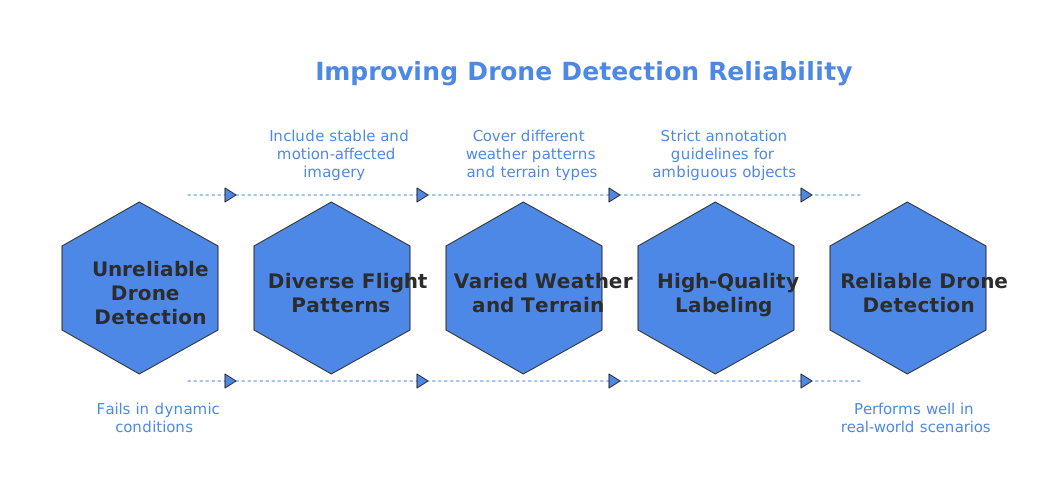
Drone detection systems operate under continuous movement. Even with stabilization, sudden flight adjustments, vibrations, or wind can introduce blur or momentary distortion in the imagery. Detection methods must therefore learn from frames captured under a variety of flight conditions. This requires dataset curation strategies that include both stable imagery and difficult, motion affected examples. Models that train only on clean data often struggle in real life because they fail to generalize under movement. Incorporating diverse flight patterns into training ensures detection remains reliable during dynamic operations.
Variability Across Weather and Terrain
Weather conditions can significantly alter object visibility. Fog, cloud shadows, glare, and snow cover change how features appear in aerial scenes. Terrain type also influences background texture, which affects detection stability. For example, dry soil, wet soil, forest canopy, and asphalt surfaces each create distinct visual environments that detection methods must learn to interpret. Robust aerial detection pipelines rely on datasets that intentionally cover different weather patterns and terrain types. This makes annotation strategy a central part of building detectors capable of reliable field deployment.
Distinguishing Objects With Similar Aerial Signatures
Objects that are visually easy to distinguish from the ground may appear almost identical from above. Vehicles of different types may share similar outlines, agricultural equipment may blend into soil patterns, and industrial structures often share repetitive geometry. Detection methods must rely on subtle cues such as shadow geometry, local context, or textural patterns to differentiate between classes. Models only learn these cues when annotation guidelines are strict and consistently applied. High quality labeling of ambiguous objects is therefore essential to prevent misclassification.
Designing Detection Workflows for Aerial AI Teams
Using Flight Planning to Improve Detection Accuracy
Detection methods perform best when drone operations are designed with the model’s needs in mind. Flight altitude, camera angle, ground sampling distance, and sensor choice all influence how detectable objects will be in the captured footage. Teams that align data collection with detection objectives create cleaner, more coherent datasets that reduce model noise. Over time, consistent flight planning also makes it easier to track improvements across dataset versions and refine detection workflows.
Improving Detection Through Dataset Iteration
Drone detection pipelines benefit from iterative dataset refinement. Hard examples collected from field deployments should be incorporated into the training set to expand model reliability. Newly discovered object types, misdetections, or environmental edge cases provide valuable insight into where the model lacks representation. Iterative updating of the dataset ensures that detection systems evolve alongside operational needs and remain effective even as new scenarios emerge in the real world.
Quality Assurance as a Core Component of Detection
Quality assurance in aerial datasets must verify not only annotation accuracy but also class consistency, object completeness, and annotation coverage. Missed objects or inconsistent boundaries can significantly affect detection confidence thresholds. Teams that integrate multi layer QA including manual review, automated checks, and cross annotator validation achieve more stable detection performance. High quality QA ensures that the detection workflow is built on reliable observations rather than noisy or ambiguous data.
Supporting Drone Detection Projects With Expert Annotation
Drone detection methods are advancing rapidly, but their success still depends heavily on the quality and structure of the underlying dataset. Detection systems that operate in real life require consistent annotation, diverse environmental representation, and clear class definitions tailored to their operational use cases. If you are building or scaling drone detection capabilities and need expert support with dataset creation, annotation workflows, or quality assurance, we can explore how DataVLab helps develop aerial detection datasets that perform reliably under real world conditions.
What are Drone detection methods?
Drone detection methods form the backbone of aerial perception, enabling drones to identify objects in varied environments and at different altitudes. This article explains the major detection approaches used in drone AI, from classic deep learning architectures to multi scale feature hierarchies, sensor fusion, and advanced contextual modeling.
What does the article explain about how aerial detection differs from ground based detection?
Drone detection systems must interpret scenes from rapidly shifting perspectives that introduce distortions uncommon in ground level vision datasets. Objects shrink as altitude increases, orientation changes become more pronounced, and motion affects clarity. Research from the University of Zurich’s Robotics and Perception Group discusses how aerial views distort object geometry in ways that require specialized detection strategies.
What are the main benefits of Drone detection methods?
Most detection architectures used in drone AI incorporate multi scale feature pyramids that allow the model to interpret objects of different sizes within the same frame. Feature pyramids extract information at multiple resolutions, giving detectors the capacity to recognize both large structures and very small targets.
What are the main challenges of Drone detection methods?
Even with stabilization, sudden flight adjustments, vibrations, or wind can introduce blur or momentary distortion in the imagery. Detection methods must therefore learn from frames captured under a variety of flight conditions. This requires dataset curation strategies that include both stable imagery and difficult, motion affected examples.
What is involved in designing detection workflows for aerial AI teams?
Detection methods perform best when drone operations are designed with the model’s needs in mind. Flight altitude, camera angle, ground sampling distance, and sensor choice all influence how detectable objects will be in the captured footage.
How can teams ensure quality in Drone detection methods?
Quality assurance in aerial datasets must verify not only annotation accuracy but also class consistency, object completeness, and annotation coverage. Missed objects or inconsistent boundaries can significantly affect detection confidence thresholds. Teams that integrate multi layer QA including manual review, automated checks, and cross annotator validation achieve more stable detection performance.