What Is Data Labeling ? A Machine Learning Guide to Classes, Targets and Training Data Quality
.jpeg)
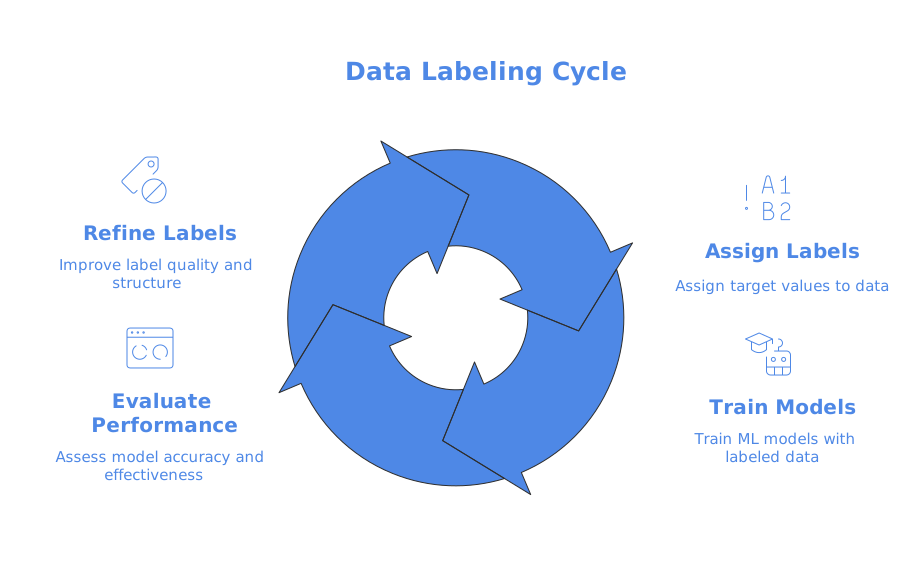
Data labeling is the process of assigning target values or categories to training data so machine learning models can learn relationships, patterns and decision boundaries. While data annotation is a broader concept, data labeling focuses specifically on creating the ground truth outputs that supervised models attempt to predict. This article explains the ML principles behind labeling, how labels influence model training, what makes a label set effective, and why classification design affects downstream accuracy. You will also learn how label noise impacts learning, how class balance shapes model generalization and how the structure of labels influences different types of ML tasks.
- Data labeling is the process of assigning target values or categories to training data so machine learning models can learn relationships, patterns and decision boundaries.
- While data annotation is a broader concept, data labeling focuses specifically on creating the ground truth outputs that supervised models attempt to predict.
- This article explains the ML principles behind labeling, how labels influence model training, what makes a label set effective, and why classification design affects downstream accuracy.
- Data labeling is the machine learning practice of assigning specific categories, classes, values or tags to samples so that a model can learn a predictable pattern from these labeled examples.
What Is Data Labeling?
Data labeling is the machine learning practice of assigning specific categories, classes, values or tags to samples so that a model can learn a predictable pattern from these labeled examples. In supervised learning, the model receives an input and a corresponding target output. The output is the label. When enough labeled examples are collected, the model begins to infer the underlying relationships that allow it to generalize to new, unseen data.
Labeling is therefore the foundation of supervised machine learning. It defines the structure of the problem, the meaning of the output, the way accuracy is measured and the overall direction of the model’s learning process. Without labels, most practical ML systems cannot be trained. Although data annotation and data labeling overlap, labeling specifically refers to the assignment of interpretable and standardized target values for training.
This article focuses on the ML-centric interpretation of data labeling. Rather than exploring operational workflows, annotation tools or project management processes, the content here emphasizes how labels shape model behavior, why ground truth matters and how different label structures correspond to different learning tasks. The goal is to provide a rigorous understanding of why labels are not simply tags but carefully designed components of an AI system.
How Data Labeling Fits Into Supervised Learning
Supervised learning depends entirely on labeled examples. In the simplest scenario, a dataset contains pairs of information: features (inputs) and labels (outputs). The model observes many of these pairs, adjusts its parameters during training and eventually learns how to map inputs to outputs.
For instance, in classification tasks, each data sample is assigned a class such as “cat”, “dog” or “car”. In regression tasks, the label is a numerical value such as a price, temperature or probability. Sequence models use labels representing ordering or structure, such as tagging each word in a sentence with a linguistic category.
A clear and accessible explanation of supervised learning principles is available through the Carnegie Mellon University Introduction to Machine Learning materials.
Data labeling plays a central role in defining what the model is expected to learn. Changing the labels changes the problem itself. If classes are too broad, the model struggles with accuracy. If classes are too granular, the dataset becomes ambiguous. If labels are inconsistent, the model learns unpredictable decision boundaries.
The Difference Between Data Annotation and Data Labeling
Data annotation refers to a broader family of tasks that provide structure, context or metadata to raw information. Annotation includes bounding boxes, segmentation masks, attributes, relationships, timestamps and textual notes. Data labeling, on the other hand, is specifically the practice of assigning target values that the model is expected to predict.
Several examples illustrate the distinction:
Image classification
The label is the class, such as “bird” or “plane”. Annotation might add bounding boxes, object counts or attributes. These annotations enrich the dataset but the label remains the central target variable.
Sentiment analysis
The label is “positive”, “neutral” or “negative”. Annotation may include keyword tagging or entity marking, which helps with interpretability but does not replace the target label.
Regression tasks
The label is a continuous value such as distance or probability. Annotation might include contextual notes or metadata, but the continuous value defines the learning objective.
Data labeling focuses on creating ground truth for supervised learning models. Annotation supports the structure of data but is not always directly used during model training. The distinction allows us to design datasets that are both descriptive and predictive.
Why Labels Are the Foundation of Ground Truth
Ground truth is the authoritative source of accuracy measurement. It defines the correct answers that a machine learning model tries to approximate. Labels form the ground truth. Their quality directly determines how well the model performs.
In ML training, the optimization algorithm reduces the difference between predicted values and true labels. If the labels contain errors, contradictions or inconsistencies, the model learns incorrect patterns. Even sophisticated architectures are limited by the quality of their training labels.
Ground truth must therefore be:
• accurate
• consistent
• complete
• aligned with the intended use case
Reliable ground truth separates robust AI systems from fragile ones. Without it, even the most advanced network architectures struggle to generalize.
A strong technical discussion of ground truth and its importance can be found in the MIT OpenCourseWare materials on machine learning.
These resources emphasize how sensitive models are to the structure and reliability of the target values they receive.
Label Structures Across Different Machine Learning Tasks
Different ML tasks require different types of labels. Understanding these structures helps clarify what data labeling means in each context.
Classification Labels
In classification, each sample is assigned one class from a predefined set. These labels must be mutually exclusive, consistent and clearly defined. Poor definition leads to overlap between classes and reduces model accuracy.
Multi Label Classification
In multi label scenarios, a sample can belong to multiple classes simultaneously. For example, an image may contain both a bicycle and a person. Labels become sets of classes rather than single categories, and the model learns to predict combinations.
Regression Labels
Regression labels are continuous numerical values. They require precision and stable measurement. Small errors in regression labels can propagate through training and cause significant deviations in predictions.
Sequence Labels
Tasks such as part of speech tagging or token classification require each element in a sequence to receive its own label. This structure demands careful token alignment and standardized definitions.
Ranking or Ordinal Labels
Some problems involve ordered categories. For example, rating something as 1, 2, 3, 4 or 5. The order contains meaningful information that the model must learn.
Structured Output Labels
Complex tasks such as parsing produce structured labels like trees or graphs. These require domain expertise and careful consistency checks.
Each of these label structures demands different design considerations. The label format determines the loss function, evaluation metric and model architecture.
The Importance of Label Taxonomy and Ontology Design
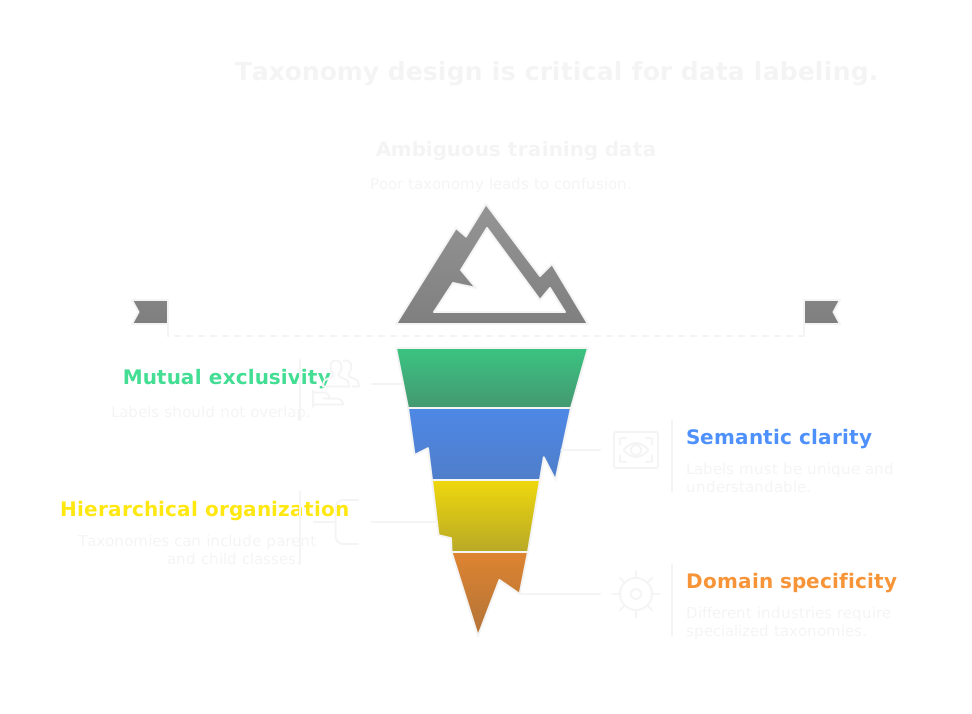
Taxonomy design is one of the most critical but overlooked aspects of data labeling. A taxonomy defines the set of labels, their boundaries, their relationships and the rules for applying them. A poorly designed taxonomy confuses annotators and produces ambiguous training data.
Key principles include:
Mutual exclusivity
Labels should not overlap unless the task explicitly requires multi labeling.
Semantic clarity
Each label must correspond to a unique and understandable concept.
Hierarchical organization
Taxonomies can include parent and child classes. For example, “vehicle” might contain “car”, “motorcycle” and “truck”. The hierarchy influences interpretability and sometimes informs model architecture.
Domain specificity
Different industries require specialized taxonomies. Medical imaging taxonomies differ from retail product taxonomies or geospatial mapping taxonomies.
Geospatial projects need taxonomies that account for scale, sensor type, and spatial classes; DataVLab’s geospatial data annotation services can implement those schemas.
Poor taxonomy design often leads to wasted labeling effort and reduced model performance. A detailed discussion of taxonomy creation appears in the University of Washington’s knowledge representation materials.
A well structured taxonomy provides clarity and helps models learn precise boundaries between classes.
How Class Balance Affects Model Generalization
Class distribution is a fundamental component of data labeling quality. When one class appears more frequently than others, the model may learn to predict the dominant class more often. This imbalance reduces the model’s ability to generalize and limits its usefulness in real world scenarios.
For classification tasks, balanced labels are often essential. If a dataset contains 95 percent negative samples and 5 percent positive samples, the model can achieve 95 percent accuracy by always predicting “negative”. This is misleading and unhelpful for practical use.
Several strategies can improve class balance:
Oversampling rare classes
Duplicating or augmenting samples to increase representation.
Undersampling frequent classes
Removing samples from overrepresented categories to reduce bias.
Synthetic sample creation
Using techniques like SMOTE to generate new examples for minority classes.
Guided data collection
Actively seeking new data that matches underrepresented categories.
Class balance is an ML design problem, not an annotation problem. The labels determine the distribution, which is why labeling must reflect the intended deployment environment.
Label Noise and Its Impact on Model Performance
Label noise refers to inaccurate, incomplete or inconsistent labels. Noise reduces model accuracy, increases training time and limits generalization. Even small amounts of noise can significantly impact performance for sensitive tasks.
Common sources of label noise include:
• human error
• outdated guidelines
• ambiguous data
• poorly defined classes
• context dependent samples
Noise can take several forms. Random noise is uncorrelated with the true label and behaves like statistical noise. Systematic noise reflects consistent mislabeling errors, which are more dangerous because the model learns the wrong pattern. Label noise also interacts with class balance. Rare classes with noise become nearly impossible for a model to interpret correctly.
The Relationship Between Labels and Loss Functions
Loss functions measure how close model predictions are to true labels. Different label structures require different loss functions. The choice of loss function influences what the model learns.
Cross entropy loss
Used for classification. Labels must be categorical or one hot encoded.
Mean squared error
Used for regression. Requires numerical labels.
CTC loss
Used in speech recognition and sequence modeling where alignment is uncertain.
Hinge loss
Used in margin based classifiers such as support vector machines.
Labels define the problem, and the problem defines the loss. A mismatch between labels and loss function usually leads to poor performance.
Evaluating Label Quality Through ML Metrics
Labeling quality cannot always be evaluated directly. Instead, ML practitioners use model driven metrics to infer whether labels are reliable.
Metrics include:
Accuracy and precision
Measure whether predictions match labels, useful only when labels themselves are trustworthy.
Recall
Evaluates how well the model identifies positive cases, critical in rare class scenarios.
ROC and PR curves
Reveal class imbalance issues and label distribution quality.
Confusion matrices
Expose systematic labeling inconsistencies or overlapping classes.
Inter annotator agreement
Quantifies consistency across multiple labelers.
Machine learning evaluation indirectly reveals whether labels are suitable. Poor metrics often indicate deeper issues with label design rather than with the model architecture.
Labeling Strategies for Different Model Architectures
Different ML architectures require different approaches to labeling. Designing labels without considering the model type can create inefficiencies.
Convolutional neural networks
Require spatially consistent labels for image tasks. Even classification labels must be accurate, but structured annotations are often supplementary.
Transformers
Depend heavily on high quality sequence labels, especially in NLP tasks. Token alignment and consistent segmentation are crucial.
Recurrent networks
Need sequential labeling for tasks like speech tagging.
Gradient boosted trees
Often used for tabular data. Labels must be well defined and balanced but require less structural complexity.
Models interpret labels differently. Understanding these differences helps guide effective label creation.
The Role of Domain Expertise in Data Labeling
Labeling high complexity data requires domain experience. For instance, annotating medical images or interpreting legal documents cannot be delegated to generalists. Domain experts define label meaning, design taxonomies, interpret ambiguous cases and ensure accuracy.
Domain expertise influences:
• label consistency
• ground truth reliability
• taxonomy structure
• interpretation of edge cases
• evaluation criteria
Industries such as healthcare, autonomous driving and geospatial intelligence depend heavily on expert labeling. The deeper the domain knowledge, the more reliable the labels and the more robust the model.
Scaling Data Labeling in Machine Learning Projects
Large ML projects often require millions of labeled examples. Scaling requires clear label definitions, consistent rules and stable taxonomies. Although this article is not focused on annotation workflow or workforce management, it is important to understand how scaling affects label design.
Scaling influences:
• how detailed labels can be
• how much context can be captured
• how to manage ambiguity
• which classes need refinement or merging
• how iterative improvements are introduced
As datasets grow, labels must remain stable across thousands of annotators and repeated iterations.
The Future of Data Labeling in ML Systems
Machine learning research continues to explore new ways to reduce labeling requirements. Semi supervised learning, weak supervision and self supervised learning aim to reduce dependence on large labeled datasets. However, these methods still rely on labeled data to calibrate metrics, evaluate performance and guide learning.
Weak supervision, for instance, uses noisy or approximate labels as long as a small set of high quality labels exists for correction. Self supervised models learn from patterns in the data itself, but labeled data remains essential for grounding the model in practical tasks.
Researchers at the University of Oxford provide extensive material on modern labeling approaches and weak supervision.
Labeling will remain integral to machine learning even as automated and hybrid systems improve.
Final Thoughts
Data labeling defines what a model should learn, how it should behave and which patterns it should recognize. It is a fundamental component of supervised learning and directly influences the reliability of AI systems. High quality labels enable stable training, strong generalization and dependable predictions. Poorly designed or inconsistent labels create confusion, noise and fragile decision boundaries.
Understanding the ML centric meaning of labeling helps practitioners build more effective datasets, select appropriate models and design learning tasks that align with business goals. While annotation tools, workforce strategies and quality assurance processes are covered in other articles, this piece provides the conceptual foundation for understanding labels as target variables in machine learning.
Looking to Strengthen Your Training Data?
If you want support designing label taxonomies, defining classes or improving the quality of your training data, our team can help. DataVLab assists with complex labeling strategies that influence ML accuracy, including classification schemas, regression labels and structured learning tasks. You can reach out to discuss your project or explore ways to improve your dataset before training your next model.
What is data labeling?
Data labeling is the process of assigning target values or categories to training data so machine learning models can learn relationships, patterns and decision boundaries. While data annotation is a broader concept, data labeling focuses specifically on creating the ground truth outputs that supervised models attempt to predict.
What does the article explain about how data labeling fits into supervised learning?
In the simplest scenario, a dataset contains pairs of information: features (inputs) and labels (outputs). The model observes many of these pairs, adjusts its parameters during training and eventually learns how to map inputs to outputs.
Why are Labels the foundation of ground truth?
Ground truth is the authoritative source of accuracy measurement. It defines the correct answers that a machine learning model tries to approximate. Their quality directly determines how well the model performs.
How does Class balance affect Model generalization?
Class distribution is a fundamental component of data labeling quality. When one class appears more frequently than others, the model may learn to predict the dominant class more often. This imbalance reduces the model’s ability to generalize and limits its usefulness in real world scenarios.
What is involved in evaluating label quality through ML metrics?
Instead, ML practitioners use model driven metrics to infer whether labels are reliable. Measure whether predictions match labels, useful only when labels themselves are trustworthy. Evaluates how well the model identifies positive cases, critical in rare class scenarios.
What is the future of Data labeling?
Machine learning research continues to explore new ways to reduce labeling requirements. Semi supervised learning, weak supervision and self supervised learning aim to reduce dependence on large labeled datasets. However, these methods still rely on labeled data to calibrate metrics, evaluate performance and guide learning.