Vehicle Tracking and Traffic Detection Datasets for Smart City AI
.jpeg)
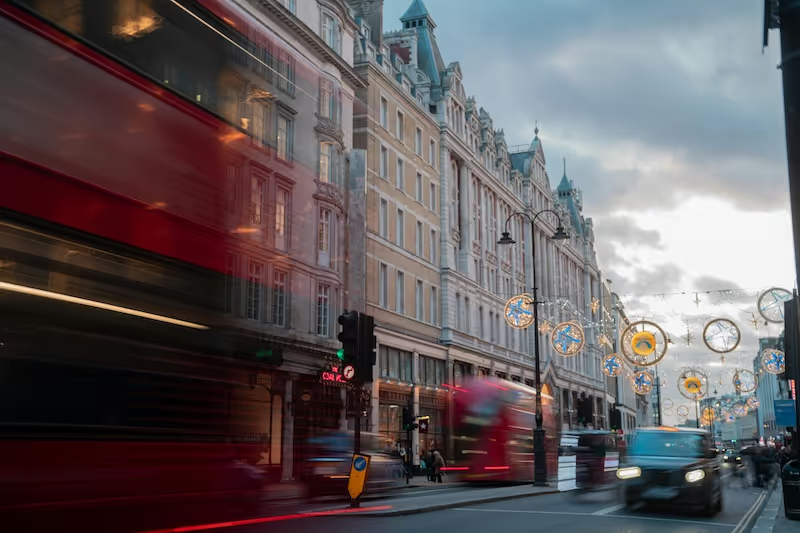
Vehicle tracking datasets form the backbone of modern smart city AI systems. These datasets include annotated video sequences capturing cars, trucks, buses, cyclists, and pedestrians across real urban environments. They enable models to understand movement patterns, analyze traffic flow, detect incidents, and manage transportation networks more efficiently. This article explains how vehicle tracking works, what types of datasets exist, what annotation workflows are required, and how deep learning models interpret the complexity of road scenes. It also explores applications in mobility management, traffic safety, congestion reduction, and predictive analytics, while highlighting the unique challenges of building reliable tracking datasets for real world city deployments.
- These datasets include annotated video sequences capturing cars, trucks, buses, cyclists, and pedestrians across real urban environments.
- They enable models to understand movement patterns, analyze traffic flow, detect incidents, and manage transportation networks more efficiently.
- This article explains how vehicle tracking works, what types of datasets exist, what annotation workflows are required, and how deep learning models interpret the complexity of road scenes.
- It also explores applications in mobility management, traffic safety, congestion reduction, and predictive analytics, while highlighting the unique challenges of building reliable tracking datasets for real world city deployments.
Vehicle tracking is the process of following objects across multiple frames in a video sequence. Smart cities rely on tracking models to monitor traffic flow, measure vehicle interactions, analyze congestion, and detect incidents. Tracking is essential for understanding how vehicles move within urban environments. Unlike simple detection, which identifies objects in a single frame, tracking captures trajectories, speed patterns, and event sequences over time.
Tracking is widely used across intelligent transportation systems, urban planning, safety analysis, and real time mobility platforms. According to research from the European Conference on Transportation Infrastructure, large cities increasingly depend on computer vision based tracking to optimize traffic operations and reduce congestion. Tracking brings temporal intelligence to transportation networks and offers insights that traditional loop sensors or manual counts cannot match.
Modern tracking systems use deep learning, optical flow, and multi object tracking algorithms to interpret urban video feeds. These models require large, realistic datasets that reflect the complexity of urban traffic conditions.
Why Vehicle Tracking Matters for Smart Cities
Real time congestion monitoring
Tracking systems help cities identify congestion as it forms. They detect slowdowns, unusual traffic patterns, and lane blockages. Operators can adjust traffic signals or dispatch response teams before congestion worsens.
Incident & anomaly detection
Tracking models detect sudden stops, collisions, erratic driving, and lane departures. Early detection helps emergency responders react faster, reducing secondary accidents and improving road safety.
Urban mobility optimization
By analyzing vehicle trajectories, cities can redesign intersections, optimize road layouts, and plan for new cycling or bus lanes. Data driven mobility planning improves efficiency and reduces emissions.
Public transit analysis
Tracking systems monitor buses, trams, and public transit vehicles. They help evaluate on time performance, route efficiency, and peak hour behaviors.
Pedestrian and cyclist protection
Tracking extends beyond vehicles to include pedestrians and cyclists. Understanding interactions between road users helps cities design safer crossings, bike lanes, and pedestrian friendly areas.
Tracking datasets make these applications possible by providing annotated sequences that reflect how different road users behave in real conditions.
How Vehicle Tracking Works
Object detection as the foundation
Tracking begins with object detection. Models locate vehicles, pedestrians, and cyclists in each frame by drawing bounding boxes around them. Detection accuracy must remain consistent across diverse lighting, weather, and camera angles.
Association across frames
Tracking models assign consistent IDs to objects across multiple frames. This is known as tracking by association. Models compare features such as appearance, position, and motion to determine how objects move over time.
Trajectory reconstruction
As objects are tracked, their positions are connected to form trajectories. These trajectories reveal path patterns, speed changes, and interactions with other road users.
Temporal event detection
Once trajectories are extracted, higher level models detect events such as near misses, dangerous overtaking, or sudden stops. This temporal analysis is critical for safety monitoring.
Data aggregation
Tracking outputs are aggregated into dashboards and analytics tools used by city planners, mobility operators, and researchers. Aggregation provides long term insights into traffic behavior.
Tracking is a multilayered pipeline that depends on high quality, well annotated video data.
Traffic Detection in Smart City AI
Traffic detection refers to the identification of vehicles, road signs, traffic lights, and pedestrians across individual video frames. Detection provides the foundational objects required for tracking and analysis.
Vehicle detection
Models identify cars, trucks, buses, motorcycles, and bicycles. They learn size, shape, and texture patterns across different vehicle categories.
Traffic sign detection
Detecting signs helps with road safety analysis, compliance monitoring, and navigation support. Signs vary significantly across countries and require specialized datasets.
Traffic light detection
Smart cities rely on traffic light detection to evaluate signal compliance and analyze intersection performance.
Pedestrian detection
Pedestrian detection is essential for safety monitoring and walkability analysis. Models must handle occlusions, diverse clothing, and unpredictable behavior.
Detection models require large quantities of annotated images capturing urban diversity across lighting, weather, and camera perspectives.
External studies from the Institute of Transportation Engineers (ITE) highlight how detection and tracking data improves adaptive traffic signal control and urban mobility planning.
Vehicle Tracking Datasets
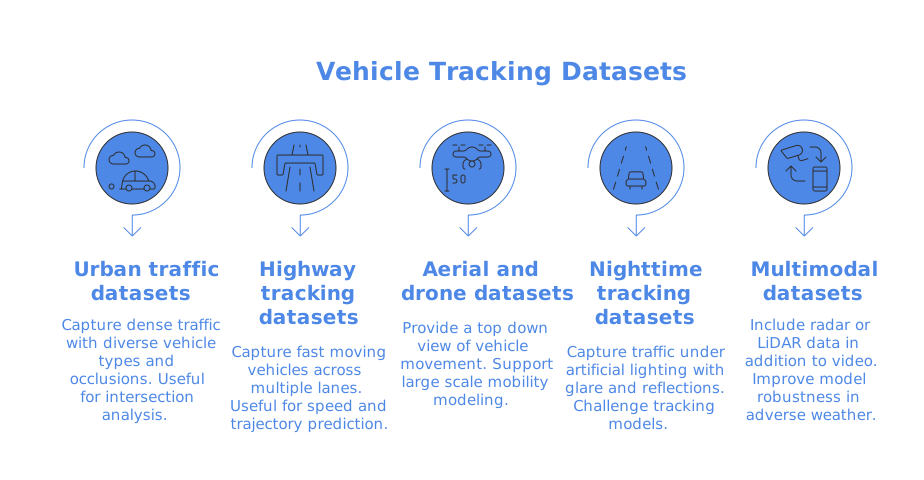
Vehicle tracking datasets contain sequences of video frames with labeled objects and tracking IDs. These datasets vary in scale, resolution, annotation detail, and environmental complexity.
Urban traffic datasets
Urban datasets capture dense traffic at intersections, roundabouts, and arterial roads. They include diverse vehicle types and frequent occlusions.
Highway tracking datasets
Highway datasets capture fast moving vehicles across multiple lanes. They are useful for speed and trajectory prediction models.
Aerial and drone based datasets
Drone datasets provide a top down view of vehicle movement. These datasets support large scale mobility modeling and urban planning.
Nighttime tracking datasets
Nighttime datasets capture traffic under artificial lighting. They include glare, reflections, and motion blur that challenge tracking models.
Multimodal datasets
Some datasets include radar or LiDAR data in addition to video. Multimodal datasets improve model robustness under adverse weather conditions.
Tracking datasets need to reflect real world diversity to avoid performance drops during citywide deployment.
Traffic Detection Datasets
Traffic detection datasets include annotated images of vehicles, pedestrians, signs, and traffic lights. They support detection training for systems that monitor traffic and identify road users.
Multi class detection datasets
These datasets include several classes such as cars, trucks, buses, motorcycles, bicycles, and pedestrians. They help models learn inter class variations.
Traffic sign datasets
Traffic sign datasets capture hundreds of sign categories. They require detailed annotation because minor differences between signs can convey very different meanings.
Traffic light datasets
Traffic light datasets include green, yellow, and red instances with varying angles, occlusions, and lighting conditions.
Weather specific datasets
Some datasets focus on rain, snow, fog, or nighttime scenes. These specialized datasets improve model robustness in challenging scenarios.
Academic work by the Transportation Data and Analytics Association shows how detection datasets improve the reliability of computer vision based traffic systems.
Traffic detection datasets serve as the foundation for vehicle tracking and mobility analytics.
Annotation for Vehicle Tracking
Object bounding boxes
Annotators draw bounding boxes around vehicles and other road users. Boxes must be consistent in size, shape, and alignment to avoid training errors.
Tracking IDs
Each object must be assigned a consistent ID across all frames in the sequence. Tracking annotation is one of the most complex labeling tasks due to object occlusions, merges, and splits.
Occlusion labeling
Annotators identify occlusions caused by other vehicles, pedestrians, or urban structures. This helps models handle difficult real world conditions.
Trajectory verification
Annotators check that reconstructed trajectories are accurate and reflect realistic movement. Errors in early frames propagate across the entire sequence.
Frame level review
Tracking annotation requires frame by frame inspection to ensure consistent labeling across the entire sequence.
High quality tracking annotation is critical for reliable smart city AI because tracking errors can lead to incorrect safety alerts or mobility insights.
Annotation for Traffic Detection
Class labeling
Annotators assign class labels such as car, truck, pedestrian, or traffic light. Clear class definitions ensure consistent labeling across the dataset.
Attribute labeling
Some datasets include attributes such as vehicle color, direction, or type. Attribute labeling supports advanced analytics such as incident investigation.
Sign and signal labeling
Traffic sign and light annotation requires careful attention to small visual details. Mislabeling can cause safety critical errors in traffic analysis.
Bounding box precision
Bounding boxes must tightly enclose each object. Loose or oversized boxes reduce detection accuracy.
Traffic detection annotation lays the groundwork for robust tracking and event recognition.
Challenges in Building Tracking and Detection Datasets
Occlusions and dense traffic
Crowded intersections often include overlapping vehicles and pedestrians. Tracking must remain consistent even when objects temporarily disappear behind others.
Weather variability
Rain, fog, snow, and low visibility conditions create challenges for both detection and tracking models. Datasets must capture a range of weather scenarios.
Perspective diversity
Cameras are installed at various heights and angles. Tracking models must generalize across downward facing cameras, fisheye lenses, and side angle perspectives.
Nighttime scenes
Nighttime introduces glare, blurring, and poor contrast. Nighttime specific datasets improve low light performance.
Motion blur
Fast moving vehicles create blur that complicates detection. Training models on blurred images improves robustness.
Real time constraints
Tracking must operate with low latency to be useful in active traffic management. Dataset design must reflect computational constraints.
Challenges highlight the need for extensive, diverse datasets that mimic real world road conditions.
Applications of Vehicle Tracking and Traffic Detection
Adaptive traffic signal control
Tracking and detection data feed traffic signals that adjust timing based on real time congestion. Adaptive systems reduce stop and go traffic and improve flow.
Safety analytics
Trajectory analysis detects near misses, sudden braking, and dangerous interactions between vehicles and pedestrians. Safety insights help cities redesign intersections or implement targeted interventions.
Incident detection and response
Tracking identifies crashes, breakdowns, and stalled vehicles. Early identification helps avoid secondary collisions and improves incident response times.
Traffic flow modeling
Tracking data feeds transportation models that predict demand, analyze patterns, and optimize long term planning decisions.
Urban freight monitoring
Cities use tracking to analyze how delivery vehicles move through commercial districts. This supports logistics planning and curbside management.
Bicycle and pedestrian safety
Tracking helps evaluate how cyclists and pedestrians interact with vehicles, guiding decisions on bike lane placement and pedestrian crossings.
Studies from the Centre for Connected and Autonomous Vehicles show how tracking data improves understanding of multi modal mobility systems.
Applications reflect the growing importance of vehicle tracking in smart city mobility frameworks.
Integrating Tracking with Smart City Ecosystems
Traffic management centers
Tracking feeds real time traffic dashboards used by operators. These dashboards visualize congestion, incidents, and vehicle movement.
Urban analytics platforms
Tracking data integrates with analytics platforms that support urban planning, safety evaluation, and policy making.
Public transportation systems
Tracking supports route optimization, headway management, and reliability assessment for buses and trams.
Parking systems
Tracking helps monitor parking occupancy and supports dynamic pricing strategies.
Smart intersections
Tracking enables AI driven intersection control that adapts based on real time road conditions.
Predictive mobility
Predictive models use tracking data to estimate future traffic conditions. This helps cities implement proactive mobility management strategies.
Integration ensures that tracking systems improve the broader smart city ecosystem rather than functioning as isolated tools.
Future of Vehicle Tracking and Traffic AI
Transformer based tracking
Next generation tracking systems use transformer architectures to capture long range dependencies and contextual relationships between objects.
Multimodal tracking
Combining video with radar, LiDAR, and IoT sensors increases robustness in poor visibility. Multimodal tracking will become more common in dense urban environments.
Edge based tracking
Running tracking models directly on cameras reduces latency and bandwidth usage. Edge devices are becoming increasingly powerful and suitable for real time tracking.
Self supervised learning
Self supervised models learn from unlabeled video, reducing dependence on costly annotations.
City scale tracking networks
Large smart cities will deploy integrated camera networks with unified tracking models covering entire districts.
Predictive mobility systems
Future cities will use tracking data to forecast congestion hours before they occur. Predictive mobility will transform traffic operations.
These trends show how tracking will evolve alongside advances in deep learning and urban data infrastructure.
Conclusion
Vehicle tracking and traffic detection datasets form the foundation of modern smart city mobility systems. They enable real time monitoring, safety analytics, adaptive signal control, and long term transportation planning. By combining detection, tracking, and event analysis, cities gain powerful tools to understand how vehicles and pedestrians move within urban environments. Building reliable systems requires high quality datasets that capture diverse lighting, weather, and perspective variations. As smart cities deploy more sensors and integrate advanced AI, vehicle tracking will become an indispensable component of urban mobility intelligence.
If your team needs expertly annotated vehicle tracking datasets, traffic detection datasets, or multi object tracking workflows, DataVLab can help.
We provide precise, scalable annotation and quality assurance for smart city AI systems.
👉 DataVLab: contact us and start your project.
What is Vehicle tracking and traffic detection datasets for smart city AI?
Vehicle tracking datasets form the backbone of modern smart city AI systems. These datasets include annotated video sequences capturing cars, trucks, buses, cyclists, and pedestrians across real urban environments. They enable models to understand movement patterns, analyze traffic flow, detect incidents, and manage transportation networks more efficiently.
Why does vehicle tracking matter for smart cities?
Tracking systems help cities identify congestion as it forms. They detect slowdowns, unusual traffic patterns, and lane blockages. Operators can adjust traffic signals or dispatch response teams before congestion worsens.
How does Vehicle tracking work?
Models locate vehicles, pedestrians, and cyclists in each frame by drawing bounding boxes around them. Detection accuracy must remain consistent across diverse lighting, weather, and camera angles. Tracking models assign consistent IDs to objects across multiple frames.
What are the main challenges of Vehicle tracking and traffic detection datasets for smart city AI?
Crowded intersections often include overlapping vehicles and pedestrians. Tracking must remain consistent even when objects temporarily disappear behind others. Rain, fog, snow, and low visibility conditions create challenges for both detection and tracking models.
What are the main use cases for Vehicle tracking and traffic detection datasets for smart city AI?
Tracking and detection data feed traffic signals that adjust timing based on real time congestion. Adaptive systems reduce stop and go traffic and improve flow. Trajectory analysis detects near misses, sudden braking, and dangerous interactions between vehicles and pedestrians.
What is the future of Vehicle tracking and traffic detection datasets for smart city AI?
Next generation tracking systems use transformer architectures to capture long range dependencies and contextual relationships between objects. Combining video with radar, LiDAR, and IoT sensors increases robustness in poor visibility. Multimodal tracking will become more common in dense urban environments.