Robot Manipulation Datasets: Annotating Grasping, Tools and Interaction Scenes for Reliable Manipulation AI
.jpeg)
Robot manipulation requires datasets that capture complex interactions between hands, tools and objects across diverse environments. High quality annotations help robots understand object geometry, identify grasp points, predict contact dynamics and execute stable manipulation strategies. This article explains how manipulation datasets are collected, how annotation taxonomies are designed, and how segmentation, keypoints, pose labels and action sequences are annotated for real world robotic tasks. It highlights challenges such as occlusion, clutter, multi object interactions and tool variability, and describes how these datasets integrate into manipulation models, imitation learning systems and reinforcement learning pipelines. The article concludes with a practical overview of how annotated manipulation datasets support reliable handling, assembly, packaging and tool use across industrial and service robotics.
- High quality annotations help robots understand object geometry, identify grasp points, predict contact dynamics and execute stable manipulation strategies.
- This article explains how manipulation datasets are collected, how annotation taxonomies are designed, and how segmentation, keypoints, pose labels and action sequences are annotated for real world robotic tasks.
- It highlights challenges such as occlusion, clutter, multi object interactions and tool variability, and describes how these datasets integrate into manipulation models, imitation learning systems and reinforcement learning pipelines.
- The article concludes with a practical overview of how annotated manipulation datasets support reliable handling, assembly, packaging and tool use across industrial and service robotics.
Why Manipulation Datasets Matter in Robotics
Robot manipulation requires a detailed understanding of objects, surfaces, shapes and interactions. Robots must grasp items reliably, handle tools safely and manipulate objects in environments where noise, clutter or occlusion complicate perception. High quality manipulation datasets teach models how to interpret geometry, estimate contact forces and predict object behavior. Research from the Yale GRAB Lab demonstrates that dataset quality significantly influences grasp success rates and the stability of manipulation strategies. Manipulation tasks depend on spatial precision and real world consistency, so datasets must reflect the complexity of practical environments.
How Manipulation Models Learn
Manipulation models learn by analyzing images, depth maps, object poses and multi step interactions. These models require annotations that capture both the visual appearance of objects and the physical relationships between them. The UC San Diego Robotics and Manipulation Lab has shown how supervised labels, demonstrations and contact information help models develop robust manipulation behaviors. Models learn to identify grasp points, predict object movement patterns and adjust motions based on feedback. High quality annotation supports both analytic models and learning based methods such as reinforcement learning or imitation learning.
Visual Understanding for Grasping
Visual understanding allows manipulation models to detect object edges, surfaces and shapes. Models analyze texture, curvature and symmetry to infer how objects can be grasped. Annotated segmentation masks help robots interpret object boundaries, while depth cues reveal geometric structures. Accurate visual labeling supports reliable grasp selection across diverse objects, sizes and orientations.
Physical Understanding for Interaction
Manipulation requires understanding forces, torques and object dynamics. Models learn how objects respond to contact and how to adjust grip pressure or orientation. Datasets that include sequential interactions help robots understand cause and effect relationships during manipulation tasks. Including physical cues in the annotations improves the model’s ability to generalize to new tasks.
Designing a Taxonomy for Manipulation Datasets
Manipulation taxonomies define the categories used to label objects, surfaces and interactions. A well designed taxonomy ensures consistent annotation, supports model training and aligns with the robot’s capabilities. The University of Washington Robotics Manipulation Lab emphasizes the importance of structuring categories around the robot’s real operational tasks.
Object Categories
Object categories include tools, containers, household items, industrial parts, packaging materials and manipulable fixtures. These categories support recognition tasks that help robots identify what they are about to grasp or manipulate. They also enable behavioral specialization, allowing models to learn tailored strategies for different object types. Well defined object categories improve generalization across tasks.
Graspable Regions
Graspable regions include handles, edges, surfaces and textured areas that support stable holding. Annotators must label these regions consistently so that models learn where successful grasps can be achieved. Graspable region taxonomy should reflect the robot’s gripper design and mechanical constraints. Clear categorization improves grasp planning accuracy and consistency.
Tool Interaction Categories
Tool interaction categories include cutting, scraping, turning, pushing and lifting actions. These categories help models learn how to manipulate tools correctly. Annotations for tool use must capture both the functional role of the tool and the contact points between the gripper and tool. This improves the model’s ability to handle multi step interactions.
Collecting Images for Manipulation Datasets
Collecting manipulation data requires controlled yet diverse setups that represent real tasks. Images should capture objects in different configurations, lighting conditions and positions. This helps models learn to generalize across challenging scenarios.
Studio Based Data Collection
Studio setups offer controlled lighting, calibrated sensors and predictable environments. These setups allow clear visualization of object boundaries and contact interactions. Studio data helps train models to understand fundamental object properties without visual noise. It provides high resolution images that support fine grained annotation tasks.
Real World Data Collection
Real world data collection includes different obstacles and setups such as kitchens, warehouses, manufacturing floors and workshop environments. These environments introduce variability in clutter, lighting, texture and object interaction patterns. Capturing real world scenes improves model robustness and supports deployment in practical settings. Real world data also includes noisy backgrounds that models must learn to handle.
Multi Sensor Data Collection
Robots often use cameras, depth sensors and tactile sensors during manipulation. Multi sensor data collection improves perception by combining depth cues with RGB images and tactile feedback. The Max Planck Institute for Intelligent Systems has demonstrated how multi modal data improves manipulation success. Collecting synchronized multi sensor streams supports robust annotation and model training.
Preprocessing Manipulation Data
Preprocessing prepares images and sensor streams for consistent and accurate annotation. Manipulation tasks require fine grained detail, so preprocessing must preserve object edges and contact areas carefully.
Lighting Adjustment
Adjusting lighting improves boundary visibility and highlights object surfaces. Manipulation requires precise interpretation of edges, so reducing shadows and glare improves annotation accuracy. Lighting normalization ensures consistent visual conditions across the dataset.
Sensor Alignment
RGB, depth and tactile sensors must be spatially aligned. Misalignment reduces annotation accuracy and introduces noise into model training. Preprocessing corrects sensor drift and ensures that all modalities provide matching structural cues. Alignment supports high quality multi modal annotations.
Noise Reduction
Manipulation scenes may include background clutter, motion blur or sensor noise. Noise reduction improves clarity and helps annotators identify contact areas precisely. Clean images improve dataset consistency and support fine grained segmentation.
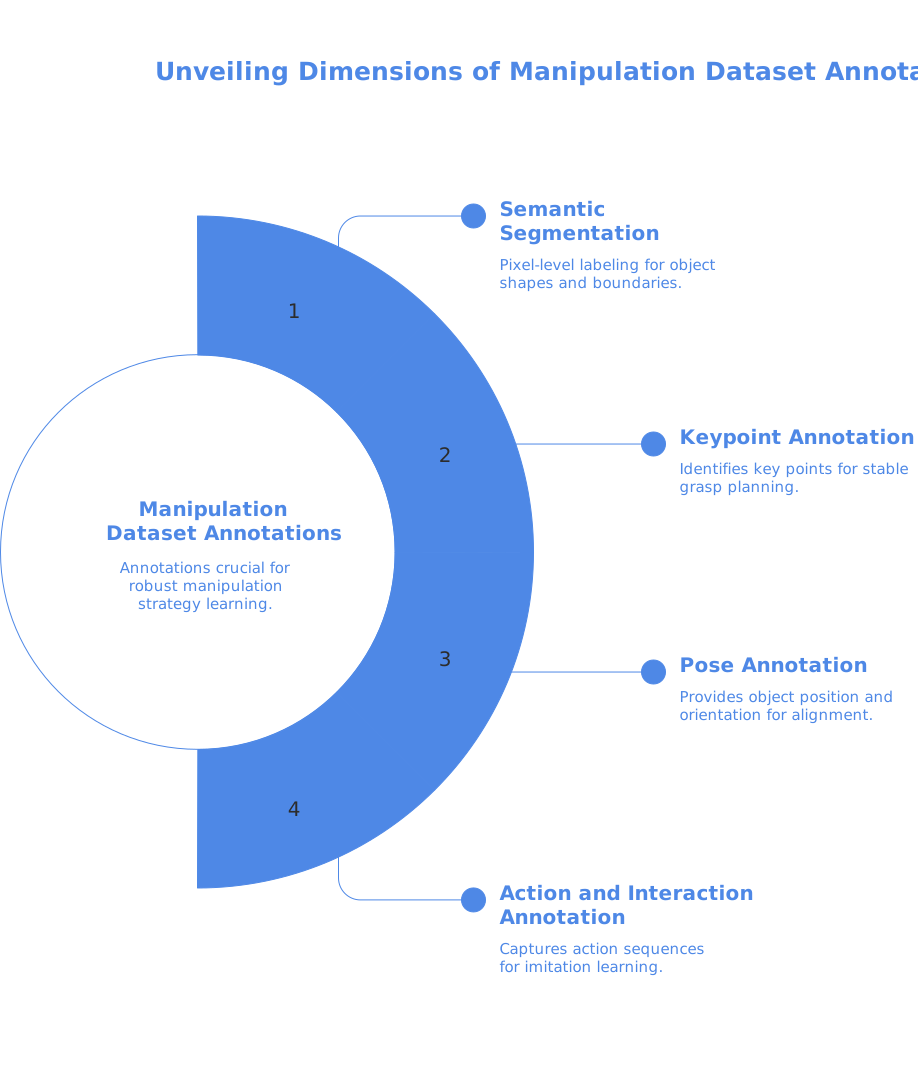
Annotation Methods for Manipulation Datasets
Manipulation datasets require annotations that capture object shapes, interaction patterns, contact points and action sequences. Choosing the right annotation method ensures models learn robust manipulation strategies.
Semantic Segmentation for Object Boundaries
Semantic segmentation labels object shapes and boundaries at the pixel level. This helps robots understand geometry and identify potential grasp locations. Segmentation is essential for tasks requiring high spatial precision, such as picking small tools or aligning parts. Accurate boundaries support stable grasping and interaction planning.
Keypoint Annotation for Grasping
Keypoint annotation identifies specific points on objects such as corners, handles or contact regions. These keypoints guide grasp planning by highlighting stable positions. Keypoints also help models estimate orientation and object pose. Consistent keypoint labeling improves the accuracy of grasp prediction models.
Pose Annotation for Object Alignment
Pose annotation provides the six degree of freedom position and orientation of objects. Pose data helps robots understand how to align their gripper with objects. Pose annotations are essential for assembly tasks where objects must be oriented precisely. Accurate pose labels improve manipulation success rates significantly.
Action and Interaction Annotation
Manipulation involves multi step interactions such as grasping, rotating or placing objects. Action annotation captures these sequences and provides supervision for imitation learning. The RSS Manipulation Workshop highlights how sequence labeling improves real world task performance. Clear interaction annotation supports robust learning of complex manipulation behaviors.
Creating Annotation Guidelines
Annotation guidelines ensure that objects, regions and interactions are labeled consistently. Detailed guidelines reduce ambiguity and help annotators handle challenging scenes effectively.
Handling Occlusion
Manipulation scenes often include occlusions caused by hands, tools or overlapping objects. Guidelines must explain how to label partially visible shapes and how to identify boundaries even when objects obscure each other. Occlusion handling improves dataset reliability and model robustness.
Labeling Contact Points
Contact points between grippers and objects are essential for understanding manipulation. Guidelines must define how to label these areas and how to handle cases where contact is subtle or brief. Consistent identification of contact points improves grasp prediction and control models.
Labeling Tool Interactions
Tool interactions require careful labeling of how objects move relative to tools. Guidelines should describe how to annotate tool blades, prongs or contact surfaces. Clear rules ensure that interaction datasets support safe and accurate manipulation learning.
Quality Control for Manipulation Datasets
Quality control ensures that manipulation datasets remain accurate across thousands of scenes. High quality annotation improves model performance and reduces manipulation errors during deployment.
Multi Stage Review
Multi stage review processes detect labeling inconsistencies, boundary errors and keypoint drift. First stage reviewers validate general labels, while second stage reviewers inspect fine detail such as contact points. This layered approach maintains consistent dataset quality.
Expert Review for Specialized Tasks
Manipulation tasks such as assembly or precision tool use require expert knowledge. Domain experts help validate complex interactions and ensure that annotations reflect real procedures. Expert review improves dataset fidelity and model accuracy in specialized environments.
Automated Validation
Automated tools detect inconsistent keypoints, irregular poses or incomplete masks. These tools help reviewers identify problematic scenes quickly. Automated validation scales effectively and reduces manual workload.
Challenges in Manipulation Dataset Annotation
Manipulation annotation involves significant challenges due to object variability, occlusion, clutter and motion. Understanding these challenges helps teams design better datasets.
Object Diversity
Objects vary widely in shape, material, size and texture. Annotators must handle irregular surfaces, transparent materials and deformable objects. Object diversity increases annotation complexity but improves dataset generalization.
Motion and Interaction Complexity
Manipulation includes motion blur, changing orientations and multi step interactions. Annotators must follow guidelines to label these dynamic scenes accurately. Motion complexity requires careful annotation and robust QA workflows.
Cluttered Interactions
Manipulation scenes often include clutter such as tools, parts and containers. Clutter complicates boundary identification and increases annotation difficulty. Datasets must include clutter to prepare models for real tasks.
How Manipulation Datasets Support Real World Robotics
Manipulation datasets support multiple layers of the robotic control stack. They help models interpret objects, choose grasps, predict interactions and execute stable motions.
Integration with Grasp Planning Models
Grasp planning models use segmentation, keypoints and pose labels to identify stable grasp strategies. High quality datasets improve grasp reliability and reduce failure rates during deployment. Grasp planning benefits significantly from detailed visual geometry.
Integration with Imitation Learning
Imitation learning models rely on labeled action sequences to learn complex tasks. Annotated interactions provide robust supervision for multi step manipulation behaviors. Imitation learning improves adaptability and performance in real world tasks.
Integration with Control and Feedback Systems
Control systems depend on accurate perception to adjust force, position and grip during manipulation. Manipulation datasets provide the visual and geometric cues needed for stable control. High quality annotations improve real time feedback regulation and enhance safety.
Supporting Your AI Projects
If you are developing manipulation datasets or designing robotic systems that interact with tools and objects, we can help you build high quality annotation workflows, create detailed labels and maintain consistency across complex scenes. Our teams specialize in segmentation, keypoints, pose annotation and multi step interaction labeling for advanced manipulation systems. If you want support for your next manipulation dataset, feel free to reach out anytime.
What are Robot manipulation datasets?
Robot manipulation requires datasets that capture complex interactions between hands, tools and objects across diverse environments. High quality annotations help robots understand object geometry, identify grasp points, predict contact dynamics and execute stable manipulation strategies. This article explains how manipulation datasets are collected, how annotation taxonomies are designed, and how segmentation, keypoints, pose labels and action sequences are annotated for real world robotic tasks.
What does the article explain about why manipulation datasets matter in robotics?
Robot manipulation requires a detailed understanding of objects, surfaces, shapes and interactions. Robots must grasp items reliably, handle tools safely and manipulate objects in environments where noise, clutter or occlusion complicate perception. High quality manipulation datasets teach models how to interpret geometry, estimate contact forces and predict object behavior.
How do manipulation models learn?
Manipulation models learn by analyzing images, depth maps, object poses and multi step interactions. These models require annotations that capture both the visual appearance of objects and the physical relationships between them. The UC San Diego Robotics and Manipulation Lab has shown how supervised labels, demonstrations and contact information help models develop robust manipulation behaviors.
What does the section on “Preprocessing manipulation data” explain?
Preprocessing prepares images and sensor streams for consistent and accurate annotation. Manipulation tasks require fine grained detail, so preprocessing must preserve object edges and contact areas carefully. Adjusting lighting improves boundary visibility and highlights object surfaces.
How can teams ensure quality in Robot manipulation datasets?
Quality control ensures that manipulation datasets remain accurate across thousands of scenes. High quality annotation improves model performance and reduces manipulation errors during deployment. Multi stage review processes detect labeling inconsistencies, boundary errors and keypoint drift.
What does the article explain about how manipulation datasets support real world robotics?
Manipulation datasets support multiple layers of the robotic control stack. They help models interpret objects, choose grasps, predict interactions and execute stable motions. Grasp planning models use segmentation, keypoints and pose labels to identify stable grasp strategies.