Semantic Scene Segmentation for Robotics: Building High Quality Datasets for Real World Autonomy
.jpeg)

Semantic scene segmentation is one of the most important computer vision methods in robotics because it allows autonomous systems to understand complex environments at a pixel level. Robots must distinguish surfaces, obstacles, objects and navigable areas with high precision to navigate safely in real world conditions. This article explains how semantic scene segmentation works in robotics, how datasets are collected and annotated, and how to design labeling guidelines that remain accurate across different environments, sensors and lighting conditions. It also explores the challenges of dynamic scenes, indoor environments, outdoor terrains and multi sensor data. The article concludes with a practical overview of how segmentation integrates into autonomous navigation stacks and how to build production ready segmentation datasets.
- Semantic scene segmentation is one of the most important computer vision methods in robotics because it allows autonomous systems to understand complex environments at a pixel level.
- Robots must distinguish surfaces, obstacles, objects and navigable areas with high precision to navigate safely in real world conditions.
- This article explains how semantic scene segmentation works in robotics, how datasets are collected and annotated, and how to design labeling guidelines that remain accurate across different environments, sensors and lighting conditions.
- The article concludes with a practical overview of how segmentation integrates into autonomous navigation stacks and how to build production ready segmentation datasets.
Why Semantic Scene Segmentation Matters in Robotics
Semantic scene segmentation enables robots to interpret the world by assigning each pixel to a meaningful category such as floor, wall, person, obstacle, machine or vegetation. This fine grained understanding supports safe navigation, collision avoidance, manipulation planning and multi robot coordination. Research groups such as the Robotics Institute at Carnegie Mellon University have shown that pixel level scene understanding significantly improves decision making in autonomous systems. Because robots operate in environments where mistakes can cause physical harm or operational downtime, reliable segmentation becomes essential. Accurate segmentation provides the foundation for robust autonomy across warehouses, factories, homes and outdoor terrains.
Understanding Scene Segmentation in Robotics
Robotic perception relies on scene segmentation to detect objects, classify surfaces and understand spatial relationships between elements. Unlike plain classification, segmentation identifies precise object boundaries, which is essential for tasks like grasping, obstacle avoidance and localization. MIT's Computer Science and Artificial Intelligence Laboratory has demonstrated how segmentation improves generalization in unstructured environments. Robots depend on this pixel level understanding to make safe decisions in situations where humans rely on intuition. Because robots cannot rely on heuristics alone, segmentation datasets must be detailed, consistent and adapted to the robot's operational domain.
How Robots Use Segmented Scenes for Navigation
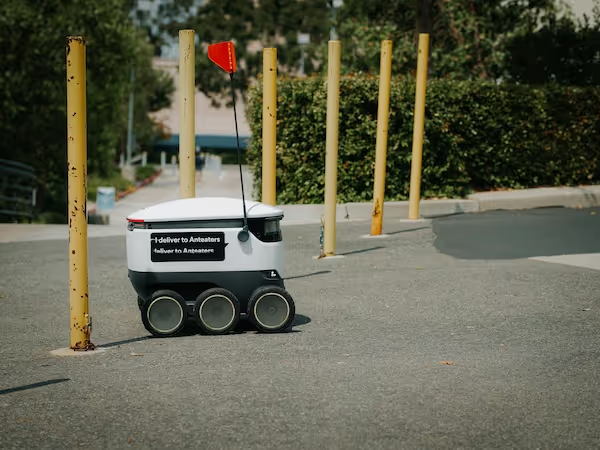
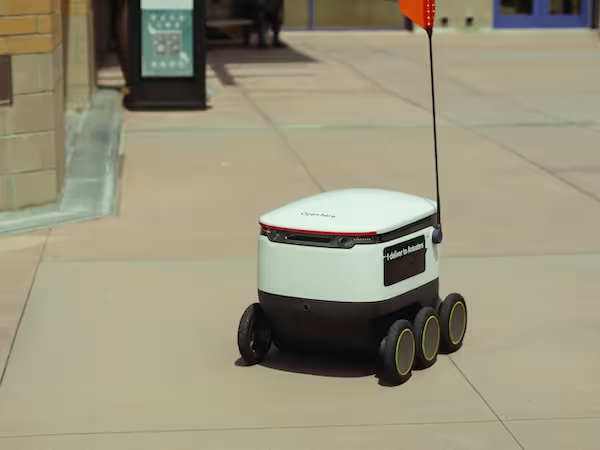
Robots use semantic maps to identify drivable areas, avoid obstacles and build long term environmental representations. Segmentation helps robots differentiate ramps from walls, doors from panels and moving people from static structures. These distinctions influence trajectory planning and real time control. When robots operate in narrow indoor spaces or cluttered industrial zones, segmentation gives them the spatial resolution needed to navigate safely. Without pixel level cues, path planning becomes unstable and unreliable.
How Robots Use Segmented Scenes for Manipulation
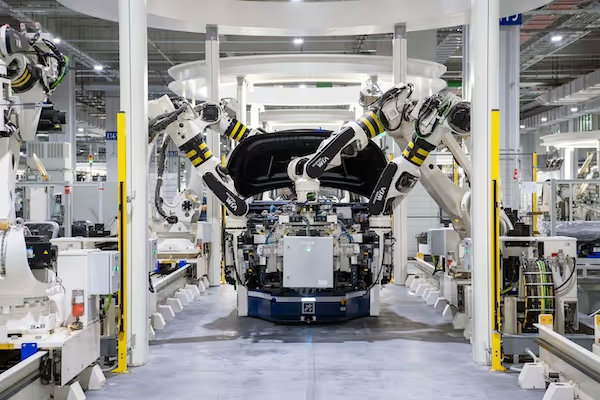
Manipulation tasks require precise knowledge of object boundaries, shapes and orientations. Segmentation identifies pickable surfaces and helps robots avoid collisions with nearby objects. In multi object environments, segmentation separates overlapping shapes so the robot can target individual items accurately. For tasks involving tools or hands, segmentation provides critical visual feedback that supports grasp strategies and contact point estimation. Without segmentation, manipulation becomes error prone, especially when objects are partially occluded.
Designing a Taxonomy for Robotic Scene Segmentation
Taxonomy design determines how scenes are labeled and how robots interpret their environments. Categories must reflect both the operational needs of the robot and the visual characteristics present in the dataset. A well structured taxonomy helps annotators apply labels consistently and helps models learn meaningful representations. ETH Zürich's Autonomous Systems Lab emphasizes the value of aligning taxonomy with robot capabilities and sensing modalities.
High Level Environmental Categories
High level categories typically include floor, ceiling, walls, doors, furniture, machines, people and vehicles. These categories help robots understand the general structure of an environment. High level segmentation improves navigation stability by guiding the robot toward safe, navigable surfaces and away from dangerous zones. These categories should be visually distinct so annotators can apply them reliably.
Application Specific Categories
Specialized robots require domain specific categories such as conveyor belts in warehouses, storage racks in logistics centers or vegetation in agricultural fields. These categories help the robot understand unique operational contexts. Application specific segmentation improves performance in specialized tasks like pallet detection, row following or tool identification. By adapting the taxonomy to the task, dataset producers improve model accuracy in real deployments.
Object and Region Level Categories
In some robotics applications, segmentation must identify fine grained subclasses such as handles, buttons, switches or machine edges. These detailed categories help robots interact with complex environments. Object level segmentation enables precise manipulation, while region level segmentation supports finer navigation control. The taxonomy must balance comprehensiveness with annotation cost to remain practical.
Collecting Images for Robotic Scene Segmentation
Dataset collection significantly influences the model's ability to generalize across real world conditions. Robots encounter dynamic scenes, changing lighting and diverse environments, so the dataset must reflect these variations. High quality collection improves dataset diversity and enhances model robustness.
Indoor Scene Collection
Indoor environments contain structured spaces with predictable layouts but significant object variability. Robotic platforms operating in homes, warehouses or factories encounter obstacles such as furniture, shelves, tools and equipment. Collecting images from multiple buildings, lighting conditions and object arrangements ensures that segmentation models learn a wide range of patterns. Indoor datasets benefit from multi angle capture, as robots often observe objects from unusual viewpoints.
Outdoor Scene Collection
Outdoor environments present challenges such as varying sunlight, shadows, vegetation, weather conditions and uneven terrain. Autonomous outdoor robots require segmentation models that handle complex textures such as grass, gravel, asphalt and rocks. Collecting data across different times of day and seasons improves model resilience. Outdoor datasets should include moving elements such as pedestrians, cyclists or animals to handle dynamic scenes.
Multi Sensor Collection
Robots frequently use RGB cameras, depth sensors and LiDAR to perceive their environment. Combining these modalities improves scene understanding and segmentation accuracy. Deploying multi sensor rigs during data collection provides complementary information that enhances labeling and training. Multi sensor datasets provide robust input for models operating in low light, challenging geometry or cluttered environments.
Preprocessing Images Before Annotation
Preprocessing improves image clarity and prepares data for consistent annotation. Because robotic scenes vary widely across environments, consistent preprocessing ensures annotators have reliable visual cues. Preprocessing must be applied carefully to avoid altering structural features essential for segmentation.
Normalizing Lighting and Exposure
Lighting inconsistencies affect segmentation accuracy. Adjusting brightness, contrast and exposure ensures consistent visibility across the dataset. Normalized lighting helps annotators identify boundaries accurately, especially in environments with shadows or reflections. Removing lighting artifacts also prevents models from learning spurious patterns.
Correcting Lens Distortion
Camera lenses may introduce distortion that affects object shapes and boundaries. Correcting distortion ensures that straight edges appear correctly and that geometry remains consistent. Robots using wide angle or fisheye lenses especially benefit from this correction. Distortion removal improves annotation accuracy and prevents misalignment between labels and images.
Aligning Multi Sensor Inputs
When datasets include depth or LiDAR, spatial alignment is essential. Annotators rely on aligned data to label objects consistently across modalities. Proper alignment also supports sensor fusion models, which combine data streams to enhance segmentation performance. Alignment preprocessing ensures seamless integration of sensor outputs.
Annotation Methods for Robotic Scene Segmentation
Annotation approaches determine the granularity and precision of the dataset. Each method has advantages depending on the complexity of the environment and the robot's needs. Consistent annotation methods improve model learning and prevent errors during deployment.
Pixel Level Semantic Segmentation
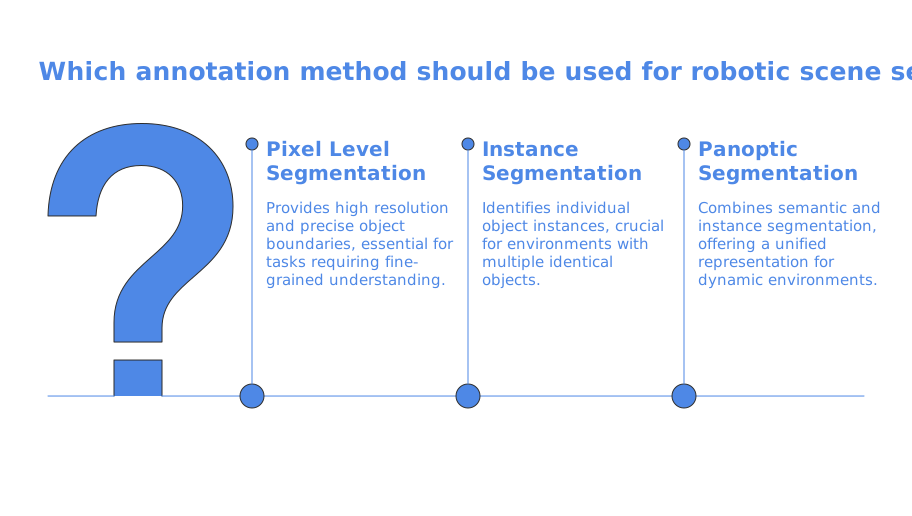
Pixel level segmentation assigns each pixel to a specific category, providing the highest resolution representation of the scene. This method captures precise object boundaries and supports accurate navigation and manipulation. Pixel level segmentation is essential for tasks requiring fine grained understanding such as obstacle avoidance or object grasping. Although time intensive, this method provides high value for advanced robotics systems.
Instance Segmentation for Object Separation
Instance segmentation identifies individual object instances, distinguishing between separate chairs, tools or boxes. This method is important in environments where multiple identical objects appear close together. Instance segmentation helps robots track objects over time and interact with them individually. It also enhances navigation by allowing robots to predict object motion patterns.
Panoptic Segmentation for Unified Understanding
Panoptic segmentation combines semantic and instance segmentation, offering a unified representation of background regions and specific object instances. This approach is beneficial in dynamic environments where robots must track moving objects while understanding static structures. Panoptic datasets provide rich information for robots performing complex spatial reasoning and long term planning.
Creating Annotation Guidelines
Annotation guidelines ensure consistent labeling across annotators and environments. Clear rules improve dataset accuracy and reduce confusion when handling complex or ambiguous cases. Strong guidelines improve model stability and facilitate large scale dataset production.
Defining Category Boundaries
Category boundaries must be clearly defined, especially when objects overlap or share similar textures. Guidelines should explain how to separate adjacent objects, how to treat partially visible elements and how to handle occlusions. Clear boundary rules improve consistency and reduce disagreement between annotators.
Handling Reflective or Transparent Surfaces
Robots frequently encounter glass, polished floors and reflective equipment. These surfaces can confuse annotators and models because they distort visible boundaries. Guidelines must specify how to label reflections, transparency and low contrast edges. Consistent handling of these surfaces improves performance in real environments.
Labeling Dynamic and Moving Objects
Robots often operate in environments with moving people, forklifts or carts. Annotators must label these moving objects accurately, even when motion blur appears in the images. Guidelines should explain how to handle partial visibility, rapid movement and occlusion during motion. Clear rules improve the model's ability to recognize dynamic elements in real time.
Quality Control for Scene Segmentation Datasets
Quality control ensures that segmentation datasets remain accurate and reliable across thousands of images. Because robotic decision making depends on segmentation outputs, errors in labeling can introduce safety risks or navigation failures. Rigorous QA processes help maintain high dataset quality.
Multi Stage Review
A multi stage review process catches inconsistencies, boundary inaccuracies and category mislabels. First stage reviewers verify category correctness, while second stage reviewers inspect boundary precision and adherence to guidelines. This layered approach reduces annotation drift and ensures long term dataset consistency.
Expert Review for Critical Environments
Certain robotic environments such as warehouses, hospitals or industrial plants require expert domain knowledge. Specialists review annotations to ensure that categories align with operational needs. Expert validation improves the reliability of models deployed in high risk or regulated environments.
Automated Consistency Checks
Automated tools detect anomalies such as incomplete segmentation masks, mislabeled regions or irregular shapes. These checks accelerate QA and help reviewers focus on problematic areas. Automated validation complements human oversight and improves scalability.
Challenges in Robotic Scene Segmentation
Robotic scenes pose unique segmentation challenges due to dynamic conditions, cluttered spaces and unpredictable interactions. Understanding these challenges helps teams design robust datasets and annotation strategies that generalize across real deployments.
Dynamic Environments and Moving Objects
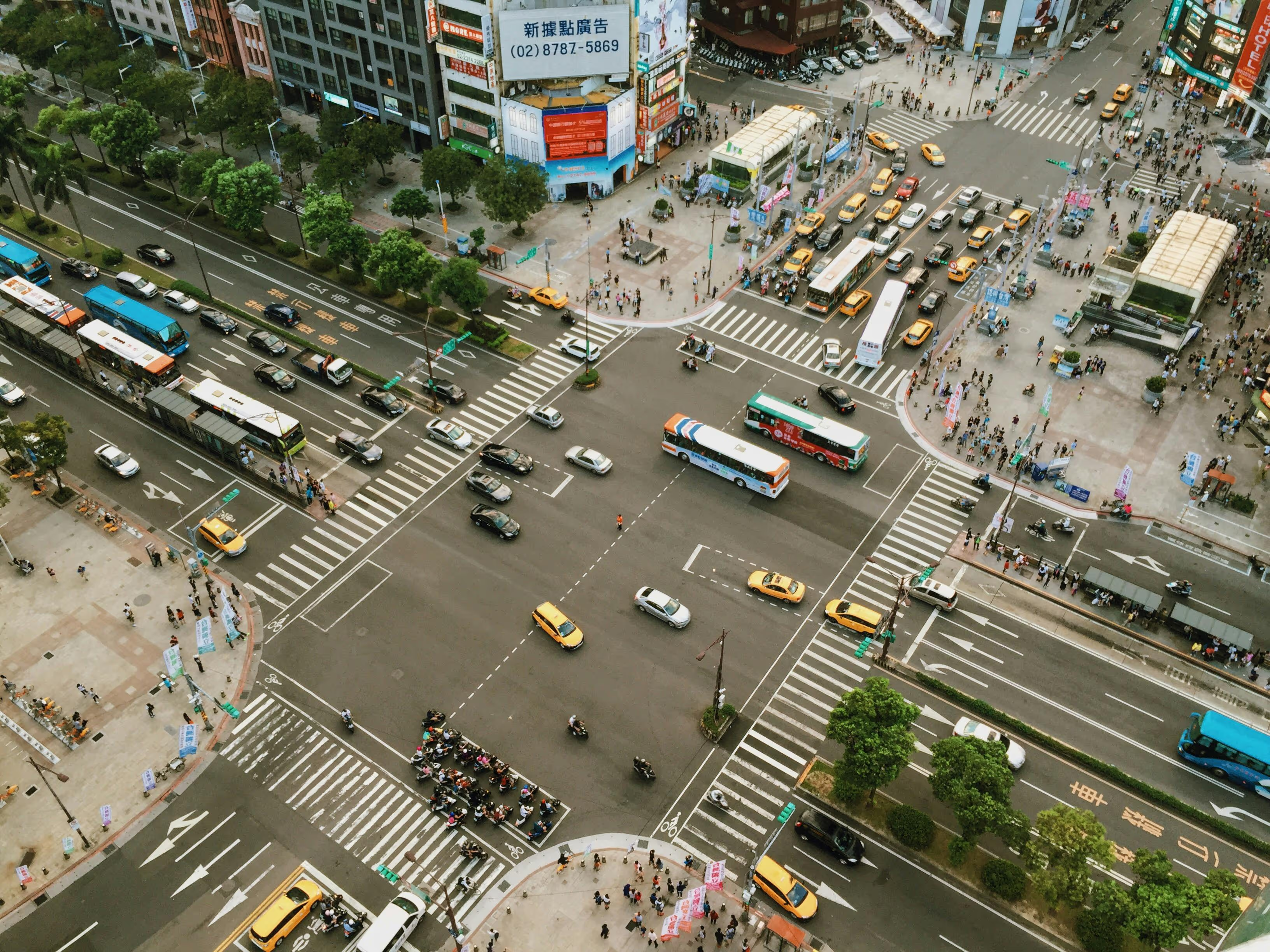
Robots must operate in environments where objects and people move unpredictably. Motion blur, temporary occlusions and variable object configurations make segmentation difficult. Datasets must include dynamic scenes to prepare models for real world complexity. Without dynamic variation, models may perform poorly during deployment.
Cluttered Indoor Spaces
Indoor environments such as warehouses, offices or factories contain dense arrangements of objects with complex geometries. These cluttered scenes require detailed segmentation to distinguish between overlapping items. Annotators must follow strict guidelines to separate closely packed objects accurately. Cluttered datasets improve model robustness in real tasks.
Outdoor Weather and Lighting Variability
Outdoor robots encounter rain, snow, dust, strong sunlight and shadows. These conditions can distort object visibility and create segmentation challenges. Datasets must include weather variability and diverse lighting to ensure model resilience. Environmental diversity strengthens generalization and reduces the risk of failures.
How Segmentation Supports Robotic Autonomy
Semantic segmentation underpins multiple layers of robotic autonomy. It supports perception, navigation, planning and control systems by providing clear environmental structure. High quality segmentation datasets improve safety, efficiency and operational reliability across robotic platforms.
Integration into Navigation Systems
Robots use segmentation outputs to classify drivable areas, detect hazards and build semantic maps. These maps guide path planning algorithms and help robots make safe navigation decisions. Segmentation enhances localization by providing landmarks and features that remain stable over time. Integrating segmentation with navigation systems improves long term autonomy.
Integration into Manipulation Systems
Manipulation depends on accurate perception of object boundaries and surfaces. Segmentation helps robots identify grasp points, avoid collisions and interact with complex tools. In industrial environments, segmentation supports automation of picking, placing and assembly tasks. Reliable object boundaries reduce control errors and improve success rates.
Supporting Multi Robot Coordination
Segmentation also supports multi robot systems that operate in shared spaces. By recognizing each robot's position and surrounding environment, segmentation facilitates safe coordination. Robots rely on segmentation to predict each other's movement patterns and avoid collisions. This capability becomes essential in high throughput environments with multiple autonomous agents.
Supporting Your Robotic Vision Projects
If you are developing robotic perception or building scene segmentation datasets, we can help you design robust annotation pipelines, create precise multi sensor labels and maintain consistent quality across complex environments. Our teams specialize in high resolution segmentation for navigation, manipulation and autonomous systems. If you want support for your next robotics dataset, feel free to reach out anytime.
What is Semantic scene segmentation for robotics?
Semantic scene segmentation is one of the most important computer vision methods in robotics because it allows autonomous systems to understand complex environments at a pixel level. Robots must distinguish surfaces, obstacles, objects and navigable areas with high precision to navigate safely in real world conditions.
Why does semantic scene segmentation matter in robotics?
Semantic scene segmentation enables robots to interpret the world by assigning each pixel to a meaningful category such as floor, wall, person, obstacle, machine or vegetation. This fine grained understanding supports safe navigation, collision avoidance, manipulation planning and multi robot coordination.
What does the section on “Preprocessing images before annotation” explain?
Preprocessing improves image clarity and prepares data for consistent annotation. Because robotic scenes vary widely across environments, consistent preprocessing ensures annotators have reliable visual cues. Preprocessing must be applied carefully to avoid altering structural features essential for segmentation.
How can teams ensure quality in Semantic scene segmentation for robotics?
Quality control ensures that segmentation datasets remain accurate and reliable across thousands of images. Because robotic decision making depends on segmentation outputs, errors in labeling can introduce safety risks or navigation failures. Rigorous QA processes help maintain high dataset quality.
What are the main challenges of Semantic scene segmentation for robotics?
Robotic scenes pose unique segmentation challenges due to dynamic conditions, cluttered spaces and unpredictable interactions. Understanding these challenges helps teams design robust datasets and annotation strategies that generalize across real deployments. Robots must operate in environments where objects and people move unpredictably.
How does Segmentation support Robotic autonomy?
Semantic segmentation underpins multiple layers of robotic autonomy. It supports perception, navigation, planning and control systems by providing clear environmental structure. High quality segmentation datasets improve safety, efficiency and operational reliability across robotic platforms.