PPE Detection Datasets: How Annotated Safety Gear Images Train Worker Protection AI
.jpeg)
PPE detection datasets provide the annotated visual data required to train AI systems that recognize helmets, vests, gloves, and other protective gear in industrial and construction environments. This article explains how these datasets are designed, what categories annotators label, and how image variation influences model performance. It reviews dataset structure, annotation workflows, edge-case handling, and the role of inspection standards in guiding annotation decisions. Readers will also learn how PPE detection datasets support real-time safety monitoring and automated compliance verification. The article concludes with an examination of data quality requirements and future directions in multimodal safety datasets.
- PPE detection datasets provide the annotated visual data required to train AI systems that recognize helmets, vests, gloves, and other protective gear in industrial and construction environments.
- This article explains how these datasets are designed, what categories annotators label, and how image variation influences model performance.
- Readers will also learn how PPE detection datasets support real-time safety monitoring and automated compliance verification.
- The article concludes with an examination of data quality requirements and future directions in multimodal safety datasets.
Understanding PPE Detection Datasets
A PPE detection dataset is a curated collection of annotated images or video frames showing workers wearing personal protective equipment in real industrial environments. These datasets contain labels that identify helmets, high-visibility vests, gloves, face shields, boots, hearing protection, or other safety gear. PPE detection datasets enable AI systems to determine whether workers meet safety requirements by analyzing visual cues automatically. Standards and guidelines such as those published by OSHA describe the essential categories of personal protective equipment that workplaces must monitor and enforce.
Why PPE Detection Matters for Industrial Safety
Industrial worksites present dynamic environments where workers are continually exposed to hazards. Ensuring that every worker uses appropriate protective gear is essential for reducing injuries and preventing operational disruptions. Manual supervision is difficult in large or complex sites where visibility is limited. PPE detection models provide consistent, automated monitoring by identifying whether safety gear is worn correctly. These models support proactive safety management, reduce response time during incidents, and help organizations monitor compliance. PPE detection datasets supply the training material required for these capabilities.
The Role of Annotated Visual Data
AI models learn to identify personal protective equipment through repeated exposure to annotated examples. Annotators highlight the exact region of each safety gear item within the image and apply detailed labels. The dataset represents variations in lighting, pose, occlusion, and equipment appearance. Capturing these variations ensures that models generalize well to real-world conditions. Annotated visual data must accurately reflect worksite diversity, including different types of helmets, vests, and protective clothing used across industries.
Components of a PPE Detection Dataset
A PPE detection dataset includes carefully structured elements that support object detection, segmentation, and classification tasks. These components influence how effectively the model can learn to identify PPE in varying conditions.
Worker and Equipment Representation
The dataset contains images showing workers in real-world or simulated environments. Workers may appear individually or in groups, and their poses can vary significantly. Equipment such as helmets or vests must appear clearly and represent a range of designs, colors, and conditions. Organizations like the National Institute for Occupational Safety and Health (NIOSH) describe the diversity of safety gear designs across industries, reinforcing the need for broad representation in annotated data.
Object-Level Annotations
Annotators label each item of protective equipment at the object level. Labels may include bounding boxes or segmentation masks depending on model requirements. For helmets, annotators identify the exact region corresponding to the shell contour. For vests, masks indicate reflective patterns or high-visibility material areas. Object-level annotations ensure that models learn precise spatial relationships within the image. Each annotation must follow strict guidelines to maintain consistency across the dataset.
Scene Variability and Background Diversity
PPE detection datasets must include diverse scenes that reflect variations across construction, manufacturing, mining, utilities, and logistics environments. Background variation helps prevent models from overfitting to a narrow subset of scenes. Images from indoor factories, outdoor worksites, elevated structures, or nighttime operations help the dataset capture realistic environmental conditions. Background diversity ensures robust performance in multi-industry settings.
Annotation Workflows for PPE Detection
Annotation workflows define how images are reviewed, labeled, and validated. These workflows must be detailed and systematic to ensure accurate and consistent annotations across the dataset.
Annotating Helmets and Head Protection
Helmet detection requires precise annotation to capture the shape, size, and orientation of the helmet across a variety of head positions. Annotators must distinguish helmets from hair, caps, or shadows and identify cases where helmets are partially obscured. Reflection, lighting changes, or dirt on helmets can complicate boundaries. Detailed annotation instructions guide annotators in handling these variations and maintaining boundary precision. Head protection annotations reflect industry standards described by bodies such as ANSI, which define safety requirements for protective helmets.
Annotating Vests and High-Visibility Clothing
Vests and high-visibility garments require annotations that capture both the material surface and reflective strips. Some vests may include partial reflective patterns, while others feature complex color combinations. Annotators must label the visible parts of the vest accurately, even when partially obscured. Changes in worker posture can alter how vests appear, requiring careful interpretation during annotation. Guidelines must address reflective glare that may distort object boundaries.
Annotating Gloves, Boots, and Additional Protective Equipment
Gloves and boots require fine-grained annotations due to their smaller size and frequent occlusion. Workers may carry tools that obscure their hands or feet. Annotators must differentiate between gloves and bare hands and identify whether boots meet required safety specifications. Additional equipment such as face shields, goggles, and hearing protection may also be annotated depending on project scope. These objects require specialized guidelines because they can be difficult to detect in low-resolution images.
Challenges in PPE Detection Annotation
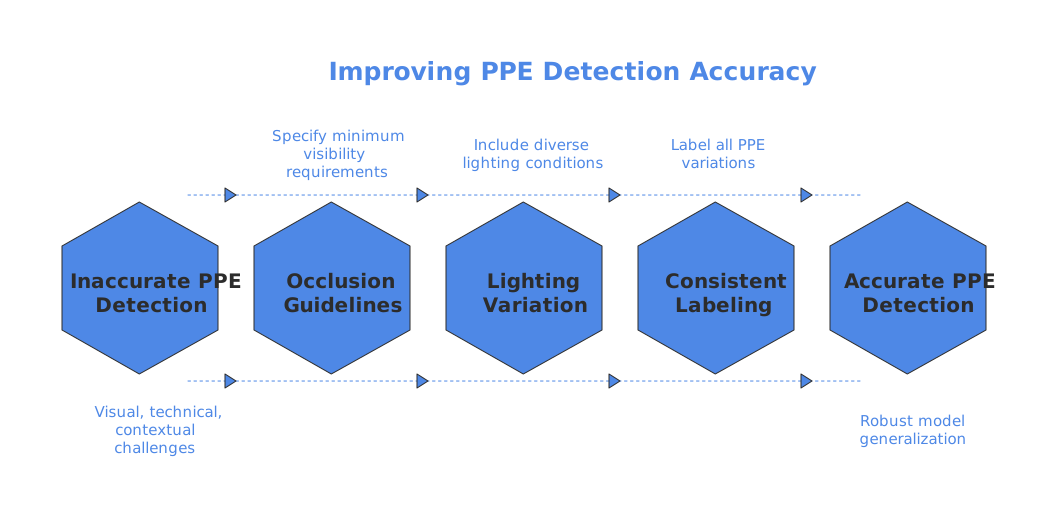
PPE annotation involves unique visual, technical, and contextual challenges that influence dataset quality and model performance.
Occlusion and Partial Visibility
Workers frequently stand behind machinery, equipment, or other workers, leading to partial visibility of protective gear. Annotators must determine how to label PPE in such cases and whether partial objects should be included. Occlusion guidelines must specify minimum visibility requirements. These decisions impact model performance in crowded or complex environments.
Lighting and Environmental Variation
Worksites often have rapidly changing lighting conditions. Bright sunlight, shadows, artificial lighting, or nighttime illumination can alter object appearance significantly. Annotators must balance precision with realism by labeling objects despite visual distortions. These variations require datasets to include images from a wide range of lighting conditions to ensure robust model generalization.
PPE Appearance Variability
Helmets, vests, and protective gear come in different colors, shapes, and designs. Models must learn to recognize all variations as PPE. Annotators must label each variation consistently, ensuring that the dataset reflects real industry diversity. The UK Health and Safety Executive highlights how PPE variation across industries influences compliance requirements and risk mitigation strategies.
Designing Annotation Guidelines for PPE Datasets
Annotation guidelines define the rules and standards annotators follow. Clear guidelines ensure that labels reflect consistent interpretations across thousands of images.
Defining PPE Categories and Subcategories
Guidelines specify the PPE categories that annotators must identify and how to differentiate between them. Subcategories may include helmet types, vest patterns, or specific glove materials. Clear categorization allows models to learn fine-grained distinctions. Defining categories carefully ensures that annotations align with industrial and construction safety requirements and model objectives.
Handling Ambiguous Cases
Guidelines include instructions for dealing with ambiguous instances such as backward-worn helmets, partially unzipped vests, or torn protective gear. Annotators must determine whether PPE is worn correctly or incorrectly. These distinctions support compliance monitoring applications. Guidelines provide examples that illustrate how to handle challenging cases and reduce ambiguity.
Quality Assurance for PPE Detection Datasets
Quality assurance ensures that annotations are accurate, consistent, and complete. High-quality datasets improve model reliability and reduce the need for post-processing corrections.
Inter-Annotator Agreement
Quality assurance teams compare annotations across multiple annotators to assess agreement. Differences highlight areas where guidelines require clarification or where additional training is needed. High agreement indicates that annotations follow consistent interpretations. This metric is essential for evaluating dataset reliability.
Review of Edge Cases
Review teams examine edge cases such as occluded objects, non-standard PPE, or visually distorted items. Edge case review ensures that annotations reflect realistic safety scenarios and improve model performance in challenging environments. These cases may be escalated to domain experts or safety professionals for verification.
Applications of PPE Detection Datasets
PPE detection datasets support a broad range of applications across construction, manufacturing, energy, logistics, and other industrial sectors.
Automated Compliance Monitoring
AI systems use PPE detection datasets to determine whether workers are wearing the required safety gear. Automated compliance monitoring reduces the need for continuous manual supervision. Organizations can generate compliance reports and identify trends in safety behavior. These systems help maintain high safety standards across large or distributed worksites.
Real-Time Hazard Prevention
PPE detection models contribute to real-time safety systems that alert supervisors when workers lack required protective gear. Automated alerts allow teams to intervene quickly and reduce incident risk. These systems enhance situational awareness and support proactive safety management. Real-time monitoring is particularly valuable in environments with high movement and limited visibility.
Post-Incident Review and Analytics
Annotated datasets help AI systems analyze incidents by correlating PPE usage with safety events. Post-incident analysis supports training, root-cause investigation, and process optimization. Safety engineers use these insights to improve worksite design and strengthen protection protocols. The American Society of Civil Engineers provides resources that describe how engineering principles support safety improvements in construction and industrial settings.
Future Directions in PPE Detection Datasets
PPE detection datasets are evolving as new imaging technologies, safety standards, and machine learning capabilities emerge. Future datasets will capture more complex relationships and scenarios.
Multimodal Safety Monitoring
Future datasets may combine RGB images, thermal imaging, depth sensors, or LiDAR data to support multimodal safety detection. These datasets enable models to detect PPE in low-light conditions or obstructed environments. Integrating multiple data types provides richer context and enhances accuracy across diverse scenarios.
Monitoring PPE Integrity and Fit
Advanced models may evaluate whether PPE is worn correctly or whether equipment is damaged. This requires datasets that annotate PPE condition, positioning, and fit. Fine-grained annotations allow models to assess more nuanced safety indicators. This evolution expands the role of PPE detection beyond simple presence recognition.
If You Are Building PPE Detection or Construction Safety Datasets
PPE detection requires high-quality annotated visual data that accurately reflects the complexity of industrial and construction environments. If you need support creating datasets for helmet detection, vest identification, protective gear monitoring, or broader safety analytics, the DataVLab team can help design annotation workflows that ensure precision, consistency, and real-world relevance. Share your objectives, and we can help you build robust safety detection datasets tailored to your operational needs.
What are PPE detection datasets?
PPE detection datasets provide the annotated visual data required to train AI systems that recognize helmets, vests, gloves, and other protective gear in industrial and construction environments. This article explains how these datasets are designed, what categories annotators label, and how image variation influences model performance.
Why does PPE detection matter for industrial safety?
Industrial worksites present dynamic environments where workers are continually exposed to hazards. Ensuring that every worker uses appropriate protective gear is essential for reducing injuries and preventing operational disruptions. Manual supervision is difficult in large or complex sites where visibility is limited.
What does the section on “Annotation workflows for PPE detection” explain?
Annotation workflows define how images are reviewed, labeled, and validated. These workflows must be detailed and systematic to ensure accurate and consistent annotations across the dataset. Helmet detection requires precise annotation to capture the shape, size, and orientation of the helmet across a variety of head positions.
What is involved in designing annotation guidelines for PPE datasets?
Annotation guidelines define the rules and standards annotators follow. Clear guidelines ensure that labels reflect consistent interpretations across thousands of images. Guidelines specify the PPE categories that annotators must identify and how to differentiate between them.
How can teams ensure quality in PPE detection datasets?
Quality assurance ensures that annotations are accurate, consistent, and complete. High-quality datasets improve model reliability and reduce the need for post-processing corrections. Quality assurance teams compare annotations across multiple annotators to assess agreement.
What is the future of PPE detection datasets?
PPE detection datasets are evolving as new imaging technologies, safety standards, and machine learning capabilities emerge. Future datasets will capture more complex relationships and scenarios. Future datasets may combine RGB images, thermal imaging, depth sensors, or LiDAR data to support multimodal safety detection.