Concrete Crack Datasets: How Annotated Damage Images Train Structural Inspection AI
.jpeg)
Concrete crack datasets provide the annotated visual evidence used to train AI systems that detect structural defects in buildings, bridges, tunnels, pavements, and industrial infrastructure. This article explains how these datasets are constructed, what types of defects they include, and how annotation teams label crack geometry, surface textures, and environmental conditions. It covers dataset structure, annotation workflows, quality assurance, and the challenges posed by lighting variation, material aging, and surface contamination. The article also explores how concrete crack datasets support automated inspection, maintenance scheduling, and engineering diagnostics. The conclusion highlights future directions in multimodal sensing, crack depth estimation, and large-scale structural monitoring with AI.
- Concrete crack datasets provide the annotated visual evidence used to train AI systems that detect structural defects in buildings, bridges, tunnels, pavements, and industrial infrastructure.
- This article explains how these datasets are constructed, what types of defects they include, and how annotation teams label crack geometry, surface textures, and environmental conditions.
- It covers dataset structure, annotation workflows, quality assurance, and the challenges posed by lighting variation, material aging, and surface contamination.
- The conclusion highlights future directions in multimodal sensing, crack depth estimation, and large-scale structural monitoring with AI.
Understanding Concrete Crack Datasets
A concrete crack dataset is a curated collection of labeled images showing fractures, fissures, and surface damage on concrete structures. These datasets train AI models to detect and classify cracks in infrastructure such as bridges, tunnels, highways, building facades, and industrial floors. Unlike generalist defect datasets, concrete crack datasets focus on the specific visual patterns associated with structural degradation, including hairline cracks, spalling, surface staining, and deep fractures that indicate structural failure risk. Annotators label each image according to crack type, geometry, severity, and environmental context to create ground truth labels that allow models to perform reliable automated inspection at scale.
Types of Cracks Represented in Concrete Datasets
Hairline Cracks
Hairline cracks are fine, shallow cracks that appear early in concrete degradation. They are often invisible to the naked eye under normal lighting conditions but become detectable through high-resolution imagery or specialized sensors. Including hairline cracks in training datasets teaches models to identify early-stage damage before it becomes structurally significant.
Surface and Structural Cracks
Surface cracks affect the outer layer of concrete without penetrating deep into the structure. Structural cracks, by contrast, extend through the material and indicate load-bearing failure risk. Annotators label these with different severity levels so models can distinguish between cosmetic and critical damage.
Spalling and Delamination
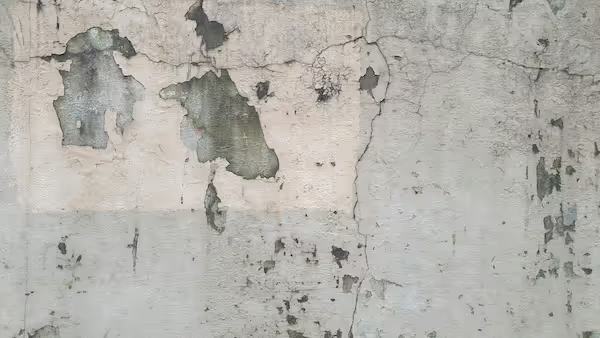
Spalling occurs when chunks of concrete detach from the surface due to freeze-thaw cycles, corrosion of reinforcing steel, or impact damage. Delamination involves layers of concrete separating from each other. Both require detailed segmentation annotations because they present as irregular shapes with variable texture and shadow patterns.
Environmental and Weathering Damage
Staining, efflorescence, and biological growth often coexist with structural damage. Training datasets must include examples that distinguish these surface phenomena from genuine cracks so models do not confuse discoloration with fractures.
How Concrete Crack Datasets Are Structured
Image and Label Pairing
Each dataset entry consists of a raw image and a corresponding annotation file. The annotation file may contain bounding boxes around detected crack regions, segmentation masks that outline crack geometry at the pixel level, or classification labels that assign a severity rating to the entire image. The choice of annotation type depends on whether the downstream model needs to locate cracks, segment their extent, or classify images by damage level.
Severity and Damage Classification
Many concrete crack datasets use hierarchical classification systems. Annotators assign both a crack type label and a severity rating that reflects the urgency of inspection or repair. These ratings help maintenance teams prioritize asset interventions and allow models to output actionable recommendations rather than binary defect flags.
Multi-Class Annotation
Advanced datasets use multi-class labels that combine crack type, location within the structure, surface condition, and environmental factors. This multi-dimensional labeling supports models that must produce detailed inspection reports rather than simple crack or no-crack predictions.
Challenges in Annotating Concrete Crack Datasets
Lighting and Shadow Variation
Lighting conditions dramatically affect how cracks appear in images. Strong shadows can make surface features look like cracks, while diffuse lighting can hide fine fractures. Annotators must evaluate each image in context and apply consistent labeling rules despite wide variation in image quality.
Scale and Resolution
Cracks range in scale from microscopic fractures to wide openings visible at distance. Datasets must capture this range and annotators must label cracks at the resolution at which they are visible in the source image. Scale calibration metadata helps models interpret crack width measurements against real-world dimensions.
Similar Surface Features
Grout lines, construction joints, and intentional surface texturing can visually resemble cracks. Annotation guidelines must define clear rules for distinguishing structural damage from intentional surface features to prevent false positive detection.
Annotation Workflows for Structural Inspection AI
Segmentation-Based Annotation
Pixel-level segmentation is the most precise annotation type for concrete crack datasets. Annotators trace the exact path and width of each crack, producing masks that models use to estimate crack geometry and structural severity. Segmentation annotation is time-intensive but produces the most informative training data for inspection models.
Bounding Box and Region Annotation
For applications requiring faster inference, bounding box annotation is more practical. Annotators mark rectangular regions around visible damage without tracing exact crack geometry. This approach supports detection models that identify the presence and location of cracks without measuring their precise shape.
Quality Assurance for Structural Data
Structural inspection datasets require multi-stage quality review because annotation errors can propagate into safety-critical model predictions. Review processes include peer annotation checks, gold standard benchmarking, and independent adjudication for disputed cases. Annotators are required to follow detailed guidelines that specify how to handle edge cases such as partially visible cracks, mixed damage types, and ambiguous surface conditions.
Applications of Concrete Crack Detection AI
Bridge and Tunnel Inspection
AI-powered crack detection reduces the cost and risk of manual bridge inspection by enabling continuous monitoring from fixed cameras or drone-mounted sensors. Models trained on well-annotated concrete crack datasets detect deterioration earlier and support more accurate risk assessment than periodic visual inspection alone.
Building Facade Monitoring
Urban building stock accumulates surface damage over time. Automated inspection systems scan facades using high-resolution cameras and flag locations requiring maintenance intervention. These systems reduce inspection costs and improve response time for at-risk structures.
Pavement and Road Assessment
Road surface monitoring systems use vehicle-mounted cameras and mobile platforms to collect continuous imagery of road surfaces. AI models classify cracking patterns, identify pothole precursors, and generate maintenance priority maps that inform road management decisions.
Industrial Facility Inspection
Factories, warehouses, and industrial plants contain extensive concrete flooring, walls, and support structures that require regular inspection. Automated defect detection reduces the need for manual inspection cycles and ensures that structural risks are identified before they create operational disruptions.
For related reading, see our guides on data annotation vs data labeling, types of data annotation and data annotation pricing.
Getting High-Quality Concrete Crack Annotation
Concrete crack datasets require annotators with structural engineering context who can distinguish between crack types, apply consistent severity ratings, and follow annotation guidelines precisely. DataVLab provides annotation services for structural inspection AI, including segmentation, bounding box annotation, and multi-class labeling for concrete, pavement, and facade inspection datasets. If you are building or expanding a structural defect detection system, contact DataVLab to discuss annotation requirements and quality standards.
What are Concrete crack datasets?
Concrete crack datasets provide the annotated visual evidence used to train AI systems that detect structural defects in buildings, bridges, tunnels, pavements, and industrial infrastructure. This article explains how these datasets are constructed, what types of defects they include, and how annotation teams label crack geometry, surface textures, and environmental conditions.
What does the article explain about how concrete crack datasets are structured?
Each dataset entry consists of a raw image and a corresponding annotation file. The annotation file may contain bounding boxes around detected crack regions, segmentation masks that outline crack geometry at the pixel level, or classification labels that assign a severity rating to the entire image.
What are the main challenges of Concrete crack datasets?
Lighting conditions dramatically affect how cracks appear in images. Strong shadows can make surface features look like cracks, while diffuse lighting can hide fine fractures. Annotators must evaluate each image in context and apply consistent labeling rules despite wide variation in image quality.
What does the section on “Annotation workflows for structural inspection AI” explain?
Pixel-level segmentation is the most precise annotation type for concrete crack datasets. Annotators trace the exact path and width of each crack, producing masks that models use to estimate crack geometry and structural severity. Segmentation annotation is time-intensive but produces the most informative training data for inspection models.
What are the main use cases for Concrete crack datasets?
AI-powered crack detection reduces the cost and risk of manual bridge inspection by enabling continuous monitoring from fixed cameras or drone-mounted sensors. Models trained on well-annotated concrete crack datasets detect deterioration earlier and support more accurate risk assessment than periodic visual inspection alone.
How can teams ensure quality in Concrete crack datasets?
Concrete crack datasets require annotators with structural engineering context who can distinguish between crack types, apply consistent severity ratings, and follow annotation guidelines precisely.