Fire and Smoke Detection Datasets: Annotated Visual Data for Environmental Hazard AI
.jpeg)

Fire and smoke detection datasets provide the annotated visual data that AI systems require to identify flames, smoke plumes, heat signatures, and ignition events across diverse environments. This article explains how these datasets are created, what types of visual cues annotators label, and how variations in lighting, materials, and atmospheric conditions influence model accuracy. It examines dataset components, annotation workflows, quality assurance, and the challenges of distinguishing smoke from fog, dust, or shadows. Readers will also learn how these datasets support wildfire monitoring, industrial fire detection, and real-time alerting systems. The article concludes with future directions in multimodal fire sensing, thermal data integration, and advanced situational awareness for environmental and industrial safety.
- Fire and smoke detection datasets provide the annotated visual data that AI systems require to identify flames, smoke plumes, heat signatures, and ignition events across diverse environments.
- This article explains how these datasets are created, what types of visual cues annotators label, and how variations in lighting, materials, and atmospheric conditions influence model accuracy.
- Readers will also learn how these datasets support wildfire monitoring, industrial fire detection, and real-time alerting systems.
- The article concludes with future directions in multimodal fire sensing, thermal data integration, and advanced situational awareness for environmental and industrial safety.
Understanding Fire and Smoke Detection Datasets
Fire and smoke detection datasets consist of annotated images or video frames that capture visual indicators of ignition, flame propagation, combustion byproducts, and smoke movement. These datasets are used to train AI systems that automatically detect fires in industrial sites, forests, residential environments, or transportation infrastructure. The National Fire Protection Association publishes research highlighting how early detection significantly reduces fire-related damage and improves response outcomes. Fire and smoke datasets aim to replicate the complexity of real-world conditions where flames and smoke exhibit diverse shapes, colors, and intensities.
Why Fire and Smoke Detection Requires High-Quality Data
Fire behavior varies significantly depending on the fuel type, oxygen availability, heat conditions, and environment. Smoke patterns also differ across materials, fire stages, and ventilation states. Traditional sensors such as smoke alarms or heat detectors do not provide sufficient spatial awareness or early-stage detection in open or complex environments. AI models trained on fire and smoke detection datasets can analyze visual cues in real time and identify early indications of combustion. These datasets enable AI systems to detect anomalies long before manual inspection or traditional alarms trigger.
Distinguishing Fire from Non-Fire Phenomena
Distinguishing flames or smoke from unrelated phenomena such as bright reflections, dust, fog, or steam is essential for reliable detection. Annotators must label visual cues carefully and consider the context in which they appear. Fire and smoke detection datasets contain examples of both true and false indicators to help models learn the differences. This reduces false alarms and improves system readiness in varied environments.
Components of a Fire and Smoke Detection Dataset
Fire and smoke detection datasets contain multiple structured elements designed to represent the full range of fire-related visual indicators.
Flame Imagery
Flame imagery showcases fires at different stages, intensities, and environmental contexts. Flames may appear as small ignition points or large combustive plumes. Annotators label flame contours and intensity zones, helping AI systems detect flame boundaries accurately. Because flame shapes fluctuate rapidly, datasets must capture multiple frames or images representing the evolution of a fire event.
Smoke Plume Imagery
Smoke plumes exhibit diverse textures and colors depending on the combustion process. Annotators label smoke regions with segmentation masks or bounding boxes. Smoke may appear white, gray, black, or yellowish depending on fuel type and fire stage. Smoke plume annotations help models understand diffusion patterns and differentiate smoke from visually similar atmospheric phenomena. Research from the U.S. Forest Service emphasizes how smoke patterns play a key role in wildfire behavior and detection.
Environmental and Structural Context
Fire and smoke detection datasets include environmental context such as forests, industrial zones, residential buildings, warehouses, tunnels, and transportation systems. Each environment influences how fire appears visually. For example, flames may blend with bright sunlight outdoors, or smoke may disperse differently depending on wind direction. Annotators capture environmental context to help models interpret fire cues accurately.
Annotation Workflows for Fire and Smoke Detection
Annotation workflows guide how flames, smoke plumes, and related visual elements are labeled across the dataset.
Flame Segmentation
Annotators trace flame boundaries using polygons or segmentation masks that follow the flame’s irregular shape. Flame contours change rapidly, requiring annotators to review images at multiple zoom levels. Precision in flame boundary annotation helps AI systems detect early ignition points or small-scale combustion events. Annotators must ensure boundary accuracy even in low-light conditions where flames appear muted.
Smoke Region Annotation
Smoke annotations require differentiating between dense and thin smoke regions. Dense smoke may obscure background textures, while thin smoke may appear partially transparent. Annotators trace smoke boundaries carefully and consider how smoke interacts with surrounding objects. Smooth transitions between smoke and background require detailed mask design. Smoke plume annotation ensures that AI systems detect early smoke formation before flames become visible.
Labeling Environmental Indicators
Environmental features such as vegetation, industrial equipment, or interior structures influence how fire appears visually. Annotators may label contextual elements to help AI systems determine fire likelihood within a scene. These labels help models differentiate between fire sources and non-hazardous bright objects. Contextual labeling supports detection in challenging environments such as industrial sites or forested areas.
Challenges in Annotating Fire and Smoke
Fire and smoke annotation presents significant challenges due to the transient and complex nature of fire-related phenomena.
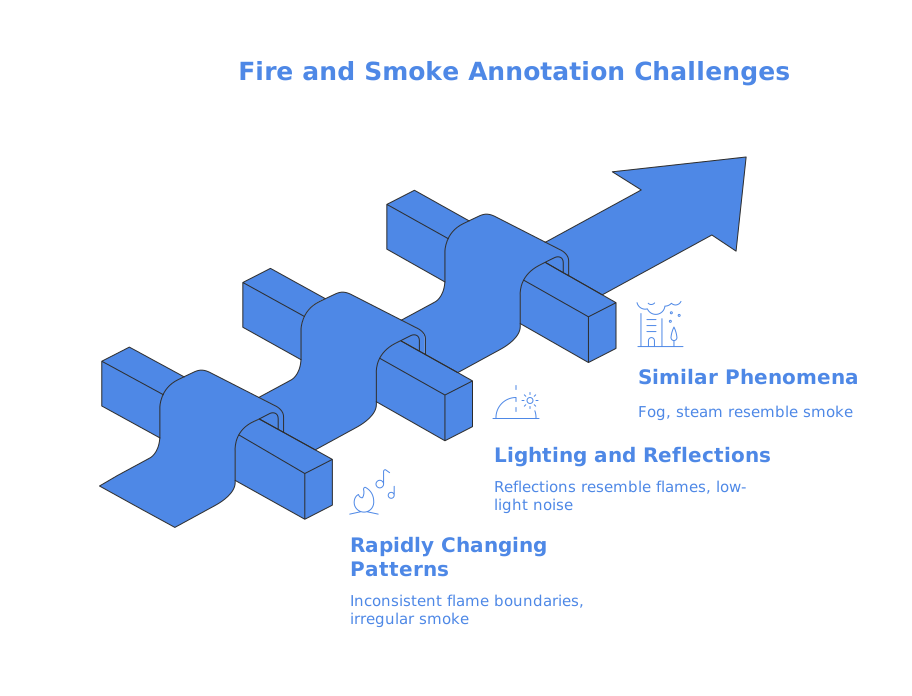
Rapidly Changing Visual Patterns
Fire and smoke exhibit continuous movement and shape changes. Annotators must determine how to label frames that show inconsistent flame boundaries. Flame shape may vary dramatically from one frame to the next, requiring consistent interpretation. Smoke plumes disperse irregularly, making boundary definition difficult in windy or open environments.
Lighting and Reflections
Bright reflections from metal surfaces, sunlight, or artificial lighting may resemble flames. Annotators must differentiate between true flames and high-intensity reflections using contextual clues. Low-light or nighttime conditions introduce noise that complicates labeling. The NIST Fire Research Division highlights how lighting conditions influence fire detection in built environments.
Similar Atmospheric Phenomena
Fog, steam, and dust particles often resemble smoke in low-resolution images. Misty environments may create similar diffusion patterns. Annotators must analyze texture continuity and color to differentiate smoke from non-smoke phenomena. Guidelines provide examples of look-alike conditions to reduce annotation errors.
Designing Annotation Guidelines
Annotation guidelines define how to label flames, smoke regions, and ambiguous atmospheric patterns in a consistent manner.
Flame Boundary Rules
Guidelines describe how to trace flame edges, identify flame cores, and handle low-contrast regions. Annotators learn how to treat overlapping flames or small ignition points that appear partially obscured. Clear rules ensure that flame annotations reflect realistic fire progression.
Smoke Classification Rules
Guidelines explain how to classify smoke density, shape, and diffusion rate. They help annotators determine whether smoke is part of the fire or a separate unrelated atmospheric effect. Examples illustrate how to treat smoke partially obscured by objects or drifting across uneven terrain.
Handling Mixed Phenomena
In many images, smoke and fire appear together, and their boundaries may overlap. Guidelines describe how to delineate these zones accurately using distinct masks. Mixed phenomena labeling supports advanced AI models that need to distinguish between flame and smoke signatures.
Quality Assurance for Fire and Smoke Datasets
Quality assurance ensures that annotations reflect high-quality interpretations of fire-related events.
Multi-Reviewer Verification
Reviewers verify labels across multiple annotators to ensure accuracy and consistency. Discrepancies involving flame boundaries or smoke regions trigger refinement cycles. Multi-reviewer processes reduce labeling noise and improve dataset reliability.
Edge Case Review
Quality assurance teams review challenging cases such as partial visibility, reflections, or unusual smoke behavior. Fire detection experts may evaluate edge cases to ensure that annotations align with known fire behavior patterns. These reviews strengthen the dataset’s ability to handle real-world complexity.
Applications of Fire and Smoke Detection Datasets
Fire and smoke detection datasets support a broad range of applications across environmental safety, industrial monitoring, and emergency response.
Early Fire Detection
AI systems trained on these datasets can identify small ignition points before fires escalate. Early detection allows responders to intervene quickly and prevent major damage. Fire-safe organizations emphasize how early intervention significantly improves containment and reduces risk.
Wildfire Monitoring
In forested areas, AI models help detect smoke plumes at early stages, even when flames are not visible. These systems analyze long-distance imagery and identify subtle smoke cues. Wildfire monitoring supports conservation agencies and emergency services, especially in regions prone to seasonal fires.
Industrial Safety Detection
Industrial sites such as warehouses, manufacturing plants, and energy facilities rely on automated detection to monitor large spaces. AI systems detect fire or smoke in areas where traditional sensors have limited coverage. These systems enhance situational awareness in high-risk industrial environments.
Future Directions in Fire and Smoke Detection Datasets
Fire and smoke detection datasets continue to evolve alongside advancements in sensing technologies and environmental monitoring.
Thermal and Multimodal Sensing
Future datasets may integrate thermal imaging, infrared data, or multispectral data to enhance detection accuracy. Multimodal datasets help models detect fires under low visibility or nighttime conditions. These enhancements expand the dataset’s ability to represent complex fire scenarios.
Predictive Fire Behavior Modeling
AI systems may use annotated datasets to predict fire spread patterns by analyzing flame evolution and smoke diffusion. Predictive modeling supports fire management teams in developing preventive measures and responding to changing conditions. Integration with atmospheric datasets will further enhance predictive capabilities.
If You Are Preparing Fire or Environmental Safety Detection Datasets
Fire and smoke detection systems rely on annotated datasets that accurately capture the complexity of flames and smoke across diverse environments. If you are building datasets for hazard identification, environmental monitoring, or early detection systems, the DataVLab team can help design annotation workflows that ensure high-quality, consistent, and domain-relevant data. Share your objectives, and we can support your fire detection initiatives with precisely annotated multimodal data.
What are Fire and smoke detection datasets?
Fire and smoke detection datasets provide the annotated visual data that AI systems require to identify flames, smoke plumes, heat signatures, and ignition events across diverse environments. This article explains how these datasets are created, what types of visual cues annotators label, and how variations in lighting, materials, and atmospheric conditions influence model accuracy.
What does the article explain about why fire and smoke detection requires High-Quality data?
Fire behavior varies significantly depending on the fuel type, oxygen availability, heat conditions, and environment. Smoke patterns also differ across materials, fire stages, and ventilation states. Traditional sensors such as smoke alarms or heat detectors do not provide sufficient spatial awareness or early-stage detection in open or complex environments.
What does the section on “Annotation workflows for fire and smoke detection” explain?
Annotation workflows guide how flames, smoke plumes, and related visual elements are labeled across the dataset. Annotators trace flame boundaries using polygons or segmentation masks that follow the flame’s irregular shape. Flame contours change rapidly, requiring annotators to review images at multiple zoom levels.
What are the main challenges of Fire and smoke detection datasets?
Fire and smoke annotation presents significant challenges due to the transient and complex nature of fire-related phenomena. Fire and smoke exhibit continuous movement and shape changes. Annotators must determine how to label frames that show inconsistent flame boundaries.
How can teams ensure quality in Fire and smoke detection datasets?
Quality assurance ensures that annotations reflect high-quality interpretations of fire-related events. Reviewers verify labels across multiple annotators to ensure accuracy and consistency. Discrepancies involving flame boundaries or smoke regions trigger refinement cycles.
What is the future of Fire and smoke detection datasets?
Fire and smoke detection datasets continue to evolve alongside advancements in sensing technologies and environmental monitoring. Future datasets may integrate thermal imaging, infrared data, or multispectral data to enhance detection accuracy. Multimodal datasets help models detect fires under low visibility or nighttime conditions.