Keyword Spotting Dataset: Training AI to Detect Wake Words and Voice Commands
.jpeg)

Keyword spotting datasets contain short audio clips labeled with specific trigger words or short phrases that help AI systems detect wake words such as “Hey Siri”, “OK Google”, or predefined command terms. These datasets include clean recordings, noisy variations, different accents, multiple speakers, and diverse recording conditions to ensure models remain reliable across environments. This article explains how keyword spotting datasets are constructed, what annotation strategies they require, and why phonetic diversity, background noise modeling, and speaker variation are essential for achieving high wake-word accuracy. It also outlines the challenges of false positives, balancing rare and common keywords, ensuring temporal precision, and validating dataset quality for real-time applications used in mobile devices, IoT products, automotive systems, and embedded voice interfaces.
- Keyword spotting datasets contain short audio clips labeled with specific trigger words or short phrases that help AI systems detect wake words such as “Hey Siri”, “OK Google”, or predefined command terms.
- These datasets include clean recordings, noisy variations, different accents, multiple speakers, and diverse recording conditions to ensure models remain reliable across environments.
- This article explains how keyword spotting datasets are constructed, what annotation strategies they require, and why phonetic diversity, background noise modeling, and speaker variation are essential for achieving high wake-word accuracy.
- Datasets contain short audio samples of predefined keywords spoken by many different speakers.
Why Keyword Spotting Datasets Matter
Powering Wake Words and Always-On Voice Interfaces
Keyword spotting datasets train models to detect predefined words quickly and accurately. Wake-word detection forms the basis of hands-free interaction for smartphones, smart speakers, and automotive systems. Research from the Speech and Audio Group at Johns Hopkins University shows that wake-word reliability depends heavily on high-quality keyword datasets with broad variability. Clean and consistent datasets ensure that voice interfaces activate only when intended.
Supporting Embedded and Low-Power Devices
Keyword spotting systems often run on low-power processors in IoT devices, wearable technology, and mobile hardware. These models require lightweight architectures trained on well-structured datasets with short clips and precise labels. Good training data allows small models to maintain high accuracy despite limited computational resources.
Improving Safety and Real-Time Responsiveness
Keyword spotting is used in safety-critical applications, including emergency detection, driver monitoring, and industrial systems. Reliable datasets ensure AI can detect critical command words and react instantly without latency or false triggers. High-quality data directly impacts operational safety.
Core Components of Keyword Spotting Datasets
Short, Precisely Labeled Audio Clips
Datasets contain short audio samples of predefined keywords spoken by many different speakers. Each clip is labeled with the exact keyword and metadata describing speaker identity, accent, environment, and recording conditions. Precision ensures the model recognizes the keyword even when spoken quickly.
Negative Samples for Non-Keyword Audio
Non-keyword samples include background noise, filler speech, and unrelated words. These samples help models avoid false positives by teaching them how to distinguish keywords from surrounding speech. Balanced negative sampling is essential for robust performance.
Noise-Augmented Audio and Acoustic Variability
Keyword datasets include recordings in noisy environments such as streets, kitchens, vehicles, and offices. Additional noise augmentation improves robustness by simulating realistic acoustic conditions. Environmental diversity strengthens reliability in field deployments.
Variability That Strengthens Keyword Spotting Models
Speaker Diversity Across Age, Gender, and Accent
The same keyword sounds different depending on the speaker’s accent, speech rate, pitch, and tone. Including diverse speakers ensures that models do not overfit to a narrow set of voices. The European Language Resources Association emphasizes that broad accent diversity improves generalization across regions.
Microphone and Device Variation
Recordings differ depending on microphone type, recording distance, and device quality. Including samples from smartphones, headsets, laptops, and embedded microphones helps models perform consistently across hardware.
Overlapping Speech and Background Noise Conditions
In real environments, keywords often occur alongside conversations, appliances, or environmental sounds. Datasets that include overlapping audio help models isolate keywords reliably in chaotic settings. This is especially important for automotive and smart-home applications.
Techniques Used to Build Keyword Spotting Datasets
Controlled Recording Sessions
Participants record predefined keyword lists in controlled settings to produce clean samples. These sessions ensure high audio quality and consistent prompting, creating strong baseline data for training.
Crowdsourced Keyword Collection
Crowdsourcing platforms allow rapid collection of keyword samples from diverse speakers worldwide. This method expands dataset diversity and improves model robustness, especially for multilingual or global products.
Synthetic Augmentation for Noise and Tempo
Dataset creators apply synthetic augmentation such as speed variation, pitch shifting, noise injection, and compression artifacts. These transformations create data that more accurately reflects real-world acoustic variation and strengthens model resilience.
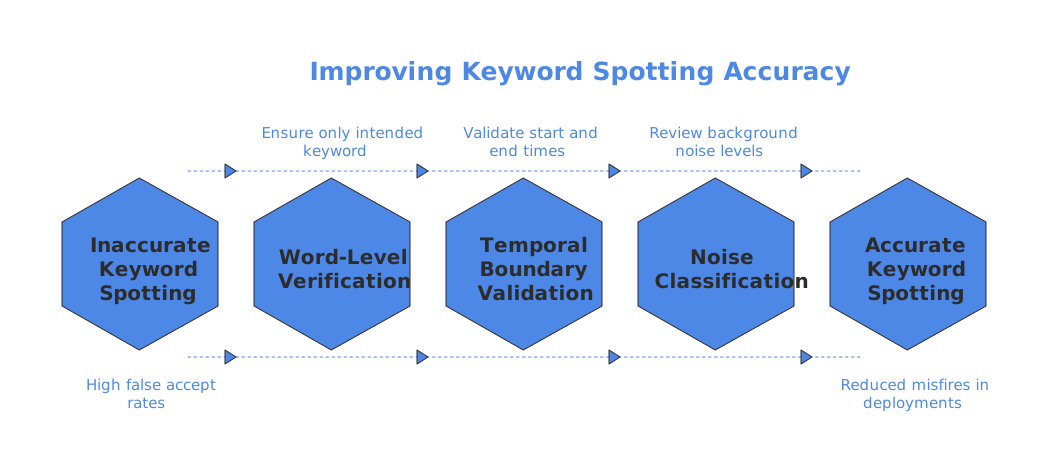
Annotation and Quality Assurance for Keyword Data
Word-Level Label Verification
Annotators verify that each sample contains only the intended keyword. Mislabeling even a small percentage of samples can significantly impact false accept rates. Consistent annotation is crucial for real-time performance.
Temporal Boundary Validation
Keyword spotting requires models to detect the exact moment the keyword is spoken. Annotators validate start and end times to ensure alignment with audio content. Precise boundaries reduce misfires in real deployments.
Noise Classification and Metadata Checks
Annotators review background noise levels, categorize acoustic environments, and verify microphone metadata. Accurate metadata supports noise modeling and device-robust training strategies.
Applications Enabled by Keyword Spotting Datasets
Smart Speakers and Hands-Free Devices
Keyword spotting powers wake-word activation for smart speakers, home assistants, and connected devices. High-quality datasets ensure reliable activation across voices and environments.
Automotive Voice Controls
Drivers rely on keyword detection to interact with navigation, music, and communication systems. Robust keyword spotting improves safety by minimizing distraction and ensuring systems respond reliably.
Mobile and IoT Command Systems
Keyword spotting enables low-power voice commands for mobile apps, wearables, and embedded devices. These applications require datasets that support reactive and dependable keyword detection.
Supporting Keyword Spotting Dataset Development
Keyword spotting datasets form the backbone of wake-word detection, command recognition, and hands-free voice interfaces. Their accuracy depends on speaker diversity, noise variation, precise annotation, and multi-stage quality assurance. If your team needs support creating, annotating, or validating keyword spotting datasets, we can explore how DataVLab helps deliver high-quality audio datasets for low-power voice AI systems across industries.
What is Keyword spotting dataset?
Keyword spotting datasets contain short audio clips labeled with specific trigger words or short phrases that help AI systems detect wake words such as “Hey Siri”, “OK Google”, or predefined command terms. These datasets include clean recordings, noisy variations, different accents, multiple speakers, and diverse recording conditions to ensure models remain reliable across environments.
What does the article explain about why keyword spotting datasets matter?
Keyword spotting datasets train models to detect predefined words quickly and accurately. Wake-word detection forms the basis of hands-free interaction for smartphones, smart speakers, and automotive systems. Research from the Speech and Audio Group at Johns Hopkins University shows that wake-word reliability depends heavily on high-quality keyword datasets with broad variability.
What does the section on “Variability that strengthens keyword spotting models” explain?
The same keyword sounds different depending on the speaker’s accent, speech rate, pitch, and tone. Including diverse speakers ensures that models do not overfit to a narrow set of voices. The European Language Resources Association emphasizes that broad accent diversity improves generalization across regions.
How can teams ensure quality in Keyword spotting dataset?
Annotators verify that each sample contains only the intended keyword. Mislabeling even a small percentage of samples can significantly impact false accept rates. Keyword spotting requires models to detect the exact moment the keyword is spoken.
What are the main use cases for Keyword spotting dataset?
Keyword spotting powers wake-word activation for smart speakers, home assistants, and connected devices. High-quality datasets ensure reliable activation across voices and environments. Drivers rely on keyword detection to interact with navigation, music, and communication systems.
What does the section on “Automotive voice controls” explain?
Drivers rely on keyword detection to interact with navigation, music, and communication systems. Robust keyword spotting improves safety by minimizing distraction and ensuring systems respond reliably.