
Human-in-the-Loop AI Systems: Technical Foundations for Reliable Machine Learning
.jpeg)
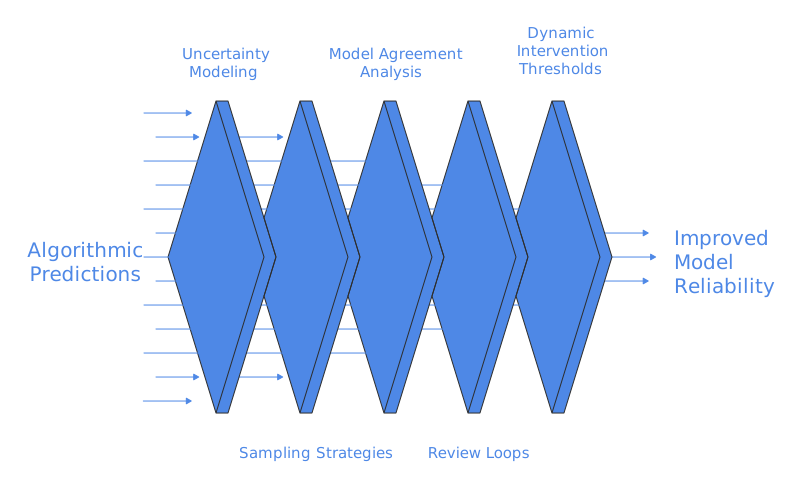
Human-in-the-Loop (HITL) systems strengthen machine learning models by combining human judgment with algorithmic predictions at critical points in the training and inference pipeline. This article explores HITL from a technical perspective, focusing on uncertainty modeling, sampling strategies, model agreement analysis, offline and online review loops, and dynamic human intervention thresholds. It explains how HITL systems reduce noise, refine ground truth, and provide corrective supervision that improves both learning dynamics and model reliability. This guide avoids operational annotation details and instead focuses on the system-level mechanics that make HITL essential for high performance ML deployment.
- Human-in-the-Loop (HITL) systems strengthen machine learning models by combining human judgment with algorithmic predictions at critical points in the training and inference pipeline.
- This article explores HITL from a technical perspective, focusing on uncertainty modeling, sampling strategies, model agreement analysis, offline and online review loops, and dynamic human intervention thresholds.
- It explains how HITL systems reduce noise, refine ground truth, and provide corrective supervision that improves both learning dynamics and model reliability.
- This guide avoids operational annotation details and instead focuses on the system-level mechanics that make HITL essential for high performance ML deployment.
Human-in-the-Loop systems introduce structured human feedback into machine learning workflows to improve accuracy, reduce error rates and stabilize generalization. HITL is not a labeling workflow or a QA routine. Instead, it is a machine learning system design approach in which models request human input at strategic moments based on uncertainty, disagreement or task complexity. The goal of HITL is to compensate for model weaknesses by introducing targeted human knowledge where it has the highest impact.
In technical terms, HITL stabilizes the loss landscape during training and helps correct drifting patterns during deployment. Models depend on ground truth to refine their internal representations. When those representations become unstable due to sparse data, changing conditions or ambiguous cases, human intervention provides corrective direction. This makes HITL essential in environments where errors have high cost or where data distributions shift frequently.
HITL systems follow quantifiable logic. The model evaluates its own uncertainty or confidence level and decides whether to route a sample for human review. This routing logic depends on statistical measures, threshold rules and sampling algorithms. HITL therefore links machine learning theory with decision science and automated routing. A solid conceptual foundation for these ideas can be found in the UC Berkeley course on learning and planning:.
Why HITL Matters for Modern Machine Learning Systems
Modern ML models operate in environments that are inherently dynamic. Data distributions shift, user behavior evolves and deployment conditions vary. Without corrective mechanisms, models drift over time. HITL serves as a stabilizing force that counteracts drift by providing targeted corrections rooted in human understanding. In supervised systems, HITL ensures that ground truth remains accurate even as data evolves.
Another reason HITL matters is that ML models make probabilistic predictions. These probabilities reflect confidence, but confidence is not always reliable. A model may assign high confidence to an incorrect prediction if it has encountered biased or incomplete training data. HITL systems introduce safeguards by identifying low confidence samples or uncertain predictions and routing them for human judgment. This prevents incorrect predictions from influencing decisions in high impact environments.
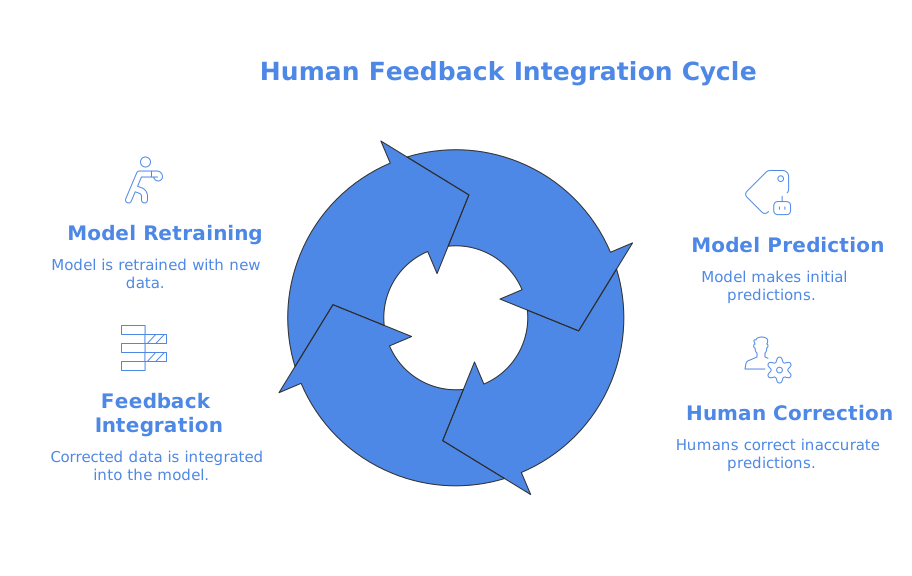
HITL also enables iterative learning. When humans correct model predictions, those corrections can be added back into the training set. This reinforces correct behavior and reduces repeat errors. It also accelerates the model’s adaptation to new patterns. Over time, the fusion of human corrections and machine inference creates a virtuous cycle of performance improvement.
Finally, HITL supports transparency and accountability. In regulated industries or safety critical applications, automated systems must have human oversight. HITL provides the infrastructure for structured intervention and traceable decision making.
Modeling Uncertainty in HITL Systems
Uncertainty modeling is the foundation of HITL routing. Models generate predictions along with confidence scores. These scores indicate how strongly the model believes the prediction is correct. However, confidence does not always reflect uncertainty accurately. Therefore, HITL systems must incorporate additional metrics to determine when human review is necessary.
Predictive Uncertainty
Predictive uncertainty represents the model’s lack of confidence in its output. In classification tasks, uncertainty is often estimated using entropy. High entropy indicates that the model sees multiple classes as similarly plausible. Samples with high entropy are excellent candidates for human review because they reflect decision ambiguity.
Epistemic Uncertainty
Epistemic uncertainty reflects a lack of knowledge in the model. This type of uncertainty arises when the model encounters unfamiliar patterns or distribution shift. Bayesian neural networks and dropout-based approximations are commonly used to estimate epistemic uncertainty. High epistemic uncertainty indicates that the model has little prior experience with similar samples.
Aleatoric (Stochastic) Uncertainty
Aleatoric uncertainty arises from noise inherent in the data. This type of uncertainty cannot be reduced through training alone. HITL systems can help manage aleatoric uncertainty by introducing human judgment in noisy or ambiguous situations. Although humans cannot eliminate noise, they can provide more consistent interpretation.
Understanding uncertainty types helps define routing logic and review thresholds. To explore the mathematical foundations of uncertainty in ML, the Visual Computing Group at ETH Zurich provides relevant technical material:.
Uncertainty Sampling Strategies in HITL
Uncertainty sampling is a method for selecting which samples require human intervention. Instead of reviewing all model predictions, HITL systems use sampling strategies to focus human attention on the most informative or ambiguous cases.
Least Confidence Sampling
In least confidence sampling, the model routes samples where the highest predicted class probability is still low. These low confidence cases reflect uncertainty. Humans review these samples to provide corrective supervision. This method is efficient and easy to implement but may not capture more nuanced uncertainty patterns.
Margin Sampling
Margin sampling considers the difference between the top two predicted classes. A small margin indicates that the model is unsure which class is correct. Margin sampling helps identify challenging samples that may benefit from human review. It is often more reliable than least confidence sampling in multi class problems.
Entropy Sampling
Entropy sampling evaluates the distribution of predicted class probabilities. Higher entropy indicates more uncertainty. This method is effective for detecting cases where the model is broadly unsure rather than confused between two classes. Entropy sampling is especially useful in tasks where multiple classes may be plausible.
Hybrid Sampling
Hybrid sampling combines multiple uncertainty metrics to create more robust selection criteria. For example, combining entropy with margin sampling captures a broader array of uncertain samples. This approach reduces bias and improves coverage of challenging cases.
Uncertainty sampling helps HITL systems prioritize human effort efficiently. It ensures that review is focused on cases where human input has the greatest impact.
Model Disagreement as a HITL Trigger
Model disagreement is another effective signal for routing samples to human reviewers. When multiple models or ensemble components disagree, it indicates uncertainty or ambiguity. HITL systems can use disagreement metrics to identify samples that require human review.
Ensemble Disagreement
Ensemble methods combine multiple models to improve performance. When ensemble members produce different predictions for the same sample, it signals uncertainty. Human review resolves these cases and helps strengthen the ensemble’s consensus over time.
Cross Model Validation
In cross model validation, different model architectures produce predictions on the same sample. Disagreement between architectures provides another measure of uncertainty. This technique is especially useful in high complexity domains where single models may overfit or misinterpret patterns.
Error Patterns in Model Disagreement
Repeated disagreement in specific classes or scenarios may indicate underlying issues in training data or class definitions. HITL systems can help uncover these issues by routing these cases to human experts. This feedback helps refine taxonomy definitions and improve training quality.
Model disagreement provides a complementary signal to confidence based sampling. Combining both approaches enhances the reliability of HITL systems.
Online vs Offline HITL Systems
HITL systems can operate at different stages of the ML lifecycle. Online systems operate during inference, while offline systems support model training. Each approach has different goals and implementation considerations.
Offline HITL for Training Refinement
Offline HITL systems route samples from the training dataset for human review. These systems prioritize uncertainty, disagreement or low quality labels. Human corrections become part of the training data, improving the model’s ability to generalize. Offline HITL strengthens supervised learning by refining ground truth.
Online HITL for Live Predictions
Online HITL systems operate during deployment. When models encounter uncertain or high risk cases, predictions are routed to humans before a final decision is made. This ensures safe operation in real time environments. Online HITL is common in fraud detection, content moderation and decision support systems.
Hybrid HITL
Hybrid HITL systems combine online and offline approaches. They route uncertain predictions for immediate human review and later add corrected predictions to the training dataset. Hybrid systems support continuous improvement and adapt to distribution shifts effectively.
Online and offline HITL systems serve different purposes but complement each other. Their integration creates a comprehensive feedback loop.
Designing Routing Logic and Thresholds
Routing logic determines when the model should request human intervention. thresholds must be carefully chosen to balance accuracy, efficiency and cost.
Confidence Thresholds
Confidence thresholds define the minimum probability required to accept a prediction without human review. Lower thresholds increase human involvement, while higher thresholds reduce it. Threshold selection depends on task complexity and acceptable error rates. Calibration ensures that confidence scores reflect actual uncertainty.
Mixed Signal Thresholds
Mixed thresholds combine confidence, entropy and disagreement. This approach produces more reliable routing decisions by incorporating multiple uncertainty signals. Mixed thresholds reduce false positives and false negatives in routing logic.
Dynamic Thresholding
Dynamic thresholding adjusts routing decisions based on real time performance or drift detection. For example, if drift is detected, thresholds may be lowered to route more samples for review. Dynamic systems adapt to changing environments and maintain model reliability.
Routing logic is a critical component of HITL systems. It determines the balance between automation and human oversight.
Human Feedback as Training Signals
Human corrections serve as training signals that refine the model’s understanding. When integrated properly, human feedback creates a corrective loop that strengthens model performance over time.
Corrective Labels
Corrective labels replace incorrect model predictions with human verified labels. These corrections help the model learn from mistakes. They reinforce correct patterns and discourage incorrect ones. Corrective labels are particularly effective when combined with incremental training.
Feedback Weighting
Not all human feedback should be treated equally. Expert labels may carry more weight than novice corrections. Feedback can also be weighted based on confidence or class complexity. Weighted feedback helps models learn more effectively from high quality corrections.
Iterative Feedback Loops
Iterative loops involve multiple rounds of prediction, correction and retraining. These loops create compounding improvements. The model gradually becomes more accurate and confident in difficult areas. Iterative feedback loops are common in active learning systems.
Feedback integration is essential for turning human corrections into lasting performance gains.
Active Learning and HITL Integration
Active learning is a machine learning technique that selects the most informative samples for labeling. HITL enhances active learning by providing human corrections for challenging samples. Together, they create efficient training workflows that focus human attention on high value data.
Query Strategies
Active learning uses query strategies to select samples for labeling. Common strategies include uncertainty sampling, margin sampling and diversity sampling. These strategies align naturally with HITL routing logic. Samples selected by active learning often overlap with those requiring human review.
Reducing Annotation Volume
By focusing on informative samples, active learning reduces the total volume of required labels. HITL ensures that corrections are accurate. This combination improves performance with fewer labeled examples. It is especially effective in domains with expensive or time consuming annotation.
Continuous Learning Cycles
Active learning and HITL form continuous learning cycles. The model selects challenging samples, humans provide corrections and the model retrains. This cycle accelerates learning and reduces annotation waste. It also helps the model adapt to new data distributions.
Active learning and HITL are complementary techniques. Their integration creates efficient and adaptive training pipelines.
For deeper insights into active learning research, the TUM Vision and Learning Lab provides helpful material:.
Failure Mode Detection Through HITL
HITL systems help detect failure modes that may not be apparent during initial training. Failure modes occur when the model consistently misinterprets specific patterns or classes. They often indicate gaps in training data or issues in model architecture.
Identifying Persistent Errors
When HITL systems route the same types of errors repeatedly, it indicates a persistent failure mode. These patterns help teams identify weaknesses in the dataset or taxonomy structure. Persistent errors may require specialized data collection or model redesign.
Detecting Distribution Shift
If uncertain samples cluster around new patterns, it may indicate distribution shift. HITL systems help identify these shifts by routing ambiguous predictions to humans. Human review confirms whether new patterns represent meaningful changes in the environment.
Addressing High Risk Areas
Failure modes may emerge in high risk areas such as rare classes or edge conditions. HITL systems highlight these cases and help teams prioritize corrective action. Addressing these areas improves overall reliability.
Failure mode detection strengthens the robustness of machine learning systems.
Reducing Model Drift Through Human Oversight
Model drift occurs when the statistical properties of input data change. Drift weakens model accuracy and reduces reliability. HITL systems counteract drift by introducing corrective supervision at critical points.
Early Detection of Drift
HITL systems detect drift by monitoring patterns in uncertain predictions. Sudden increases in uncertainty may indicate that the model is encountering unfamiliar patterns. Human review helps confirm whether drift is occurring.
Corrective Data Collection
Human reviewed samples provide corrective training data that realigns the model with the new distribution. This reduces drift impact and stabilizes performance. Corrective data collection is essential for long term model maintenance.
Continuous Adaptation
HITL systems support continuous adaptation. As drift evolves, humans provide targeted corrections. These corrections help the model adapt quickly without requiring full retraining. Continuous adaptation supports long term reliability in dynamic environments.
HITL systems provide essential safeguards against drift and help maintain model accuracy.
Evaluating HITL System Performance
Evaluating HITL systems involves both technical metrics and operational metrics. These metrics ensure that HITL systems are effective and efficient.
Technical Metrics
Technical metrics include uncertainty reduction, error correction rates and model calibration improvement. These metrics evaluate how HITL influences model behavior. Improved calibration and reduced uncertainty indicate that HITL is effective.
Operational Metrics
Operational metrics include review throughput, human workload and routing accuracy. These metrics assess the efficiency of HITL workflows. Balanced workloads and accurate routing indicate that thresholds are well calibrated.
Combined Metrics
Combined metrics evaluate the overall impact of HITL on model performance. These metrics include end to end accuracy improvement, reduction in failure modes and improved generalization. Combined metrics show how HITL contributes to the broader ML system.
Evaluation ensures that HITL remains aligned with model goals and operational constraints.
Final Thoughts
Human in the loop AI systems provide essential corrective feedback for machine learning models. By integrating uncertainty modeling, disagreement detection, routing logic and active learning, HITL systems strengthen training and improve model robustness. They help detect failure modes, counteract drift and stabilize performance in real world environments. This article presented a deep technical guide to HITL, avoiding overlap with annotation workflows or ML labeling theory. These principles help teams design reliable and adaptive ML systems that benefit from structured human oversight.
Looking to Build a High Performance HITL Pipeline?
If you want support designing uncertainty thresholds, routing logic or feedback loops for your machine learning system, DataVLab can help. We specialize in building reliable human in the loop workflows that improve model performance, reduce drift and strengthen ground truth quality. You can reach out anytime to discuss your project or request a technical assessment of your HITL architecture.
What are Human-in-the-Loop AI systems?
Human-in-the-Loop (HITL) systems strengthen machine learning models by combining human judgment with algorithmic predictions at critical points in the training and inference pipeline. This article explores HITL from a technical perspective, focusing on uncertainty modeling, sampling strategies, model agreement analysis, offline and online review loops, and dynamic human intervention thresholds.
Why does HITL matter for modern machine learning systems?
Modern ML models operate in environments that are inherently dynamic. Data distributions shift, user behavior evolves and deployment conditions vary. HITL serves as a stabilizing force that counteracts drift by providing targeted corrections rooted in human understanding.
How can teams ensure quality in Human-in-the-Loop AI systems?
In cross model validation, different model architectures produce predictions on the same sample. Disagreement between architectures provides another measure of uncertainty. This technique is especially useful in high complexity domains where single models may overfit or misinterpret patterns.
What does the section on “Online vs offline HITL systems” explain?
HITL systems can operate at different stages of the ML lifecycle. Online systems operate during inference, while offline systems support model training. Each approach has different goals and implementation considerations.
What does the section on “Human feedback as training signals” explain?
Human corrections serve as training signals that refine the model’s understanding. When integrated properly, human feedback creates a corrective loop that strengthens model performance over time. Corrective labels replace incorrect model predictions with human verified labels.
What does the section on “Reducing model drift through human oversight” explain?
Model drift occurs when the statistical properties of input data change. HITL systems counteract drift by introducing corrective supervision at critical points. HITL systems detect drift by monitoring patterns in uncertain predictions.


