Data Labeling Best Practices: Building Reliable Ground Truth for Machine Learning
.jpeg)
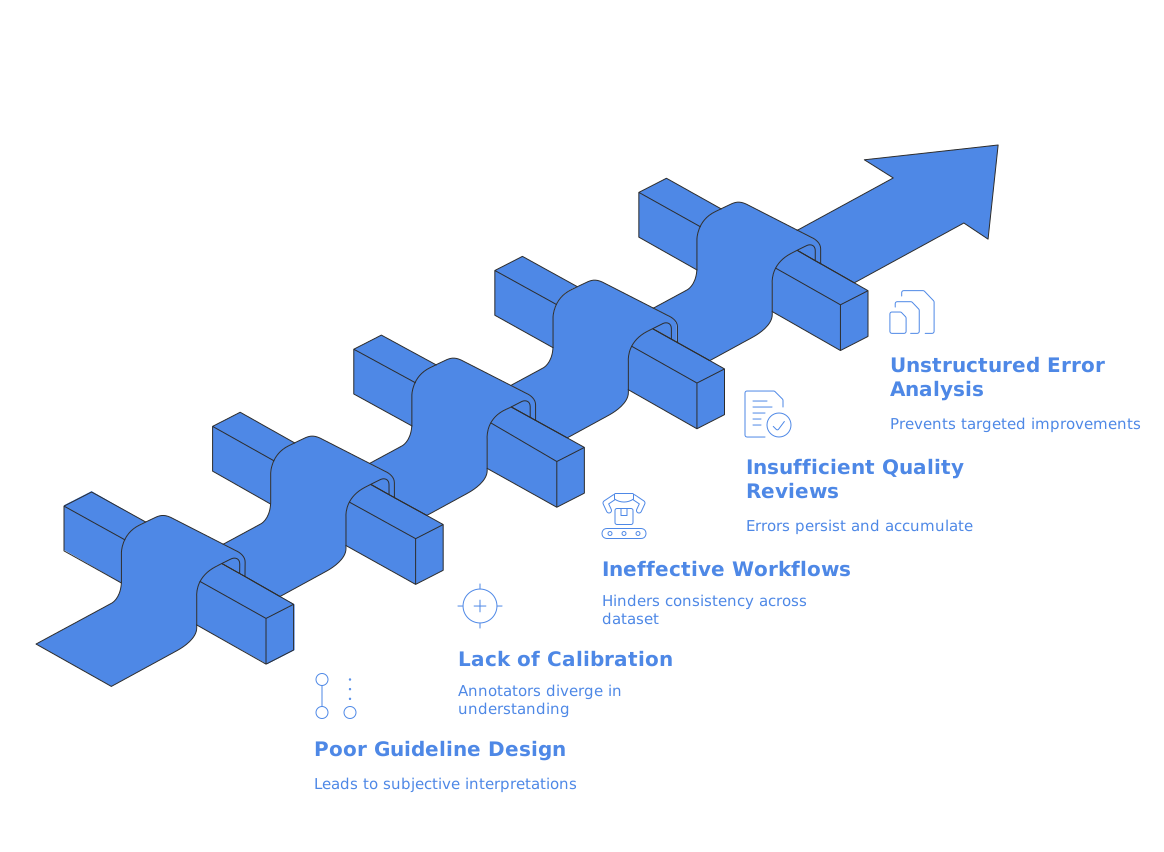
Data labeling best practices determine the consistency, accuracy and reliability of supervised machine learning systems. This article covers the operational techniques that ensure high quality annotations, including guideline design, calibration sessions, multi annotator workflows, quality reviews and structured error analysis. It explains how annotation teams maintain consistency across large datasets and how effective QA loops reduce noise and improve downstream performance. The focus is entirely on operational quality management, ensuring full differentiation from your earlier articles on labeling theory and image annotation.
- Data labeling best practices determine the consistency, accuracy and reliability of supervised machine learning systems.
- This article covers the operational techniques that ensure high quality annotations, including guideline design, calibration sessions, multi annotator workflows, quality reviews and structured error analysis.
- It explains how annotation teams maintain consistency across large datasets and how effective QA loops reduce noise and improve downstream performance.
- This guide covers the practices that separate annotation programs that produce reliable, high-quality labeled datasets from those that produce noise-contaminated training data that degrades model performance.
Data Labeling Best Practices for High Quality Machine Learning Datasets
The quality of labeled training data determines the ceiling of machine learning model performance. No amount of architectural sophistication, hyperparameter tuning, or compute investment can recover from systematically incorrect or inconsistent labels. This guide covers the practices that separate annotation programs that produce reliable, high-quality labeled datasets from those that produce noise-contaminated training data that degrades model performance.
Define Your Annotation Schema Before You Start
The single most common and costly mistake in annotation programs is beginning to label data before the annotation schema is finalized. A schema defines what gets labeled, what categories exist, how boundaries between categories are defined, and what annotators should do when they encounter edge cases. Starting annotation with an incomplete schema means that early annotations are inconsistent with later ones, requiring rework that can invalidate significant annotation investment.
Effective schema development requires three things. First, a pilot annotation pass on a representative sample of your real data using a draft schema. The pilot reveals ambiguities, missing categories, and boundary definitions that did not surface during schema design. Second, a review of the pilot output by the annotation team and domain experts to refine definitions before scaling. Third, a final inter-annotator agreement measurement on the revised schema to confirm that annotators can apply it consistently before full production begins.
The schema should specify not just what categories exist but what the boundary criteria for each category are, how to handle items that fall near boundaries, what to do with examples that do not fit any category, and whether annotation is at the item level, the region level, or the element level depending on the modality.
Write Annotation Guidelines That Actually Work
Annotation guidelines are the primary mechanism through which you transfer your labeling intent to the people doing the work. Guidelines that are vague, incomplete, or that fail to cover real cases found in your data produce inconsistent labels regardless of annotator quality. Good annotation guidelines share several characteristics.
They are specific rather than general. Rather than saying label this category when the content is harmful, they specify exactly which characteristics make content harmful, give positive and negative examples for each characteristic, and explain how to handle cases where characteristics partially apply.
They cover edge cases explicitly. The cases annotators most frequently disagree on are almost always the edge cases that guidelines do not address. Identifying these cases during pilot annotation and specifying exactly how they should be labeled is one of the highest-leverage investments in annotation consistency.
They are versioned and updated as the annotation program progresses. As new edge cases emerge and policy understanding develops, guidelines must be updated and the changes communicated clearly to all annotators. Unannounced guideline changes are one of the most common sources of systematic label inconsistency in large annotation programs.
They include visual examples wherever possible. For image and video annotation tasks, visual examples of correct and incorrect annotation are more effective than written descriptions at producing consistent annotator behavior. For text annotation tasks, concrete examples of how specific sentence types should be labeled are more effective than abstract rules.
Use Inter-Annotator Agreement to Measure and Improve Consistency
Inter-annotator agreement measures how consistently different annotators label the same items. It is the most direct quality signal available in annotation because it measures consistency directly rather than inferring it from downstream model performance. Inter-annotator agreement measurement should be a routine part of every annotation program, not just an occasional check.
The most widely used agreement metrics are Cohen's kappa for binary and categorical classification tasks, which corrects for chance agreement, and Krippendorff's alpha for tasks with ordinal or continuous labels. For spatial annotation tasks like bounding box or segmentation annotation, intersection over union measures spatial consistency.
Agreement measurement serves two purposes. First, it identifies annotators whose work diverges from the consensus, enabling targeted coaching and quality intervention before their labels contaminate large portions of the dataset. Second, it identifies categories and edge case types where annotators systematically disagree, which indicates ambiguity in the annotation guidelines rather than annotator error. Systematic disagreement on specific categories should trigger guideline review rather than individual annotator correction.
Target agreement levels depend on the task. For binary classification, inter-annotator kappa above 0.8 is generally considered strong agreement. For fine-grained spatial annotation tasks, lower agreement is often acceptable because spatial judgment involves genuine uncertainty. Setting unrealistically high agreement targets for complex tasks can produce superficially high agreement through annotator conformity rather than genuine label consistency.
Implement Gold Standard Validation
Gold standard validation inserts known-correct items into annotation queues and measures how often annotators label them correctly. Unlike inter-annotator agreement, which measures consistency between annotators, gold standard validation measures accuracy against a fixed reference. It is one of the most effective methods for ongoing quality monitoring because it provides continuous measurement of individual annotator accuracy without requiring separate quality review workflows.
Creating a gold standard set requires selecting representative items across all categories and edge case types, labeling them by expert annotators or through consensus adjudication, and verifying that the gold standard labels are themselves reliable. A gold standard set that contains errors or ambiguities will produce misleading accuracy measurements.
Gold standard items should be refreshed periodically to prevent annotators from memorizing the answers to specific items. The proportion of gold standard items in annotation queues depends on the program scale and quality requirements, but typically ranges from five to fifteen percent of total items reviewed.
Build In Multiple Review Stages
Single-pass annotation without review produces lower quality output than multi-stage review pipelines, particularly for complex annotation tasks or specialist domains. The most effective multi-stage pipelines combine peer review by fellow annotators, QA lead review of samples drawn from the full annotator pool, and gold standard validation as a continuous background quality check.
Peer review catches annotation errors that the original annotator made but that are recognizable to another trained annotator. It is particularly effective for spatial annotation tasks where boundary errors and missed objects are visible in the output. QA lead review applies a higher standard of judgment to catch systematic errors that peer review misses. Gold standard validation catches individual annotator drift that is not apparent in peer review because the drifting annotator and peer reviewer may share the same misconception.
The overhead of multi-stage review is typically ten to thirty percent of the cost of the original annotation pass. For tasks where annotation quality directly affects safety, regulatory compliance, or high-stakes model decisions, this overhead is justified. For tasks where moderate quality is acceptable, single-pass annotation with gold standard monitoring may be sufficient.
Track and Manage Annotator Performance Over Time
Annotation quality is not static. Annotators can drift from guidelines over time as they develop informal shortcut heuristics, as their understanding of category boundaries evolves away from the intended definition, or as they become fatigued from repetitive work. Tracking individual annotator performance over time through gold standard scores and inter-annotator agreement metrics enables early detection of drift before it contaminates large volumes of labeled data.
Regular calibration sessions where annotators review their own errors and discuss difficult cases with QA leads maintain alignment with guidelines over time. These sessions are also the most effective mechanism for sharing emerging edge cases and guideline updates across the annotation workforce.
Annotator performance data enables feedback loops that improve individual annotation quality and identify training gaps. It also enables selective sampling strategies that apply higher review rates to annotators whose historical accuracy is lower, concentrating QA effort where it has the most impact.
Document Annotation Decisions for Reproducibility
Annotation programs that do not document their decisions accumulate technical debt that becomes expensive when models are retrained, when annotation is audited, or when guidelines need to be updated. Documentation requirements include version-controlled annotation guidelines with change logs, records of edge case decisions and the reasoning behind them, annotator calibration records, quality metric histories, and records of any data that was reannotated and why.
This documentation is particularly important for regulated industries where annotation methodology may be subject to audit, for safety-critical applications where annotation decisions must be defensible, and for long-running annotation programs where team turnover means the original decision-makers may no longer be available to explain historical choices.
Match Annotator Expertise to Task Requirements
Generalist annotation pools are appropriate for tasks that require everyday judgment: basic image classification, simple sentiment labeling, straightforward text categorization. Tasks that require specialized knowledge, medical imaging annotation, legal document labeling, technical code review, automotive sensor data annotation, require annotators with relevant domain expertise that cannot be compensated for through better guidelines or more intensive QA.
Mismatching annotator expertise to task requirements is one of the most common and most expensive annotation program mistakes. The cost of reannotating a large dataset because the original annotators lacked the domain knowledge to produce reliable labels far exceeds the cost of sourcing specialist annotators from the start. For tasks in doubt, a small pilot with domain-expert annotators is the most reliable way to establish whether the task requires specialist annotation before committing to full-scale production.
For more on how annotation type complexity and annotator expertise requirements relate to project cost, see our guide on data annotation pricing. For guidance on selecting a provider with the right domain expertise for your project, see our guide on how to choose a data annotation company.
For related reading, see our guides on data annotation vs data labeling and AI training data.
Applying These Practices at Scale
DataVLab applies these practices across all annotation programs. Our standard workflow includes schema validation before production begins, structured annotation guidelines with versioned change logs, three-stage quality review combining peer review, QA lead oversight, and gold standard validation, and annotator performance tracking with regular calibration sessions.
For teams evaluating whether their current annotation program is following these practices or who need to establish a new program on the right foundations, our data annotation services and enterprise data labeling solutions are designed around these quality principles from the start. Contact us to discuss your annotation quality requirements.
What is Data labeling best practices?
Data labeling best practices determine the consistency, accuracy and reliability of supervised machine learning systems. This article covers the operational techniques that ensure high quality annotations, including guideline design, calibration sessions, multi annotator workflows, quality reviews and structured error analysis.
What are the best practices for Data labeling best practices?
The quality of labeled training data determines the ceiling of machine learning model performance. No amount of architectural sophistication, hyperparameter tuning, or compute investment can recover from systematically incorrect or inconsistent labels. This guide covers the practices that separate annotation programs that produce reliable, high-quality labeled datasets from those that produce noise-contaminated training data that degrades model performance.
What does the section on “Write annotation guidelines that actually work” explain?
Rather than saying label this category when the content is harmful, they specify exactly which characteristics make content harmful, give positive and negative examples for each characteristic, and explain how to handle cases where characteristics partially apply.
What does the section on “Use Inter-Annotator agreement to measure and improve consistency” explain?
Inter-annotator agreement measures how consistently different annotators label the same items. It is the most direct quality signal available in annotation because it measures consistency directly rather than inferring it from downstream model performance. Inter-annotator agreement measurement should be a routine part of every annotation program, not just an occasional check.
How can teams ensure quality in Data labeling best practices?
Gold standard validation inserts known-correct items into annotation queues and measures how often annotators label them correctly. Unlike inter-annotator agreement, which measures consistency between annotators, gold standard validation measures accuracy against a fixed reference. It is one of the most effective methods for ongoing quality monitoring because it provides continuous measurement of individual annotator accuracy without requiring separate quality review workflows.
What does the section on “Applying these practices at scale” explain?
Our standard workflow includes schema validation before production begins, structured annotation guidelines with versioned change logs, three-stage quality review combining peer review, QA lead oversight, and gold standard validation, and annotator performance tracking with regular calibration sessions.