How to Label Data for Machine Learning: A Deep Technical Guide
.jpeg)
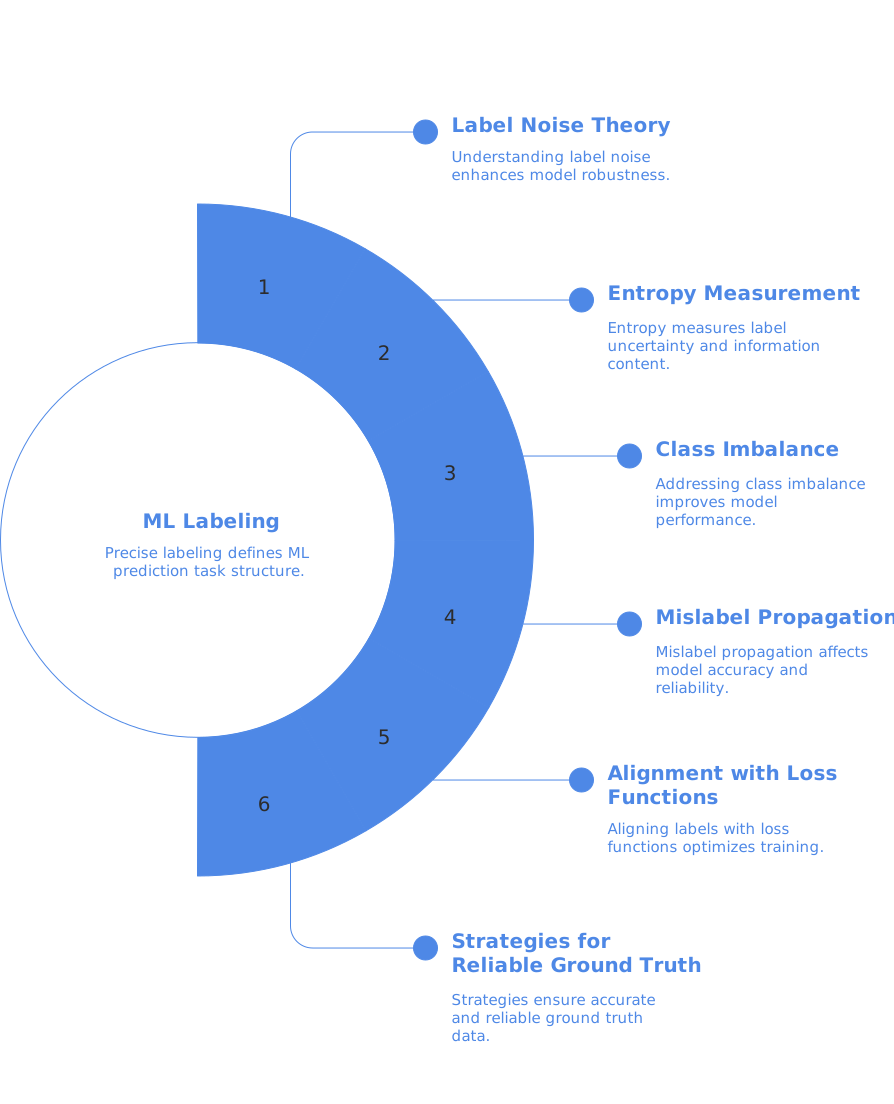
Labeling data for machine learning requires technical precision that extends far beyond assigning categories to samples. Labels define the mathematical structure of the prediction task, influence gradient behavior during training and determine how models develop internal representations. This article explores the advanced principles behind ML labeling, including label noise theory, entropy measurement, class imbalance, mislabel propagation, alignment with loss functions and strategies for constructing reliable ground truth. It focuses on the technical and statistical aspects of labeling rather than annotation workflows, ensuring complete differentiation from earlier articles.
- Labeling data for machine learning requires technical precision that extends far beyond assigning categories to samples.
- Labels define the mathematical structure of the prediction task, influence gradient behavior during training and determine how models develop internal representations.
- This article explores the advanced principles behind ML labeling, including label noise theory, entropy measurement, class imbalance, mislabel propagation, alignment with loss functions and strategies for constructing reliable ground truth.
- It focuses on the technical and statistical aspects of labeling rather than annotation workflows, ensuring complete differentiation from earlier articles.
How to Label Data for Machine Learning: A Deep Technical Guide
Labeling data for machine learning is a technical process that shapes every aspect of a model's learning behavior. Labels are not simply descriptive tags. They are mathematical structures that guide gradient descent, influence loss functions, define task boundaries and set constraints on model generalization. High fidelity labels create predictable learning behavior, while poor labels amplify noise, distort representations and produce fragile models. The effectiveness of supervised learning rests on the stability, consistency and correctness of labeled data.
This article focuses on the technical dimension of ML labeling. It explains how labels interact with training dynamics, how structural errors propagate through model layers and how noise affects optimization stability. This article highlights ML theory, statistical behavior and ground truth reliability. These principles apply across modalities, including tabular, text, sensor and visual data.
Machine learning practitioners often underestimate the importance of label quality. Many assume that models will compensate for imperfections. In reality, label noise can cripple even the most advanced architectures. Understanding how to design, validate and refine labels is therefore essential to achieving reliable accuracy. For a structured introduction to machine learning theory, the Carnegie Mellon University course materials provide foundational context.
Why Machine Learning Labels Require Technical Design
Labels determine the mathematical nature of the target variable. In classification, labels define discrete decision boundaries. In regression, they represent numerical values linked to continuous behavior. In sequence labeling, they produce structured outputs that models must interpret token by token. Because labels are the backbone of supervised learning, their structure must be technically sound and aligned with the model's objective.
The design of labels directly influences the loss landscape. Accurate labels create smooth gradients that help models converge efficiently. Inconsistent labels create noisy gradients that destabilize training. When loss surfaces are irregular, models may struggle to reach a good local minimum or may overfit to noise. This behavior is especially problematic in deep neural networks where small errors can propagate through many layers.
Labels also determine how models interpret features. When labels are consistent, the model develops distinct representation clusters in the latent space. When labels are noisy, representation clusters become blurred, making it difficult for the model to learn separable decision boundaries. This often leads to poor generalization, especially in edge cases.
High quality labels therefore require domain knowledge, statistical consistency, semantic clarity and deep understanding of model requirements. Labels must be designed not only to be human readable but also to be mathematically coherent.
Label Noise and Its Effect on Model Behavior
Label noise is one of the most harmful issues in supervised learning. Even small amounts of noise can cause dramatic reductions in accuracy. Models attempt to minimize loss by fitting to the data they are given. When labels are incorrect, the model learns incorrect associations that degrade generalization.
Types of Label Noise
There are two primary types of label noise: random noise and systematic noise. Random noise occurs when labels are incorrect without any consistent pattern. This type of noise adds variation to the training process but does not necessarily bias the model. Systematic noise occurs when labels are consistently incorrect in a particular direction. This type of noise is far more dangerous because the model learns stable but incorrect patterns.
How Noise Affects Optimization
Noise corrupts gradient updates. During training, the model calculates gradients that represent how predictions should change to match labels. Noisy labels distort these gradients, leading the model away from optimal solutions. In deep networks, these errors accumulate significantly over many layers, limiting convergence quality and increasing training time.
How Noise Affects Generalization
Noisy labels weaken decision boundaries. In classification tasks, models become less confident and produce unstable predictions. In regression tasks, noise increases output variance and reduces calibration. In sequence labeling tasks, noise disrupts token alignment and leads to error propagation across the sequence.
An in depth discussion of how noise impacts training can be found through research from the University of Toronto.
Understanding these dynamics is essential for designing noise reduction strategies.
Label Entropy and Information Theory in ML Labeling
Entropy is a key measure of uncertainty in labeling. High entropy indicates that labels are ambiguous or inconsistently applied. Low entropy indicates that labels are clear and consistent.
Entropy affects model learning in several ways. When entropy is high, the model receives unclear signals during training. It becomes more difficult for the model to develop strong associations between features and labels. This results in weaker decision boundaries, lower confidence and higher error rates. High entropy labels often occur in tasks with ambiguous categories or insufficient guidelines.
Entropy is especially important in multi class classification. When multiple classes overlap semantically, annotators may label similar samples differently. This inconsistency increases entropy and reduces model accuracy. To manage entropy, teams must refine taxonomies, clarify category definitions and create examples that illustrate boundary cases.
Entropy also affects calibration. Models trained on high entropy labels produce poorly calibrated probability distributions. Their predicted probabilities do not reflect true likelihood, which reduces reliability in decision making systems. Managing entropy helps maintain statistical integrity and improves model interpretability.
Class Imbalance and Its Impact on Labeling
Class imbalance is a common issue in supervised learning. When some classes appear much more frequently than others, the model learns to favor the dominant class. Labels therefore must be structured to reflect the true distribution of data in the deployment environment.
Why Class Imbalance Matters
Imbalanced labels skew gradient calculations. The dominant class contributes far more training signals, causing the model to prioritize its patterns. Minority classes receive fewer gradient updates and therefore are not learned correctly. This leads to high accuracy but poor recall on important classes.
Strategies for Addressing Imbalance
Approaches include oversampling minority classes, undersampling dominant classes and using synthetic data generation techniques such as SMOTE. These techniques create more balanced label distributions and support stronger learning.
Impact on Loss Functions
Loss functions must also be adjusted to accommodate imbalance. Weighted cross entropy or focal loss helps models focus more on minority classes. These methods reduce the emphasis on dominant classes and improve classification recall.
Class imbalance is a labeling issue, not simply a dataset issue. The distribution of labels determines how the model interprets class prevalence. Maintaining balance is crucial for real world accuracy.
Label Calibration and Alignment with Model Outputs
Labels must align with model output structures. Misalignment between labels and outputs leads to loss function instability and poor predictions. For example, classification labels must be represented in a format compatible with softmax outputs. Regression labels must match the desired numerical range. Sequence labels must align with token boundaries.
Calibration in Classification
Classification labels should be mapped to consistent categorical indices. If class indices are not stable, the model will receive inconsistent gradient updates. Calibration involves ensuring that labels reflect true class membership and that semantic differences between classes are preserved.
Calibration in Regression
Regression labels must match the intended prediction scale. If the model expects normalized values but labels use raw values, training becomes unstable. Proper scaling ensures that gradients are meaningful and that regression outputs remain interpretable.
Calibration in Sequence Labeling
Sequence labels must align with tokenization. If labels do not match token boundaries, the model receives incorrect alignment signals. In tasks like named entity recognition, this error reduces accuracy significantly.
Alignment is essential for stable model behavior. Labels must reflect structural requirements and be compatible with model outputs.
Label Representation and Its Influence on Learning
Labels can be represented in various formats, each affecting how the model processes information. For classification, labels may be represented as class indices, one hot vectors or probability distributions. Representing labels incorrectly introduces inconsistency that models struggle to interpret.
Class Indices
Class indices represent categories numerically. Although efficient, class indices can cause issues if classes are not truly ordinal. The model may implicitly interpret index differences as meaningful distances. For example, if class 0 and class 1 represent unrelated categories, assigning these values may incorrectly imply closeness.
One Hot Encoding
One hot vectors avoid imposing ordinal structure. They provide clear boundaries between classes but increase dimensionality. This representation works well for multi class tasks and reduces label rigidity.
Soft Labels
Soft labels represent classes using probability distributions rather than discrete categories. They are useful for distillation or tasks with inherent ambiguity. However, they require careful calibration to avoid amplifying uncertainty.
Representation influences how models interpret label relationships. Choosing the correct representation ensures that models learn appropriate patterns.
Label Error Propagation Through Model Layers
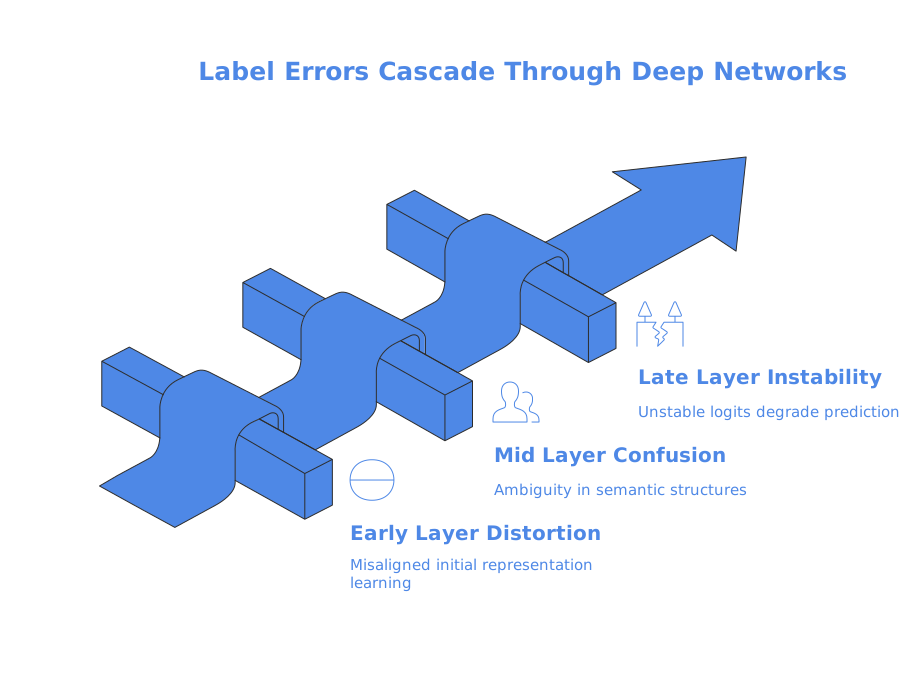
Label errors propagate through multiple layers of a model. Deep networks amplify the effect of incorrect labels because each layer builds on representations learned from previous layers. Errors introduced early in the learning process become deeply embedded in the network structure.
Early Layer Distortion
Incorrect labels distort the model's initial representation learning. Convolutional layers learn edge, texture and shape patterns from training data. If labels do not accurately reflect classes, these early representations become misaligned. This distortion limits the model's ability to form meaningful higher level features.
Mid Layer Confusion
Middle layers attempt to combine low level features into semantic structures. Label noise causes ambiguity in these structures. The model produces patterns that overlap or contradict true semantics. This confusion reduces the model's ability to differentiate between similar classes.
Late Layer Instability
Final layers map representations to class probabilities or numerical outputs. Label errors produce unstable logits, increase variance and degrade prediction confidence. This instability affects accuracy and calibration. In sequence models, error propagation is particularly problematic because token misalignment weakens context interpretation.
Understanding propagation helps teams implement strategies to reduce noise early in the labeling process.
Multi Label and Multi Task Labeling Complexities
Multi label and multi task learning require special labeling strategies. These tasks introduce dependencies between labels that must be reflected in the labeling structure. Incorrect modeling of these dependencies weakens the learning process.
Multi Label Tasks
In multi label classification, each sample may belong to multiple categories. Labels must capture the relationship between classes accurately. If annotators fail to apply consistent combinations, the model learns inconsistent class co occurrence patterns. For example, if certain classes often appear together but are inconsistently labeled, the model receives contradictory signals.
Multi Task Learning
In multi task settings, the model learns several tasks simultaneously. Labels for each task must be consistent and compatible. If one task's labels are noisy, the noise will affect the shared representation layers and reduce performance across all tasks. This interconnectedness makes labeling quality even more important.
Dependency Modeling
Labels must represent relationships correctly. Hierarchical labels or structured encodings help models learn dependencies and improve generalization. Incorrect dependency modeling introduces noise that impacts all related outputs.
These complexities illustrate how labeling for multi label and multi task models requires thoughtful structural design.
Structured Labeling for Sequence Models
Sequence labeling tasks require labels to be aligned with token boundaries and contextual dependencies. Incorrect sequence labeling creates cascading errors that significantly reduce model performance.
Token Alignment
Labels must match tokenization. For example, in named entity recognition, labels must align with the split between subwords. Misalignment leads to incorrect training signals and reduces accuracy. Annotators must use token aware labeling tools to maintain alignment.
Contextual Dependencies
Sequence labels rely on context. For example, part of speech tagging depends on surrounding words. Labels must reflect this context consistently. Inconsistent contextual interpretation introduces noise into sequence models.
Error Propagation
Sequence models propagate errors across time steps. If one label is incorrect, subsequent labels may be affected. This behavior requires strict consistency and careful review of sequence boundaries.
Structured labeling for sequence tasks requires attention to detail, alignment precision and strong guideline adherence.
Techniques to Reduce Label Noise
Reducing label noise is essential for stable model performance. Several techniques help reduce noise and improve label fidelity.
Cross Annotation
Multiple annotators label the same sample, and discrepancies are resolved through consensus. This approach reduces random noise and highlights ambiguous cases. It increases labeling cost but significantly improves quality.
Auditing and Review
Expert reviewers inspect samples for inconsistencies. Audits identify systematic noise, refine guidelines and ensure coherence. Regular review cycles improve long term dataset reliability.
Statistical Filtering
Models can be trained to detect noisy labels. Samples with inconsistent predictions or low confidence may indicate noise. Statistical techniques help identify problematic samples that require correction.
Self Training
Models can refine their own labels through iterative training. This approach works when initial noise levels are low. The model helps correct ambiguity and improve dataset consistency.
Noise reduction ensures that models learn stable and reliable patterns.
How Labeling Affects Generalization and Bias
Labeling decisions influence generalization and may introduce bias if not designed carefully. Labels reflect human interpretations of data, which can introduce subjective patterns that models replicate.
Overly Narrow Labels
Labels that capture overly specific distinctions may reduce generalization. Models may overfit to narrow definitions and struggle with slight variations. Broad, well defined labels improve robustness.
Missing Classes
If labels exclude certain categories, models will not learn to recognize them. Missing classes produce blind spots that reduce safety in real world applications.
Human Bias
Subjective interpretations can introduce demographic or cultural bias. Models trained on biased labels reproduce these patterns. Careful review and balanced datasets help reduce bias.
Understanding labeling influence on generalization helps teams create more reliable and fair ML systems.
Aligning Labels with Loss Functions and Optimization
Labels must align with the loss function used during training. Misalignment leads to optimization instability.
Cross Entropy for Classification
Labels must be one hot encoded or index based for cross entropy. Incorrect label formatting leads to misinterpreted probabilities.
Huber or L1/L2 Loss for Regression
Regression labels must be numerical and correctly scaled. Outliers distort gradient behavior. Scaling improves stability.
CTC Loss for Sequence Models
Sequence labels must align with unsegmented sequences. Misalignment leads to large losses and poor convergence.
Labeling structure influences optimization behavior and must be designed accordingly.
Evaluating the Quality of ML Labels
Quality evaluation ensures that labels support stable model learning. Evaluation methods include statistical, semantic and structural analysis.
Statistical Evaluation
Measures include label distribution, entropy, class balance and correlation. These metrics identify inconsistencies or skewed patterns.
Semantic Evaluation
Experts review samples to ensure accuracy and domain alignment. Semantic evaluation identifies subtle errors that metrics cannot detect.
Structural Evaluation
Structural evaluation analyzes alignment with model outputs. Examples include checking sequence alignment or bounding box geometry for image tasks.
Evaluation ensures that labels are fit for model training and that the dataset supports strong generalization.
Final Thoughts
Labeling data for machine learning is a technical discipline that requires statistical rigor, domain understanding and alignment with model objectives. Labels shape the mathematical structure of training, influence gradient behavior and determine how models form representations. Poor labeling introduces noise, bias and instability that reduce model accuracy and generalization. High quality labels require consistent semantics, careful design, noise reduction techniques and ongoing evaluation.
This article provided an in depth technical guide to ML labeling, focusing on noise theory, entropy, calibration, structure and loss alignment. These principles help teams build reliable datasets that support high performance ML systems. By mastering these concepts, practitioners can significantly improve model accuracy and robustness across many application areas.
Want to Strengthen Your ML Labeling Strategy?
If you want support designing label taxonomies, reducing noise or improving the consistency of your ground truth, our team can help. DataVLab specializes in complex labeling strategies that influence ML training quality, including classification schemas, sequence labeling rules and structured outputs. You can reach out to discuss your project or request a technical assessment of your existing dataset.
What is How to label data for machine learning?
Labeling data for machine learning requires technical precision that extends far beyond assigning categories to samples. Labels define the mathematical structure of the prediction task, influence gradient behavior during training and determine how models develop internal representations.
What does the article explain about why machine learning labels require technical design?
Labels determine the mathematical nature of the target variable. In regression, they represent numerical values linked to continuous behavior. In sequence labeling, they produce structured outputs that models must interpret token by token.
Why does class imbalance matter?
The dominant class contributes far more training signals, causing the model to prioritize its patterns. Minority classes receive fewer gradient updates and therefore are not learned correctly. This leads to high accuracy but poor recall on important classes.
What does the section on “Label representation and its influence on learning” explain?
Labels can be represented in various formats, each affecting how the model processes information. For classification, labels may be represented as class indices, one hot vectors or probability distributions. Representing labels incorrectly introduces inconsistency that models struggle to interpret.
How does Labeling affect Generalization and bias?
Labeling decisions influence generalization and may introduce bias if not designed carefully. Labels reflect human interpretations of data, which can introduce subjective patterns that models replicate. Labels that capture overly specific distinctions may reduce generalization.
What is involved in evaluating the quality of ML labels?
Quality evaluation ensures that labels support stable model learning. Evaluation methods include statistical, semantic and structural analysis. Measures include label distribution, entropy, class balance and correlation.