Helmet Detection with Computer Vision : Building Robust Datasets for Workplace Safety AI
.jpeg)
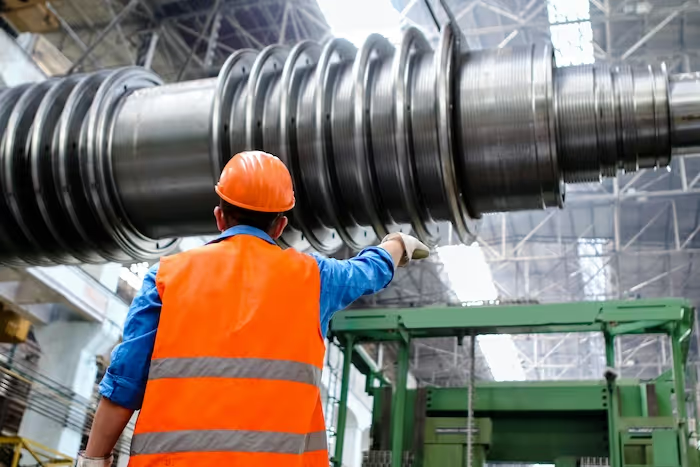
Helmet detection is one of the most widely deployed workplace safety applications in computer vision. By detecting whether workers wear protective helmets in industrial and construction environments, AI systems help reduce accidents, support compliance, and automate safety monitoring. This article explains how helmet detection models work, how datasets are collected and annotated, what challenges appear in real world deployments, and how factories integrate helmet detection into broader PPE compliance workflows. It also discusses imaging setups, model architectures, edge deployment constraints, and the growing role of multimodal inspection systems. As industries push toward safer, more efficient operations, helmet detection has become a foundational component of workplace safety AI.
- By detecting whether workers wear protective helmets in industrial and construction environments, AI systems help reduce accidents, support compliance, and automate safety monitoring.
- This article explains how helmet detection models work, how datasets are collected and annotated, what challenges appear in real world deployments, and how factories integrate helmet detection into broader PPE compliance workflows.
- As industries push toward safer, more efficient operations, helmet detection has become a foundational component of workplace safety AI.
- Helmet detection refers to the use of computer vision models to identify whether workers are wearing protective helmets in industrial, construction, mining, warehouse, or logistics environments.
Helmet detection refers to the use of computer vision models to identify whether workers are wearing protective helmets in industrial, construction, mining, warehouse, or logistics environments. Safety helmets are essential for preventing injuries from falling objects, collisions, slips, and overhead hazards. Despite strict workplace regulations, compliance often varies due to time pressure, oversight gaps, or inconsistent enforcement.
Computer vision provides a reliable, automated method for monitoring PPE compliance across work areas. Cameras installed around sites continuously capture video streams. AI models analyze the footage and determine whether each detected person is wearing a helmet. This supports real time alerts, historical analysis, and long term safety improvements. Research from the Center for Construction Research and Training highlights how AI driven PPE monitoring reduces incident rates and increases hazard awareness in construction sites.
Helmet detection systems now operate across factories, warehouses, utility sites, airports, rail hubs, mining operations, and construction projects worldwide.
Why Helmet Detection Is Essential for Modern Industries
Reducing head injuries
Head injuries are among the most serious workplace hazards. Proper helmet usage significantly reduces the severity of accidents. Automated detection increases consistency in monitoring compliance.
Supporting safety teams
On large sites, supervisors cannot continuously monitor every area. AI driven helmet detection assists teams by providing additional visibility and automated alerts.
Regulatory compliance
Occupational safety regulations require proper PPE usage. Helmet detection systems help maintain compliance with OSHA, ISO, and local workplace safety standards. Automated logging supports audits and safety reports.
Proactive risk management
Helmet detection provides early warnings when workers enter restricted zones without protection. Real time alerts prevent risky behavior before accidents happen.
Data driven safety insights
Aggregated detection data identifies patterns, such as areas with frequent non compliance or times of day when risks increase. This informs targeted interventions and training.
Companies increasingly adopt helmet detection as part of broader workplace safety transformations and digitalization initiatives.
What Helmet Detection Models Identify
Helmet detection models recognize both people and helmets, often performing two tasks at once:
- Person detection
Identifies workers in an image or video frame. - Helmet classification
Determines whether the detected individual is wearing a helmet.
Advanced models go further:
Helmet color classification
Different helmet colors may indicate job roles or access levels. Models learn to classify helmet colors to support safety zoning and workforce coordination.
Pose aware detection
Workers may tilt their heads, crouch, climb, or turn away from the camera. Pose aware detection systems handle these variations correctly.
Distance and proximity detection
Some deployments combine helmet detection with distance estimation to identify unsafe proximity to hazards or machinery.
Multi person tracking
To reduce false alerts and maintain temporal consistency, multi person tracking assigns IDs to workers across several frames.
Helmet detection systems may also integrate with other PPE detection modules such as identifying high visibility vests, gloves, or goggles.
How Helmet Detection Works
Person detection
Most systems begin with detecting people in the frame using object detection models. These models locate workers across diverse angles and distances.
Helmet detection or classification
Once a person is detected, the model analyzes the head region to determine whether a helmet is present. Some systems detect helmets directly as objects, while others classify head images.
Bounding box localization
Bounding boxes show the location of helmets or the absence thereof. Precise bounding boxes help downstream systems issue targeted alerts.
Segmentation based approaches
Semantic or instance segmentation models label each pixel of the helmet. Segmentation helps improve accuracy in cluttered scenes or complex lighting.
Keypoint and pose integration
Some models use head keypoints or full body pose estimation to improve robustness. Pose features help identify helmets even when the head is partially rotated or occluded.
Model fusion
Combining person detection, face detection, and helmet segmentation produces more reliable results than using a single approach.
Modern helmet detection systems combine multiple AI techniques to achieve stable performance across varied industrial scenarios.
Datasets for Helmet Detection
Helmet detection datasets must capture workers across diverse environments, including:
Indoor production lines
Lighting conditions vary, and helmets may blend with surroundings. Models must detect helmets amidst clutter, machinery, and reflective surfaces.
Outdoor construction sites
Outdoor scenes include strong sunlight, shadows, occlusions, dust, and weather changes. Datasets require robust diversity.
Mining and heavy industry
Helmets may be dirt covered or worn in dim environments. Models must identify helmets in low contrast situations.
Logistics and warehouses
Warehouses have narrow aisles, moving vehicles, and frequent worker motion. Helmet detection must remain accurate in dynamic settings. Dataset quality determines whether the model generalizes to real workplaces, especially when workers wear heterogeneous equipment.
What Helmet Detection Datasets Must Include
Multiple helmet types
Helmets vary in shape, color, size, and surface texture. Datasets must include construction helmets, industrial helmets, mining helmets, and safety caps from different manufacturers.
Different head orientations
Workers tilt, rotate, or bend their heads. Datasets must reflect front, side, rear, top down, and angled views.
Variety of lighting conditions
Strong sunlight, interior shadows, fluorescent lighting, and nighttime illumination significantly affect appearance.
Occlusions
Workers may wear hats, hoodies, headlamps, or communication devices that occlude the helmet. Other workers or equipment may partially cover the head.
PPE combinations
Workers often wear helmets together with vests, gloves, ear protectors, or goggles. The model must learn that helmets remain distinct objects irrespective of additional PPE.
Motion blur
High speed movements generate blur, especially in warehouses or construction zones. Datasets must contain frames with motion artifacts.
Contrasting backgrounds
Helmet detection must work across complex backgrounds such as building structures, trees, machinery, and stacked pallets.
A high quality helmet detection dataset is essential for building a reliable, real world AI model.
Annotation for Helmet Detection
Annotation quality is critical because helmets often occupy a small portion of the image.
Bounding boxes
Bounding boxes identify helmets and people. Annotators must define clear, tight regions around both the worker and any helmet present.
Class labels
Datasets require labels such as “helmet,” “no helmet,” or helmet color classes. Some systems include additional PPE labels for combined detection.
Instance segmentation
Segmentation masks improve accuracy by providing detailed shapes. Difficult lighting or occlusion situations particularly benefit from segmentation.
Pose annotation
Annotating keypoints or head position helps pose aware detection handle rotated or tilted heads.
Occlusion labeling
Labeling whether a helmet is fully or partially visible helps models learn robust detection in challenging environments.
Dataset balancing
Non compliance cases may be rare. Balanced annotation ensures the system detects missing helmets with high sensitivity.
Annotation for helmet detection requires trained annotators familiar with industrial PPE and consistent quality control oversight.
Challenges in Helmet Detection
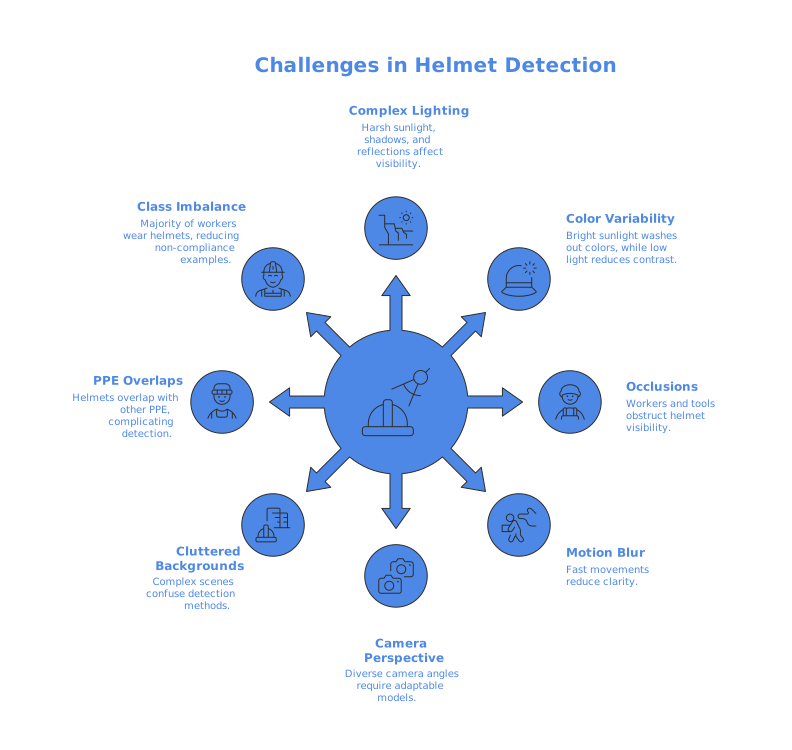
Complex lighting conditions
Outdoor construction sites experience harsh sunlight, strong shadows, glare, and reflections. Indoor environments include fluorescent flicker and mixed light sources. Models must adapt to variable lighting.
Helmet color variability
Workers wear helmets in white, yellow, orange, blue, red, or green. Bright sunlight may wash out colors, while low light reduces contrast.
Occlusions and obstructions
Workers may crouch behind equipment, turn their heads, or carry tools that obstruct their helmets. Models must infer helmet presence despite partial visibility.
Motion blur and vibration
Fast movements or camera vibration introduce blur that reduces clarity.
Camera perspective
Ceiling mounted cameras capture top down views, while perimeter cameras capture angled or side views. Datasets must include diverse perspectives.
Cluttered backgrounds
Construction materials, metal structures, and warehouse shelving create complex scenes that confuse naive detection methods.
PPE overlaps
Helmets may overlap with other PPE such as ear muffs, hoods, or lamps. Models must differentiate helmet contours from overlapping accessories.
Class imbalance
The majority of workers typically wear helmets. This reduces examples of non compliance and complicates training. These challenges make helmet detection one of the more difficult PPE detection tasks, especially in dynamic industrial environments.
Applications of Helmet Detection
Construction site monitoring
Helmet detection provides continuous monitoring to ensure workers comply with PPE requirements. Alerts help supervisors intervene in real time.
Factory and warehouse safety
Industrial facilities use helmet detection alongside forklift detection, pedestrian tracking, and proximity alerts to enhance safety and detect abnormal or defects for example.
Mining and oil facilities
Harsh environmental conditions make manual supervision difficult. Automated detection supports safety teams and incident prevention.
Smart access control
Some facilities integrate helmet detection with access gates. Workers entering restricted zones without helmets trigger alerts or denied access.
Incident analysis
Historical detection data helps analyze safety incidents, identify root causes, and improve training programs.
Compliance reporting
Automated logs help safety managers demonstrate compliance with OSHA, EU directives, or ISO certifications.
The versatility of helmet detection makes it valuable across diverse industrial sectors.
How Helmet Detection Integrates with Broader PPE Monitoring
Vest detection
Detecting high visibility vests helps ensure workers are visible to equipment operators.
Glove detection
In manufacturing environments, glove detection prevents hand injuries and supports assembly processes.
Goggle detection
Eye protection detection helps reduce incidents involving flying debris or chemical exposure.
Proximity and hazard detection
Combining PPE monitoring with hazard zone detection improves risk mitigation.
Worker tracking
Tracking adds temporal context and reduces false alerts by associating detections across multiple frames.
Helmet detection is often one component of a complete workplace safety AI ecosystem that includes behavior monitoring, equipment detection, and scene understanding.
Modeling Techniques for Helmet Detection
Convolutional neural networks
CNNs remain widely used for object detection and segmentation. They provide strong baseline accuracy across many helmet types.
Transformer based models
Transformers capture more global context and handle complex industrial scenes. They are especially useful in cluttered environments.
One stage detectors
Models such as YOLO or RetinaNet provide fast inference, useful for real time monitoring in production facilities.
Two stage detectors
Two stage methods offer higher accuracy but require more computational resources.
Segmentation networks
Networks such as Mask R CNN produce high fidelity helmet masks and improve performance under occlusion.
Hybrid models
Combining detection, segmentation, and pose estimation achieves robust multi scenario performance.
Model selection depends on environmental complexity, hardware constraints, and latency requirements.
Deploying Helmet Detection in Industrial Environments
Edge deployment
Many helmet detection systems run on edge devices placed near cameras to reduce latency. Edge deployment supports real time alerts.
Cloud processing
Cloud based systems allow more powerful models and scalable data aggregation. They are suitable for facilities with stable connectivity.
Hybrid systems
Hybrid approaches balance latency and computational power by combining edge inference with cloud level analytics.
Camera placement
Optimal camera placement reduces occlusions and improves detection rates. Overhead cameras cover wide areas, while fixed angle cameras monitor specific zones.
Integration with existing safety systems
Helmet detection integrates with alarms, control systems, and safety dashboards to support on site workflows.
Human in the loop validation
In safety critical environments, alerts may be reviewed by supervisors for confirmation before action.
Deploying helmet detection requires collaboration between AI engineers, safety officers, and facility managers.
Future of Helmet Detection and PPE AI
3D helmet detection
Depth sensors and multi camera setups will provide better helmet detection in crowded or visually complex areas.
Self supervised learning
Models will increasingly learn from unlabeled footage, reducing reliance on large annotated datasets.
Cross PPE verification
Future systems will verify helmets, vests, gloves, and goggles simultaneously.
Predictive safety analytics
Detection data will feed predictive models that forecast risk levels across shifts or zones.
Autonomous safety enforcement
As systems mature, autonomous enforcement mechanisms may deny access to hazardous zones unless PPE is detected.
Multimodal fusion
Combining RGB, depth, thermal, and LiDAR data will produce more robust safety monitoring systems.
The trend toward more intelligent, resilient safety systems will continue across all industrial sectors.
Conclusion
Helmet detection is becoming a foundational capability in workplace safety AI. By identifying whether workers wear protective headgear across construction sites, factories, warehouses, and logistics facilities, computer vision systems help prevent injuries, improve compliance, and support safer operations. Models require diverse datasets with multiple helmet types, lighting conditions, and environmental complexities. Accurate annotation, robust model design, and thoughtful deployment strategies are essential for building reliable systems. As industries continue to invest in digital transformation and safety automation, helmet detection will remain central to modern occupational safety programs.
If you need help building a high quality helmet detection dataset, developing PPE monitoring workflows, or creating consistent annotation at scale, the team at DataVLab can support you with expert quality control and tailored dataset solutions.
What is Helmet detection with computer vision?
Helmet detection is one of the most widely deployed workplace safety applications in computer vision. By detecting whether workers wear protective helmets in industrial and construction environments, AI systems help reduce accidents, support compliance, and automate safety monitoring.
Why is Helmet detection Essential for modern industries?
Head injuries are among the most serious workplace hazards. Proper helmet usage significantly reduces the severity of accidents. On large sites, supervisors cannot continuously monitor every area.
What does the article explain about what helmet detection models identify?
Person detectionIdentifies workers in an image or video frame. Helmet classificationDetermines whether the detected individual is wearing a helmet. Different helmet colors may indicate job roles or access levels.
How does Helmet detection work?
Most systems begin with detecting people in the frame using object detection models. These models locate workers across diverse angles and distances. Once a person is detected, the model analyzes the head region to determine whether a helmet is present.
What does the article explain about what helmet detection datasets must include?
Helmets vary in shape, color, size, and surface texture. Datasets must include construction helmets, industrial helmets, mining helmets, and safety caps from different manufacturers. Datasets must reflect front, side, rear, top down, and angled views.
What does the article explain about how helmet detection integrates with broader PPE monitoring?
Detecting high visibility vests helps ensure workers are visible to equipment operators. In manufacturing environments, glove detection prevents hand injuries and supports assembly processes. Eye protection detection helps reduce incidents involving flying debris or chemical exposure.