Barcode Detection and Predictive Maintenance Datasets for Industrial Automation and Logistics
.jpeg)

Barcode detection datasets and predictive maintenance datasets are now essential components of industrial automation and logistics. From warehouse operations to production line management, computer vision systems rely on high quality labeled data to identify barcodes, track inventory, detect machine conditions, and anticipate equipment failures. This article explains how barcode detection works, how datasets are built, which annotation techniques are used, and why logistics companies depend on robust AI models. It also examines predictive maintenance datasets, sensor integration, failure mode classification, and real time monitoring of industrial equipment. As factories and warehouses become increasingly automated, the role of multimodal datasets continues to grow. These datasets enable AI systems to operate reliably at scale, reduce downtime, prevent errors, and streamline complex supply chain operations.
- From warehouse operations to production line management, computer vision systems rely on high quality labeled data to identify barcodes, track inventory, detect machine conditions, and anticipate equipment failures.
- This article explains how barcode detection works, how datasets are built, which annotation techniques are used, and why logistics companies depend on robust AI models.
- It also examines predictive maintenance datasets, sensor integration, failure mode classification, and real time monitoring of industrial equipment.
- These datasets enable AI systems to operate reliably at scale, reduce downtime, prevent errors, and streamline complex supply chain operations.
Barcode detection plays a central role in warehouse automation, retail distribution, order fulfillment, and industrial logistics. Barcodes encode product identity, SKU information, batch tracking, and shipment data. Automated scanners and handheld devices have long been used, but traditional barcode readers face limitations when barcodes are damaged, curved, partially occluded, or printed on reflective surfaces.
Computer vision addresses these limitations by analyzing images or video frames and detecting barcodes in challenging real world conditions. Vision based barcode detection systems can read linear (1D) barcodes, matrix codes, and dense 2D formats such as QR codes, DataMatrix codes, and PDF417 codes. Research from the MIT Auto-ID Lab demonstrates how machine learning significantly increases barcode reading accuracy under poor lighting and angle distortion.
With the rise of robotics and automated material handling, barcode detection is rapidly transitioning from handheld scanning to real time, camera based interpretation integrated directly into conveyor belts, robotic arms, drones, and autonomous mobile robots.
Why Barcode Detection Matters for Industrial and Logistics Workflows
Inventory accuracy
Accurate barcode detection ensures the correct identification of products, reducing inventory errors that lead to financial losses and fulfillment delays.
Automation at scale
Automated warehouses increasingly depend on robotic vehicles, fixed camera arrays, and automated sorting systems. Vision based barcode detection allows robots to read labels without physical scanners.
Speed and throughput
High speed conveyors require barcode detection at frame rates that exceed handheld scanning capabilities. Computer vision handles multiple barcodes in a single frame and processes images in real time.
Reading damaged or low quality codes
Manufacturers often deal with smudged, scratched, or partially torn barcodes. Machine learning models are more adaptive and can interpret distorted patterns.
Operational resilience
Barcode detection integrated into cameras improves reliability in noisy environments where traditional scanners struggle due to vibration or surface reflectivity.
Barcodes remain one of the most efficient, low cost mechanisms for tracking items throughout supply chains, making vision based detection a natural evolution for modern logistics especially when combined with defect detection technologies.
For the annotation side of this work, see DataVLab's Industrial Data Annotation Services offering: expert annotators, EU-based teams on request and QA reports you can audit.
How Barcode Detection Works
Image acquisition
Camera systems capture images of items moving on conveyor belts, stored on shelves, or carried by robotic vehicles. The angle, resolution, lighting, and distance influence detection performance.
Localization
The first step is to identify regions in the image that potentially contain barcodes. Localization models detect candidate areas using features such as edge density, contrast, and structural patterns.
Orientation correction
Barcodes may appear rotated, upside down, skewed, or curved. Vision systems apply geometric transformations to normalize orientation before decoding.
Decoding
Once localized and aligned, the barcode is decoded either through classical algorithms or deep learning models. The decoding step converts visual patterns into alphanumeric data.
Verification and quality scoring
Some systems assign quality scores to barcodes based on clarity, contrast, and readability. These scores help maintain compliance with industry standards.
Barcode detection pipelines must be resilient to distortions caused by motion blur, glare, surface curvature, and packaging textures.
Barcode Types Found in Industrial Datasets
1D barcodes
Common in retail and warehouse operations. Examples include UPC, EAN, Code 128, and Code 39. These barcodes encode limited information but remain widely used due to fast scanning.
2D barcodes
Matrix codes such as QR, DataMatrix, and Aztec codes store significantly more data and support error correction. They are increasingly used in electronics, pharmaceuticals, aviation, and medical devices.
Stacked barcodes
Formats like PDF417 support higher density information in constrained label sizes.
Direct part marking
Industrial components, especially in aerospace and automotive, may have laser etched or dot peened codes. These require robust detection models due to low contrast and uneven surfaces.
Curved or reflective codes
Bottles, cans, and cylindrical packaging require specialized models capable of interpreting warped visual patterns.
Barcode detection datasets must capture a wide variety of real world barcode formats under diverse conditions.
Datasets Required for Barcode Detection
High quality datasets determine whether barcode models generalize across different environments and packaging types. Barcode detection datasets need to represent the challenges that arise in production and logistics.
High resolution images
Barcodes can appear very small within an image. High resolution imagery provides sufficient detail for decoding.
Multiple lighting conditions
Warehouses often vary in lighting intensity, direction, and color temperature. Glare and shadows must be present in training data to improve robustness.
Damaged barcodes
Real world datasets must include torn, scratched, wrinkled, or low contrast barcodes.
Background variability
Items may appear against cluttered shelves, concrete floors, conveyor belts, or packaging materials. Background diversity prevents false positives.
Various camera angles
Drones, robots, and fixed cameras all capture images from different perspectives. Models require multi angle training data.
Barcode density
Some images include single barcodes, while others include multiple barcodes on one item. Models must detect multiple regions reliably.
Motion blur
Moving conveyors introduce blur at high speeds. Training samples must reflect this.
Datasets must mirror the complexity of industrial environments to ensure reliable deployment.
Annotation for Barcode Detection
Annotation for barcode detection includes several steps:
Bounding box annotation
Annotators draw tight bounding boxes around each barcode, ensuring labels do not include irrelevant background.
Barcode type labels
Class labels indicate whether the barcode is QR, UPC, DataMatrix, Code 128, or another format. This helps multi class models or hybrid scanning systems.
Orientation labeling
Some pipelines require annotators to label barcode rotation or skew angles.
Quality scoring
Manufacturers sometimes request labels that categorize barcodes by clarity, sharpness, occlusion, or damage severity.
Instance segmentation
Segmentation masks help models extract barcode shapes in cluttered or reflective environments.
Metadata annotation
Information such as camera angle or lighting condition can be included to support domain adaptation.
High quality annotation is essential because decoding accuracy depends heavily on precise region of interest extraction.
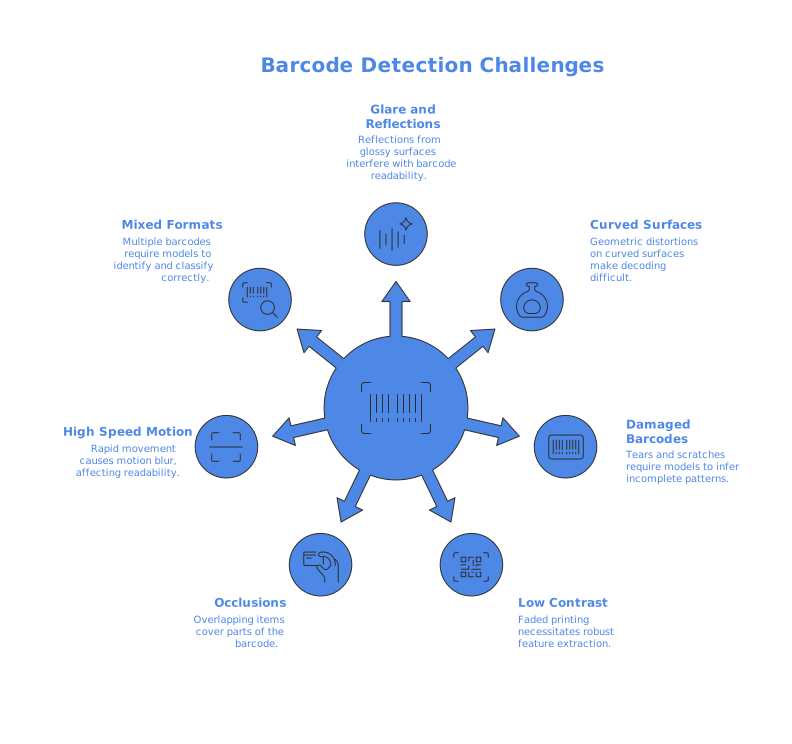
Challenges in Barcode Detection
Glare and reflections
Plastic packaging, glossy paper, and shrink wrap often cause reflections that interfere with barcode readability.
Curved surfaces
Bottles, cans, and cylindrical containers create geometric distortions that make decoding more challenging.
Damaged or partial barcodes
Tears, smudges, and scratches require models to infer incomplete patterns.
Low contrast or faded printing
In older or reused packaging, barcodes may be faded, requiring robust feature extraction.
Occlusions
Hands, tools, or overlapping items may cover part of the barcode.
High speed motion
In automated sorting, items move rapidly, creating motion blur that affects readability.
Mixed barcode formats
Some products carry multiple barcodes. Models must identify all necessary codes without misclassifying overlapping patterns.
Addressing these challenges requires well designed datasets and adaptive deep learning techniques.
Applications of Barcode Detection in Industry
Automated picking systems
Robotic arms rely on barcode detection to identify items and place them correctly in bins or containers.
Autonomous mobile robots (AMRs)
AMRs read shelf labels and pallet codes to navigate warehouses efficiently.
Sorting systems
High speed sorting lines use camera based barcode reading to route packages.
Inventory management
Cameras installed in aisles capture shelf barcodes to update stock levels.
Reverse logistics
Return processing requires reading product labels quickly, even when packaging is damaged.
Traceability and compliance
Pharmaceutical, aerospace, and medical device industries use DataMatrix and direct part marking to ensure full traceability.
Computer vision based barcode detection supports end to end logistics automation.
Predictive Maintenance in Industrial Automation
Predictive maintenance applies AI to forecast equipment failures before they occur. Models analyze sensor data, machine images, vibration signatures, or thermal patterns to identify anomalies.
Predictive maintenance datasets include labeled examples of normal operating states and abnormal conditions. They are used to train predictive models that reduce downtime and optimize maintenance schedules. Research from the European Federation of National Maintenance Societies reports that predictive maintenance can reduce unexpected failures by up to 30 percent and extend equipment life significantly.
Predictive maintenance is a crucial part of Industry 4.0, bridging machine intelligence with operational reliability.
What Predictive Maintenance Datasets Include
Sensor data
Predictive maintenance uses vibration, current, pressure, sound, and temperature data. Each sensor type captures a different aspect of machine health.
Thermal images
Infrared cameras provide thermal signatures that reveal overheating motors, friction hotspots, or electrical anomalies.
Video sequences
Camera footage helps detect belt misalignment, gear wear, lubrication issues, or slow mechanical degradation.
Time series logs
Time stamped data is essential for trend analysis and root cause identification.
Failure labels
Datasets must label failure states such as bearing faults, electrical issues, excessive vibration, or misalignment.
Operational context
Additional metadata such as machine load, production rate, or environmental conditions improves model accuracy.
Predictive maintenance datasets must be multimodal to fully capture the complexity of machine behavior.
Annotation for Predictive Maintenance
Annotation depends on the modality:
Thermal image annotation
Annotators mark hotspots, anomalous patterns, or abnormal thermal gradients.
Video annotation
Frame by frame inspection identifies mechanical anomalies such as slippage, wobbling, or irregular movement.
Time series labeling
Fault timestamps or sequences must be clearly labeled to support supervised learning.
Failure classification
Datasets require labels for each failure type, enabling multiclass prediction.
Severity annotation
Failure severity helps prioritize alerts and maintenance actions.
Annotation for predictive maintenance requires technical understanding of equipment behavior and close collaboration with engineers.
Challenges in Predictive Maintenance Datasets
Rare failures
Machine failures are infrequent, creating extreme class imbalance.
Sensor noise
Real world sensors produce noisy signals affected by temperature, vibration, or electrical interference.
Changing machine conditions
Wear, lubrication, load, and environmental changes affect machine signatures.
Multimodal integration
Synchronizing audio, thermal, vibration, and video data is technically challenging.
Long time horizons
Failures may evolve over weeks or months, requiring long term data collection.
High variance across machine types
Models trained on one machine may not generalize to another without adaptation.
Predictive maintenance datasets require careful design and significant engineering effort.
Applications of Predictive Maintenance
Manufacturing plants
Equipment such as motors, conveyors, pumps, and compressors benefit from predictive monitoring.
Logistics and warehousing
Automated storage and retrieval systems depend on predictive maintenance to avoid costly downtime.
Utilities and energy
Wind turbines, transformers, and solar inverters rely on predictive models to maintain reliability.
Transportation
Rail, aviation, and automotive industries use predictive maintenance for engines, brakes, and mechanical assemblies.
Food processing equipment
Predictive models prevent breakdowns in mixers, slicers, grinders, and packaging machines.
Mining and heavy industry
High value equipment requires early detection of wear to avoid hazardous failures.
Predictive maintenance improves reliability across all sectors of industrial automation.
How Barcode Detection and Predictive Maintenance Work Together
Although barcode detection and predictive maintenance seem unrelated, together they form a powerful dataset ecosystem for industrial automation:
- Barcode detection improves product tracking and inventory visibility
- Predictive maintenance minimizes equipment downtime
- Combined, they ensure that automated factories operate continuously and efficiently
Robotic systems that read barcodes for navigation also rely on predictive maintenance models to schedule self servicing or battery management. Conveyor belts used for barcode scanning also require predictive models to prevent mechanical failures. Together, both data types support the broader transformation toward intelligent, data driven industrial operations.
Conclusion
Barcode detection datasets and predictive maintenance datasets are foundational to modern industrial automation. They support streamlined logistics, accurate product identification, reduced downtime, and improved operational efficiency. High quality image data, robust annotation, and multimodal signals allow AI models to operate reliably across complex environments. As factories and warehouses continue to integrate robotics, conveyor systems, and automated scanning technologies, the importance of well curated datasets grows significantly.
If your organization needs support building barcode detection datasets, predictive maintenance datasets, or complex multimodal annotation pipelines, DataVLab can assist with expert quality control and scalable, high precision labeling tailored to the needs of industrial AI.
What is Barcode detection and predictive maintenance datasets for industrial automation and logistics?
Barcode detection datasets and predictive maintenance datasets are now essential components of industrial automation and logistics. From warehouse operations to production line management, computer vision systems rely on high quality labeled data to identify barcodes, track inventory, detect machine conditions, and anticipate equipment failures.
Why does barcode detection matter for industrial and logistics workflows?
Accurate barcode detection ensures the correct identification of products, reducing inventory errors that lead to financial losses and fulfillment delays. Automated warehouses increasingly depend on robotic vehicles, fixed camera arrays, and automated sorting systems. Vision based barcode detection allows robots to read labels without physical scanners.
How does Barcode detection work?
Camera systems capture images of items moving on conveyor belts, stored on shelves, or carried by robotic vehicles. The angle, resolution, lighting, and distance influence detection performance. The first step is to identify regions in the image that potentially contain barcodes.
What are the main use cases for Barcode detection and predictive maintenance datasets for industrial automation and logistics?
Robotic arms rely on barcode detection to identify items and place them correctly in bins or containers. AMRs read shelf labels and pallet codes to navigate warehouses efficiently. High speed sorting lines use camera based barcode reading to route packages.
What does the article explain about what predictive maintenance datasets include?
Predictive maintenance uses vibration, current, pressure, sound, and temperature data. Each sensor type captures a different aspect of machine health. Infrared cameras provide thermal signatures that reveal overheating motors, friction hotspots, or electrical anomalies.
What does the article explain about how barcode detection and predictive maintenance work together?
Barcode detection improves product tracking and inventory visibility. Combined, they ensure that automated factories operate continuously and efficiently. Robotic systems that read barcodes for navigation also rely on predictive maintenance models to schedule self servicing or battery management.