Foreign Material Detection in Food : How AI Prevents Contamination in Modern Food Manufacturing
.jpeg)

Foreign material detection in food manufacturing has become one of the most important applications of computer vision and machine learning. Contaminants such as plastic fragments, metal pieces, bone shards, glass particles, or organic debris can compromise food safety, trigger product recalls, and damage consumer trust. This article explains how AI based detection systems work, how datasets are collected, what annotation workflows are used, and why food manufacturers increasingly rely on automated quality control. It also examines the challenges of foreign material inspection, including heterogeneous products, complex shapes, and variable lighting. As regulations tighten and consumer expectations rise, food manufacturers must adopt reliable foreign material detection to maintain safety, reduce waste, and protect brand reputation.
- Foreign material detection in food manufacturing has become one of the most important applications of computer vision and machine learning.
- Contaminants such as plastic fragments, metal pieces, bone shards, glass particles, or organic debris can compromise food safety, trigger product recalls, and damage consumer trust.
- This article explains how AI based detection systems work, how datasets are collected, what annotation workflows are used, and why food manufacturers increasingly rely on automated quality control.
- As regulations tighten and consumer expectations rise, food manufacturers must adopt reliable foreign material detection to maintain safety, reduce waste, and protect brand reputation.
Foreign material detection refers to identifying objects that should not be present in processed food products. Contaminants may enter the production line at many stages, from raw materials to packaging. Food manufacturers must monitor these stages carefully to prevent safety hazards and maintain compliance with regulatory standards.
Traditional detection methods rely on manual visual checks, metal detectors, sieves, or X ray scanning. While effective in specific use cases, these methods suffer from limited resolution, high false positives, and difficulty detecting non metallic contaminants. Machine learning has transformed the field by providing more accurate and adaptive detection capabilities. Models learn from examples of contamination and identify patterns that traditional rule based systems cannot capture. Research from the FoodSafety.gov Knowledge Center highlights the increasing adoption of machine learning for contamination detection across the food processing industry.
Food manufacturers now integrate AI into inspection tunnels, conveyor belts, packaging lines, and raw material sorting stations to detect unwanted materials at unprecedented speed and precision.
Why Foreign Material Detection Has Become Critical
Consumer safety
Contaminated food poses significant health risks. Even small fragments of plastic, metal, bone, or glass can cause injury or digestive issues. AI based detection systems offer high sensitivity and fast response times, protecting consumers from hazardous products.
Regulatory pressure
Regulators increasingly require strict monitoring of contamination risks. Agencies such as the FDA, EFSA, and national food safety authorities impose heavy penalties for lapses in detection. Automated inspection supports compliance with Hazard Analysis and Critical Control Point (HACCP) and ISO 22000 standards.
Recall prevention
Food recalls are costly, logistically complex, and damaging to brand reputation. Automated foreign material detection reduces the likelihood of contaminated products reaching consumers. According to insights from the Institute of Food Technologists, recalls due to physical contaminants remain a top concern for global food brands.
Production efficiency
Manual inspection slows down production and introduces variability. AI based inspection integrates seamlessly into high speed conveyer systems and ensures consistent real time detection.
Waste reduction
Accurate detection helps avoid false rejections, preserving good batches and improving overall yield. Overly sensitive rule based systems often discard safe products unnecessarily.
Foreign material detection is now a pillar of food safety strategies across dairy, meat, bakery, beverage, ready meals, and packaged goods production.
Common Types of Foreign Materials in Food Processing
Contamination sources vary depending on the type of food, processing environment, and machinery used. Machine learning models must account for a broad spectrum of foreign materials.
Metal fragments
Metal contaminants often originate from broken machine components, cutting tools, or equipment wear. Traditional metal detection works well, but deep learning supports verification and reduces false alarms triggered by product characteristics such as salt content or packaging foil.
Plastic pieces
Plastic is one of the most frequent contaminants due to widespread use of packaging, gloves, and utensils. Plastic can vary in shape, color, and opacity, which makes detection challenging for rule based systems.
Glass shards
Glass contaminants pose severe safety risks. Bottling lines, jar packaging, and glass mixing equipment are common sources. X ray imaging paired with machine learning offers better accuracy in detecting glass fragments embedded within food.
Bone fragments
In meat and fish processing, bone detection is a major requirement for product safety. Traditional X ray algorithms often struggle with small or partial fragments. Deep learning improves detection of irregular bone shapes, even in complex textures.
Rubber and silicone debris
Gaskets, seals, and suction components degrade over time and may enter the food stream. Machine learning helps detect these materials despite variations in shape and deformation.
Organic contaminants
Foreign materials may originate from insects, wood splinters, or plant residue. Their irregular morphology requires datasets that capture broad variability.
Stones or soil particles
Agricultural raw materials may introduce stones, dirt, and solid impurities. Sorting systems increasingly use machine learning combined with color and hyperspectral imaging.
Identifying these materials requires carefully designed imaging setups and comprehensive datasets.
How Foreign Material Detection Works
Multimodal imaging
Food products vary in density, texture, color, and internal composition. Modern detection systems use multiple imaging techniques such as optical cameras, X ray scanning, near infrared imaging, and hyperspectral analysis to capture different visual signatures. Systems that combine modalities benefit from higher accuracy and lower false positives.
Machine learning classification
Classification models distinguish between contaminated and clean samples. They analyze global features such as shape, texture, and intensity patterns. Although simple, classification can provide fast screening on uniform products.
Object detection models
Object detection identifies the location of foreign materials using bounding boxes. This is effective for irregular contaminants like plastic parts or fragments on the surface.
Semantic segmentation
Segmentation maps provide pixel wise labeling of contaminants, capturing detailed shapes. This approach is crucial when foreign materials blend into the background or share visual characteristics with the product.
Anomaly detection
Anomaly models learn the distribution of normal product images and flag deviations. This helps detect contaminants that lack consistent visual patterns.
Transformers and deep models
Transformer architectures capture context across large areas, making them effective for heterogeneous food products. Research from the University of Reading’s Food Processing Engineering Group demonstrates how transformer based models improve detection of mixed shape contaminants in bakery and cereal processing.
Machine learning systems adapt to product variation and environmental noise better than traditional rule based algorithms.
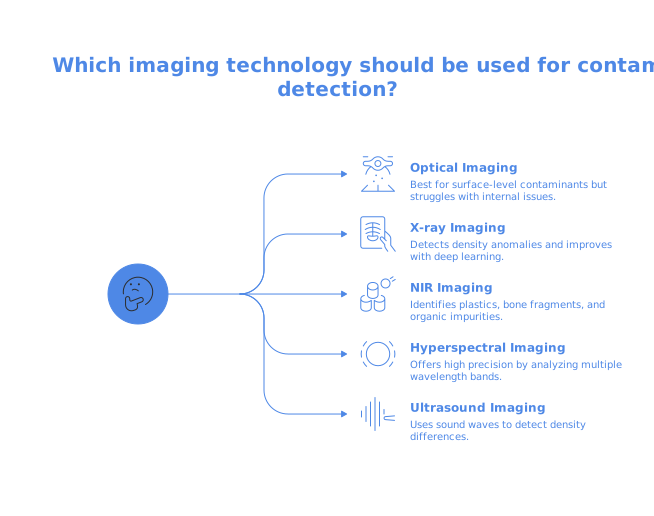
Imaging Technologies Used in Contamination Detection
Optical imaging
RGB cameras capture surface level contaminants. Optical systems excel in identifying visible debris but struggle with internal contamination.
X ray imaging
X ray systems remain one of the most widely used techniques. They detect density anomalies within packaged or bulk products. Pairing X ray data with deep learning improves sensitivity to small or low contrast materials.
Near infrared (NIR) imaging
NIR imaging detects contaminants based on light absorption patterns. It is useful for detecting plastics, bone fragments, and organic impurities.
Hyperspectral imaging
Hyperspectral systems analyze hundreds of wavelength bands, offering rich information about material composition. Machine learning interprets these high dimensional signals to detect contaminants with high precision.
Ultrasound and acoustic imaging
Some systems use sound waves to identify density differences. Machine learning helps classify patterns that may indicate foreign material presence.
Food manufacturers often combine these imaging technologies to achieve high sensitivity across diverse contamination types.
Datasets for Foreign Material Detection
Effective foreign material detection requires high quality datasets representing contaminants across different stages of the production process.
Diverse contaminant types
Datasets must include a wide range of foreign materials: plastics, bone, rubber, glass, metals, stones, and organic debris. Each contaminant appears in many shapes, sizes, and positions.
Multiple backgrounds and food types
Different foods introduce variation in texture, color, density, and moisture. Models must learn to distinguish contaminants from irregular food structures.
High resolution imagery
Small contaminants require high resolution cameras. Low resolution training data may prevent models from recognizing micro debris.
Multimodal datasets
X ray, hyperspectral, and NIR images provide complementary information. Multimodal datasets enable models to generalize better.
Balanced positive and negative samples
Foreign materials are rare, making datasets imbalanced. Collecting enough positive samples is a major challenge that often requires synthetic data augmentation.
Product variability
Datasets must capture variation across batches, production speeds, geographic sources of raw materials, and seasonal changes. Variability improves generalization in real production environments.
Dataset quality has a direct impact on detection accuracy, especially for small or visually similar contaminants.
Annotation for Foreign Material Detection
Annotation is particularly challenging in food inspection because contaminants can be extremely small or partially hidden.
Bounding boxes
Bounding boxes identify regions where contaminants appear. Annotators must place tight boxes around each object without including unnecessary background.
Pixel level segmentation
Segmentation is essential for precise localization of thin or irregular contaminants. Segmenting small fragments requires meticulous manual effort and multiple QA cycles.
Class labels
Some contaminant types require specific labeling such as metal fragment, plastic shard, bone piece, or glass particle. Class differentiation improves downstream analytics.
Contour annotation
Polygon or contour annotation helps capture irregular shapes such as splintered fragments or organic debris.
Visibility and occlusion labeling
Food products often hide contaminants beneath surface layers. Annotators label whether contaminants are fully or partially visible to help train robust models.
Temporal annotation
In conveyor belt video datasets, annotators ensure consistency across frames to support tracking and temporal smoothing.
Annotation for foreign materials demands a highly trained workforce and structured QA processes to ensure consistency and reliability.
Challenges in Foreign Material Detection
Small and fine contaminants
Many contaminants are only a few millimeters long. Detecting these requires high resolution imaging, precise annotation, and strong model training.
Irregular shapes
Contaminants vary widely in shape and may break into unpredictable pieces. Models must learn diverse shape distributions.
Variable backgrounds
Food products such as cereal, pasta, meat, or vegetables have irregular textures. Background complexity increases false positive rates.
Moisture and reflectivity
Moist surfaces introduce glare, shadows, and specular highlights that confuse traditional vision systems. Machine learning helps adapt to these challenging conditions.
Packaging interference
Foil packaging, plastic films, and transparent containers add visual noise. Some contaminants may be masked by packaging artifacts.
Non visible contaminants
Certain contaminants blend visually with the product. X ray or NIR imaging helps address this issue, but requires more complex datasets.
Class imbalance
Foreign materials occur infrequently. Collecting enough data is difficult, often requiring synthetic augmentations or anomaly detection approaches.
High speed constraints
Detection systems must operate in real time. Models need fast inference speed, optimized hardware, and robust integration.
These challenges make foreign material detection one of the most technically demanding applications in food manufacturing AI.
Applications of Foreign Material Detection in the Food Industry
Meat and poultry processing
Bone fragments are a major concern in boneless meat products. AI models paired with X ray scanners detect small bones more accurately than traditional algorithms.
Seafood production
Fish bones, shell fragments, and scale clusters can pose safety risks. Deep learning improves bone detection in complex fish textures.
Dairy and cheese processing
Plastic pieces from packaging or equipment can contaminate cheese blocks. Optical and X ray combined systems detect contaminants earlier in the process.
Bakery and cereal production
Foreign materials such as metal shavings, plastic fragments, or insect debris can appear in grain based products. Machine learning helps detect these contaminants despite irregular product shapes.
Vegetable and fruit processing
Sorting lines use machine learning with hyperspectral imaging to detect stones, soil, or organic debris mixed with produce.
Confectionery and snack foods
Chocolates, bars, and snack items vary in shape and surface texture. AI improves contaminant detection by learning product variability.
Beverage bottling
Glass shards pose a major risk in bottling operations. Deep learning combined with X ray systems provides highly reliable detection.
Applications span the entire food production chain, from raw material inspection to final packaging.
How Machine Learning Improves Traditional Detection Technologies
Reducing false positives
Traditional detection systems often misinterpret harmless variations as contaminants. AI reduces unnecessary rejections and preserves product yield.
Handling variation in product appearance
Deep learning models adapt to complex and irregular shapes that cannot be handled by fixed rule logic.
Adapting to environmental conditions
Lighting variation, machine vibration, and temperature changes affect optical signals. Machine learning provides robust feature extraction despite noise.
Integrating multiple imaging modalities
AI fuses data from X ray, hyperspectral, and optical sensors to produce a unified detection output.
Continuous improvement
Machine learning systems improve over time as more data is collected. This creates a feedback loop that refines detection accuracy.
These advantages explain why machine learning is rapidly becoming standard in modern food manufacturing facilities.
Factory Integration and Deployment
Conveyor belt scanning
Most detection systems are deployed above or below conveyor belts where products pass under cameras or scanners. High speed production lines require real time inference.
Inspection tunnels
Dedicated inspection tunnels combine multiple imaging systems. Machine learning analyzes the resulting signals to detect contaminants.
Edge computing devices
Edge processors execute models locally to reduce latency. This is essential for fast conveyor lines or high resolution images.
Centralized quality dashboards
Detection results are aggregated into dashboards for QA teams. Data helps monitor trends, identify problematic suppliers, or adjust process parameters.
Automated rejection mechanisms
When contaminants are detected, automated ejectors remove defective items from the line. Integration with PLC systems is essential.
Traceability and logging
Detection events must be recorded to maintain traceability and compliance. ML systems integrate with MES and ERP platforms to support audits.
Deployment complexity depends on product type, speed, and imaging modality.
Future of Foreign Material Detection with AI
Self supervised contamination models
Self supervised learning will reduce the need for large labeled datasets by learning structure from unlabeled production footage.
Synthetic contaminant simulation
Factories will increasingly use synthetic data to train models on rare contaminants, improving coverage and reducing data collection costs.
Multimodal sensor fusion
Future systems will unify X ray, hyperspectral, optical, and thermal data to achieve near perfect detection sensitivity.
Factory wide contamination prediction
AI systems will track contamination patterns across time and identify upstream root causes before foreign materials reach critical points.
On device anonymization and privacy
As more video data is collected, privacy preserving techniques will be built into inspection systems.
Proactive maintenance
Detection analytics will reveal equipment wear patterns that correlate with rising contamination risks.
AI will become a proactive tool for contamination prevention, not only detection.
Conclusion
Foreign material detection is one of the most important quality control processes in food manufacturing. Machine learning and advanced imaging technologies provide manufacturers with powerful tools to detect plastic fragments, bone pieces, metal particles, glass shards, and organic debris. By improving detection accuracy, reducing false positives, and handling complex food textures, AI systems help prevent recalls, protect brand reputation, and ensure consumer safety. High quality datasets, precise annotation, and reliable imaging setups are essential for building robust models. As the food industry continues to automate and scale, foreign material detection will remain a foundational application of computer vision and machine learning.
👉 If your food manufacturing team needs expertly annotated datasets for foreign material detection, multimodal inspection, or complex visual QA workflows, DataVLab can help.
We support demanding food production environments with high accuracy annotation, scalable pipelines, and rigorous quality assurance.
What is Foreign material detection in food?
Foreign material detection in food manufacturing has become one of the most important applications of computer vision and machine learning. Contaminants such as plastic fragments, metal pieces, bone shards, glass particles, or organic debris can compromise food safety, trigger product recalls, and damage consumer trust.
What does the article explain about why foreign material detection has become critical?
Even small fragments of plastic, metal, bone, or glass can cause injury or digestive issues. AI based detection systems offer high sensitivity and fast response times, protecting consumers from hazardous products. Regulators increasingly require strict monitoring of contamination risks.
What does the section on “Common types of foreign materials in food processing” explain?
Contamination sources vary depending on the type of food, processing environment, and machinery used. Machine learning models must account for a broad spectrum of foreign materials. Metal contaminants often originate from broken machine components, cutting tools, or equipment wear.
How does Foreign material detection work?
Food products vary in density, texture, color, and internal composition. Modern detection systems use multiple imaging techniques such as optical cameras, X ray scanning, near infrared imaging, and hyperspectral analysis to capture different visual signatures. Systems that combine modalities benefit from higher accuracy and lower false positives.
What are the main use cases for Foreign material detection in food?
Bone fragments are a major concern in boneless meat products. AI models paired with X ray scanners detect small bones more accurately than traditional algorithms. Fish bones, shell fragments, and scale clusters can pose safety risks.
How does Machine learning improve Traditional detection technologies?
Traditional detection systems often misinterpret harmless variations as contaminants. AI reduces unnecessary rejections and preserves product yield. Deep learning models adapt to complex and irregular shapes that cannot be handled by fixed rule logic.