Defect Detection with Machine Learning : How AI Identifies Flaws, Anomalies, & Foreign Objects in Manufacturing
.jpeg)
Machine learning has transformed the way manufacturers detect defects and foreign objects on production lines. Instead of relying on manual inspection or traditional rule based machine vision, modern factories use AI models that identify surface flaws, structural defects, contamination, and assembly errors with high accuracy. This article explains how defect detection systems work, how datasets are created and annotated, which machine learning techniques are used, and why foreign object inspection is becoming essential for safety and regulatory compliance. It also covers operational challenges such as lighting variability, fast moving production lines, and domain adaptation across different materials. As manufacturers increase automation, defect detection becomes one of the core applications of industrial computer vision, influencing yield rates, production cost, and overall product reliability.
- Machine learning has transformed the way manufacturers detect defects and foreign objects on production lines.
- Instead of relying on manual inspection or traditional rule based machine vision, modern factories use AI models that identify surface flaws, structural defects, contamination, and assembly errors with high accuracy.
- This article explains how defect detection systems work, how datasets are created and annotated, which machine learning techniques are used, and why foreign object inspection is becoming essential for safety and regulatory compliance.
- As manufacturers increase automation, defect detection becomes one of the core applications of industrial computer vision, influencing yield rates, production cost, and overall product reliability.
Defect Detection in Modern Manufacturing
Defect detection refers to the automated identification of flaws, anomalies, or foreign objects in manufactured products. Defects may include cracks, scratches, dents, discoloration, missing components, misalignments, contamination, or structural inconsistencies. Traditionally, manufacturers relied heavily on manual inspection teams or handcrafted rule based machine vision systems. While these methods work in simple scenarios, they struggle with complex textures, changing lighting, and subtle defects that are difficult to encode using fixed thresholds.
Machine learning significantly improves this process. Instead of defining rules manually, models learn directly from examples of defects and non defects. According to research from the Fraunhofer Institute for Manufacturing Engineering and Automation, deep learning systems often outperform traditional vision methods in environments with high product variability. The shift toward learning based methods allows manufacturers to reduce false positives, catch micro defects, and maintain consistent quality even as production volume scales.
Manufacturers across automotive, electronics, plastics, pharmaceuticals, and aerospace now rely on machine learning based defect detection as a core component of their quality control infrastructure.
Why Defect Detection Matters for Production Lines
Product quality and brand reputation
High defect rates damage customer trust and increase warranty costs. Machine learning helps maintain consistent quality standards by catching anomalies that manual inspectors may overlook. A stable defect detection pipeline protects brand reputation and reduces the risk of product recalls.
Yield optimization and cost reduction
In industries such as electronics or medical devices, even minor defects can lead to rejected batches. AI based detection helps minimize scrap rates by identifying root causes earlier in the process. Detecting issues upstream also prevents costly downstream failures and reduces rework.
Regulatory compliance
Certain industries require strict compliance with safety and quality regulations. Food, pharmaceuticals, and aerospace products must be inspected for contamination, structural weaknesses, or foreign object debris. Automated inspection helps companies remain compliant with these standards.
Worker safety
Some inspections involve hazardous environments or repetitive visual tasks that cause fatigue. Machine learning reduces the burden on workers by automating tedious inspection processes while improving accuracy.
Scalability and consistency
Manual inspection accuracy varies between workers and shifts. AI provides consistent, scalable performance across different production speeds and environmental conditions.
These benefits make defect detection one of the highest ROI applications of machine learning in industrial settings.
Types of Defects Machine Learning Can Detect
Surface defects
Surface imperfections such as scratches, abrasions, cracks, dents, pits, or holes occur in manufacturing of metals, plastics, ceramics, and composite materials. AI models learn texture patterns that distinguish normal surfaces from flawed ones.
Structural defects
Structural defects affect the internal integrity of products. In some cases, computer vision is combined with X ray, ultrasound, or thermal imaging. Machine learning interprets these modalities to identify internal cracks or voids.
Assembly defects
Missing screws, misaligned components, or inverted parts frequently appear in consumer electronics, appliances, and industrial machinery. Object detection and classification models help detect assembly errors quickly.
Contamination and foreign objects
Foreign object debris is a major concern in automotive, aerospace, and food manufacturing. Detecting unwanted materials such as metal fragments, plastic particles, or biological contaminants is essential for product safety. Research from the Aerospace Industries Association highlights the risks of foreign object debris in high precision manufacturing.
Dimensional irregularities
Some defects stem from incorrect dimensions. Machine learning works with metrology systems to detect parts that do not meet tolerance specifications.
Color and texture abnormalities
Subtle variations in color or texture may indicate quality issues in textiles, plastics, and printed surfaces. Machine learning helps detect these variations despite shifts in lighting or camera settings.
Defect detection models must be flexible enough to learn a wide range of defect types across materials.
How Machine Learning Detects Defects
Image classification
Classification models determine whether an item is defective or non defective. They are useful for binary decisions but provide limited localization.
Object detection
Object detection models identify the location of defects using bounding boxes. These models are ideal for scratches, dents, holes, or foreign objects on a surface.
Semantic segmentation
Segmentation models label each pixel according to defect or non defect categories. This provides highly detailed defect localization, especially for irregular shapes.
Anomaly detection
Anomaly models learn what “normal” looks like and flag any deviation. This is helpful when defect types are rare or unpredictable. It also reduces the need for collecting thousands of defect samples.
Deep learning approaches
Convolutional neural networks and transformer based architectures capture complex textures, lighting conditions, and subtle patterns. Research from the Berkeley Artificial Intelligence Research Laboratory shows that transformer models can capture fine surface irregularities that older CNNs may miss.
Using multiple model types helps manufacturers tailor inspection to specific materials and defect categories.
Foreign Object Debris Detection in Manufacturing
Foreign object debris, often referred to as FOD, includes contaminants such as broken tooling, metal shavings, plastic fragments, hair, dirt, or organic materials that should not be present in the final product. Detecting FOD is critical in sectors where safety, hygiene, or precision are essential. In aerospace, even small particles can cause catastrophic equipment failure. In food manufacturing, contaminants pose serious health risks and regulatory consequences.
FOD sources
Foreign objects may come from broken equipment, packaging materials, mishandling, or external contamination introduced during manufacturing. Identifying the root cause is essential for process improvement.
Detection approaches
Computer vision models detect unwanted objects by identifying unusual shapes, colors, or textures that differ from the expected product surface. Multimodal imaging such as X ray or hyperspectral analysis is increasingly used when contaminants are visually similar to the product.
Dataset diversity
FOD datasets must include a wide variety of contaminant types in different orientations and lighting conditions. Foreign materials vary greatly in shape and appearance, so training requires carefully curated examples.
Industry relevance
Studies from the National Center for Food Safety and Technology highlight how machine learning reduces contamination risks and improves detection accuracy in food processing facilities.
Foreign object detection requires sophisticated annotation workflows due to the small size and irregular shape of contaminants.
Datasets Required for Defect Detection
High quality datasets determine how well a defect detection system performs. Defect datasets should include diverse examples across lighting conditions, material types, and defect variations.
Positive and negative samples
Datasets must include examples of both defects and non defects. Balanced datasets prevent the model from over predicting one class.
Multiple defect categories
Different defect types such as cracks, dents, and scratches should be labeled separately to help the model differentiate between defect classes.
High resolution images
Defects are often small and subtle. High resolution imaging improves the model’s ability to detect micro imperfections.
Modality diversity
Some datasets include thermal images, depth maps, or X ray slices. These modalities support detection of internal defects or foreign objects invisible to standard cameras.
Real production variability
Datasets must capture production variability such as different batches, colors, textures, and surface finishes. This ensures deployment robustness.
Datasets for defect detection require careful planning because many defects occur infrequently and are challenging to collect at scale.
Annotation for Defect Detection
Bounding box annotation
Bounding boxes help locate defects such as cracks, scratches, or foreign objects. Boxes must tightly capture the defect region to avoid training errors.
Pixel wise segmentation
Segmentation labels provide granular information about the exact shape and extent of defects. This is essential for irregular shapes or diffuse areas.
Classification labels
Some datasets require simple labels indicating whether an item is defective. This is useful for binary classification scenarios.
Severity annotation
Some manufacturers categorize defects by severity levels such as minor, moderate, or critical. Severity labels help downstream decision systems prioritize inspection results.
Contour and polygon annotation
Polygon annotation is useful for defects with fine boundaries such as thin cracks or small punctures.
Annotation for defect detection requires strong quality assurance because even small inconsistencies can degrade model performance.
Challenges in Defect Detection
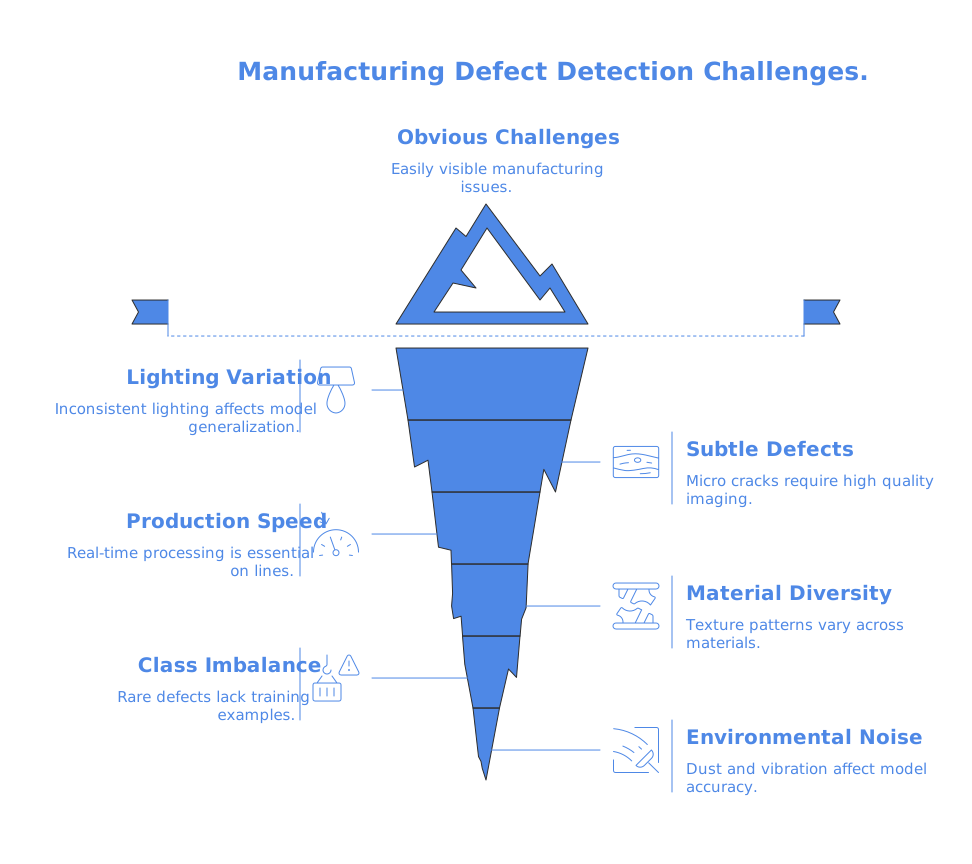
Lighting variation
Manufacturing environments often have inconsistent lighting due to reflective surfaces, shadows, and machine glare. Models must generalize across these variations.
Subtle defects
Many defects are difficult for the human eye to detect. Micro cracks or faint discolorations require high quality imaging and precise annotation.
Fast production speeds
On high speed production lines, cameras must capture sharp images and models must process them in real time. Latency reduction becomes essential.
Material diversity
Different materials present different texture patterns. Models trained on one type of surface may perform poorly on another. Domain adaptation helps address this challenge.
Class imbalance
Some defect types occur rarely. Collecting enough examples for training is difficult, making anomaly detection essential.
Environmental noise
Dust, vibration, motion blur, and reflections introduce noise that models must handle effectively.
These challenges underscore the importance of robust training datasets and carefully engineered machine learning pipelines.
Applications of Defect Detection in Industry
Automotive manufacturing
AI detects paint defects, welding inconsistencies, assembly misalignment, and foreign debris in engine components. Automated inspection ensures consistency across thousands of units produced daily.
Electronics and semiconductor production
Machine learning identifies microscopic surface contamination, soldering defects, wafer scratches, and circuit board anomalies. Even minor defects can cause catastrophic electrical failures.
Aerospace and defense
Aircraft components must meet extremely high safety standards. AI detects cracks, structural defects, and foreign object debris in critical parts.
Pharmaceutical and medical device manufacturing
Defect detection ensures that packaging, capsules, syringes, and sensitive equipment meet regulatory standards. This reduces patient risk and improves traceability.
Food and beverage production
AI helps detect foreign materials such as metal fragments, plastic pieces, or organic contaminants. This reduces recall risks and improves compliance with food safety regulations.
Textile and packaging industries
Models detect stitching errors, printing defects, and material inconsistencies that affect product appearance and performance. It can also detect barcode inconsistencies.
The breadth of use cases shows how central defect detection has become to industrial automation.
How Factories Deploy Machine Learning Systems
Camera integration
Inspection cameras are installed at strategic points along production lines. Their placement depends on product geometry and the type of defects being targeted.
Edge computing
Many factories process images directly on edge devices to reduce latency. This is especially important for fast moving assembly lines.
Centralized AI systems
Some facilities use cloud based AI platforms to run more complex models. Cloud systems enable continuous updates and large scale dataset aggregation.
Hybrid inspection workflows
Manufacturers often combine rule based systems with machine learning. Traditional filters handle simple defects while deep learning focuses on complex or ambiguous cases.
Feedback loops
Inspection results feed back into the production line to adjust machinery, reduce defect rates, or modify process parameters.
A successful deployment requires robust integration between hardware, software, and manufacturing operations.
Future of Defect Detection with AI
Transformer based vision models
Transformers provide stronger context understanding and handle complex textures better than traditional CNNs. Their performance continues to improve across industrial tasks.
Self supervised learning
Self supervised methods reduce the need for labeled datasets by learning directly from large amounts of unlabeled production footage.
Multimodal inspection
Combining color images with thermal, hyperspectral, or X ray inputs leads to higher accuracy. Multimodal fusion is especially useful for detecting internal defects.
Synthetic defect generation
Synthetic data is increasingly used to simulate rare defects. This helps address class imbalance and improves robustness.
Adaptive inspection
Future systems will automatically adapt detection thresholds based on production conditions, improving long term reliability.
Machine learning will continue to evolve alongside manufacturing automation, becoming more predictive, autonomous, and resilient.
Conclusion
Defect detection using machine learning has become a critical component of modern quality control systems. By analyzing images, segmenting defect regions, and interpreting complex textures, AI models identify anomalies that traditional rule based methods struggle to detect. Whether manufacturers are looking for surface cracks, assembly defects, foreign object debris, or contamination, machine learning provides a scalable and accurate solution. High quality datasets, expert annotation, and robust deployment pipelines ensure consistent performance across production lines. As industrial automation accelerates, defect detection will play an even larger role in ensuring product reliability, safety, and compliance.
👉 If your team needs expertly annotated defect detection datasets, foreign object detection workflows, or high accuracy inspection data for machine learning, DataVLab can help.
We support demanding industrial environments with scalable, precise annotation and QA processes.
What is Defect detection with machine learning?
Machine learning has transformed the way manufacturers detect defects and foreign objects on production lines. Instead of relying on manual inspection or traditional rule based machine vision, modern factories use AI models that identify surface flaws, structural defects, contamination, and assembly errors with high accuracy.
Why does defect detection matter for production lines?
High defect rates damage customer trust and increase warranty costs. Machine learning helps maintain consistent quality standards by catching anomalies that manual inspectors may overlook. A stable defect detection pipeline protects brand reputation and reduces the risk of product recalls.
How does Machine learning detect Defects?
Classification models determine whether an item is defective or non defective. They are useful for binary decisions but provide limited localization. Object detection models identify the location of defects using bounding boxes.
What are the main challenges of Defect detection with machine learning?
Manufacturing environments often have inconsistent lighting due to reflective surfaces, shadows, and machine glare. Many defects are difficult for the human eye to detect. Micro cracks or faint discolorations require high quality imaging and precise annotation.
What are the main use cases for Defect detection with machine learning?
AI detects paint defects, welding inconsistencies, assembly misalignment, and foreign debris in engine components. Automated inspection ensures consistency across thousands of units produced daily. Machine learning identifies microscopic surface contamination, soldering defects, wafer scratches, and circuit board anomalies.
What does the article explain about how factories deploy machine learning systems?
Inspection cameras are installed at strategic points along production lines. Their placement depends on product geometry and the type of defects being targeted. Many factories process images directly on edge devices to reduce latency.