Hand Tracking Datasets: How to Annotate Keypoints, Depth Maps and Kinematics for XR and Vision AI
.jpeg)

This article explains how hand tracking datasets are designed and annotated for computer vision, XR input systems and robotics. It covers skeleton definitions, keypoint placement, depth maps, motion sequences, occlusion rules, temporal consistency, calibration methods and quality validation. It also describes how these datasets support gesture interfaces, manipulation prediction and hand pose recognition models.
- This article explains how hand tracking datasets are designed and annotated for computer vision, XR input systems and robotics.
- It covers skeleton definitions, keypoint placement, depth maps, motion sequences, occlusion rules, temporal consistency, calibration methods and quality validation.
- It also describes how these datasets support gesture interfaces, manipulation prediction and hand pose recognition models.
- Hand tracking datasets provide the structured keypoint and motion data that computer vision systems use to detect, track and interpret hand pose.
Hand tracking datasets provide the structured keypoint and motion data that computer vision systems use to detect, track and interpret hand pose. These datasets contain labeled joint coordinates, depth cues, temporal sequences and camera calibration information. Research from the ETH Zürich Computer Vision Lab shows that accurate keypoint annotations significantly improve hand pose estimators, especially in sequences with occlusions and rapid movement. Because XR interfaces, gesture recognition systems and robotics pipelines depend on precise tracking, dataset quality directly influences model stability and user experience. High-quality hand tracking datasets must capture diverse poses, lighting conditions and user behaviors.
Why Hand Tracking Is Foundational for XR and CV Systems
Hand tracking enables natural interaction in AR/VR applications, supports gesture-based control systems, and provides detailed pose information for robotics and simulation workflows. Modern AI models rely on labeled joint trajectories to learn accurate representations of hand movement. Accurate datasets help models generalize across users, viewpoints and environments. Studies from the Max Planck Institute for Intelligent Systems highlight that consistent keypoint labeling improves performance in unconstrained settings such as gaming and teleoperation. Hand tracking datasets therefore form a critical building block for real-time applications.
Supporting natural hand interfaces in XR
Hand tracking allows users to interact with virtual environments without controllers. Datasets train models to recognize gestures, selection motions and hands-free interactions. Accurate tracking improves responsiveness. Stable pose estimation enhances immersion. High-quality datasets make these interactions intuitive.
Improving gesture recognition systems
Gesture recognition models depend on clear and consistent pose sequences. Keypoint trajectories allow the model to interpret motion patterns. High-quality labels help distinguish similar gestures. Better tracking improves classification accuracy. Reliable datasets reduce false positives during real use.
Enabling robotics and teleoperation
Robotic systems benefit from understanding human hand movements. Hand tracking datasets help predict operator actions and support telemanipulation. Consistent labeling improves model planning. Better prediction strengthens remote control systems. Stable tracking enhances safety and efficiency.
Capturing High-Quality Data for Hand Tracking
The quality of a hand tracking dataset depends strongly on the capture setup. Good hardware configuration ensures that hand joints remain visible and geometrically consistent across frames. Recording environments must allow annotators to identify joints without ambiguity.
Using multi-camera setups
Tracking hands in 3D requires multiple cameras to capture all joint positions. Multi-view setups reduce ambiguity caused by occlusions. They support robust 3D reconstruction. Multiple viewpoints strengthen temporal alignment. This configuration increases annotation accuracy.
Leveraging depth and IR sensors
Depth and infrared sensors provide high-contrast silhouettes of hands. These sensors help capture finger articulation even in low-light environments. Depth cues improve 3D keypoint reliability. IR imagery helps isolate hand contours. Combined modalities strengthen pose estimation.
Ensuring stable and neutral backgrounds
Hands must be visible without background interference. Solid-colored or structured backgrounds help annotators locate joints accurately. Stable backgrounds reduce confusion during annotation. Clean imagery improves downstream modeling. Controlled capture conditions support consistent tracking.
Defining a Hand Skeleton and Keypoint Structure
Hand tracking datasets rely on a skeleton model with predefined joints. This skeleton determines how keypoints are labeled and how pose estimation models interpret movement.
Choosing a consistent keypoint taxonomy
A standard skeleton typically contains wrist, finger bases, middle joints and fingertips. Annotators must follow an identical ordering and naming scheme across all images. Consistency reduces interpretation errors. A stable taxonomy strengthens pose learning. Structured definitions improve dataset coherence.
Designing 2D and 3D keypoint formats
Depending on the task, keypoints may be labeled in image coordinates or in 3D space. Annotators must follow precise coordinate conventions. Proper formatting supports accurate reconstruction. Clear separation between 2D and 3D labels prevents confusion. This improves integration with training pipelines.
Handling extended or unusual poses
Hands can take many shapes, including stretched, curled or partially folded poses. Annotators must apply the same skeleton consistently in all cases. Consistent handling supports robustness. Uniform pose interpretation strengthens model generalization. Structured rules reduce annotation drift.
Annotating Keypoints Accurately and Consistently
Keypoint annotation is the core of a hand tracking dataset. Precise placement affects both pose reconstruction and gesture understanding.
Annotating joints with pixel accuracy
Annotators must place keypoints on the exact center of joint locations. Small deviations can propagate into poor pose estimation. Pixel-level accuracy ensures stable learning. Clean placement reduces geometric noise. Accurate joints improve downstream applications.
Handling self-occlusion
Fingers often block each other, creating ambiguous joint positions. Annotators must avoid guessing hidden joints and instead follow predefined occlusion rules. These rules ensure consistent interpretation. Proper occlusion handling improves dataset robustness. Stable strategies strengthen model performance.
Maintaining temporal smoothness
Hand tracking datasets include motion sequences. Joints must move smoothly across frames without unnatural jumps. Annotators must review sequences for continuity. Consistency strengthens gesture interpretation. Temporal accuracy supports reliable modeling.
Creating Motion Sequences and Kinematic Labels
Hand tracking requires more than static keypoints. Temporal sequences and motion attributes help models understand dynamic gestures and fast movements.
Capturing high-frame-rate sequences
Fast finger movements require high frame rates to prevent motion blur. Annotators benefit from detailed temporal resolution. High-speed capture preserves joint detail. Better sequences support accurate gesture modeling. Strong capture quality enhances dynamics understanding.
Annotating motion direction and intent
Some datasets require additional labels such as movement direction or functional gestures. Annotators must follow structured rules for these annotations. Extra motion metadata enriches the dataset. Intent labeling supports gesture command systems. Clear motion definitions improve interpretability.
Ensuring temporal alignment across sensors
When using multiple sensors, time synchronization must remain accurate. Annotators must verify alignment for each frame. Proper synchronization ensures consistent trajectories. This supports reliable gesture classification. Temporal alignment strengthens dataset integrity.
Addressing Occlusions and Challenging Conditions
Hands frequently experience occlusions from clothing, tools or self-blocking finger configurations. Good datasets must include rules for handling these difficulties.
Occlusions from the hand itself
Finger-over-finger occlusions introduce ambiguity. Annotators must apply consistent rules for labeling visible versus hidden joints. This stabilizes learning signals. Proper handling increases robustness. Reliable occlusion strategies support realistic modeling.
Occlusions from external objects
Hands may hold items or touch surfaces in some datasets. Annotators must identify which joints remain visible. Consistent interpretation prevents mistakes. These cases improve generalization to real-world environments. Structured handling strengthens model behavior.
Handling extreme viewpoints
Hands viewed from above, below or from unusual angles may distort perspective. Annotators must apply skeleton definitions consistently. Robust labeling improves pose estimation. Clear rules reduce ambiguity. Strong consistency supports training stability.
Quality Control for Hand Tracking Datasets
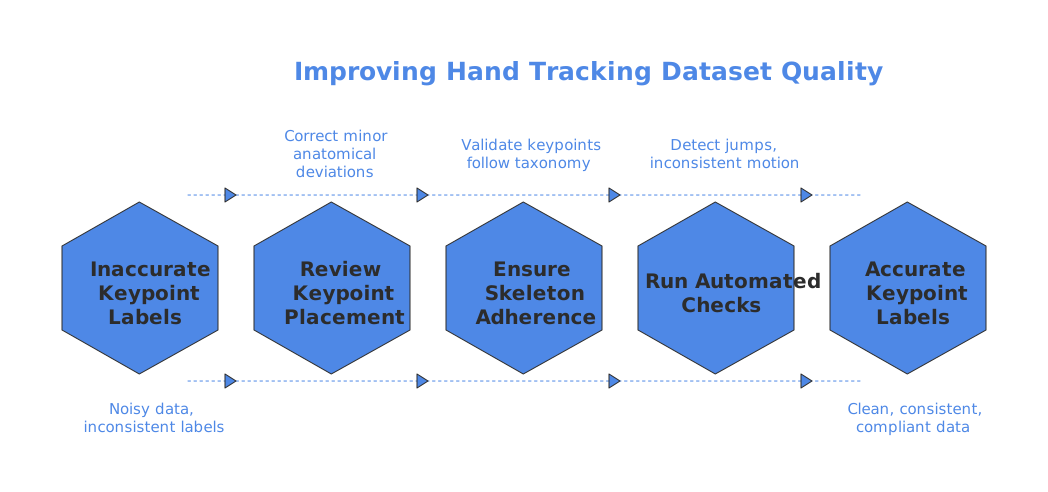
Quality control ensures that keypoint labels remain accurate, consistent and compliant with the skeleton definition. QC cycles detect noise early and prevent errors from spreading across sequences.
Reviewing keypoint placement
QC reviewers inspect whether joints match anatomical locations. Minor deviations must be corrected. Clean placement improves model performance. Careful review strengthens dataset coherence. Precise QC enhances training outcomes.
Ensuring adherence to skeleton definitions
Cross-checking whether keypoints follow the intended taxonomy prevents structural drift. Skeleton validation improves downstream usability. Consistent skeleton usage increases reliability. Structured review supports stable datasets. Validation maintains long-term health.
Running automated trajectory checks
Automated tools detect sudden jumps, inconsistent motion or invalid keypoint ordering. Automation accelerates QC for large datasets. These checks complement manual review. Automated validation improves scalability. Combined QC ensures high accuracy.
Integrating Hand Tracking Data Into XR and AI Pipelines
Hand tracking datasets must be organized and integrated properly so they can support training, evaluation and deployment of XR or CV systems. Good integration strengthens real-world performance.
Preparing balanced evaluation splits
Evaluation sets must include varied poses, lighting scenarios and user demographics. Balanced evaluation improves robustness. Structured splits ensure reproducibility. Reliable testing supports model tuning. Good evaluation design enhances deployment readiness.
Aligning datasets with gesture and XR systems
Hand tracking outputs must match coordinate scales and metadata conventions expected by XR engines. Alignment improves usability. Consistent metadata strengthens integration. Proper alignment reduces implementation friction. Good dataset structure supports real-time performance.
Supporting continual dataset updates
As gesture vocabularies expand, datasets must grow accordingly. Annotators must maintain consistent skeleton definitions and rules. Stable expansion supports long-term training. Consistent updates strengthen evolving applications. Good processes help scale the dataset.
If you are developing a hand tracking dataset or want support designing robust annotation workflows, we can explore how DataVLab helps teams create reliable and scalable training data for XR, gesture systems and vision AI.
What are Hand tracking datasets?
This article explains how hand tracking datasets are designed and annotated for computer vision, XR input systems and robotics. It covers skeleton definitions, keypoint placement, depth maps, motion sequences, occlusion rules, temporal consistency, calibration methods and quality validation.
Why is Hand tracking Foundational for XR and CV systems?
Hand tracking enables natural interaction in AR/VR applications, supports gesture-based control systems, and provides detailed pose information for robotics and simulation workflows. Modern AI models rely on labeled joint trajectories to learn accurate representations of hand movement.
How can teams ensure quality in Hand tracking datasets?
The quality of a hand tracking dataset depends strongly on the capture setup. Good hardware configuration ensures that hand joints remain visible and geometrically consistent across frames. Recording environments must allow annotators to identify joints without ambiguity.
What is involved in defining a hand skeleton and keypoint structure?
Hand tracking datasets rely on a skeleton model with predefined joints. This skeleton determines how keypoints are labeled and how pose estimation models interpret movement. A standard skeleton typically contains wrist, finger bases, middle joints and fingertips.
What does the section on “Quality control for hand tracking datasets” explain?
Quality control ensures that keypoint labels remain accurate, consistent and compliant with the skeleton definition. QC cycles detect noise early and prevent errors from spreading across sequences. QC reviewers inspect whether joints match anatomical locations.
What is involved in integrating hand tracking data into XR and AI pipelines?
Hand tracking datasets must be organized and integrated properly so they can support training, evaluation and deployment of XR or CV systems. Evaluation sets must include varied poses, lighting scenarios and user demographics. Hand tracking outputs must match coordinate scales and metadata conventions expected by XR engines.