Hand-Object Interaction Datasets: How to Annotate Contact, Grasping and Manipulation Data for XR and Robotics AI
.jpeg)

This article explains how hand-object interaction datasets are captured, annotated and structured for AI systems in AR/VR, robotics, teleoperation and human–computer interaction. It covers grasp taxonomy design, hand pose labeling, object pose alignment, contact point mapping, affordance annotation, occlusion handling, metadata structures and quality control. It also describes how these datasets support manipulation learning, XR interfaces, simulation engines and embodied AI.
- This article explains how hand-object interaction datasets are captured, annotated and structured for AI systems in AR/VR, robotics, teleoperation and human–computer interaction.
- It covers grasp taxonomy design, hand pose labeling, object pose alignment, contact point mapping, affordance annotation, occlusion handling, metadata structures and quality control.
- It also describes how these datasets support manipulation learning, XR interfaces, simulation engines and embodied AI.
- Because AR/VR interfaces and embodied robots rely heavily on accurate hand-object understanding, high-quality datasets must capture subtle motion cues, surface interactions and affordance relationships.
Hand-object interaction datasets are essential for training AI systems that understand how humans grasp, manipulate or interact with physical tools and everyday objects. These datasets require precise annotations of hand pose, object geometry, contact patterns and temporal sequences that reflect realistic manipulation behavior. Research from the CMU Perceptual Computing Lab highlights that small improvements in grasp-contact accuracy dramatically increase downstream robotic manipulation success rates. Because AR/VR interfaces and embodied robots rely heavily on accurate hand-object understanding, high-quality datasets must capture subtle motion cues, surface interactions and affordance relationships. Building these datasets demands advanced domain knowledge and careful curation workflows.
Datasets that capture depth, pose, and contact geometry can be built through DataVLab’s 3D annotation services.
Why Hand-Object Interaction Data Matters for Modern AI Systems
Hand-object interaction is a core component of human intelligence, allowing people to manipulate tools, operate devices or execute complex tasks. AI systems that attempt to replicate these capabilities require dense and accurate datasets so they can learn realistic manipulation strategies. Human demonstrations contain rich visual and kinematic signals that AI models must generalize from. Studies from the MIT Interaction Lab show that learning from human hand-object interactions improves robot dexterity, grasp planning and error recovery. Without structured datasets capturing natural contact dynamics, these systems fail to model real-world manipulation behavior effectively.
Enabling manipulation learning for robotics
Robotic grasping and manipulation pipelines rely on annotated interactions to understand how humans hold, support and rotate objects. These datasets allow robots to infer stable grasp configurations and task-specific motions. Accurate hand-object labels improve planning robustness. Strong data quality leads to better real-world task execution. Manipulation learning depends directly on dataset precision.
Supporting XR and VR hand interaction systems
AR/VR environments require realistic hand-object tracking to support gameplay, training simulations or interface controls. Datasets help models interpret how virtual hands should behave when interacting with virtual objects. Accurate interaction cues improve immersion. Better modeling enhances user experience. Structured datasets drive more natural XR interactions.
Improving teleoperation and remote manipulation
Teleoperation systems benefit from understanding how human hands adapt to constraints and object properties. Annotated datasets help train models that predict operator intent. High-quality interaction data improves responsiveness. Accurate mapping supports safer remote control. Interaction datasets strengthen teleoperation feedback loops.
Capturing High-Quality Hand-Object Interaction Data
Dataset quality begins with capturing representative and stable examples across diverse objects, tasks and subjects. Capture conditions must support accurate hand and object tracking. These early steps influence the entire annotation pipeline and model performance.
Multi-view camera setups
Hand-object interactions are highly three-dimensional, requiring multiple camera angles to capture finger motion, occlusions and object rotations. Multi-view setups improve spatial reconstruction. These setups help annotators resolve ambiguities arising from partial visibility. Multi-view recording ensures depth accuracy. Comprehensive coverage enhances dataset richness.
Using depth or RGB-D sensors
Depth sensors provide essential geometric cues for contact interpretation. RGB-D systems allow annotators to see object surfaces and hand contours clearly. Depth improves occlusion handling. This richness helps models understand object geometry. Combining RGB and depth supports fine-grained annotation.
Stabilizing lighting and backgrounds
Hand-object datasets require consistent lighting to avoid shadows that distort contact boundaries. Clean backgrounds help segment hands and objects more easily. Stable visual conditions reduce annotation error. Consistent lighting improves pose extraction. Good capture quality strengthens dataset reliability.
Designing a Grasp and Interaction Taxonomy
A clear taxonomy defines how gestures, grasps and object interactions are categorized. These labels guide annotators and help models learn structured manipulation behavior. Strong taxonomies support generalization across object shapes and tasks.
Defining grasp categories
Common grasp types include pinch, power, precision, lateral and tool-specific grasps. Annotators must label these consistently. Grasp categories help models infer intent. These labels support better control in robotics. Clear definitions improve training data clarity.
Identifying interaction primitives
Interaction primitives include pushing, pulling, twisting, lifting or sliding. These primitives define task-level behavior. Annotators must classify primitives based on visual cues. Structured primitives support task understanding. Balanced coverage improves downstream abstraction.
Capturing task context
Hand-object interactions vary by the underlying goal. Tasks such as pouring, cutting or assembling require different hand poses. Annotators must document context to support hierarchical reasoning. Contextual labeling improves dataset richness. Task-aware annotation enhances model interpretability.
Annotating Hand Pose and Finger Kinematics
Hand pose annotation involves labeling joint positions, finger angles and wrist orientation across frames. This is one of the most difficult parts of interaction datasets because hands occlude themselves and objects frequently.
Labeling 2D or 3D hand keypoints
Keypoints represent joints and fingertips. Annotators must place these across views or reconstruct 3D positions. Accurate keypoints enable robust pose estimation. Clean labels reduce geometric ambiguity. High-quality keypoints strengthen manipulation modeling.
Handling occlusions during grasping
Fingers often disappear behind objects during manipulation. Annotators must avoid guessing hidden joint locations. Guidelines must define how to treat occluded keypoints. Consistent occlusion rules improve dataset reliability. Proper handling supports stable training signals.
Maintaining temporal pose consistency
Finger poses evolve continuously during interaction. Annotators must maintain smooth keypoint trajectories. Temporal awareness supports realistic modeling. Consistent sequences improve action understanding. Stable pose curves strengthen time-based reasoning.
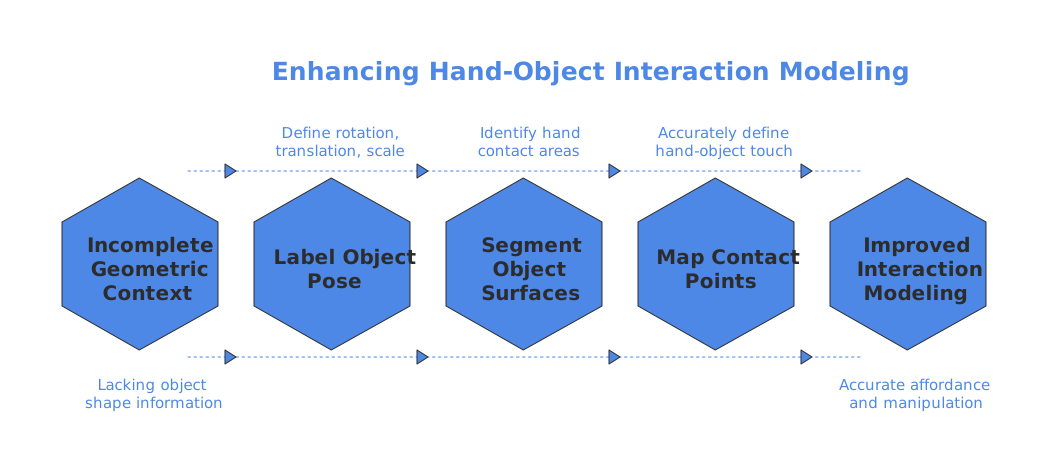
Annotating Object Pose, Geometry and Surface Contact
Object annotation complements hand pose by providing models with geometric context. Object shape, orientation and position influence how hands interact with surfaces. Accurate object annotation enables better affordance and manipulation modeling.
Labeling object pose
Object pose includes rotation, translation and scale. Annotators must align object frames consistently. Stable pose labeling supports accurate contact mapping. Clear pose representation strengthens grasp prediction. Structured pose annotation enhances realism.
Segmenting object surfaces
Object surfaces must be segmented so models can identify where hands make contact. Surface-level annotation improves affordance understanding. Fine segmentation supports simulation engines. Accurate surface representation helps predict grasp stability. Surface detail enriches dataset quality.
Mapping contact points
Contact points define where hands touch objects. Annotators must identify these points accurately across frames. Contact labeling helps models learn force distribution and grasp feasibility. Precise contact maps improve predictive modeling. Contact detail is essential for manipulation analysis.
Capturing Affordances and Interaction Semantics
Affordances describe how objects should be interacted with. Annotating affordances helps models understand task intent and object functionality. This enables more intelligent manipulation behaviors.
Identifying object affordances
Object affordances include handles, grips, lids or levers. Annotators must document these based on visual cues. Affordance labeling supports context-aware manipulation. These cues guide grasp prediction. Rich affordances improve interpretability.
Labeling functional interaction zones
Different object areas serve distinct functions, such as blade edges or container openings. Annotators must define which regions relate to specific tasks. These functional zones help models reason about usage. Structured labeling increases semantic detail. Clear functional annotation improves downstream accuracy.
Capturing failure cases
Recording incorrect grasps or failed attempts provides contrastive learning signals. Annotators must label unsuccessful interactions. Failure examples improve model robustness. They teach systems to avoid unstable grasps. Balanced datasets enhance manipulation reliability.
Quality Control for Hand-Object Interaction Datasets
Quality control ensures accuracy across hand pose, object geometry and interaction semantics. Review cycles detect annotation drift and inconsistencies. Strong QC pipelines improve dataset integrity and model performance.
Reviewing keypoint accuracy
Reviewers must inspect joint positions for precision. Even small shifts affect pose interpretation. Accurate keypoints enhance manipulation modeling. Thorough review reduces geometric noise. QC strengthens dataset reliability.
Validating contact consistency
Contact points must align with actual physical touching. Reviewers ensure labels do not drift across frames. Consistent contact annotation improves affordance learning. Stable labels strengthen time-based predictions. This step is essential for realistic modeling.
Running automated geometry checks
Automated tools can detect pose conflicts, invalid trajectories or overlapping labels. Automation scales efficiently. It complements manual review. Automated checks improve dataset scalability. Combined QC increases dataset robustness.
Integrating Interaction Data Into XR, Robotics and Embodied AI
Once complete, hand-object interaction datasets integrate into training pipelines for robotics, XR applications and embodied AI systems. Clean integration ensures efficient model development and real-world usability.
Preparing training splits with task diversity
Training sets must reflect a broad range of tasks and objects. Balanced splits improve generalization. Structured partitioning strengthens evaluation reliability. Thoughtful distribution maintains task coverage. Balanced splits support stable training.
Aligning datasets with simulation engines
Simulation platforms require consistent geometric formats. Annotators must ensure pose and contact data follow standardized structures. Simulation alignment improves transfer learning. Structured integration enhances usability. Stable formatting reduces friction.
Supporting continuous expansion
As new interaction types or objects arise, datasets must grow. Annotators must maintain consistent taxonomies and labeling rules. Stable expansion supports long-term scalability. Consistent updates enhance dataset adaptability. Structured growth strengthens real-world applications.
If you are developing hand-object interaction datasets or need help creating structured annotation workflows for XR or robotics AI, we can explore how DataVLab supports teams requiring precise and scalable training data for manipulation and embodied intelligence.
What are Hand-Object interaction datasets?
This article explains how hand-object interaction datasets are captured, annotated and structured for AI systems in AR/VR, robotics, teleoperation and human–computer interaction. It covers grasp taxonomy design, hand pose labeling, object pose alignment, contact point mapping, affordance annotation, occlusion handling, metadata structures and quality control.
Why does hand-Object interaction data matter for modern AI systems?
Hand-object interaction is a core component of human intelligence, allowing people to manipulate tools, operate devices or execute complex tasks. AI systems that attempt to replicate these capabilities require dense and accurate datasets so they can learn realistic manipulation strategies.
How can teams ensure quality in Hand-Object interaction datasets?
Dataset quality begins with capturing representative and stable examples across diverse objects, tasks and subjects. Capture conditions must support accurate hand and object tracking. These early steps influence the entire annotation pipeline and model performance.
What is involved in annotating hand pose and finger kinematics?
Hand pose annotation involves labeling joint positions, finger angles and wrist orientation across frames. This is one of the most difficult parts of interaction datasets because hands occlude themselves and objects frequently. Annotators must place these across views or reconstruct 3D positions.
What does the section on “Quality control for Hand-Object interaction datasets” explain?
Quality control ensures accuracy across hand pose, object geometry and interaction semantics. Strong QC pipelines improve dataset integrity and model performance. Contact points must align with actual physical touching.
What is involved in integrating interaction data into XR, robotics and embodied AI?
Once complete, hand-object interaction datasets integrate into training pipelines for robotics, XR applications and embodied AI systems. Clean integration ensures efficient model development and real-world usability. Training sets must reflect a broad range of tasks and objects.