Gesture Recognition Datasets: How to Annotate Motion, Sequences and Semantics for XR and Human–Computer Interaction AI
.jpeg)

This article explains how gesture recognition datasets are created for XR interfaces, human–computer interaction and computer vision models. It covers gesture taxonomies, temporal segmentation, keyframe labeling, motion encoding, multimodal signals, context annotation, quality control and integration into training pipelines. It also highlights how gesture datasets support real-time control, intent detection and immersive interaction systems.
- This article explains how gesture recognition datasets are created for XR interfaces, human–computer interaction and computer vision models.
- It covers gesture taxonomies, temporal segmentation, keyframe labeling, motion encoding, multimodal signals, context annotation, quality control and integration into training pipelines.
- It also highlights how gesture datasets support real-time control, intent detection and immersive interaction systems.
- Gesture recognition datasets provide the labeled motion, sequence segmentation and semantic categories that AI systems use to interpret human gestures.
Gesture recognition datasets provide the labeled motion, sequence segmentation and semantic categories that AI systems use to interpret human gestures. These datasets capture hand movement, arm trajectories, body cues and temporal patterns that define meaningful commands. Research from the University of Toronto Computational Human Interaction Lab shows that gesture recognition accuracy depends heavily on precise temporal boundaries and consistent labeling across similar motions. Because XR environments, multimodal interfaces and robotics systems rely on reliable gesture understanding, dataset quality directly influences usability and responsiveness. High-quality gesture datasets require structured taxonomies and carefully segmented motion examples.
Gesture datasets that include depth, joint trajectories, or spatial hand pose can use DataVLab’s 3D annotation services for geometry-aware labels.
Why Gesture Recognition Matters for Modern Interaction Systems
Gesture recognition enables natural control in AR/VR environments, touchless interfaces, robotics teleoperation and accessibility applications. Models trained on labeled sequences learn to interpret user intent based on motion cues rather than explicit device input. Studies from the University of Munich Human Motion Lab demonstrate that strong gesture annotations significantly improve classification robustness in noisy or unconstrained environments. Gesture datasets therefore support intuitive and expressive interactions.
Enabling controller-free interaction in XR
Gesture recognition allows users to navigate menus, manipulate virtual objects or trigger actions without controllers. Annotated sequences teach models how gestures appear in real use cases. Strong datasets improve responsiveness. Better gesture interpretation strengthens immersion. High-quality annotations make XR interactions feel natural.
Supporting robotics and teleoperation
Teleoperation systems use gestures as high-level commands or as intent signals. Gesture datasets help models distinguish gestures reliably across contexts. Consistent annotation improves safety and responsiveness. Clear gesture recognition enhances control precision. Structured datasets support advanced remote manipulation.
Improving accessibility and touchless interfaces
Gesture-based control helps users with limited mobility or in sterile environments where touch should be minimized. Annotated gesture examples help models handle a broad range of movement profiles. Good datasets support inclusivity. Reliable recognition enhances user confidence. High-quality data supports universal design.
Capturing High-Quality Gesture Data
The foundation of a gesture dataset is high-quality multimodal input that captures motion consistently across diverse users and environments. Good capture setups help avoid ambiguity during annotation.
Using RGB, depth and motion sensors
Gesture datasets often combine RGB footage with depth sensors or inertial devices. Multiple modalities help models learn motion patterns more accurately. RGB captures appearance cues. Depth provides geometric structure. IMUs capture fine-grained movement.
Recording full-body or upper-body views
Depending on the gesture vocabulary, datasets may require full-body or upper-body visibility. Annotators must ensure consistent framing. Full-body views support gestures involving torso or leg motion. Upper-body views emphasize hand and arm gestures. Consistent framing improves dataset stability.
Ensuring temporal and sensor synchronization
When using multiple sensors, signals must be synchronized across frames. Misalignment reduces annotation reliability. Time-accurate capture supports stable segmentation. Good synchronization enhances motion interpretation. Reliable timing supports robust modeling.
Designing a Gesture Taxonomy for Annotation
Gesture taxonomies define how sequences are grouped into categories. Clear categories help annotators label gestures consistently. Strong taxonomy design reduces confusion and strengthens downstream learning.
Defining discrete and continuous gestures
Some gestures are static poses, while others involve dynamic motion trajectories. Annotators must categorize both types consistently. Clear definitions prevent ambiguity. Proper grouping enhances classification performance. Structured taxonomies improve dataset clarity.
Handling culturally specific or contextual gestures
Gestures may vary across regions or contexts. Annotators must document cultural differences when relevant. This prevents misclassification. Context-aware taxonomies support broader generalization. Cultural distinctions enrich dataset diversity.
Designing hierarchical gesture categories
Some gestures share common motion patterns. Hierarchical categories capture these relationships. This structure supports multi-level recognition tasks. Hierarchies help models infer semantic similarity. Good hierarchy design improves generalization.
Segmenting Temporal Sequences for Gesture Labels
Temporal segmentation is the most critical part of gesture recognition annotation. Annotators must determine the exact start and end of each gesture to avoid introducing noise.
Identifying gesture boundaries
Annotators must detect motion cues that indicate when a gesture begins or ends. Clear boundary rules reduce ambiguity. Good segmentation improves model stability. Accurate boundaries prevent overlap. Boundary precision strengthens classification.
Labeling keyframes
Keyframes represent important moments within the gesture sequence. These frames help guide temporal models. Annotators must select keyframes consistently. Keyframe labeling enhances interpretability. Structured keyframes support advanced modeling.
Handling transitional movements
Gestures often include transitions between states. Annotators must decide whether transitions belong to the gesture or remain unclassified. Consistent rules improve dataset reliability. Proper handling prevents ambiguous training signals. Clear segmentation supports temporal understanding.
Annotating Motion Features and Trajectories
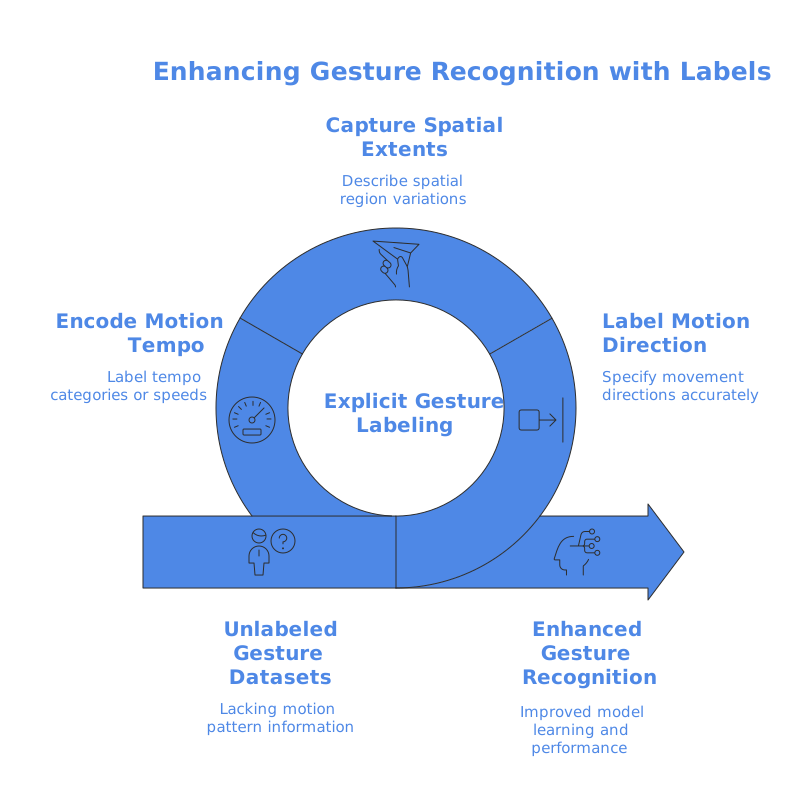
Some gesture datasets require explicit labeling of motion patterns or trajectories. These labels help models learn direction, speed and spatial structure.
Labeling motion direction
Annotators must specify movement directions when relevant. Direction labels support command-level gesture interpretation. Consistent direction annotation improves robustness. Clear labels strengthen temporal reasoning. Direction cues enhance real-time performance.
Capturing spatial extents
Gestures may span different spatial regions. Annotators must describe these variations accurately. Spatial metadata supports more nuanced classification. Better spatial understanding improves model flexibility. Structured labeling strengthens dataset richness.
Encoding motion tempo
Gesture speed or tempo influences meaning. Annotators may label tempo categories or numeric speeds. Tempo annotation supports gesture disambiguation. Consistent tempo labeling enriches modeling. Nuanced metadata enhances temporal learning.
Incorporating Context, Intent and Interaction Metadata
Gesture recognition often depends on context, such as what the user intends or how other objects influence the gesture. Contextual metadata helps models interpret gestures correctly.
Capturing environmental context
Annotators must document relevant scene elements. Context helps systems infer gesture meaning. Better context representation supports multi-modal reasoning. Structured context enhances real-world performance. Context metadata enriches dataset detail.
Labeling user intent
Intent labels distinguish between similar motions with different purposes. Annotators must follow clear rules. Intent labeling improves accuracy in command-driven systems. Structured intent metadata enhances interpretability. Good intent annotation strengthens downstream AI.
Representing interaction cues
Gestures may relate to on-screen elements, devices or virtual objects. Annotators must label these relationships. Interaction metadata improves semantic modeling. Clear relationships support contextual reasoning. Structured metadata strengthens HCI applications.
Handling Occlusions, Motion Blur and Challenging Conditions
Gestures often occur in fast or cluttered environments. Good datasets must capture these scenarios clearly and annotate them consistently.
Managing occlusions
Hands or arms may hide behind other body parts or objects. Annotators must avoid inventing motion. Clear occlusion handling prevents label noise. Proper annotation improves robustness. Occlusion-aware labeling strengthens dataset quality.
Addressing motion blur
Fast gestures can introduce blur. Annotators must follow rules for interpreting blurred frames. Consistent handling reduces ambiguity. Clear guidance helps maintain dataset stability. Motion blur coverage improves real-world reliability.
Capturing low-light or constrained environments
Gesture systems must work outside ideal lighting. Annotators must ensure labels remain reliable in difficult visual conditions. Diverse environments strengthen model adaptation. Realistic capture improves generalization. Low-light scenarios enrich dataset value.
Quality Control for Gesture Recognition Datasets
Quality control ensures that gesture labels, sequence boundaries and metadata remain consistent. QC cycles detect drift or inconsistencies early.
Reviewing temporal boundaries
Reviewers ensure gesture start and end points match definitions. Accurate boundaries improve classification. QC prevents label drift across sequences. Boundary consistency enhances dataset structure. Precision supports clean training signals.
Validating category consistency
Gesture categories must match definitions without overlap. QC teams inspect ambiguous examples. Category consistency strengthens downstream performance. Reliable categories reduce confusion. Structured validation enhances dataset reliability.
Running automated temporal checks
Automation can detect sudden frame-level anomalies, inconsistent segmentation or invalid transitions. Automated checks complement manual review. They improve scalability. Automation strengthens dataset robustness. Combined QC ensures long-term stability.
Integrating Gesture Datasets Into XR and HCI Pipelines
Once annotated, gesture datasets must be prepared for training, evaluation and integration with real-time systems.
Creating evaluation sets with diverse gestures
Evaluation sets must include all gesture types across varying conditions. Balanced evaluation reveals model weaknesses. Good benchmarks support improvement. Reliable testing enhances deployment. Structured evaluation strengthens performance analysis.
Aligning datasets with XR input engines
Gesture formats must match XR system requirements for coordinate systems, timing and metadata. Consistent formatting improves integration. Good alignment reduces engineering friction. Structured output supports real-time responsiveness. Proper formatting enhances usability.
Supporting expansion for new gesture vocabularies
Gesture systems evolve with new command sets. Datasets must accommodate periodic expansion. Consistent annotation rules support long-term growth. Expansion workflows maintain dataset quality. Structured updates support future interaction modes.
If you are creating a gesture recognition dataset or need support designing temporal annotation workflows, we can explore how DataVLab helps teams build precise and scalable training data for XR, robotics and human–computer interaction AI.
What are Gesture recognition datasets?
This article explains how gesture recognition datasets are created for XR interfaces, human–computer interaction and computer vision models. It covers gesture taxonomies, temporal segmentation, keyframe labeling, motion encoding, multimodal signals, context annotation, quality control and integration into training pipelines.
Why does gesture recognition matter for modern interaction systems?
Gesture recognition enables natural control in AR/VR environments, touchless interfaces, robotics teleoperation and accessibility applications. Models trained on labeled sequences learn to interpret user intent based on motion cues rather than explicit device input. Studies from the University of Munich Human Motion Lab demonstrate that strong gesture annotations significantly improve classification robustness in noisy or unconstrained environments.
How can teams ensure quality in Gesture recognition datasets?
The foundation of a gesture dataset is high-quality multimodal input that captures motion consistently across diverse users and environments. Good capture setups help avoid ambiguity during annotation. Gesture datasets often combine RGB footage with depth sensors or inertial devices.
What does the section on “Segmenting temporal sequences for gesture labels” explain?
Temporal segmentation is the most critical part of gesture recognition annotation. Annotators must determine the exact start and end of each gesture to avoid introducing noise. Annotators must detect motion cues that indicate when a gesture begins or ends.
What does the section on “Quality control for gesture recognition datasets” explain?
Quality control ensures that gesture labels, sequence boundaries and metadata remain consistent. Reviewers ensure gesture start and end points match definitions. Automation can detect sudden frame-level anomalies, inconsistent segmentation or invalid transitions.
What is involved in integrating gesture datasets into XR and HCI pipelines?
Once annotated, gesture datasets must be prepared for training, evaluation and integration with real-time systems. Evaluation sets must include all gesture types across varying conditions. Gesture formats must match XR system requirements for coordinate systems, timing and metadata.