Grammar Correction Datasets: How Annotated Error Corpora Train Language Models for Writing Quality
.jpeg)
Grammar correction datasets provide the annotated examples that train AI systems to detect and correct writing errors across different domains and proficiency levels. This article explains how these datasets are created, what types of errors they include, and how annotation teams design labels that capture grammar, syntax, and language usage patterns. It examines dataset structure, segmentation strategies, error categorization, and quality assurance workflows. Readers will also learn how grammatical error correction models use these datasets to support writing assistance, education technology, and natural language processing applications. The article concludes with a detailed look at evaluation criteria and emerging trends in grammar correction dataset development.
- Grammar correction datasets provide the annotated examples that train AI systems to detect and correct writing errors across different domains and proficiency levels.
- This article explains how these datasets are created, what types of errors they include, and how annotation teams design labels that capture grammar, syntax, and language usage patterns.
- Readers will also learn how grammatical error correction models use these datasets to support writing assistance, education technology, and natural language processing applications.
- The article concludes with a detailed look at evaluation criteria and emerging trends in grammar correction dataset development.
Understanding Grammar Correction Datasets
Grammar correction datasets consist of text samples annotated with grammatical, syntactic, and usage errors. They are foundational resources for training language models to identify mistakes and propose accurate corrections. These datasets include manually annotated sentences, student writing samples, educational materials, and controlled texts created to represent specific error types. Because grammatical structure varies across languages and proficiency levels, dataset design must reflect a broad spectrum of real-world writing styles. Linguistic resources such as the Universal Dependencies project illustrate how annotated language structures provide models with consistent grammatical references that influence grammar correction performance. Grammar correction datasets build on these linguistic principles by adding layers of error labels.
Importance of Grammar Correction in NLP
Grammatical error correction is a key task in natural language processing, serving applications in writing improvement, language learning, and automated editing. AI writing tools depend on high-quality datasets to detect subtle errors such as incorrect verb agreement, misplaced modifiers, inappropriate prepositions, or missing determiners. Without labeled training data that captures these variations, models cannot perform consistent corrections. Annotated datasets therefore play a critical role in helping AI systems understand grammatical patterns and generate improved text outputs.
How Grammar Correction Differs from General NLP Tasks
Unlike general NLP tasks that focus on broad language understanding, grammar correction requires models to identify deviations from standard language norms. These deviations may result from typographical mistakes, linguistic interference, or incomplete mastery of grammatical rules. Grammar correction datasets must incorporate both erroneous and corrected versions of text so that models can learn the mapping between them. This paired structure distinguishes grammar correction datasets from traditional corpora used for classification or language modeling. As a result, data preparation and annotation workflows must be designed specifically for error-focused learning objectives.
Components of a Grammar Correction Dataset
A well-structured grammar correction dataset contains carefully segmented text samples, annotated error types, and canonical corrections. These components provide the building blocks for supervised learning approaches that aim to improve writing quality.
Source Text Samples
The source samples may include essays, short responses, exam submissions, synthetically generated error sentences, or transcripts of spoken language. Samples drawn from educational settings often provide diverse error patterns that reflect the language proficiency of learners. Research from language acquisition institutions such as the MIT Language Learning Lab contributes to insights about how learners produce errors during writing development. Including such samples helpws ensure that grammar correction models can address errors commonly made by non-native speakers.
Error Labels
Error labels categorize mistakes according to grammatical function. Categories may include verb tense, determiners, prepositions, articles, punctuation, and sentence structure. Detailed annotation guidelines help annotators identify error boundaries and assign labels consistently. Models rely on these labels to understand not only where an error lies but also what kind of grammatical rule it violates. A strong grammar correction dataset captures both frequent and infrequent error types to ensure balanced learning.
Corrected Versions
For every error instance, annotators provide a corrected version of the text. The corrected version represents the intended meaning while following standard grammar rules. This correction serves as the target output for the model during training. Providing corrected versions requires linguistic expertise to ensure that edits reflect valid improvements rather than stylistic preferences. Correction consistency across annotators is essential for model reliability.
Annotation Workflows for Grammar Correction
Annotation workflows determine dataset quality by defining how errors are identified, labeled, and corrected. Because grammar correction is a highly specialized task, workflows must be precise and thorough.
Error Identification
Annotators begin by identifying segments of text containing grammatical issues. This step requires careful reading and may involve semantic interpretation to determine the writer’s intended meaning. Ambiguous cases are documented and resolved through team discussions. Resources from linguistic societies, such as the Linguistic Society of America, provide foundational grammar references that assist annotators in making informed decisions.
Error Categorization
Once errors are identified, they are categorized based on grammatical function. Categorization guidelines must define clear boundaries to ensure that similar errors receive consistent labels. For instance, determiners and articles may be grouped or separated depending on dataset requirements. Annotators also describe why an error belongs to a particular category, helping maintain clarity during quality review.
Correction Annotation
Annotators then correct the text, ensuring that changes follow standard language usage. Corrections must remain minimal to preserve the writer’s original structure and meaning. Excessive rewriting can introduce bias or distort the learning objective. Many datasets adopt a philosophy of minimal edits to ensure that models learn targeted corrections rather than stylistic rewriting. Annotators follow guidelines that specify acceptable edit types and disallow arbitrary rephrasing.
Challenges in Creating Grammar Correction Datasets
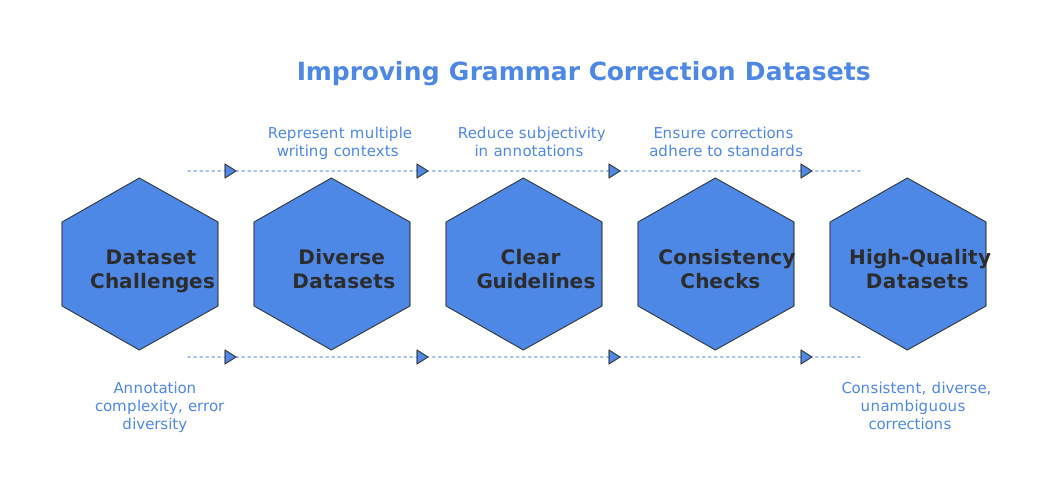
Grammar correction datasets present several challenges, including annotation complexity, error diversity, and consistency requirements. These challenges require rigorous quality assurance and well-designed workflows.
Inconsistent Writing Styles
Writers produce errors that vary based on proficiency, background, and context. Students, professional writers, and non-native speakers all generate different patterns of mistakes. Capturing this variation requires diverse datasets that represent multiple writing contexts. Without such coverage, models may overfit to specific error types and perform poorly on new text samples.
Ambiguous or Multifunctional Errors
Some grammatical errors are ambiguous, especially when multiple valid corrections exist. Annotators must determine which correction best reflects intended meaning and standard usage. Guidelines help reduce subjectivity, but complex cases require team-level review. Ambiguity can also arise when a sentence exhibits multiple simultaneous errors, requiring careful separation of error units.
Maintaining Correction Consistency
Different annotators may propose different correct versions of the same sentence. Consistency checks ensure that corrections adhere to a shared standard. Quality reviewers examine corrected samples, verify that edits follow established rules, and revise inconsistent corrections. This process protects the dataset from noise that could degrade model performance.
Designing Annotation Guidelines
Annotation guidelines form the foundation of grammar correction datasets by defining categories, examples, and decision rules. They must be comprehensive enough to cover edge cases while remaining manageable for annotators.
Error Category Definitions
Guidelines define each error type clearly, distinguishing between closely related categories. For example, guidelines may clarify how to differentiate between article misuse and determiner omission. These distinctions influence how models learn to classify and correct errors. Annotators rely on category definitions to maintain accuracy across large datasets.
Examples and Edge Cases
Guidelines include annotated examples to illustrate how to treat ambiguous or complex errors. Examples help annotators understand context and learn how to apply rules consistently. They also provide insight into how corrections should be made in rare or atypical cases. Including edge case examples ensures that annotators handle uncommon errors properly.
How AI Models Use Grammar Correction Datasets
AI models use grammar correction datasets to learn the mapping between erroneous and corrected text. During training, models analyze labeled examples to identify patterns that distinguish correct grammar from errors.
Pattern Recognition
Models learn grammatical structures, syntactic dependencies, and error patterns through repeated exposure to annotated samples. They identify recurring mistakes such as determiner omission or incorrect preposition use. By analyzing patterns across the dataset, models develop internal representations that guide error detection and correction.
Correction Generation
During inference, models generate corrected output by applying learned patterns to new text samples. They propose alternatives that reflect standard grammatical usage. Correction accuracy depends on the quality of the annotated pairings in the dataset. High-quality datasets improve model reliability and reduce hallucinated corrections.
Evaluating Grammar Correction Datasets
Evaluation ensures that grammar correction datasets meet accuracy, consistency, and representational requirements. Evaluation involves reviewing error annotations, correction quality, and category distribution.
Annotation Quality Checks
Reviewers examine labeled samples to confirm that errors are correctly identified and categorized. They compare annotations across annotators to detect disagreement. Inconsistent labels are corrected to maintain dataset integrity. NLP research communities such as the ACL Anthology provide frameworks for evaluating annotation reliability and inter-annotator agreement.
Correction Validation
Corrected versions must be verified to ensure they represent valid grammatical improvements. Reviewers confirm that edits follow minimal modification principles and adhere to standard language norms. They also check whether corrected text preserves the writer’s intended meaning. This validation step is crucial for ensuring that the dataset supports learning objectives effectively.
Applications of Grammar Correction Datasets
Grammar correction datasets support a wide range of applications in education, language learning, content creation, and automated writing assistance. These applications rely on consistent, high-quality datasets to ensure reliable model outputs.
Educational Technology and Writing Feedback
Education platforms use grammar correction models to provide feedback on student writing. These models identify errors, explain corrections, and assist students in improving their writing skills. By learning from annotated datasets, models can adapt feedback to different proficiency levels and writing contexts. Research from Cambridge’s education programs demonstrates how writing proficiency assessments benefit from structured linguistic data.
Writing Tools and Productivity Applications
Grammar correction datasets support writing tools that provide real-time suggestions for improving clarity, correctness, and tone. These tools rely on models trained to detect subtle errors in professional or technical writing. Models must understand variations in style and context to provide accurate recommendations.
Future Directions in Grammar Correction Datasets
Grammar correction datasets will continue to evolve as language models become more capable and writing styles shift across digital platforms. Future developments may include new annotation methods, domain-specific datasets, and multilingual expansions.
Domain-Specific Grammar Correction
Future grammar correction datasets may focus on domain-specific writing such as medical documentation, legal communication, or academic research. These domains introduce unique error patterns and specialized language. Creating datasets tailored to specific fields improves model performance in targeted applications.
Multilingual Grammar Correction
As language models expand to support more languages, grammar correction datasets will incorporate multilingual samples. These datasets must capture language-specific grammatical structures and common errors made by learners. Expanding datasets across languages increases model versatility and supports global language learning initiatives.
If You Are Preparing Grammar Correction or Writing Quality Datasets
High-quality grammar correction datasets are essential for training reliable grammatical error correction models. If you are designing datasets for writing improvement, education technology, or language-focused AI, the DataVLab team can help structure annotation workflows that enhance accuracy and consistency. Share your objectives, and we can support your NLP development with precisely annotated error corpora.
What are Grammar correction datasets?
Grammar correction datasets provide the annotated examples that train AI systems to detect and correct writing errors across different domains and proficiency levels. This article explains how these datasets are created, what types of errors they include, and how annotation teams design labels that capture grammar, syntax, and language usage patterns.
What does the article explain about how grammar correction differs from general NLP tasks?
Unlike general NLP tasks that focus on broad language understanding, grammar correction requires models to identify deviations from standard language norms. These deviations may result from typographical mistakes, linguistic interference, or incomplete mastery of grammatical rules.
What does the section on “Annotation workflows for grammar correction” explain?
Annotation workflows determine dataset quality by defining how errors are identified, labeled, and corrected. Because grammar correction is a highly specialized task, workflows must be precise and thorough. Annotators begin by identifying segments of text containing grammatical issues.
What are the main challenges of Grammar correction datasets?
Grammar correction datasets present several challenges, including annotation complexity, error diversity, and consistency requirements. These challenges require rigorous quality assurance and well-designed workflows. Writers produce errors that vary based on proficiency, background, and context.
What does the article explain about how AI models use grammar correction datasets?
AI models use grammar correction datasets to learn the mapping between erroneous and corrected text. During training, models analyze labeled examples to identify patterns that distinguish correct grammar from errors. Models learn grammatical structures, syntactic dependencies, and error patterns through repeated exposure to annotated samples.
What is the future of Grammar correction datasets?
Grammar correction datasets will continue to evolve as language models become more capable and writing styles shift across digital platforms. Future developments may include new annotation methods, domain-specific datasets, and multilingual expansions. Future grammar correction datasets may focus on domain-specific writing such as medical documentation, legal communication, or academic research.