Fashion Segmentation Dataset: Annotating Apparel, Hair Texture, and Visual Features for AI Models
.jpeg)

Fashion segmentation datasets provide pixel-level labels for garments, accessories, and hair textures, enabling AI systems to interpret apparel imagery with high precision. These datasets support clothing parsing, virtual try-on systems, recommendation engines, and fashion-focused visual search tools. This article explains how segmentation masks are created, how annotators label hair texture and garment components, and how deep learning models use these datasets to recognize fine-grained apparel features. It also examines challenges such as overlapping garments, varied lighting, and complex hairstyles. The article concludes with emerging techniques that combine segmentation with multimodal styling data for advanced fashion AI applications.
- Fashion segmentation datasets provide pixel-level labels for garments, accessories, and hair textures, enabling AI systems to interpret apparel imagery with high precision.
- These datasets support clothing parsing, virtual try-on systems, recommendation engines, and fashion-focused visual search tools.
- This article explains how segmentation masks are created, how annotators label hair texture and garment components, and how deep learning models use these datasets to recognize fine-grained apparel features.
- The article concludes with emerging techniques that combine segmentation with multimodal styling data for advanced fashion AI applications.
Understanding Fashion Segmentation
Fashion segmentation refers to the process of assigning pixel-level labels to garments, accessories, and hair regions in fashion images. Unlike classification or bounding box labeling, segmentation delivers dense visual annotations that allow AI models to identify the precise contours and boundaries of clothing elements. These labels power high-level applications such as apparel parsing, outfit understanding, virtual try-on systems, and image-based fashion search. Research such as UperNet experiments demonstrates how segmentation architectures can capture detailed visual boundaries across multiple clothing layers.
Why Segmentation Is Essential for Fashion AI
Segmentation is a core component of modern fashion AI because apparel recognition requires more than identifying a garment type. Pixel-level boundaries help models distinguish between overlapping clothing layers and identify how garments interact within an outfit. Segmentation also supports extracting texture regions, identifying silhouette shapes, and locating accessories with geometric accuracy. These granular features help build more reliable recommendation systems and smarter styling assistants.
Role of Hair Texture in Fashion Datasets
Hair texture classification is often integrated into fashion segmentation datasets because hair influences styling perception, image aesthetics, and visual understanding. Annotating hair regions and hair texture types allows models to separate hair from garments, improving segmentation quality. Hair texture labels also help models interpret visual identity, shape contrast, and color distribution across the image. Deep learning research on hair recognition demonstrates how texture classification supports robust fashion parsing.
Components of Fashion Segmentation Datasets
Fashion segmentation datasets contain several structured elements that define garment regions, hair textures, and accessory boundaries.
Pixel-Level Garment Masks
Pixel-level masks define exact regions of garments such as tops, pants, dresses, jackets, or skirts. These masks provide detailed spatial information that enables image parsing and virtual fitting workflows. Mask accuracy influences how well models interpret garment layering and silhouette structure.
Hair Region and Texture Labels
Datasets include masks for hair regions and texture labels that describe characteristics such as straightness, curl patterns, or braided structures. These labels help models differentiate hair from apparel and support more accurate segmentation. Texture classification is essential for datasets focusing on full-body fashion analysis.
Accessory Segmentation
Accessories such as hats, bags, belts, and shoes are segmented to improve understanding of overall outfit composition. Accessory segmentation ensures that the model recognizes distinct visual elements that influence styling recommendations and outfit evaluation. The diversity of accessory shapes makes this component critical for complete fashion understanding.
Annotation Workflows for Fashion Segmentation
Annotation workflows establish how annotators create segmentation masks and label attributes in fashion datasets.
Creating Pixel-Level Masks
Annotators use polygon tools or freehand segmentation tools to outline garments and accessories. Pixel-level alignment must reflect garment boundaries precisely, including folds, shadows, and overlapping layers. Detailed mask creation ensures that AI models can learn from consistent examples across diverse image conditions.
Labeling Garment Categories
Annotators assign category labels to each segmented region based on garment type. These categories include main clothing items and accessory types. Category labeling follows detailed guidelines that define each garment type and provide examples. Annotators review visual cues such as seams, cuts, and silhouettes to ensure accurate labeling.
Labeling Hair Texture
Annotators assess hair regions and assign texture labels based on visible characteristics. They evaluate curl patterns, smoothness, and volume to determine appropriate labels. Hair labeling improves segmentation accuracy by clarifying boundaries between hair and clothing. Datasets may include multiple texture categories to reflect diverse hair types.
Challenges in Annotating Fashion Segmentation Datasets
Fashion segmentation presents challenges due to clothing variety, pose differences, and lighting conditions.
Overlapping Garments
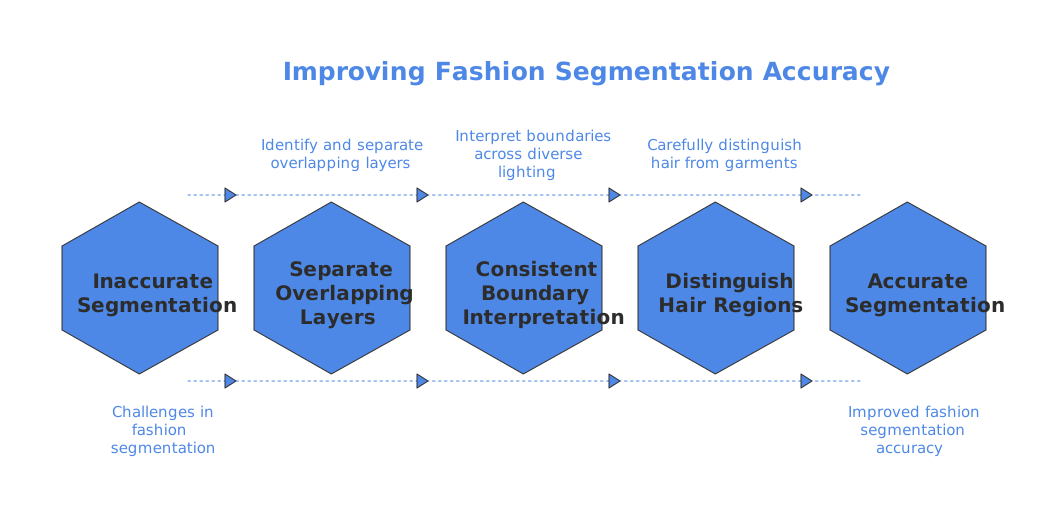
Outfits often include multiple layers such as jackets over shirts or sweaters under coats. Annotators must identify and separate overlapping layers while preserving accurate mask boundaries. Overlapping garments increase dataset complexity and require meticulous labeling.
Variable Lighting and Pose
Lighting changes how garments appear, influencing shadow boundaries and color contrast. Annotators must interpret boundaries consistently across images with diverse lighting. Pose differences create additional challenges because clothing contours shift as models move or turn.
Complex Hair Structures
Hair texture varies widely across individuals and can overlap with garments. Annotators must distinguish hair regions carefully to ensure that segmentation reflects accurate boundaries. Complex styles such as braids or layered cuts require detailed mask work.
Designing Annotation Guidelines for Fashion Segmentation
Annotation guidelines define consistent rules for annotating apparel and hair regions across large datasets.
Garment Boundary Definitions
Guidelines describe how to identify garment edges and interpret overlapping layers. They provide examples of correct boundary placement and explain how to handle ambiguous areas. Clear definitions ensure consistent mask creation.
Texture Labeling Criteria
Guidelines outline how annotators should classify hair textures. They describe how to interpret texture cues and differentiate similar styles. These criteria help ensure that hair labeling remains consistent across diverse datasets.
Accessory Labeling Rules
Guidelines specify how to identify and label accessories such as handbags, belts, hats, and footwear. Accessory labeling rules help annotators understand shape cues and visual distinctions. Consistency in accessory labeling ensures complete outfit representation.
Quality Assurance for Fashion Segmentation
Quality assurance ensures that segmentation data remains accurate, consistent, and reliable.
Mask Precision Checks
Reviewers evaluate segmentation masks to ensure that they align with garment boundaries. Precision checks focus on edge accuracy, shape consistency, and layer separation. Mask quality directly affects model training outcomes.
Attribute Validation
Reviewers confirm that hair texture and garment type labels match visual characteristics. Attribute validation detects inconsistencies in category assignments. This process helps maintain classification accuracy across datasets.
Dataset Balance Review
Reviewers ensure that dataset categories remain balanced and represent diverse garment types, hair styles, and accessories. Balanced datasets support better model generalization and reduce training bias. Trend and style diversity enhance dataset utility.
Applications of Fashion Segmentation and Texture Datasets
Segmentation and texture datasets support a range of applications across fashion technology.
Virtual Try-On Systems
Pixel-level segmentation enables virtual try-on systems to overlay garments on users while preserving contours and body shape details. Accurate segmentation ensures realistic fitting and visual alignment. Garment masks support rendering systems that simulate fabric movement.
Outfit Recognition
Segmentation supports identifying complete outfits by analyzing relationships among garments and accessories. AI systems evaluate how items work together, influencing recommendation engines. Parsing outfit structure helps AI models understand aesthetic compatibility.
Apparel Search and Retrieval
Segmentation enhances visual search systems by helping models recognize garment regions and match them with similar products. Texture classification supports detailed matching based on fabric type and pattern. Segmentation improves retrieval accuracy in search engines.
E-commerce Catalog Enhancement
Segmentation data improves product tagging, attribute extraction, and catalog enrichment. Retailers use segmentation insights to automate labeling workflows. Kaggle's fashion segmentation datasets illustrate how pixel-level masks support catalog automation.
Future Directions in Fashion Segmentation and Texture Analysis
Future fashion AI will integrate segmentation with multimodal analysis for advanced styling and personalization.
Combined Texture and Style Modeling
Future models will integrate texture classification with silhouette recognition and trend detection. These combined models support more advanced style analysis. Integrated modeling enhances fashion recommendation performance.
Real-Time Apparel Segmentation
Advances in hardware acceleration will enable real-time segmentation for virtual fitting and styling applications. Real-time segmentation allows interactive fashion experiences. These systems support next-generation retail interfaces.
Multimodal Visual Understanding
Future systems will incorporate segmentation with textual, behavioral, and contextual data. Multimodal understanding improves trend forecasting and personalization. FashionNet and related research demonstrate how combined models enhance outfit evaluation.
If You Are Preparing Fashion Segmentation or Texture Datasets
Precise segmentation and texture datasets are essential for building advanced fashion AI systems, from virtual try-on platforms to catalog automation and visual search. If you are preparing fashion segmentation datasets or building AI systems that rely on pixel-level garment understanding, the DataVLab team can help design rigorous annotation workflows and scalable dataset pipelines. Share your objectives, and we can support your fashion AI initiatives with tailored, high-quality data solutions.
What is Fashion segmentation dataset?
Fashion segmentation datasets provide pixel-level labels for garments, accessories, and hair textures, enabling AI systems to interpret apparel imagery with high precision. These datasets support clothing parsing, virtual try-on systems, recommendation engines, and fashion-focused visual search tools.
Why is Segmentation Essential for fashion AI?
Segmentation is a core component of modern fashion AI because apparel recognition requires more than identifying a garment type. Pixel-level boundaries help models distinguish between overlapping clothing layers and identify how garments interact within an outfit.
What does the section on “Annotation workflows for fashion segmentation” explain?
Annotation workflows establish how annotators create segmentation masks and label attributes in fashion datasets. Annotators use polygon tools or freehand segmentation tools to outline garments and accessories. Pixel-level alignment must reflect garment boundaries precisely, including folds, shadows, and overlapping layers.
What are the main challenges of Fashion segmentation dataset?
Fashion segmentation presents challenges due to clothing variety, pose differences, and lighting conditions. Outfits often include multiple layers such as jackets over shirts or sweaters under coats. Annotators must identify and separate overlapping layers while preserving accurate mask boundaries.
How can teams ensure quality in Fashion segmentation dataset?
Quality assurance ensures that segmentation data remains accurate, consistent, and reliable. Reviewers evaluate segmentation masks to ensure that they align with garment boundaries. Precision checks focus on edge accuracy, shape consistency, and layer separation.
What is the future of Fashion segmentation dataset?
Future fashion AI will integrate segmentation with multimodal analysis for advanced styling and personalization. Future models will integrate texture classification with silhouette recognition and trend detection. These combined models support more advanced style analysis.