Texture Classification Dataset: Annotating Visual Features for Product Recognition and Retail AI
.jpeg)

Texture classification datasets are essential for training AI systems that recognize surface patterns, materials, and visual micro-features within product imagery. These datasets support product classification, defect detection, visual search, and automated tagging across retail and manufacturing environments. This article explains how texture datasets are structured, how annotation teams label surface-level features, and how deep learning models interpret fine-grained patterns. It also examines dataset challenges, quality assurance pipelines, and the role of multi-modal data in improving classification accuracy. Readers will learn how texture features enhance product categorization and how enterprises use annotated visuals to support large-scale retail and manufacturing AI systems.
- Texture classification datasets are essential for training AI systems that recognize surface patterns, materials, and visual micro-features within product imagery.
- These datasets support product classification, defect detection, visual search, and automated tagging across retail and manufacturing environments.
- This article explains how texture datasets are structured, how annotation teams label surface-level features, and how deep learning models interpret fine-grained patterns.
- Readers will learn how texture features enhance product categorization and how enterprises use annotated visuals to support large-scale retail and manufacturing AI systems.
Understanding Texture Classification in Product Recognition
Texture classification refers to the process of identifying and categorizing visual patterns, surface structures, and material characteristics in images. These micro-features influence how products are recognized, grouped, and differentiated by AI systems. Texture datasets contain thousands of images representing diverse surface properties such as smoothness, roughness, grain, weave patterns, metallic shine, or organic irregularities. Deep learning models trained on these datasets learn to detect subtle differences across visually similar items, which is essential for accurate product classification. The Describable Textures Dataset from the Visual Geometry Group provides examples of how structured texture categories support advanced recognition tasks.
Why Texture Matters in Product Classification
Many products share similar shapes or silhouettes but differ in material composition, manufacturing finish, or surface pattern. Texture helps AI models distinguish among fabrics, plastics, metals, woods, food items, and decorative materials. In retail environments, texture influences category placement, attribute extraction, and automated tagging accuracy. In manufacturing, texture classification helps detect surface defects, quality variations, and inconsistencies in production lines. Texture datasets allow AI systems to encode these micro-features and apply them to product recognition workflows.
Texture Classification and Deep Learning
Deep learning models interpret texture using convolutional layers that extract spatial patterns from images. These models learn high-dimensional representations of surface properties by analyzing visual cues such as frequency, orientation, and granularity. Research published in scientific sources demonstrates how deep learning techniques outperform traditional texture descriptors by capturing complex hierarchical patterns in image datasets. Texture classification datasets enable these models to generalize across products and environments.
Components of Texture Classification Datasets
Texture classification datasets contain images, metadata, and labels that represent diverse visual characteristics.
Surface Pattern Categories
Datasets include categories such as smooth, wrinkled, dotted, lined, fibrous, metallic, or porous surfaces. These categories help models learn how textures differ at the pixel level. Each category contains multiple examples under different lighting conditions, orientations, and material contexts. These variations enable AI systems to learn robust texture representations.
Material-Level Labels
Datasets often include material labels such as fabric, leather, plastic, metal, ceramic, wood, or stone. Material classification helps AI systems identify what products are made of. Material labels support product classification tasks in both retail and industrial settings. For example, identifying whether a product is made of leather or synthetic fabric influences category placement and recommendation logic.
Fine-Grained Annotations
In some datasets, annotators label fine-grained properties such as weave type, surface imperfections, glossiness, or texture density. These fine-grained labels enhance model performance in tasks that require detailed visual understanding. Deep learning research highlights how fine-grained annotations can improve classification accuracy for visually similar categories.
Annotation Workflows for Texture Datasets
Annotation workflows define how texture images are reviewed, labeled, and validated for deep learning applications.
Identifying Surface Features
Annotators evaluate images to identify key texture characteristics. They assess variations in brightness, pattern repetition, edge density, and visual granularity. Annotators categorize textures according to detailed guidelines that define how each surface type should be labeled. These guidelines ensure consistent interpretation across large datasets.
Labeling Material Categories
Annotators assign material labels based on visual cues such as reflectivity, grain appearance, and micro-structural patterns. Material labeling lays the foundation for higher-level product classification. Accurate material labels enable deep learning models to infer how texture influences product attributes.
Multi-Image Verification
Texture classification requires reviewing multiple images of the same surface under different conditions. Annotators compare images to verify consistency in labels. Multi-image review supports dataset reliability by confirming that annotations reflect stable texture properties rather than lighting or noise artifacts.
Challenges in Texture Dataset Annotation
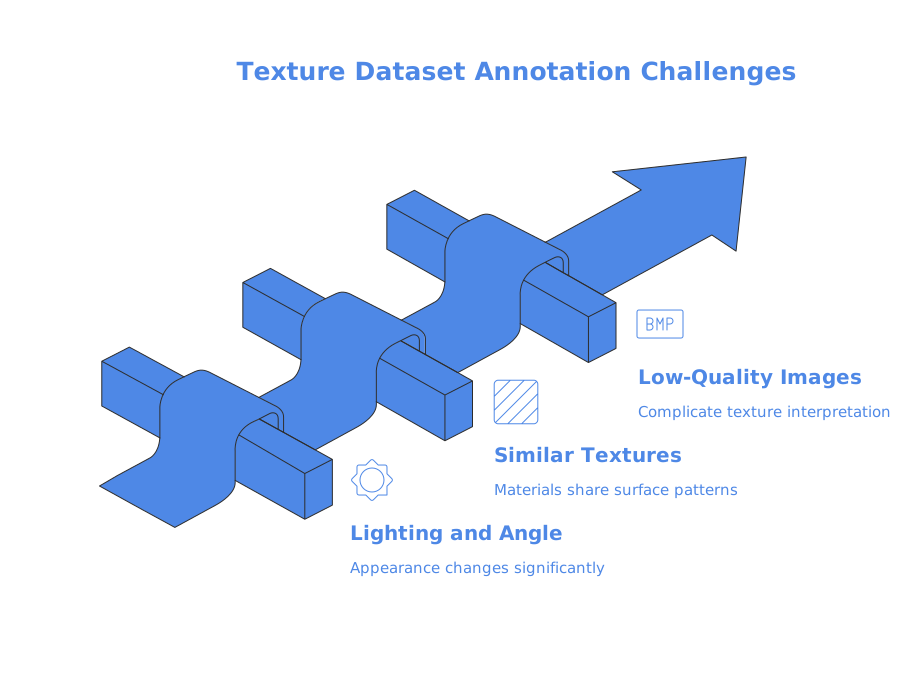
Texture dataset annotation presents several challenges due to visual ambiguity and environmental variability.
Variability in Lighting and Angle
Texture appearance changes significantly with lighting conditions, shadows, and camera angle. Annotators must distinguish between lighting artifacts and inherent texture patterns. Deep learning models trained on diverse datasets generalize better to real-world imagery because they are exposed to multiple variations during training.
Similar Textures Across Materials
Different materials may share similar surface patterns. For example, woven fabrics and certain natural fibers can appear visually similar. Annotators must consider both pattern and material context when labeling textures. This requires careful review of visual cues and consistent guideline application.
Low-Quality or Noisy Images
Images with low resolution, noise, or motion blur complicate texture interpretation. Annotators must rely on clear reference examples to ensure correct labeling. Dataset curators may exclude images that fail to meet quality standards. Consistent image quality supports more accurate model training.
Designing Annotation Guidelines for Texture Classification
Annotation guidelines ensure consistent interpretation of texture features across diverse imagery.
Defining Texture Categories
Guidelines describe each texture type and provide examples of characteristic patterns. They explain how to identify unique features such as grain thickness, line curvature, or spot density. Detailed definitions reduce ambiguity and improve annotation consistency. Guidelines often include edge cases that illustrate borderline textures.
Material Context Rules
Guidelines specify how material context influences texture labels. Annotators use these rules to determine whether visually similar surfaces belong to different material categories. Material context rules ensure that annotations reflect accurate product information. These guidelines support downstream tasks such as product classification and material recognition.
Feature Extraction Principles
Guidelines describe how annotators should interpret visual features such as frequency of repetition or micro-pattern orientation. Feature extraction principles help annotators analyze texture structure systematically. These principles provide a foundation for consistent labeling across diverse datasets.
Quality Assurance for Texture Classification
Quality assurance ensures that texture datasets are accurate, consistent, and useful for deep learning training.
Consensus Evaluation
Quality assurance teams review annotations across multiple annotators to identify inconsistencies. Consensus evaluation helps refine guidelines and improve future annotation accuracy. Multi-reviewer agreement supports dataset reliability.
Image Quality Screening
Reviewers examine image clarity, lighting, resolution, and noise levels. Images that fail to meet quality standards may be replaced or removed. Quality screening ensures that training data reflects realistic but usable conditions.
Category Balance Monitoring
Reviewers check for balanced representation across texture categories. Balanced datasets help AI models learn equally from all categories. Imbalanced datasets may produce biased or inaccurate predictions.
How Texture Datasets Support Product Classification
Texture datasets improve product classification by enabling AI models to understand fine-grained surface details that distinguish visually similar items.
Differentiating Similar Product Types
Many products belong to categories that appear visually similar, such as textiles, ceramics, or natural fibers. Texture classification helps AI systems differentiate these items using micro-level visual cues. For example, woven fabrics differ subtly from knitted fabrics in pattern density and structure. Texture datasets provide the examples that models need to learn these differences.
Enhancing Material Recognition
Texture information helps determine material type when product shapes and colors do not provide enough context. Material recognition supports product categorization, filtering, and attribute extraction. Texture datasets allow AI systems to recognize materials even when text descriptions are missing or ambiguous.
Supporting Visual Search Systems
Visual search engines depend on texture features to match user-uploaded images with similar products. Texture classification improves the relevance of visual search results. AI models use texture representations to detect patterns that align with user queries.
Applications of Texture Classification
Texture classification supports a wide range of applications across retail, manufacturing, and quality control.
Retail Product Tagging
Retailers use texture classification to assign material attributes and surface features automatically. These attributes improve filtering, product discovery, and recommendation quality. Texture tagging enhances product data by identifying characteristics that may not appear in descriptions or metadata.
E-commerce & Fashion Catalog Enhancement
Texture insights support automated enrichment of product catalogs. AI models categorize products by texture-related characteristics such as smoothness, roughness, softness, or glossiness. Enhanced catalogs improve search accuracy and reduce manual tagging effort.
Manufacturing Quality Detection
Texture classification helps detect defects such as scratches, cracks, dents, or inconsistencies in surface finish. Deep learning models trained on texture datasets can identify anomalies during production. This supports quality control pipelines and reduces manufacturing waste.
Material Sorting and Verification
Texture classification assists in verifying incoming materials and supporting automated sorting systems. AI models analyze surface patterns to confirm material type and detect inconsistencies. These capabilities improve accuracy in supply chain and production environments.
Future Directions in Texture Classification
Advances in deep learning and multi-modal AI will expand the possibilities of texture classification.
Multimodal Feature Fusion
Future models will integrate images, spectral data, and material properties to improve classification accuracy. Multimodal fusion supports deeper understanding of surface characteristics. These models help interpret complex relationships between texture, material, and manufacturing processes.
Self-Supervised Texture Learning
Self-supervised learning techniques will reduce the amount of labeled data needed for texture analysis. Models may learn texture representations automatically by analyzing unlabeled images. This approach supports scalability in environments with limited labeled data.
Real-Time Texture Recognition
Advances in hardware acceleration will enable real-time texture classification for manufacturing and retail applications. These capabilities support automated quality inspection and live visual search tools.
If You Are Preparing Texture or Product Classification Datasets
Texture classification datasets play a central role in improving product recognition, catalog accuracy, and surface-level feature extraction. If you are building texture datasets or integrating surface analysis into product classification workflows, the DataVLab team can support you with precise, scalable, and domain-aligned annotation solutions. Share your objectives, and we can help design robust datasets that strengthen your AI models across retail and manufacturing environments.
What is Texture classification dataset?
Texture classification datasets are essential for training AI systems that recognize surface patterns, materials, and visual micro-features within product imagery. These datasets support product classification, defect detection, visual search, and automated tagging across retail and manufacturing environments.
What does the section on “Understanding texture classification in product recognition” explain?
Texture classification refers to the process of identifying and categorizing visual patterns, surface structures, and material characteristics in images. These micro-features influence how products are recognized, grouped, and differentiated by AI systems. Texture datasets contain thousands of images representing diverse surface properties such as smoothness, roughness, grain, weave patterns, metallic shine, or organic irregularities.
What are the main challenges of Texture classification dataset?
Texture dataset annotation presents several challenges due to visual ambiguity and environmental variability. Texture appearance changes significantly with lighting conditions, shadows, and camera angle. Annotators must distinguish between lighting artifacts and inherent texture patterns.
What is involved in designing annotation guidelines for texture classification?
Annotation guidelines ensure consistent interpretation of texture features across diverse imagery. Guidelines describe each texture type and provide examples of characteristic patterns. They explain how to identify unique features such as grain thickness, line curvature, or spot density.
What does the article explain about how texture datasets support product classification?
Texture datasets improve product classification by enabling AI models to understand fine-grained surface details that distinguish visually similar items. Many products belong to categories that appear visually similar, such as textiles, ceramics, or natural fibers. Texture classification helps AI systems differentiate these items using micro-level visual cues.
What is the future of Texture classification dataset?
Advances in deep learning and multi-modal AI will expand the possibilities of texture classification. Future models will integrate images, spectral data, and material properties to improve classification accuracy. Multimodal fusion supports deeper understanding of surface characteristics.