Furniture Classification: How AI Organizes Home Goods for Retail Catalogs and Visual Search
.jpeg)
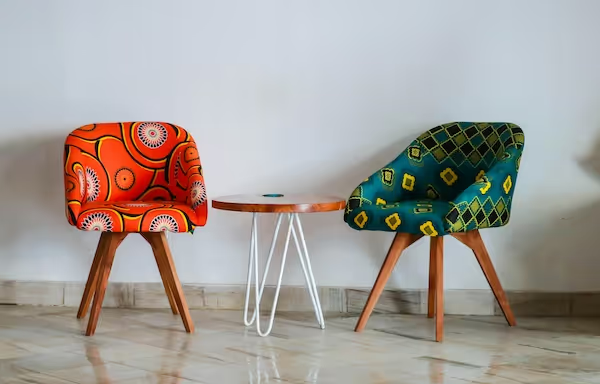
Furniture classification uses AI to recognize home goods, categorize product images, and organize retail catalogs based on style, material, and function. This article explains how furniture datasets are structured, how annotation teams label furniture types, and how models interpret visual features such as shape, texture, and structural design. It also examines challenges related to lighting, occlusion, and style variability. Applications in visual search, AR-based shopping tools, and catalog enrichment are discussed. The article concludes with emerging trends in 3D understanding and multimodal classification for home goods.
- Furniture classification uses AI to recognize home goods, categorize product images, and organize retail catalogs based on style, material, and function.
- This article explains how furniture datasets are structured, how annotation teams label furniture types, and how models interpret visual features such as shape, texture, and structural design.
- Applications in visual search, AR-based shopping tools, and catalog enrichment are discussed.
- The article concludes with emerging trends in 3D understanding and multimodal classification for home goods.
Understanding Furniture Classification
Furniture classification refers to identifying furniture types, attributes, styles, and materials from images to support e-commerce cataloging, visual search, and augmented reality retail experiences. AI models trained on furniture datasets learn to recognize visual cues that distinguish chairs, sofas, tables, beds, cabinets, and decor items. These datasets contain images captured in studio settings, real homes, or retail environments. A number of public datasets illustrate how structured furniture imagery supports classification research, such as Kaggle's furniture image dataset containing labeled examples across multiple product types.
Why Furniture Classification Matters in Retail
Furniture retailers rely heavily on accurate classification to support catalog structure, search relevance, and recommendation quality. Home goods are highly visual products, and customers evaluate style, shape, and materials before making purchasing decisions. Misclassified items reduce search accuracy and disrupt browsing experiences. Classification helps retailers organize inventories and automate product tagging at scale. This improves product discovery and enhances customer engagement.
How AI Enhances Furniture Recognition
Deep learning models interpret furniture images by analyzing structure, contours, textures, and patterns. They learn representations of furniture categories that help distinguish similar items. These representations support tasks such as product matching, visual filtering, and style analysis. AI models also evaluate contextual cues in room scenes to locate furniture and assign labels. Research published in ACM Digital Library demonstrates how scene understanding techniques improve furniture recognition accuracy.
Components of Furniture Classification Datasets
Furniture classification datasets contain several structured elements that help AI models interpret home goods.
Category Labels
Datasets include labels for major furniture types such as sofas, chairs, tables, cabinets, beds, shelves, and desks. They may also include subcategories that describe variations in size, shape, or function. These labels support classification tasks that reflect retail catalog structure. Category labels must remain consistent across diverse image sources.
Style and Design Attributes
Furniture items vary widely in style and design. Datasets may include style labels such as modern, traditional, rustic, or minimalist. These styles influence customer preferences and browsing behavior. Style attributes enrich classification models and support personalized recommendations. Autodesk's design resources illustrate how furniture shapes and construction details influence stylistic classification.
Material and Texture Features
Materials such as wood, metal, fabric, and plastic influence the visual appearance of furniture. Texture features such as grain patterns or fabric weave help models recognize material types. Datasets may include material annotations to support more detailed classification. Material recognition enhances catalog enrichment and filtering.
Annotation Workflows for Furniture Recognition
Annotation workflows define how product images are labeled to support AI training.
Multi-Modal Image Review
Annotators evaluate images that include furniture in diverse environments. Some images are captured in studio backgrounds, while others appear in furnished room scenes. Annotators interpret context to identify furniture boundaries and assign correct labels. Multi-modal review ensures that annotations remain consistent across environments.
Category Assignment
Annotators assign category labels based on furniture type. They evaluate shape, function, and structural features to determine correct classification. Category assignment must follow guidelines that define distinctions among similar items such as armchairs versus lounge chairs. Accurate category assignment supports catalog clarity.
Labeling Style and Materials
Annotators assign style and material labels based on visible cues. Style labeling requires interpreting design features such as curves, edges, and proportions. Material labeling involves recognizing wood grain, metal surfaces, or fabric textures. Annotators follow detailed guidelines to ensure correct interpretation across diverse items.
Challenges in Furniture Dataset Annotation
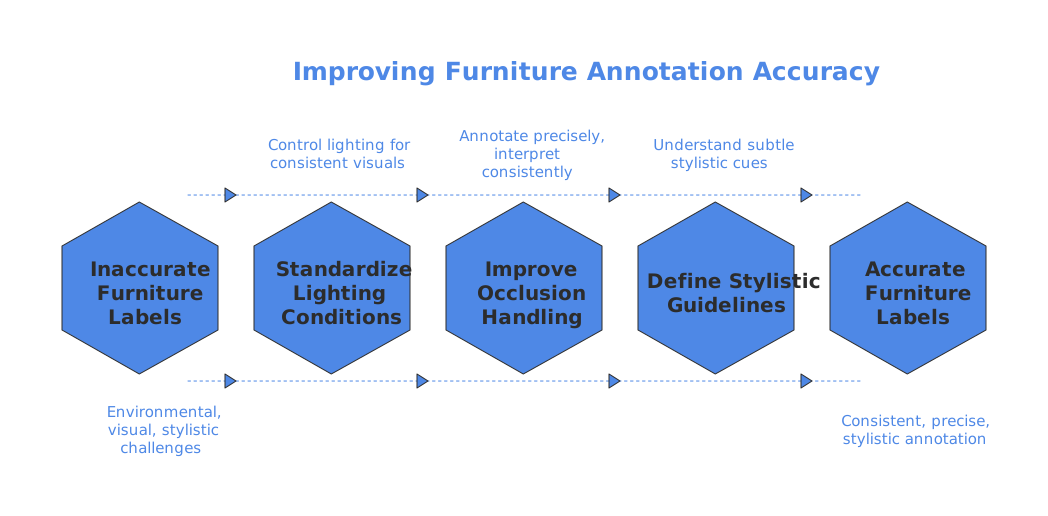
Furniture annotation presents several challenges rooted in environmental factors, visual similarity, and stylistic diversity.
Lighting and Background Variability
Furniture images vary widely in lighting conditions, ranging from bright studio lighting to dimly lit room scenes. Lighting affects color perception and may obscure surface details. Annotators must interpret these variations carefully to assign accurate labels. Lighting variability also influences how models learn texture and shape cues.
Occlusion and Scene Complexity
Furniture often appears within full room scenes where objects overlap or partially obstruct each other. Annotators must distinguish the target furniture item from surrounding decor. Occlusion challenges require precise annotation and consistent interpretation. Scene complexity increases the difficulty of identifying object boundaries.
Style Overlap
Some furniture styles share similar features, complicating style classification. For example, modern and contemporary styles may overlap in design characteristics such as geometric shapes or minimal ornamentation. Annotators must understand subtle stylistic cues to assign accurate labels. Style overlap requires well-defined guidelines.
Designing Annotation Guidelines for Furniture Classification
Annotation guidelines ensure that category, style, and material labels remain consistent across large datasets.
Category Definitions
Guidelines describe how to classify distinct furniture types and provide examples for each. They outline how to distinguish between similar categories such as armchairs and accent chairs. Clear category definitions reduce annotation ambiguity.
Style Interpretation Rules
Guidelines explain how to interpret design cues that define furniture styles. They provide examples of typical features and clarify differences among stylistic categories. Style interpretation rules improve consistency across annotators.
Material Labeling Criteria
Guidelines describe how annotators should interpret material cues such as wood grain patterns, fabric textures, or metallic reflections. Material labeling criteria ensure that annotations accurately reflect physical attributes. Material consistency helps models learn reliable representations.
Quality Assurance for Furniture Classification
Quality assurance ensures that labeled furniture datasets meet accuracy and consistency requirements.
Multi-Reviewer Validation
Reviewers evaluate labels assigned by multiple annotators to identify inconsistencies. Multi-reviewer validation reinforces guideline correctness and highlights areas requiring refinement. This process supports dataset reliability.
Mask or Crop Verification
For datasets involving bounding boxes or segmentation masks, reviewers ensure that annotations align with furniture boundaries. Verification focuses on accuracy of shape, edge placement, and contextual alignment. Accurate masks improve downstream model performance.
Attribute Consistency Checks
Reviewers ensure that style and material labels remain consistent across similar furniture items. Attribute consistency supports personalized recommendation systems and catalog enrichment. Consistency checks help maintain dataset coherence.
Applications of Furniture Classification
Furniture classification supports a wide range of applications in retail, design, and home visualization.
Visual Search Engines
Visual search tools use furniture classification to match user-uploaded images with similar products. AI models analyze shape, style, and material cues to generate accurate matches. Furniture classification improves search relevance and user engagement.
Augmented Reality Shopping
Augmented reality applications rely on classification to identify furniture types and recommend compatible styles. AR platforms use classification results to position items correctly within room scenes. Research on furniture detection demonstrates how segmentation and classification improve AR interactions.
Catalog Enrichment and Tagging
Classification supports automated tagging workflows that reduce manual effort in maintaining large furniture catalogs. Labels such as style, material, and color help organize products and improve filtering. Catalog enrichment helps retailers maintain consistent product data.
Interior Scene Understanding
Furniture product classification helps models understand room layouts and identify relationships among objects. Scene understanding supports design tools and layout recommendations. ScienceDirect topics on furniture design illustrate how structural features influence classification.
Future Directions in Furniture Classification
Innovations in AI will expand the capabilities of furniture classification systems.
3D Furniture Understanding
Future models will incorporate 3D representations to improve recognition of shape, depth, and structural features. 3D understanding supports virtual design tools and spatial planning applications. These models will reduce reliance on 2D imagery.
Style and Material Fusion Models
Next-generation models will combine style and material cues to refine classification accuracy. Fusion models integrate multiple attribute types to improve recognition. These capabilities support more detailed catalog enrichment.
Generative Design Integration
Future systems may integrate generative models to simulate furniture arrangements and evaluate style compatibility. These models will analyze style cues and generate layout suggestions. Generative integration supports advanced design workflows.
If You Are Preparing Furniture or Home Goods Classification Datasets
Accurate furniture classification is essential for retail search, AR-powered shopping, and catalog enrichment across home goods platforms. If you are building datasets for furniture or interior retail applications, the DataVLab team can support your annotation workflows with precise labeling, scalable processes, and robust dataset structures. Share your objectives, and we can help design home goods datasets that enhance your AI models and improve customer experience across digital retail channels.
What is Furniture classification?
Furniture classification uses AI to recognize home goods, categorize product images, and organize retail catalogs based on style, material, and function. This article explains how furniture datasets are structured, how annotation teams label furniture types, and how models interpret visual features such as shape, texture, and structural design.
Why does furniture classification matter in retail?
Furniture retailers rely heavily on accurate classification to support catalog structure, search relevance, and recommendation quality. Home goods are highly visual products, and customers evaluate style, shape, and materials before making purchasing decisions. Misclassified items reduce search accuracy and disrupt browsing experiences.
What are the main challenges of Furniture classification?
Furniture annotation presents several challenges rooted in environmental factors, visual similarity, and stylistic diversity. Furniture images vary widely in lighting conditions, ranging from bright studio lighting to dimly lit room scenes. Lighting affects color perception and may obscure surface details.
What is involved in designing annotation guidelines for furniture classification?
Annotation guidelines ensure that category, style, and material labels remain consistent across large datasets. Guidelines describe how to classify distinct furniture types and provide examples for each. They outline how to distinguish between similar categories such as armchairs and accent chairs.
How can teams ensure quality in Furniture classification?
Quality assurance ensures that labeled furniture datasets meet accuracy and consistency requirements. Reviewers evaluate labels assigned by multiple annotators to identify inconsistencies. Multi-reviewer validation reinforces guideline correctness and highlights areas requiring refinement.
What is the future of Furniture classification?
Innovations in AI will expand the capabilities of furniture classification systems. Future models will incorporate 3D representations to improve recognition of shape, depth, and structural features. 3D understanding supports virtual design tools and spatial planning applications.