Annotating Thermal and Multispectral Drone Imagery for AI Applications
.jpeg)
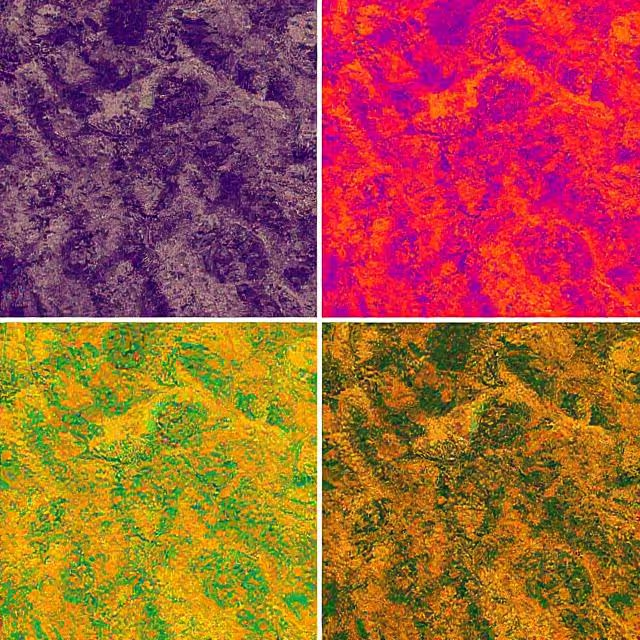
Thermal and multispectral drone imagery plays a vital role in developing advanced AI models across agriculture, energy, disaster response, and security. But before AI can interpret these images, they must be annotated with precision. This comprehensive guide explores the unique challenges of annotating non-visible spectrum data, explains the real-world use cases that rely on these annotations, and shares the best strategies to ensure your data fuels accurate and reliable machine learning models. Whether you're building computer vision pipelines or managing annotation projects, this article offers the practical insights you need to make thermal and multispectral annotation a success.
- Thermal and multispectral drone imagery plays a vital role in developing advanced AI models across agriculture, energy, disaster response, and security.
- But before AI can interpret these images, they must be annotated with precision.
- Unlike RGB images that mimic human vision, thermal and multispectral images capture data outside the visible light spectrum.
- Let’s explore how annotated thermal and multispectral data powers real-world AI systems.
Why Thermal and Multispectral Imagery Matters for AI 🛰️
Unlike RGB images that mimic human vision, thermal and multispectral images capture data outside the visible light spectrum. This makes them incredibly powerful for AI applications that need to detect patterns invisible to the naked eye.
- Thermal imagery records infrared radiation, providing heat signatures useful for spotting energy leaks, wildlife, or human presence.
- Multispectral imagery captures data across multiple wavelength bands (e.g., near-infrared, red edge), enabling vegetation health analysis, water stress detection, and more.
Together, these imaging types empower AI models to analyze environments at a deeper, more actionable level.
Where It’s Used:
- Agriculture: Crop monitoring, yield prediction, irrigation optimization.
- Energy: Solar panel inspection, power line monitoring, thermal leak detection.
- Public Safety: Search and rescue missions, wildfire detection.
- Environmental Monitoring: Pollution mapping, forest health tracking.
- Construction & Infrastructure: Moisture detection, heat leak identification, structural anomaly mapping.
The only caveat? AI can’t do anything useful with this data unless it’s properly annotated.
The Unique Challenge of Annotating Beyond the Visible Spectrum 🌡️📡
Annotation in the thermal and multispectral space isn't just “drawing boxes”—it's about interpreting and labeling spectral phenomena, which often don’t have clear visual boundaries like RGB images do.
Key Differences from RGB Annotation:
- Low visual clarity: Thermal blobs and NIR contrasts often lack sharp edges.
- Multi-band complexity: Multispectral images require interpreting relationships across bands.
- Temperature scaling: Thermal imagery needs consistent calibration or normalization.
- Misalignment issues: Multispectral and thermal sensors may be offset from RGB ones, complicating fusion.
This complexity makes annotation both technically demanding and context-sensitive—requiring skilled annotators and careful preprocessing.
Real-World Use Cases That Rely on Accurate Annotations 🔍
Let’s explore how annotated thermal and multispectral data powers real-world AI systems.
🌾 Precision Agriculture
In smart farming, multispectral annotations enable AI to:
- Detect plant stress by labeling chlorophyll-deficient zones in NIR/red edge bands.
- Annotate weed clusters or pest-infected areas invisible in RGB images.
- Train yield prediction models using per-plant spectral variations.
Thermal images can also be labeled to detect irrigation issues, flagging cooler or hotter-than-normal crop zones.
⚡ Renewable Energy & Infrastructure Monitoring
Thermal annotation is key in:
- Solar farm inspection: Identifying defective solar panels via thermal hotspots.
- Powerline and transformer monitoring: Labeling thermal anomalies before they lead to failures.
- Building energy audits: AI models learn to spot insulation defects by training on annotated heat leak regions.
Read more on how AI inspects solar panels
🔥 Disaster Response & Wildfire Monitoring
Drones equipped with thermal and multispectral cameras assist in:
- Wildfire boundary mapping by labeling high-heat zones.
- Victim detection via body heat during search and rescue.
- Post-disaster heat surveys (e.g., looking for hot gas leaks or remaining fires in collapsed structures).
Annotations here must be both fast and accurate, often needing human-in-the-loop verification for mission-critical tasks.
🛠️ Construction and Asset Management
In large construction zones:
- Thermal drones help spot leaks or overheating systems.
- Annotated thermal maps guide safety inspections by pinpointing malfunctioning HVACs or overheated machinery.
- Multispectral layers can reveal material inconsistencies or water pooling under surfaces.
🐘 Wildlife & Environmental Monitoring
Thermal annotation supports:
- Nocturnal animal tracking in conservation areas.
- Anti-poaching surveillance.
- Population heatmaps for behavioral analysis.
Multispectral annotation adds:
- Vegetation segmentation for ecosystem health.
- Habitat classification based on reflectance signatures.
Learn more from NASA’s AVIRIS program on remote sensing for ecological AI.
Preprocessing: Preparing Your Images for Annotation
Before jumping into annotation, smart preprocessing of thermal and multispectral data ensures higher quality and model-friendly labels.
Techniques to Consider:
- Spectral band selection: For multispectral data, select the most relevant bands (e.g., NDVI, NDRE).
- Histogram equalization or normalization: Enhances contrast in thermal frames.
- Sensor alignment and registration: Align RGB + thermal + multispectral data accurately, especially for data fusion projects.
- Temperature thresholding: Highlight meaningful differences (e.g., equipment overheating).
- Denoising filters: Remove sensor noise that could mislead annotation.
Investing in this prep work can drastically reduce annotation ambiguity and increase downstream AI performance.
Best Practices for High-Quality Annotation Outcomes ✅
Thermal and multispectral annotation isn’t just about labeling pixels—it’s about capturing nuanced scientific signals in a way that AI models can understand and replicate. Below are expanded best practices to help ensure annotation precision, efficiency, and strategic value.
🔍 Involve Domain-Specific Annotators
Annotations involving temperature gradients, vegetation indices, or energy outputs require specialized knowledge. Collaborate with:
- Agronomists for multispectral crop imagery.
- Electrical engineers or technicians for thermal power line or transformer inspections.
- Wildlife experts for thermal animal monitoring tasks.
This avoids misinterpreting spectral signals and improves label trustworthiness.
🎯 Build Clear and Context-Aware Annotation Protocols
General annotation guidelines are not enough. Instead, define spectrum-specific labeling standards:
- Use relative vs. absolute thresholds (e.g., “label anything 15% hotter than ambient” vs. “label any pixel above 70°C”).
- Set minimum area or duration requirements for annotations to filter out noise (e.g., ignore transient heat blips under 1 second).
- Clarify multi-class behavior: Can an object be labeled as both “damaged panel” and “hotspot”?
A clear protocol eliminates subjective guesswork and improves annotation consistency across teams.
🧠 Implement Layered Visual Aids
Since raw spectral imagery can be abstract, overlay aids help:
- For thermal: show side-by-side RGB + thermal views to provide spatial cues.
- For multispectral: allow toggling between NDVI, NDRE, or raw bands.
- Add elevation, GPS metadata, or temperature scale legends directly on the annotation interface.
This ensures annotators see the story behind the data, not just pixels.
🔁 Embrace Iterative Labeling and Feedback Loops
Instead of a one-and-done approach, follow an active iteration cycle:
- Annotate a baseline dataset.
- Train a model.
- Analyze errors and edge cases.
- Refine annotations based on model blind spots.
This creates a virtuous improvement loop, especially important in spectral imagery where data can be ambiguous or change over time.
🧪 Validate with Ground Truth When Possible
When feasible, compare annotations to:
- Field sensor data (e.g., thermometer readings, soil moisture probes).
- RGB drone footage captured simultaneously.
- Time-series overlays to verify that thermal patterns persist over multiple frames or flights.
This adds external verification to prevent spectral mislabeling.
🚦Use Confidence Scoring or Heatmaps
Not all annotations are equal. By assigning confidence levels to certain labels or drawing model-informed heatmaps, you can:
- Prioritize expert review of uncertain zones.
- Guide semi-automated annotation or flag ambiguous areas for further inspection.
🔐 Maintain Data Integrity with Secure Pipelines
Spectral imagery often includes sensitive infrastructure or environmental data. Use secure, version-controlled annotation platforms that offer:
- Role-based access control.
- End-to-end encryption.
- Detailed audit trails for every annotation or correction.
This is especially vital for applications involving public safety, energy, or critical infrastructure.
📚 Train Annotators with Use Case Scenarios
Beyond technical training, provide narrative use case examples like:
- “Here’s what a crop with potassium deficiency looks like in NIR.”
- “This thermal frame shows a fire risk near an overloaded cable.”
- “This NDVI pattern suggests flooding stress.”
These contextual tutorials help annotators think like the AI system you’re building.
Why Quality Annotation Drives Better AI Models 📈
In thermal and multispectral domains, the margin of error is thin—and quality annotations directly influence model trustworthiness.
Good annotations enable:
- Precise segmentation of thermal anomalies or plant health zones.
- Time-series tracking of spectral evolution over seasons or operating hours.
- Multimodal fusion, where thermal + RGB + multispectral data is combined in model pipelines.
AI models trained on low-quality or inconsistent annotations risk:
- False positives in fire detection.
- Missed yield anomalies in crops.
- Misclassification of structural defects.
As such, data annotation is not a backend task—it’s a strategic investment in AI performance.
Common Pitfalls to Watch Out For 🚫
Here are some recurring challenges to avoid:
- Annotation fatigue: Especially when dealing with thousands of grayscale thermal images—quality can drop over time.
- Poor sensor calibration: Skewed thermal values or incorrect band alignment lead to mislabeled data.
- Lack of metadata: Without knowing exact flight height, temperature ranges, or sensor specs, annotators may misinterpret what they’re seeing.
- Over-generalization: Avoid labeling too broadly (e.g., tagging whole frames as “overheating”) without precision.
Working with a skilled annotation team that’s been trained on non-visible spectrum labeling makes a critical difference.
Exploring What’s Ahead in Spectral Annotation AI 🚀
Spectral imaging for AI is rapidly evolving. As sensor technology advances and AI demands grow, the annotation landscape will shift dramatically. Here's a glimpse into what the future holds:
🧠 Rise of Multimodal AI Learning
Future AI systems will combine RGB + thermal + multispectral + LiDAR + GPS into unified models. These systems will:
- Detect context-rich anomalies (e.g., overheating machinery surrounded by stressed vegetation).
- Make fused predictions from multiple spectral sources.
- Require perfectly co-registered annotations across all sensor views.
Implication: Annotation platforms must evolve to support multi-layer labeling, 3D fusion, and temporal alignment across different modalities.
🛠️ Synthetic Spectral Data & Annotation Simulators
AI developers are beginning to use synthetic data to:
- Simulate infrared signatures.
- Create synthetic NDVI or NDRE patterns.
- Mimic heat diffusion over time.
Tools like NVIDIA’s Omniverse or Unreal Engine are being adapted to generate photo-realistic thermal/multispectral environments. These require synthetic annotations, which blend procedural generation with manual QA.
🤖 Semi-Automated Annotation with AI Assistance
Expect more platforms to offer:
- AI-suggested bounding boxes or masks based on past annotations.
- Active learning pipelines that flag only uncertain or rare edge cases.
- Annotation acceleration tools trained specifically on thermal/multispectral imagery.
This will help reduce time spent on repetitive tasks and focus human effort where it matters most.
🌐 Interoperability Standards and Open Datasets
As spectral AI use grows, so will the demand for:
- Common annotation schemas for thermal and multispectral imagery.
- Publicly available benchmark datasets, much like COCO or ImageNet, but for non-RGB domains.
- Industry-specific datasets (e.g., Agriculture, power, wildfire).
Examples include:
This will standardize how AI researchers and industry practitioners define success.
📦 Packaged AI-as-a-Service for Spectral Imagery
Expect future platforms to offer ready-to-deploy AI APIs for:
- Thermal fault detection.
- Vegetation index mapping.
- Drone-based asset inspections.
These systems will rely on massively annotated datasets, often crowdsourced or outsourced, making the quality and scalability of annotation a business-critical differentiator.
🌍 Global Environmental Monitoring at Scale
With the rise of climate change response, disaster tracking, and food security missions, thermal and multispectral drones will be part of:
- Real-time monitoring grids across regions.
- Automated change detection systems that spot environmental shifts.
- Citizen science annotation platforms, where volunteers contribute to spectral labeling.
The scale of data will grow, and with it, the sophistication of annotation workflows.
🧬 Annotating Spectral Anomalies at the Molecular Level
In the future, hyperspectral (narrow-band) imaging will push beyond what multispectral offers today. AI models will classify:
- Chemical leaks or gas signatures based on ultra-fine spectral changes.
- Disease markers in crops detectable only at high spectral resolution.
These will require even more nuanced, spectrum-informed annotations, possibly integrating spectral fingerprint libraries.
Let’s Bring Your Spectral Data to Life 🌱📊
Thermal and multispectral drone imagery opens new frontiers in AI—but only if the data is annotated with care, domain knowledge, and precision. From agriculture to infrastructure, environmental safety to emergency response, high-quality annotation makes the difference between “just another AI model” and a truly reliable system.
Whether you’re launching a new drone-based AI project or refining an existing one, don’t leave annotation as an afterthought.
👉 Ready to annotate your drone data with expert precision?
Let’s talk about how we can bring your spectral imagery to life—Get in touch with our team at DataVLab and see what world-class annotation can do for your AI.
How do teams annotate Thermal and multispectral drone imagery for AI applications?
Thermal and multispectral drone imagery plays a vital role in developing advanced AI models across agriculture, energy, disaster response, and security. But before AI can interpret these images, they must be annotated with precision. Unlike RGB images that mimic human vision, thermal and multispectral images capture data outside the visible light spectrum.
Why does thermal and multispectral imagery matter for AI?
Unlike RGB images that mimic human vision, thermal and multispectral images capture data outside the visible light spectrum. This makes them incredibly powerful for AI applications that need to detect patterns invisible to the naked eye.
What are the main challenges of Annotating thermal and multispectral drone imagery for AI applications?
Annotation in the thermal and multispectral space isn't just “drawing boxes”—it's about interpreting and labeling spectral phenomena, which often don’t have clear visual boundaries like RGB images do. Low visual clarity: Thermal blobs and NIR contrasts often lack sharp edges.
What are the main use cases for Annotating thermal and multispectral drone imagery for AI applications?
Let’s explore how annotated thermal and multispectral data powers real-world AI systems. Detect plant stress by labeling chlorophyll-deficient zones in NIR/red edge bands. Annotate weed clusters or pest-infected areas invisible in RGB images.
What does the section on “Preprocessing: preparing your images for annotation” explain?
Before jumping into annotation, smart preprocessing of thermal and multispectral data ensures higher quality and model-friendly labels. Spectral band selection: For multispectral data, select the most relevant bands (e.g., NDVI, NDRE). Histogram equalization or normalization: Enhances contrast in thermal frames.
What does the article explain about why quality annotation drives better AI models?
In thermal and multispectral domains, the margin of error is thin—and quality annotations directly influence model trustworthiness. Precise segmentation of thermal anomalies or plant health zones. Time-series tracking of spectral evolution over seasons or operating hours.