Annotating Tactical Movements for Sports Strategy AI: From Team Formations to Play Patterns
.jpeg)
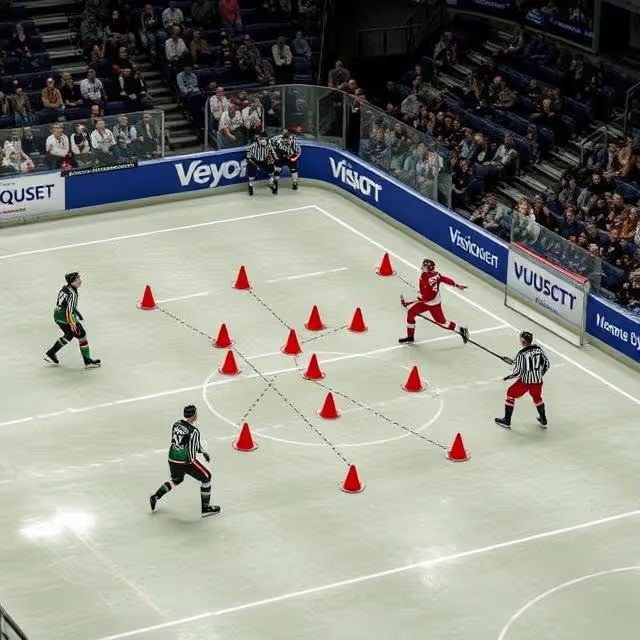
From fluid team formations to intricate play patterns, sports tactics are increasingly decoded not by coaches alone, but by AI systems trained on annotated game footage. Strategic annotation of player positions, movements, and in-game decisions allows artificial intelligence to analyze, predict, and even optimize plays. This article dives deep into how annotation fuels sports strategy AI, explores how teams and developers harness tactical data, and offers a look into the next wave of intelligent coaching tools.
- From fluid team formations to intricate play patterns, sports tactics are increasingly decoded not by coaches alone, but by AI systems trained on annotated game footage.
- Strategic annotation of player positions, movements, and in-game decisions allows artificial intelligence to analyze, predict, and even optimize plays.
- This article dives deep into how annotation fuels sports strategy AI, explores how teams and developers harness tactical data, and offers a look into the next wave of intelligent coaching tools.
- Tactical annotation turns raw game footage into structured intelligence.
Why Tactical Annotation Matters in Modern Sports
The competitive edge in sports no longer comes solely from better athletes or luck—it’s data. Tactical annotation turns raw game footage into structured intelligence. This means that AI can move beyond player detection and tracking to answer nuanced questions like:
- “Is this a 4-3-3 or a diamond midfield?”
- “What pattern led to that goal?”
- “Are these passing triangles recurring?”
Teams are turning to AI-powered platforms like Hudl, Second Spectrum, and StatsBomb to gain strategic insights from this kind of annotation, pushing performance analysis into the future.
Understanding Tactical Movement in Context
The Flow of the Game
Tactical movement is the coordinated motion of players according to game situations. It’s not just about where a player is—but why they’re there and how that fits into the overall game plan. These movements involve:
- Off-ball runs
- Pressing patterns
- Build-up sequences
- Transitions between attack and defense
When these are labeled and contextualized, AI can digest full-match behavior and reveal strategic strengths and weaknesses.
Formation Recognition 📐
AI models trained with annotated footage can infer formations automatically. Whether a football team shifts from a 3-5-2 to a 5-3-2 mid-match or a basketball team moves into a zone defense, the patterns can be detected—if the underlying data is precise and well-labeled.
From Annotation to Insight: The Workflow That Powers AI
Frame-by-Frame Positional Tagging
Key frames are selected from broadcast or multi-camera footage where players are tagged by:
- Position (e.g., LB, CAM, RW)
- Relative location (zone, half-space, final third)
- Tactical phase (build-up, transition, pressing, etc.)
Movement Vector Labeling ➡️
Players' movements are often represented with directional vectors over time, allowing AI to learn:
- Speed and acceleration patterns
- Tendency to drift into specific zones
- Pressing or retreating behavior
Spatial Relationships and Group Dynamics
Teams are annotated as collective units as well, such as:
- Lines of engagement
- Vertical and horizontal spacing
- Compression and expansion metrics
This enables algorithms to analyze team compactness, control of space, and coordinated maneuvers.
Real-World Applications: Strategy AI in Action
Scouting Opponents with AI
Scouting departments are using strategy AI to identify the recurring tactical habits of rival teams. For example, by analyzing 10 games where a team employs aggressive high pressing, AI can suggest counterstrategies.
A real-world implementation can be seen in the Premier League, where clubs use annotated video data with Opta’s Vision AI to understand tactical behaviors and find weaknesses before match day.
Training Scenario Simulation
AI models built on annotated tactical data can simulate match scenarios. Coaches can test:
- “How would our formation hold under a high press?”
- “What if our fullbacks pushed up further?”
- “Where are our vulnerable transition zones?”
Simulation tools help teams make evidence-based adjustments to their game plans.
Auto-Generated Tactical Reports
Using annotation-based models, some systems can now generate full tactical summaries post-match. These include:
- Formation timelines
- Heatmaps for tactical phases
- Metrics like “pass network density” or “final third entries by channel”
This level of reporting would take analysts hours manually—but AI now automates it.
Key Elements to Annotate in Tactical Footage
To truly unlock strategic insights, annotations must move beyond the individual. Here’s what makes a difference in AI training:
Zone Occupancy 📍
Annotate where players are during critical phases (e.g., defensive third during a counterattack) to model spatial control.
Chain Reactions and Triggers
Marking what causes what is crucial:
- A winger’s run that pulls a defender wide
- A midfielder’s touch triggering a press
- A goalkeeper’s quick release starting a counter
Chain logic is a major frontier in teaching AI about game intelligence.
Spacing and Synchronization
Spacing annotations—how players adjust gaps or maintain compactness—teach AI about team discipline and shape. Synchronization tags show how units (defense, midfield) move in harmony or disharmony.
The Challenge of Dynamic Systems
No formation is static. A team may start in a 4-2-3-1 but shift to a 3-2-5 in possession. Tactical annotation must therefore:
- Capture transitioning shapes
- Annotate contextual formations (offensive vs defensive)
- Recognize floating roles (false 9s, inverted fullbacks)
Annotating these subtleties is what makes AI strategic, not just reactive.
Sports Beyond Football: Tactical Annotation in Other Disciplines
Basketball
In basketball, annotating pick-and-roll patterns, zone defenses, or transition spacing gives AI data to dissect playbooks. Tools like Synergy Sports already integrate this for pro teams.
Annotations include:
- Offensive set recognition (e.g., horns, floppy, zipper cuts)
- Defensive scheme shifts (man-to-man, zone trap)
- Player off-ball positioning during set plays
American Football
In American football, where each play is highly scripted, annotation includes:
- Pre-snap formations
- Motion patterns
- Blocking schemes
- Defensive coverage types
This structured approach lends itself particularly well to AI modeling.
Ice Hockey & Rugby
These sports also benefit from annotated tactics: defensive formations during power plays (hockey) or line breaks and ruck formations (rugby). The complexity increases, but so does the strategic insight.
How AI Models Learn from Tactical Annotations
AI doesn’t simply view tactical annotations as static metadata—it learns from them dynamically, using a combination of computer vision, spatial-temporal modeling, and deep learning to understand the rhythm and structure of the game. This learning process is multi-layered:
Pattern Recognition and Tactical Templates
Annotated game footage gives AI access to repeatable formations and movement sequences. For example:
- 4-4-2 pressing traps in football
- Triangle offenses in basketball
- Cover 2 schemes in American football
Once these patterns are labeled across hundreds of instances, AI systems can learn to detect and categorize tactics even in new, unseen footage. This pattern recognition is often driven by convolutional neural networks (CNNs) in conjunction with player tracking data.
Spatial-Temporal Sequence Modeling
Tactics aren’t static—they unfold over time. To make sense of this evolution, AI uses:
- Recurrent Neural Networks (RNNs) and LSTM models to understand sequential play development
- Transformers, which excel at long-range dependencies and context, especially for modeling game phases (e.g., transitions, buildup, counter-attacks)
These models learn the “before and after” of key events: what movement led to a shot, how a formation shifted after a substitution, or how a team adapted after conceding.
Relationship Graphs and Player Networks
Using annotations, AI can construct relational graphs of players, capturing:
- Passing networks and movement synchrony
- Defensive coverage zones
- Role-based coordination (e.g., fullback overlapping with winger)
These graphs help AI reason about collective team behavior, not just individual performance. Graph Neural Networks (GNNs) are increasingly used to model these interactions.
Clustering and Comparative Analysis
With enough annotated games, AI can group similar tactical phases and situations, such as:
- Goal buildup patterns
- Successful press-breaking sequences
- Recurrent defensive breakdowns
This clustering allows coaches and analysts to compare matches across seasons, opponents, and tactical experiments, identifying which strategies yield the best outcomes under which circumstances.
Reinforcement Learning for Tactical Simulation
In more advanced applications, annotated data is used to simulate match environments where AI agents (e.g., digital players or teams) learn optimal strategies through trial and error. Using reinforcement learning, these agents:
- Explore decision-making options (pass vs. dribble, press vs. drop back)
- Learn from the rewards associated with different outcomes (goal, turnover, foul)
- Suggest tactical alternatives that may not be obvious to human coaches
This is already happening in research at organizations like DeepMind and FIFA’s AI division, pointing to a future of adaptive, self-learning strategy engines.
Combining Annotation with Event Data for Deeper Insights
Platforms like Wyscout and InStat now combine tactical Video Annotations with event data like:
- Passes, shots, tackles
- xG (expected goals)
- Pressure events and ball recoveries
When video annotations sync with timestamped event data, AI can contextualize tactics and outcomes in a fully integrated manner.
The Role of Human Expertise in Tactical Annotation
Despite advances, tactical annotation still heavily relies on domain knowledge:
- Former players and analysts identify formations better than machines
- Human annotators recognize unstructured behaviors AI may miss
- Manual quality control is essential for annotation consistency
This hybrid human-in-the-loop model ensures that annotations align with tactical intent, not just on-screen patterns.
Ethical and Competitive Considerations
With access to tactical annotations, questions arise:
- Should all teams have access to the same AI insights?
- How do you balance competitive secrecy with data sharing?
- What’s the line between smart analytics and surveillance?
Leagues and governing bodies are starting to draft policies on how AI-generated tactical insights can be used fairly.
Future Trends: What’s Next in Tactical AI?
As AI continues to mature, the fusion of tactical annotation and advanced modeling techniques will reshape how teams, broadcasters, and fans experience sports. Here’s what’s coming next:
Real-Time Tactical Feedback and In-Game Coaching Assistants
Soon, AI systems will provide live tactical recommendations to coaches via wearable devices, tablets, or stadium consoles:
- "Your midfield line is too flat—introduce a pivot."
- "Switch to a back three to counter their wide overload."
- "Opposition's left side is vulnerable—target that zone."
With real-time annotation pipelines and edge computing, this could become an AI-powered co-pilot for coaches, particularly in high-stakes, fast-paced environments like basketball or American football.
AI-Assisted Set-Piece Design and Optimization
Tactical annotation enables AI to analyze millions of historical set-piece plays, evaluating their success rates, spatial setups, and opponent weaknesses. Platforms will soon:
- Auto-generate set-piece variants based on current squad attributes
- Simulate their success probabilities against known opponent patterns
- Visually overlay play previews on training ground tablets or AR glasses
This transforms set-piece training from guesswork into data-driven precision engineering.
Player-Centric Tactical Intelligence
Annotation-enriched AI will soon offer tactical heatmaps personalized to individual players, showing:
- Decision-making biases (e.g., always dribbles inside vs outside)
- Spacing discipline and deviations from role-based expectations
- Real-time feedback on tactical compliance during matches
This will help develop smarter players who understand tactics contextually, not just technically.
Tactical Gamification and Fan Engagement
Imagine watching a match and getting live tactical breakdowns, made possible by AI trained on annotated movements:
- Why a certain press worked
- How a passing triangle formed before the assist
- Tactical shifts after a red card
Broadcasters and second-screen apps will use this data to gamify tactical understanding, appealing to a growing base of data-savvy fans and fantasy league players.
Personalized Strategy Engines for Amateur and Youth Sports
Annotation tools will be democratized and simplified, allowing grassroots teams and academies to:
- Annotate footage from smartphone cameras
- Receive auto-generated coaching insights
- Benchmark their tactical performance against professional standards
This opens the door to AI-driven coaching at every level, from elite clubs to weekend five-a-side teams.
Multimodal Tactical Modeling
The next frontier lies in combining visual annotations, audio (coach instructions), GPS data, and physiological metrics into one model:
- How did heart rate spike during pressing phases?
- Were vocal cues associated with successful transitions?
- Did positioning change when fatigue set in?
This multimodal fusion will allow AI not just to model tactics—but to understand the physical and psychological context that drives them.
Let’s Put It into Play 🎯
If you're developing AI systems for sports strategy or leading a performance analysis team, the message is clear: precise tactical annotation is the foundation. It powers smarter AI models, deeper insights, and a competitive edge that’s more strategic than ever before.
Whether you're working in football, basketball, rugby, or any team-based sport, annotating tactical movements is the gateway to unlocking intelligent, adaptable, and truly game-aware AI systems.
Ready to level up your strategy with data-driven intelligence?
👉 Talk to our annotation experts at DataVLab and let’s build the tactical brain your AI project deserves.
How do teams annotate Tactical movements for sports strategy AI?
From fluid team formations to intricate play patterns, sports tactics are increasingly decoded not by coaches alone, but by AI systems trained on annotated game footage. Strategic annotation of player positions, movements, and in-game decisions allows artificial intelligence to analyze, predict, and even optimize plays.
Why does tactical annotation matter in modern sports?
The competitive edge in sports no longer comes solely from better athletes or luck—it’s data. Tactical annotation turns raw game footage into structured intelligence. Teams are turning to AI-powered platforms like Hudl, Second Spectrum, and StatsBomb to gain strategic insights from this kind of annotation, pushing performance analysis into the future.
What are the main use cases for Annotating tactical movements for sports strategy AI?
Scouting departments are using strategy AI to identify the recurring tactical habits of rival teams. For example, by analyzing 10 games where a team employs aggressive high pressing, AI can suggest counterstrategies. A real-world implementation can be seen in the Premier League, where clubs use annotated video data with Opta’s Vision AI to understand tactical behaviors and find weaknesses before match day.
What are the main challenges of Annotating tactical movements for sports strategy AI?
A team may start in a 4-2-3-1 but shift to a 3-2-5 in possession. Annotating these subtleties is what makes AI strategic, not just reactive.
What does the article explain about how AI models learn from tactical annotations?
AI doesn’t simply view tactical annotations as static metadata—it learns from them dynamically, using a combination of computer vision, spatial-temporal modeling, and deep learning to understand the rhythm and structure of the game. Annotated game footage gives AI access to repeatable formations and movement sequences.
What’s next in tactical AI?
As AI continues to mature, the fusion of tactical annotation and advanced modeling techniques will reshape how teams, broadcasters, and fans experience sports. "Switch to a back three to counter their wide overload.". With real-time annotation pipelines and edge computing, this could become an AI-powered co-pilot for coaches, particularly in high-stakes, fast-paced environments like basketball or American football.