What Is Human Pose Estimation in Retail AI ?
.jpeg)

Human pose estimation is a computer vision technique that detects human body keypoints and maps them into a structured skeleton that describes posture, movement, and physical interactions. It enables AI systems to understand how people stand, reach, walk, turn, or interact with objects. In retail environments, pose estimation is becoming a powerful tool for analyzing shopper behavior, managing queues, ensuring in store safety, and supporting smart checkout systems. This article explains what pose estimation is, how the underlying models work, how datasets are annotated, and how retailers can use pose data to build better customer experiences. It also examines challenges such as privacy, occlusions, body orientation, and lighting variations, and outlines where pose estimation is heading as part of next generation retail analytics.
- Human pose estimation is a computer vision technique that detects human body keypoints and maps them into a structured skeleton that describes posture, movement, and physical interactions.
- In retail environments, pose estimation is becoming a powerful tool for analyzing shopper behavior, managing queues, ensuring in store safety, and supporting smart checkout systems.
- This article explains what pose estimation is, how the underlying models work, how datasets are annotated, and how retailers can use pose data to build better customer experiences.
- It also examines challenges such as privacy, occlusions, body orientation, and lighting variations, and outlines where pose estimation is heading as part of next generation retail analytics.
Human pose estimation is the process of detecting key body points such as the head, shoulders, elbows, wrists, hips, knees, and ankles in an image or video. By linking these points into a skeleton like structure, computer vision systems can infer the pose and movement of an individual. The estimates form the foundation of action recognition, gesture analysis, movement tracking, and behavior understanding.
Pose estimation gives AI a structured representation of the human body, enabling systems to interpret posture, actions, and subtle physical cues. In retail environments, this allows stores to move beyond simple foot traffic statistics and gain insights into how customers interact with products, how queues form, and whether safety conditions are being met. Research from the Visual Computing Center at KAUST shows that pose estimation is one of the most reliable ways to analyze human activity from video in real time.
Pose estimation models can operate on single images, video streams, or multi camera systems. This flexibility makes them suitable for a wide range of retail use cases from shopper movement analysis to smart checkout validation.
Why Pose Estimation Matters in Retail AI
Understanding shopper behavior
Pose estimation helps retailers analyze how customers move through the store. It reveals which shelves they approach, how long they stay, which areas they visit, and how they interact with products. This information supports store layout optimization and product placement.
Shelf interaction analysis
Retailers need to know when customers reach for products, examine items, or return them to the shelf. Pose estimation identifies reaching, bending, lifting, and other gestures that indicate product interest or purchase intent.
Queue management
Pose estimation allows stores to monitor queue formation at checkout counters, service areas, or fitting rooms. By detecting standing posture, direction of attention, and movement patterns, systems can estimate queue length and waiting time.
Smart checkout validation
Automated checkout systems rely on pose estimation to ensure that items scanned or bagged correspond to customer actions. By tracking hand movements and posture, systems can validate that the actions match expected behavior.
Safety and loss prevention
Pose estimation helps detect slips, falls, crouching, or suspicious behavior such as concealment gestures. This enhances safety monitoring and loss prevention strategies without requiring intrusive methods.
Operational efficiency
Staff activity, restocking posture, and workflow patterns can be analyzed to improve store operations. Pose estimation provides insights into movements that affect productivity.
Retail environments are dynamic, complex, and visually cluttered. Pose estimation enables precise analysis without intrusive sensors or wearable devices.
Key Concepts in Human Pose Estimation
Keypoints
Keypoints represent individual body landmarks such as wrists, elbows, and knees. Models detect these points as coordinates in the image.
Skeleton
The skeleton is formed by connecting keypoints with lines that represent limbs. This structure provides a simplified representation of human posture.
Body part segmentation
Some pose estimation systems use segmentation masks to define body regions. Segmentation helps achieve more detailed analysis of physical movements.
2D vs 3D pose estimation
2D pose estimation projects body keypoints onto the image plane.
3D pose estimation reconstructs the pose in three dimensional space.
3D analysis provides more accurate movement interpretation, especially in retail spaces with depth complexity.
Single person vs multi person pose estimation
Single person models focus on one individual.
Multi person models detect all people in the scene and assign keypoints to each.
Multi person pose estimation is essential in crowded stores.
Understanding these concepts is foundational to applying pose estimation in real world retail environments.
How Pose Estimation Works
Step 1: Person detection
Multi person pose estimation begins with detecting people in the frame. Detection models identify bounding boxes containing individuals.
Step 2: Keypoint detection
Within each bounding box, keypoint detection models identify the coordinates of body landmarks. They use convolutional networks or transformer based architectures to predict keypoint heatmaps.
Step 3: Skeleton construction
After detecting coordinates, the system links keypoints into a skeleton by following a predefined body structure. This creates a simplified model of human posture.
Step 4: Pose refinement
Post processing steps refine the keypoints using constraints such as limb lengths, joint angles, and temporal smoothing. This helps stabilize the pose in video streams.
Step 5: Action inference
Once the skeleton is established, systems infer actions or gestures based on keypoint movement, acceleration, and spatial relationships. This step is useful for understanding shopper behavior or safety events.
The entire process relies on high quality pose estimation datasets that capture diverse poses, lighting conditions, and camera angles.
Deep Learning Models for Pose Estimation
Top down approaches
Top down pipelines detect a person first and estimate pose inside that region. They offer high accuracy for each person but can be slow in crowded scenes.
Bottom up approaches
Bottom up models detect all keypoints at once and assemble skeletons afterward. They scale better in dense environments but require complex post processing.
Heatmap based models
These models generate heatmaps where each keypoint corresponds to a probability distribution. The location with the highest probability is chosen as the estimated point.
Graph convolutional networks
Some models treat the skeleton as a graph and use graph convolutional networks to understand joint relationships. These models excel in action or gesture recognition.
Transformer based models
Transformers capture long range relationships and handle multi scale features effectively. They are becoming popular for multi person pose estimation.
Research from the MIT Computer Science and Artificial Intelligence Laboratory highlights the advantages of transformer based pose estimation for crowded environments.
Different model types work better depending on whether the retail environment is crowded, cluttered, or requires detailed gesture interpretation.
Datasets Used for Human Pose Estimation
Pose estimation datasets include annotated images or videos where keypoints, skeletons, and sometimes body part masks are labeled. These datasets must include diverse environments, clothing styles, body shapes, camera angles, and lighting conditions.
Multi person indoor datasets
Retail environments require datasets that capture indoor lighting, occlusions, reflective surfaces, and cluttered backgrounds.
Crowd datasets
Datasets capturing crowded environments are useful for multi person pose estimation in busy retail stores.
Action focused datasets
These datasets include actions such as reaching, bending, lifting, and walking. They help train retail oriented models that interpret shopping behavior.
3D pose datasets
3D datasets support depth aware pose estimation for understanding hand movements, product interactions, and mid air gestures.
Synthetic pose datasets
Synthetic datasets generate diverse poses using simulated humans. They help fill gaps when collecting real world pose data is difficult or expensive.
Pose datasets must be carefully curated to ensure robust model performance across diverse retail scenarios.
Annotation for Human Pose Estimation
Keypoint annotation
Annotators manually place points on specific body landmarks. Consistency is essential because even small placement errors can affect model training.
Skeleton annotation
Annotators connect keypoints according to a standardized skeleton. Skeleton structure varies depending on model type and use case.
Visibility and occlusion labeling
Occlusion annotation indicates whether keypoints are visible, partially visible, or fully hidden. This helps models learn to infer occluded joints.
Action annotation
Some datasets require labeling actions such as reaching for a product, walking, or bending. Action labels support downstream analytics in retail environments.
Quality control
Pose annotation requires strict QA processes to ensure consistent joint placement across thousands of images. This is one of the most labor intensive annotation tasks.
Annotation complexity is high due to the precision required for keypoint and skeleton placement.
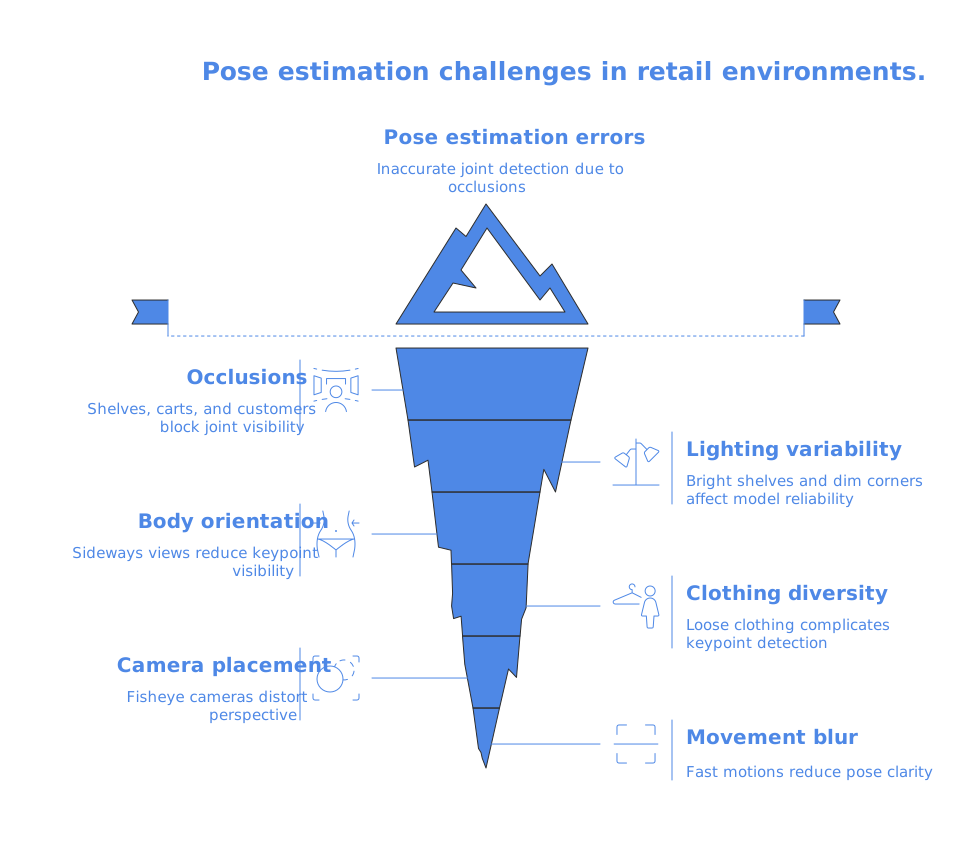
Challenges in Human Pose Estimation
Occlusions in crowded environments
Retail environments include occlusions from shelves, carts, signage, and other customers. Occlusions make it difficult to detect all joints accurately.
Lighting variability
Stores have varied lighting, including bright shelves, reflective surfaces, and dim corners. Lighting changes affect model reliability.
Body orientation
Sideways or rear facing views reduce keypoint visibility. Models must infer pose even when the body is partially hidden or rotated away from the camera.
Clothing diversity
Loose clothing, jackets, hats, and accessories create irregular silhouettes that complicate keypoint detection.
Camera placement
Ceiling mounted fisheye cameras distort perspective. Shelf edge cameras capture partial views. Models must work across multiple camera angles.
Movement blur
Fast motions such as reaching or turning create blur that reduces pose clarity, especially in lower resolution video feeds.
These challenges show why pose estimation models require robust dataset design and comprehensive annotation.
Applications of Pose Estimation in Retail AI
Shelf interaction monitoring
Pose estimation helps detect when a shopper reaches for an item, examines a product, or returns it to the shelf. This data helps retailers evaluate product engagement.
In store journey analysis
Tracking shopper posture and navigation patterns provides insights into how customers move through the store. This supports layout optimization, product placement, and zone analysis.
Queue detection and management
Pose estimation identifies standing posture, attention direction, and movement patterns that indicate queue formation. This helps stores deploy staff proactively.
Smart checkout and loss prevention
Pose estimation helps verify that actions near the checkout counter match expected behavior. It detects irregular motions, concealment gestures, or unscanned item movements.
Safety monitoring
Slip and fall detection uses pose changes to identify sudden drops or unusual postures. Early alerts support quicker response and reduce liability risks.
Staff performance analysis
Pose estimation can analyze staff tasks such as restocking, greeting customers, or performing service activities. This helps optimize workflows and reduce physical strain.
Pose estimation provides both behavioral insights and operational intelligence that can significantly improve retail performance.
Privacy and Ethical Considerations
Anonymized body representation
Pose estimation represents people only as keypoints and skeletons. This reduces privacy risks because no facial details or identity information is used.
Data minimization
Many retailers use pose data only for aggregate analytics, not for identifying individuals. This reduces regulatory risk.
Compliance with regional laws
GDPR, CCPA, and other regulations require clear disclosure about video analytics. Retailers must implement strong governance and data handling policies.
Secure data storage
Pose datasets must be encrypted, access controlled, and anonymized where possible.
Ethical deployment
Pose estimation should be used responsibly to improve customer experience and safety, not to track or profile individuals.
Privacy conscious pose estimation supports responsible innovation in retail analytics.
Future of Human Pose Estimation in Retail AI
Multicamera 3D pose estimation
Future systems will integrate ceiling cameras, shelf edge cameras, and mobile sensors to reconstruct full 3D body poses. This will improve gesture recognition and interaction analysis.
Real time pose driven alerts
Stores will use pose alerts to identify falls, overcrowding, or suspicious movements. Automated alerts improve safety and reduce response time.
Self supervised pose learning
Models will increasingly learn from unlabeled in store footage, reducing the need for expensive annotation.
Fine grained hand and finger tracking
More precise keypoint detection will improve product interaction analysis and smart checkout validation.
Integration with LLM and multimodal AI
Pose data combined with language models will enable richer behavioral insights without compromising privacy.
Pose estimation will become a core component of next generation retail intelligence systems.
Conclusion
Human pose estimation provides a powerful method for interpreting human movement, posture, and interactions in retail environments. By detecting keypoints and constructing skeletal representations, pose estimation helps stores analyze shopper behavior, monitor shelf interactions, manage queues, improve safety, and enhance operational efficiency. Building robust models requires diverse datasets, precise annotation, and strong privacy safeguards. As retail AI continues to evolve, pose estimation will play a central role in creating more intelligent, responsive, and customer centric store experiences.
If your team needs expertly annotated pose estimation datasets, keypoint labeling, skeleton tracking, or retail analytics video annotation, DataVLab can help.
We specialize in high accuracy annotation for computer vision in retail environments.
👉 Get in touch to start your project: DataVLab
What is human pose estimation in retail AI?
Human pose estimation is a computer vision technique that detects human body keypoints and maps them into a structured skeleton that describes posture, movement, and physical interactions. It enables AI systems to understand how people stand, reach, walk, turn, or interact with objects.
Why does pose estimation matter in retail AI?
Pose estimation helps retailers analyze how customers move through the store. It reveals which shelves they approach, how long they stay, which areas they visit, and how they interact with products. This information supports store layout optimization and product placement.
How does Pose estimation work?
Multi person pose estimation begins with detecting people in the frame. Within each bounding box, keypoint detection models identify the coordinates of body landmarks. They use convolutional networks or transformer based architectures to predict keypoint heatmaps.
What are the main challenges of Human pose estimation in retail AI?
Retail environments include occlusions from shelves, carts, signage, and other customers. Occlusions make it difficult to detect all joints accurately. Stores have varied lighting, including bright shelves, reflective surfaces, and dim corners.
What are the main use cases for Human pose estimation in retail AI?
Pose estimation helps detect when a shopper reaches for an item, examines a product, or returns it to the shelf. Tracking shopper posture and navigation patterns provides insights into how customers move through the store. This supports layout optimization, product placement, and zone analysis.
What is the future of Human pose estimation in retail AI?
Future systems will integrate ceiling cameras, shelf edge cameras, and mobile sensors to reconstruct full 3D body poses. This will improve gesture recognition and interaction analysis. Stores will use pose alerts to identify falls, overcrowding, or suspicious movements.