Product Classification in Inventory Management: How AI Structures SKU Data for Accurate Stock Control
.jpeg)

Product classification in inventory management refers to the process of organizing SKUs into structured categories and attribute groups that support accurate stock tracking, replenishment, and warehouse operations. This article explains how classification systems are designed, how annotated datasets support AI-driven categorization, and how taxonomy alignment improves ERP and WMS performance. It examines annotation processes, quality assurance workflows, and the challenges of managing inconsistent supplier data. Readers will also learn how product classification supports warehouse routing, demand forecasting, cycle counting, and multi-location inventory strategies. The article concludes with future directions in multimodal classification, automated data cleansing, and self-updating taxonomy systems.
- Product classification in inventory management refers to the process of organizing SKUs into structured categories and attribute groups that support accurate stock tracking, replenishment, and warehouse operations.
- This article explains how classification systems are designed, how annotated datasets support AI-driven categorization, and how taxonomy alignment improves ERP and WMS performance.
- Readers will also learn how product classification supports warehouse routing, demand forecasting, cycle counting, and multi-location inventory strategies.
- The article concludes with future directions in multimodal classification, automated data cleansing, and self-updating taxonomy systems.
Understanding Product Classification in Inventory Management
Product classification in inventory management refers to categorizing items according to structured taxonomies that support stock visibility, warehouse workflows, and supply chain operations. Unlike consumer-facing product classification, inventory classification focuses on consistency, data quality, and operational efficiency. Inventory systems need clear categories to identify stock locations, determine replenishment rules, and standardize item descriptions for forecasting. Classification accuracy is essential because inventory errors propagate through procurement, warehousing, shipping, and financial reporting. Industry guidelines from APICS emphasize how structured classification supports effective inventory management practices across supply chains.
Why Inventory Classification Matters
Accurate classification helps teams manage inventory across warehouses, distribution centers, and retail locations. Classification determines how items are stored, picked, counted, and replenished. Misclassified items increase operational costs by disrupting putaway logic, lowering picking efficiency, and generating inaccurate reorder calculations. Inventory classification provides the structure required for ERP and WMS systems to function effectively, ensuring that data remains consistent across locations and systems.
Classification vs Categorization in Inventory Systems
In inventory management, classification refers to placing items within structured hierarchies that support operational processes, while categorization refers to grouping items based on business rules or attributes. Both concepts work together to improve data organization. Classification often reflects physical storage requirements, hazard considerations, or usage frequency. Categorization may reflect cost groupings, ABC analysis, or lifecycle stages. Clear classification improves inventory planning and reduces discrepancies during cycle counting.
Components of Inventory Classification
Inventory classification systems rely on several structured elements that ensure consistency and operational relevance.
SKU Hierarchies
SKU hierarchies represent product families at multiple levels, such as department, class, subclass, and item type. These hierarchies support warehouse slotting, pick path design, and replenishment planning. SKU hierarchies must reflect operational constraints such as storage environment, weight limitations, or handling requirements. They also align with enterprise taxonomy structures to ensure consistency across procurement, sales, and financial reporting.
Inventory Attributes and Metadata
Attributes describe item characteristics such as size, weight, material, shelf life, handling requirements, and storage temperature. Attribute accuracy is essential for safe storage, compliant operations, and optimized warehouse routes. Metadata also includes identifiers such as barcodes, GTINs, EANs, and supplier IDs. Standards such as GS1 SmartSearch provide guidance on structuring product identifiers for searchability and operational consistency.
Warehouse Product Taxonomy
Warehouse product taxonomy refers to the structured set of categories used to manage storage and handling. Taxonomies may include hazardous materials zones, temperature categories, fragile goods classifications, or equipment compatibility requirements. Warehouse taxonomies influence how automated systems route items and determine resource allocation strategies.
Annotation Workflows for Inventory Classification
Annotation workflows define how product data is reviewed, labeled, and validated to support AI-driven classification models.
Multi-Modal Data Collection
Annotators review both product images and structured information such as supplier descriptions, datasheets, and ERP attributes. This multi-modal approach ensures that classification captures all relevant information. Images provide information on form factor and packaging, while datasheets provide technical specifications. Combining these sources supports more accurate classification.
Category Assignment
Annotators assign SKUs to warehouse-specific or enterprise taxonomies. They evaluate product families, physical characteristics, and handling requirements to determine correct placement. Category assignment requires familiarity with warehouse processes and inventory rules. Annotators follow detailed guidelines that define category boundaries and provide examples of similar items.
Attribute Labeling for Inventory Requirements
Attribute labeling focuses on operational needs such as weight thresholds, storage conditions, hazard levels, and packaging dimensions. Annotators interpret supplier documentation to extract accurate attribute labels. Attribute labeling supports warehouse planning, helps determine pick strategies, and ensures that storage environments comply with operational requirements.
Challenges in Inventory Classification Annotation
Inventory classification involves unique challenges due to inconsistent data, supplier variability, and warehouse constraints.
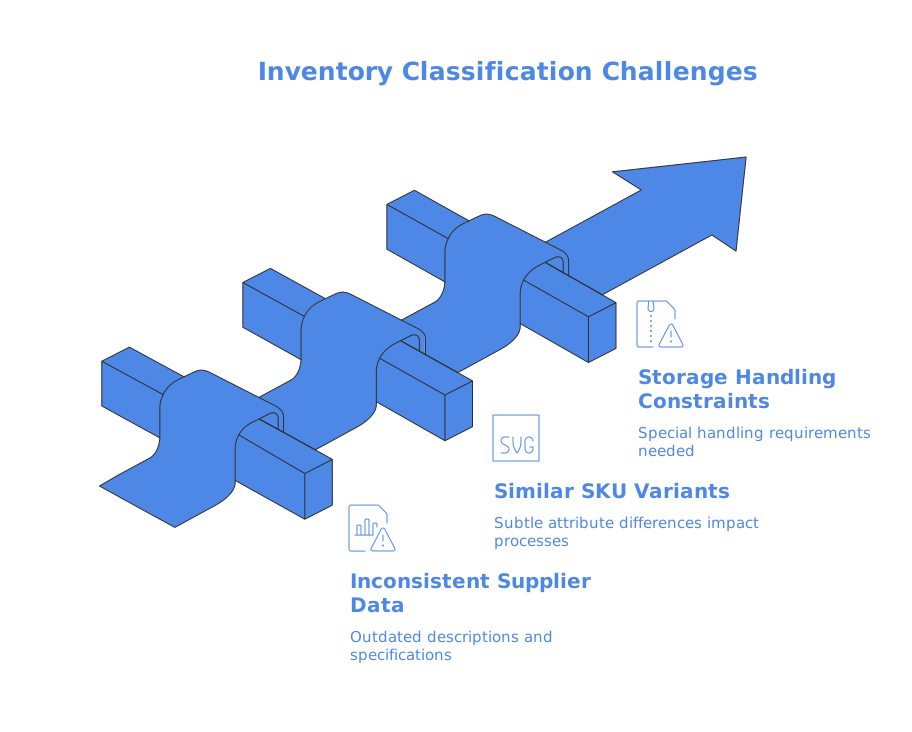
Inconsistent Supplier Data
Supplier data may include outdated descriptions, incomplete specifications, or inconsistent formatting. Annotators must interpret available information and fill gaps using guidelines. Inconsistent data is a common challenge in inventory management, especially when suppliers use different attribute standards. ISO 8000-61 provides guidance on improving master data quality and classification processes in complex environments.
Similar SKU Variants
SKUs may differ only slightly in attributes such as size, color, or packaging. These subtle differences can influence storage and picking processes. Annotators must identify which attributes determine whether items belong to distinct classifications. This challenge requires reviewing images and text together to ensure accurate classification.
Storage and Handling Constraints
Items may require special handling due to fragility, temperature sensitivity, or hazard classification. Annotators must identify these constraints from product documentation and assign correct categories. Storage constraints directly influence warehouse routing and safety protocols. Incorrect handling classification can result in damaged goods or safety risks.
Multi-Warehouse Differences
Different warehouses may follow different taxonomies or storage rules. Annotators must classify items in a way that aligns with enterprise-wide standards. Multi-warehouse complexity adds layers of variability that require ongoing taxonomy governance.
Designing Annotation Guidelines for Inventory Classification
Annotation guidelines establish consistent rules for labeling inventory data.
Defining Inventory-Specific Taxonomies
Guidelines describe each category and subcategory within the inventory taxonomy. They define how to classify items based on physical characteristics, handling rules, and storage requirements. These taxonomies align with broader supply chain definitions such as those maintained by CSCMP, which provides detailed frameworks for supply chain terminology.
Attribute Labeling Standards
Guidelines describe how annotators should interpret and assign attributes such as dimensions, materials, and packaging types. Attribute standards ensure that data remains consistent across inventory records. Standards align with structured product schemas such as those used by search engines for product representation.
Examples and Edge Case Handling
Guidelines provide examples of difficult classification cases, such as items with overlapping storage requirements or ambiguous product descriptions. Annotators use examples to make consistent judgments about classification boundaries. Edge case instructions reduce ambiguity and improve dataset quality.
Quality Assurance for Inventory Classification
Quality assurance processes verify classification consistency, attribute accuracy, and compliance with operational requirements.
Inter-Annotator Review
Reviewers compare classifications across annotators to detect inconsistencies or boundary violations. Disagreements highlight areas where guidelines require improvement. Multi-reviewer evaluation ensures that classification remains consistent across large datasets.
Attribute Validation
Quality assurance teams perform attribute consistency checks to confirm that attributes match supplier documentation and warehouse rules. Attribute accuracy is essential for preventing operational errors. Validation ensures that inventory systems use reliable data for routing and replenishment.
Taxonomy Alignment Checks
Reviewers ensure that classification aligns with enterprise taxonomies and ERP requirements. They confirm that items are placed in correct categories according to business logic. These checks support inventory visibility and system interoperability.
How Product Classification Supports Inventory Management
Product classification enhances inventory processes across warehousing, forecasting, and supply chain functions.
Improving Stock Visibility
Classification enables real-time stock visibility by organizing items into structured groups. Visibility improves forecasting accuracy and reduces stockouts. It also supports more effective reporting by highlighting performance across product families.
Optimizing Warehouse Operations
Classification determines where items are stored and how they are picked. Items with similar handling requirements may be grouped together to improve efficiency. Classification supports wave picking, zone picking, and bin allocation strategies. Accurate classification improves warehouse throughput and reduces labor costs.
Strengthening Replenishment Planning
Classification ensures that replenishment rules are applied consistently across similar items. It supports ABC analysis, safety stock calculations, and reorder point optimization. Classification provides a foundation for calculating inventory requirements accurately.
Enhancing Multi-Warehouse Logistics
Classification helps distribute inventory across warehouses based on demand patterns and storage constraints. Multi-location industrial stock accuracy depends on consistent classification across facilities. Classification supports network optimization and improves service levels.
Future Directions in Inventory Classification
Inventory classification is evolving as supply chain systems adopt advanced AI capabilities.
Self-Updating Taxonomies
Future classification systems will automatically suggest taxonomy updates based on changing inventory patterns, new SKUs, or supplier data changes. Self-updating taxonomies support scalability and reduce manual data maintenance. These systems improve responsiveness to business needs.
Automated Data Cleansing
AI models will help identify discrepancies in supplier data and suggest corrections. Automated data cleansing improves master data quality and enhances system reliability. These capabilities will reduce manual intervention and accelerate catalog onboarding.
Multimodal Classification Models
Future models will combine images, technical specifications, sensor data, and warehouse metadata to classify items more accurately. Multimodal systems improve classification in environments with incomplete or inconsistent supplier information.
If You Are Structuring Inventory Classification or Warehouse Data
Accurate product classification is essential for maintaining stock visibility, optimizing warehouse operations, and improving supply chain workflows. If you are designing classification datasets or building AI systems for inventory or warehouse environments, the DataVLab team can help develop precise, scalable, and operationally aligned annotation workflows. Share your requirements, and we can support your inventory classification initiatives with structured and high-quality data solutions.
What is Product classification in inventory management?
Product classification in inventory management refers to the process of organizing SKUs into structured categories and attribute groups that support accurate stock tracking, replenishment, and warehouse operations. This article explains how classification systems are designed, how annotated datasets support AI-driven categorization, and how taxonomy alignment improves ERP and WMS performance.
Why does inventory classification matter?
Accurate classification helps teams manage inventory across warehouses, distribution centers, and retail locations. Classification determines how items are stored, picked, counted, and replenished. Misclassified items increase operational costs by disrupting putaway logic, lowering picking efficiency, and generating inaccurate reorder calculations.
What does the section on “Annotation workflows for inventory classification” explain?
Annotation workflows define how product data is reviewed, labeled, and validated to support AI-driven classification models. Annotators review both product images and structured information such as supplier descriptions, datasheets, and ERP attributes. This multi-modal approach ensures that classification captures all relevant information.
What are the main challenges of Product classification in inventory management?
Inventory classification involves unique challenges due to inconsistent data, supplier variability, and warehouse constraints. Supplier data may include outdated descriptions, incomplete specifications, or inconsistent formatting. Annotators must interpret available information and fill gaps using guidelines.
How can teams ensure quality in Product classification in inventory management?
Quality assurance processes verify classification consistency, attribute accuracy, and compliance with operational requirements. Reviewers compare classifications across annotators to detect inconsistencies or boundary violations. Multi-reviewer evaluation ensures that classification remains consistent across large datasets.
How does Product classification support Inventory management?
Product classification enhances inventory processes across warehousing, forecasting, and supply chain functions. Classification enables real-time stock visibility by organizing items into structured groups. It also supports more effective reporting by highlighting performance across product families.