License Plate Detection and Recognition : How LPR Systems Power Smart City and Mobility AI
.jpeg)
License plate detection and recognition systems, commonly known as LPR or ANPR, have become core components of modern smart city infrastructures. They automate vehicle identification across tolling, parking management, traffic enforcement, and access control. This article explains how LPR systems work, how datasets are constructed and annotated, what deep learning architectures are used, and why high quality image labeling is essential for reliable deployment. It also explores challenges such as varied lighting, global plate formats, privacy constraints, and real world conditions. The goal is to provide a complete technical and strategic understanding of LPR for practitioners building or evaluating smart city computer vision systems.
- License plate detection and recognition systems, commonly known as LPR or ANPR, have become core components of modern smart city infrastructures.
- This article explains how LPR systems work, how datasets are constructed and annotated, what deep learning architectures are used, and why high quality image labeling is essential for reliable deployment.
- It also explores challenges such as varied lighting, global plate formats, privacy constraints, and real world conditions.
- The goal is to provide a complete technical and strategic understanding of LPR for practitioners building or evaluating smart city computer vision systems.
License plate detection and recognition, also known as LPR or ANPR, refers to the automated process of locating a vehicle’s license plate in an image and converting the plate characters into digital text. The system performs two fundamental tasks. First, detection models identify where the license plate is located on the vehicle. Second, OCR models interpret the alphanumeric sequence on the plate. Together, these models enable fast, reliable vehicle identification at scale.
LPR is widely used in traffic enforcement, parking automation, toll collection, logistics operations, and access control. As smart cities integrate more digital infrastructure, LPR systems allow authorities and operators to automate tasks that traditionally required manual verification. Research from the International Association of Transportation Regulators (IATR) emphasizes how LPR technology improves efficiency, compliance, and operational safety in mobility systems.
The reliability of LPR depends on the quality of training data, the diversity of environmental conditions captured, and the strength of annotation workflows. Urban environments present numerous challenges including glare, rain, occlusions, angled views, and plate variations. Robust datasets are essential for building models that perform consistently across these scenarios.
Why LPR Matters for Smart Cities and Mobility Systems
Traffic enforcement automation
Cities use LPR to enforce speed limits, red light signals, bus lane restrictions, and intersection rules. Automated enforcement reduces manual labor and enhances compliance. It also enables more consistent monitoring across large urban areas.
Parking and access management
Parking operators rely on LPR for gated access, ticketless entry, automated billing, and dwell time calculations. This reduces congestion at parking facilities and improves user experience. LPR also supports residential access control, loading zone management, and restricted area monitoring.
Tolling and road pricing
LPR systems enable fully automated toll booths and congestion pricing zones. Vehicles are identified instantly without requiring RFID tags or manual payment. Tolling automation increases throughput and reduces delays.
Fleet and logistics operations
Distribution centers, ports, and warehouses rely on LPR to track vehicle entry and exit. This enhances security, streamlines documentation, and automates workflows across logistics operations.
Law enforcement and public safety
LPR helps identify stolen vehicles, track vehicles linked to investigations, and monitor sensitive locations. Automated alerts allow authorities to respond quickly to potential threats.
The widespread adoption of LPR is driven by its effectiveness, scalability, and compatibility with existing camera infrastructure.
How License Plate Detection Works
Locating the plate region
The first step in LPR is detecting the location of the plate on the vehicle. Detection models analyze vehicle images and identify rectangular regions that correspond to license plates. These models rely on features such as character density, plate borders, reflectivity, and aspect ratios.
Handling angled views and perspective distortion
Urban camera networks often capture vehicles at steep angles. Detection models must handle tilt, rotation, and perspective distortion. Annotated datasets include diverse viewpoints to help models generalize across camera placements.
Managing varying plate designs
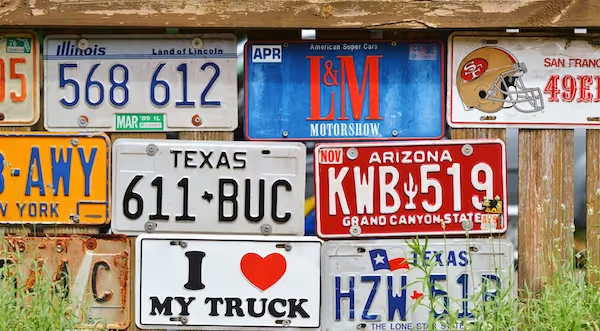
License plates vary significantly across countries and regions. Their designs include different border styles, fonts, background colors, emblem placements, and security markings. Detection models must learn to recognize these patterns reliably.
Low light and nighttime conditions
Nighttime scenes introduce challenges such as glare from headlights, reflective surfaces, and motion blur. High quality datasets include nighttime samples, infrared imagery, or long exposure captures to ensure robust performance.
Weather related issues
Rain, fog, snow, and dust obscure plate details. Detection models must learn to operate under adverse conditions by training on labeled images that reflect these scenarios.
Detection quality directly influences OCR accuracy because poorly cropped plates lead to misread characters. Annotation must therefore be precise and consistent.
How License Plate Recognition (OCR) Works
Character segmentation
After detecting the plate, many systems segment the characters before running OCR. This approach is useful for plates with consistent spacing. However, many modern models now use end to end OCR that extracts the entire sequence without segmentation.
Text recognition models
OCR models use convolutional and transformer architectures to interpret alphanumeric sequences. They must handle variations in fonts, spacing, embossing, color, and reflective materials. Models such as CRNNs and transformer based OCR architectures are widely used due to their robustness.
Handling multilingual plates
Some regions include Arabic, Cyrillic, Japanese, Hindi, Korean, or special regional characters. OCR models must be trained on character sets that represent the region where the system is deployed. This requires specialized annotation and additional dataset coverage.
Noise reduction
OCR pipelines incorporate pre processing such as deblurring, contrast adjustment, and de skewing. These steps help the model interpret characters more accurately, especially in challenging conditions.
Confidence scoring
OCR outputs often include confidence scores for each character. These scores help detect unreadable plates, low quality captures, or frames that require fallback to additional algorithms.
OCR accuracy depends heavily on annotation quality because even small labeling errors can propagate through the entire system.
Datasets Used in LPR Systems
Vehicle level images
These images include full vehicle scenes captured across various angles. Annotators draw bounding boxes around the license plates. This dataset supports the detection stage.
Plate crops
Plate crops are used directly for OCR training. They represent isolated plates with diverse backgrounds, angles, and lighting conditions.
Synthetic plate datasets
Synthetic data helps augment real world images by generating realistic variations in fonts, formats, colors, and textures. Synthetic data increases dataset diversity and reduces annotation time.
Nighttime and low light datasets
Nighttime datasets include infrared imagery or color captures under street lighting. They simulate real operational conditions for urban camera networks.
Multinational datasets
These datasets include plates from multiple regions. They are essential for building models that generalize across borders or for vendors operating in international markets.
External resources from the ITS World Congress show how public and private datasets accelerate LPR research and standardize evaluation benchmarks.
Dataset diversity is essential for capturing the complexity of real world LPR environments.
Annotation for License Plate Detection
Bounding box annotation
Annotators draw bounding boxes around the license plate region. Consistency is important because bounding box variation affects detection model training. Annotators must include the full plate without cutting off characters or capturing excessive surrounding area.
Multiple plate annotation
Some images contain more than one plate, such as trailers or dual plate configurations. Annotation workflows must account for these scenarios.
Occlusion labeling
Urban vehicles may have plates partially covered by dirt, tape, foliage, or shadows. Annotators mark occlusions to help the model learn these variations.
Angle and perspective guidelines
Annotation teams use guidelines for angled plates to ensure consistent box shapes across different viewpoints. This improves model performance in real world deployments.
Quality control
Multi layer review processes ensure annotation consistency. This reduces noise in the dataset and enhances detection reliability.
Annotation accuracy is critical because detection errors will cascade into OCR performance issues.
Annotation for License Plate Recognition (OCR)
Character level transcription
Annotators transcribe the exact alphanumeric sequence displayed on the plate. This requires strict accuracy because a single incorrect character can mislead OCR models.
Special character and symbol labeling
Some plates include symbols, regional marks, or dual line formats. Annotation teams follow guidelines to represent these symbols consistently.
Segmentation labeling when required
If the system uses segmented OCR, annotators draw boxes around individual characters. This is time consuming but useful for some model architectures.
Handling regional differences
Different regions use varying encoding schemes. Annotators must follow regional conventions for representing characters and sequences.
Verification and review
Every plate transcription undergoes multi reviewer verification to avoid transcription errors. OCR datasets require extremely high precision.
OCR annotation is one of the most demanding workflows in computer vision due to the need for absolute accuracy.
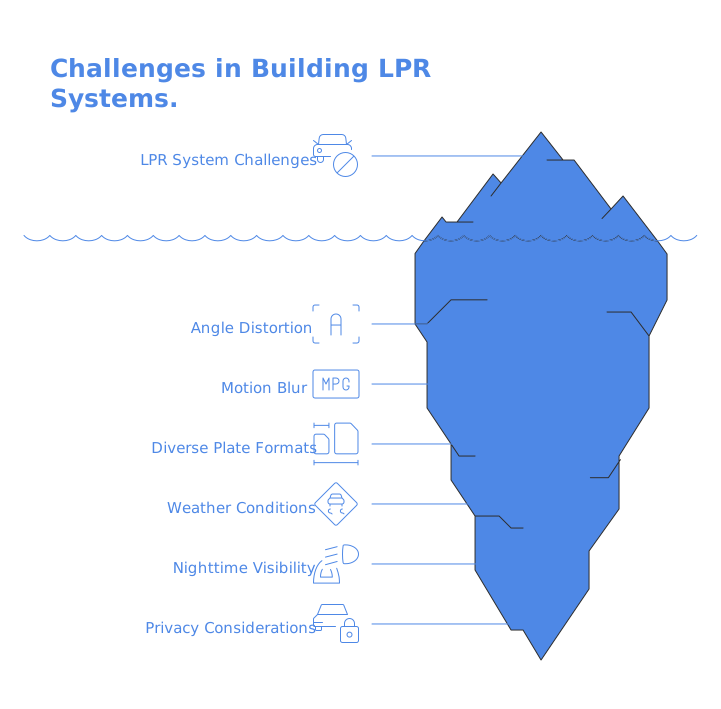
Challenges in Building LPR Systems
Angle distortion
Plates captured from high angles appear distorted. Perspective correction helps but requires strong detection models and well annotated datasets.
Motion blur
Vehicles traveling at high speed create blurring, especially in low light conditions. Models require training on blurred samples to maintain reliability.
Diverse plate formats
Global license plates differ in color, layout, font, and ornamentation. Models must learn this variability. Region specific models often outperform universal models due to reduced variability.
Weather conditions
Fog, rain, snow, and dust obscure plates. This creates challenges for both detection and OCR. Multisensor approaches, such as combining infrared and visible imagery, improve performance.
Nighttime visibility
Nighttime scenes include glare from headlights or reflections on glossy plate materials. These conditions require specialized annotation and additional pre processing.
Privacy and regulatory considerations
LPR systems capture sensitive data. Deployments must comply with regional privacy laws including GDPR. Data governance frameworks must ensure transparency, secure storage, and ethical use.
These challenges highlight the importance of dataset design and robust training methodologies.
Real World Applications of LPR
Traffic law enforcement
Automated enforcement identifies speeding, illegal turns, lane violations, and red light infractions. By integrating detection with timestamped scene metadata, LPR systems support evidence based enforcement.
Urban access management
Cities implement low emission zones, congestion pricing, and restricted access areas. LPR automates entry decisions and monitors violations.
Parking automation
Parking systems rely on LPR for cashless entry, frictionless exit, and dynamic billing. This improves throughput and reduces queues.
Industrial and security operations
Facilities use LPR to authorize employee vehicles, track deliveries, and monitor high security areas. Automated systems reduce manual checks and enhance operational visibility.
Logistics and fleet management
Distribution centers use LPR to automate gate operations and log fleet movement. This accelerates processing times and reduces administrative overhead.
Research from the Trafikverket Swedish Transport Administration demonstrates how LPR based enforcement reduces road congestion and improves compliance.
These applications make LPR one of the most commercially valuable computer vision technologies used in urban environments.
Integrating LPR with Smart City Systems
Traffic management platforms
LPR integrates with traffic control systems to enhance data accuracy. Vehicle identification allows cities to analyze commuting patterns and optimize signal schedules.
Public safety systems
LPR supports rapid identification of suspicious or stolen vehicles. Integration with police databases improves emergency response.
Parking systems
LPR adds real time occupancy data to parking management platforms. This enables dynamic pricing and congestion reduction.
Logistics automation
Integrating LPR with supply chain systems helps operators automate delivery workflows and track shipments more efficiently.
Revenue collection
LPR increases revenue accuracy for tolling, parking, and congestion pricing systems. Automated billing reduces disputes and administrative work.
Integrated systems enhance the value of LPR by combining it with broader smart city analytics.
Future of License Plate Recognition
Transformer based OCR
Transformers provide higher accuracy for complex fonts, curved plates, and multilingual sequences. Future OCR models will likely rely heavily on transformer architectures.
Multimodal LPR systems
Combining optical cameras with thermal or infrared sensors helps mitigate lighting issues and improves nighttime reliability.
Self supervised datasets
Models will increasingly learn from unlabeled video streams. This reduces dependency on expensive, manually labeled datasets.
On camera LPR
Edge computing advancements enable on device processing. This reduces bandwidth requirements and improves real time performance.
Privacy preserving LPR
Techniques such as federated learning, edge anonymization, and encrypted inference help balance utility with privacy.
These innovations will strengthen the role of LPR in smart city ecosystems and mobility platforms.
Conclusion
License plate detection and recognition systems are essential for modern smart city infrastructure, enabling accurate, automated vehicle identification across many domains. Building effective LPR models requires robust datasets, precise annotation, and sophisticated neural architectures that can handle diverse environmental and regional conditions. By understanding how detection and OCR pipelines work, organizations can deploy reliable solutions that enhance transportation management, urban mobility, public safety, and operational efficiency. As smart cities continue to evolve, LPR will remain one of the most valuable and widely deployed computer vision technologies.
If your organization needs expert dataset creation, annotation, or QA for LPR, OCR, or vehicle detection systems, DataVLab can help.
We specialize in high precision labeling for complex smart city applications.
👉 Contact us at DataVLab
What is License plate detection and recognition?
License plate detection and recognition systems, commonly known as LPR or ANPR, have become core components of modern smart city infrastructures. They automate vehicle identification across tolling, parking management, traffic enforcement, and access control. This article explains how LPR systems work, how datasets are constructed and annotated, what deep learning architectures are used, and why high quality image labeling is essential for reliable deployment.
Why does LPR matter for smart cities and mobility systems?
Cities use LPR to enforce speed limits, red light signals, bus lane restrictions, and intersection rules. Automated enforcement reduces manual labor and enhances compliance. It also enables more consistent monitoring across large urban areas.
How does License plate detection work?
The first step in LPR is detecting the location of the plate on the vehicle. Detection models analyze vehicle images and identify rectangular regions that correspond to license plates. These models rely on features such as character density, plate borders, reflectivity, and aspect ratios.
What are the main challenges of License plate detection and recognition?
Perspective correction helps but requires strong detection models and well annotated datasets. Vehicles traveling at high speed create blurring, especially in low light conditions. Models require training on blurred samples to maintain reliability.
What are the main use cases for License plate detection and recognition?
Automated enforcement identifies speeding, illegal turns, lane violations, and red light infractions. By integrating detection with timestamped scene metadata, LPR systems support evidence based enforcement. Cities implement low emission zones, congestion pricing, and restricted access areas.
What is the future of License plate detection and recognition?
Transformers provide higher accuracy for complex fonts, curved plates, and multilingual sequences. Future OCR models will likely rely heavily on transformer architectures. Combining optical cameras with thermal or infrared sensors helps mitigate lighting issues and improves nighttime reliability.