How Annotated Data Powers Augmented Reality Shopping Experiences
.jpeg)
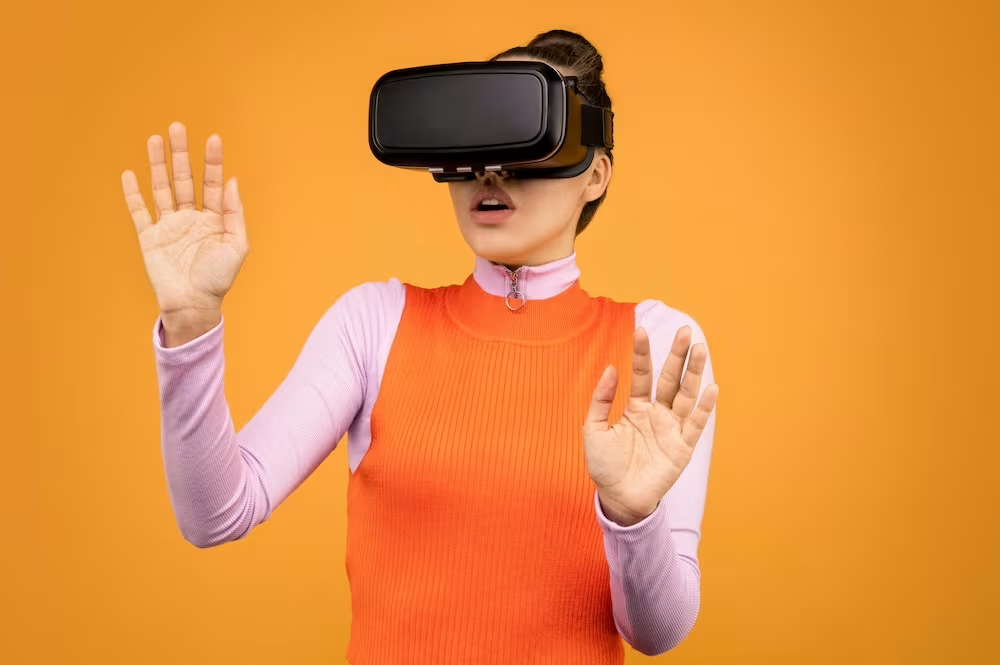
Augmented Reality (AR) is transforming how we shop—bringing products to life before a single purchase is made. But behind this cutting-edge technology lies a critical element that often goes unnoticed: annotated data. This article dives deep into how annotated datasets are the backbone of successful AR applications in retail. We explore real-world use cases, explain how data labeling enables lifelike AR experiences, and offer insights into challenges and future trends. Whether you're a retailer, developer, or data specialist, this guide will give you a comprehensive look at the intersection of AR and data annotation in commerce.
- Augmented Reality (AR) is transforming how we shop—bringing products to life before a single purchase is made.
- But behind this cutting-edge technology lies a critical element that often goes unnoticed: annotated data.
- This article dives deep into how annotated datasets are the backbone of successful AR applications in retail.
- We explore real-world use cases, explain how data labeling enables lifelike AR experiences, and offer insights into challenges and future trends.
Augmented Reality in Retail: A Quick Glance
Imagine pointing your phone at your living room and seeing how a new sofa fits. Or virtually trying on sunglasses to see which style suits you—all in real time. That’s the magic of AR shopping. According to a 2023 report by Statista, the AR retail market is projected to reach over $12 billion by 2026, driven by consumer demand for personalization and convenience.
What makes these experiences seamless and visually realistic isn’t just the AR engine—it’s the quality of annotated data feeding it.
🔍 Why Annotated Data Is the Hidden Powerhouse Behind AR Shopping
AR shopping apps rely heavily on computer vision, object detection, and real-world spatial understanding. Annotated data plays a pivotal role in:
- Recognizing real-world objects: Furniture, faces, clothing, and spaces are identified thanks to labeled datasets.
- Anchoring virtual objects: For accurate placement in a real environment, annotations help define physical boundaries and surfaces.
- Tracking movement: User gestures, rotations, and camera angles must be interpreted through annotated motion datasets.
- Rendering textures and scale: Annotation guides the AR model to maintain consistent size and resolution across devices and environments.
Without a high-quality dataset, AR interactions become clunky, inaccurate, or simply unusable.
✨ The Core AR Experiences Enhanced by Annotated Data
Virtual Try-Ons (Clothes, Accessories, Makeup)
When shoppers try on clothes or beauty products virtually, the AR model must recognize body landmarks such as facial contours, eyes, shoulders, and arms. Annotated images with precise keypoints and segmentation outlines allow the AR system to:
- Detect body parts accurately, even across different skin tones and lighting.
- Overlay virtual garments or makeup with realistic shading.
- Adjust dynamically to body movement.
L’Oréal’s AR app and Sephora's Virtual Artist both rely on robust annotated datasets for these immersive experiences.
🧠 Pro insight: These datasets are often enhanced with 3D keypoint data and depth information to improve occlusion realism—like lipstick not spilling outside lips or earrings following head turns.
Virtual Furniture Placement
For home decor or furniture retail, AR must identify the floor plane, walls, lighting, and room layout. Datasets used here are annotated for:
- Surface detection (planes, edges)
- Object recognition (tables, rugs, etc.)
- Spatial depth (distance and occlusion)
Apps like IKEA Place or Wayfair’s AR feature use this to allow you to visualize a couch exactly where you’d place it—true to scale and lighting.
Product Preview and Customization
Want to see how a sneaker would look in blue suede vs. red leather? Annotated datasets help drive:
- Accurate texture mapping
- Material recognition and substitution
- Real-time color and lighting adaptation
By labeling objects and materials in training datasets, the AR engine can change styles, colors, or finishes dynamically without rendering inconsistencies.
Interactive Product Demos
High-ticket items like electronics, kitchen appliances, or luxury goods often include interactive demos through AR. Annotation allows these to:
- Open/close parts virtually (e.g., fridge doors)
- Show layers of a product (e.g., cross-sections)
- Simulate usage scenarios (e.g., heat emission or battery usage)
This is enabled through detailed 3D models aligned with annotated 2D imagery, ensuring consistency and realism across devices.
From Pixels to AR: The Journey of Annotated Data
Let’s follow the lifecycle:
- Raw data collection – Retailers gather thousands of product images, customer photos, or in-store videos.
- Annotation – These are manually or semi-automatically labeled: bounding boxes, segmentation masks, keypoints, 3D depth data, or skeleton tracking.
- Model training – AR engines use these datasets to train models capable of recognizing patterns, surfaces, and interactions.
- Validation – Annotated validation sets ensure the model performs under real-world variations: different skin tones, lighting, camera angles.
- Deployment & feedback – As AR apps go live, user behavior generates new data for refinement.
📌 A continuous feedback loop between annotated data and user experience improves model accuracy over time.
Challenges of Building AR Experiences Without Accurate Annotations
Despite growing enthusiasm for AR commerce, many retailers stumble when it comes to training data quality.
Inaccurate Object Boundaries
In retail settings, misaligned bounding boxes can lead to virtual items floating awkwardly off the user’s body or out of scale.
Diversity and Inclusion
If training datasets lack diversity—skin tones, body shapes, lighting conditions—the AR model underperforms for large segments of users. Inclusive annotation practices are critical.
Dynamic Environments
A room’s lighting changes across the day. People move. Clothing wrinkles. Annotated data needs to cover these edge cases to maintain realism.
Real-time Performance vs. Dataset Complexity
Highly detailed annotations (like pixel-perfect segmentation or 3D skeletons) offer better accuracy but can slow down performance. It’s a balancing act between speed and realism.
📈 Real-World AR Shopping Use Cases Powered by Annotation
ASOS Virtual Catwalk
Using annotated human pose datasets and 3D models, ASOS enables users to watch a model walk down their own street wearing the clothes—through their phone camera.
Warby Parker's Virtual Eyeglass Try-On
By training models with annotated facial landmark data, Warby Parker’s AR app adapts glasses to different face sizes, widths, and even lighting reflections.
Nike Fit
Nike uses annotated foot scans and real-time data to recommend shoe sizes via AR. Bounding boxes and keypoint-based annotation help assess width, length, and arch type.
Walmart’s AR Home Design
With plane detection and annotated depth data, users can place, resize, and rearrange home items with centimeter-level precision.
Behind the Scenes: Who’s Doing the Annotating?
Building world-class AR experiences depends on the quality of annotation pipelines. Here's what happens backstage:
- In-house annotation teams – Some major retailers hire internal teams to manage sensitive datasets.
- Specialized annotation companies – Outsourced partners like DataVLab provide high-accuracy annotation tailored to computer vision applications.
- Synthetic datasets – Some Retailers use tools like NVIDIA Omniverse to simulate realistic environments and generate auto-labeled data.
- QA and validation – A second pass of annotation ensures consistency and accuracy, especially for segmentation and keypoints.
Many organizations adopt hybrid models, combining manual annotation, AI-assisted tools, and rigorous QA to meet retail-grade quality.
🤖 Emerging Trends in AR Shopping and Annotation
Real-Time AR with Edge AI
As AR moves onto wearables and mobile AR glasses, there’s a shift to edge inference, where models are processed on-device. This demands lighter models trained with annotated data optimized for real-time use.
3D and Volumetric Annotation
New annotation standards are emerging to handle 3D datasets, allowing better product rotation, occlusion handling, and spatial realism. Companies like Scale AI and Deepen AI are exploring volumetric annotation formats for AR/VR applications.
AR + Generative AI
Tools like OpenAI’s Sora or NVIDIA’s StyleGAN could generate custom backgrounds or model behaviors—but still need labeled real-world data to align with user reality. Think of it as “annotated grounding” for generative realism.
Inclusive AI and AR Ethics
Major brands are prioritizing ethical datasets—ensuring fair representation across age, ethnicity, body size, and disability status. Annotation pipelines are being revised to reduce bias and improve inclusion.
🔮 What the Future Holds: AR Shopping as the New Norm
In the next 3–5 years, experts predict AR will move from novelty to necessity in e-commerce. Annotated data will continue to be the foundation enabling:
- Hyper-personalized recommendations
- Cross-platform consistency (mobile, tablet, smart glasses)
- Voice + AR integration (hands-free shopping)
- Haptic feedback for tactile simulations
As new modalities like eye tracking and gesture-based interactions emerge, annotation strategies must evolve too—labeling gaze direction, micro-gestures, or even emotional responses.
Ready to Elevate Your AR Shopping Experience? Here’s Your Next Step 🚀
If you're building an AR application—or thinking about it—the secret to success lies in your data. High-quality annotation fuels every engaging, intuitive, and personalized AR interaction your customers will love.
👋 At DataVLab, we specialize in crafting precise, scalable annotation pipelines tailored for AR retail use cases. Whether you're launching a try-on app, furniture visualizer, or virtual showroom, we can help you build the dataset that drives it.
Let’s bring your retail vision to life—pixel by pixel.
→ Get in touch with our team and see how annotated data can power your next-gen AR commerce.
How does Annotated data power Augmented reality shopping experiences?
Augmented Reality (AR) is transforming how we shop—bringing products to life before a single purchase is made. But behind this cutting-edge technology lies a critical element that often goes unnoticed: annotated data. This article dives deep into how annotated datasets are the backbone of successful AR applications in retail.
Why is Annotated data the hidden powerhouse behind AR shopping?
AR shopping apps rely heavily on computer vision, object detection, and real-world spatial understanding. Recognizing real-world objects: Furniture, faces, clothing, and spaces are identified thanks to labeled datasets. Anchoring virtual objects: For accurate placement in a real environment, annotations help define physical boundaries and surfaces.
What are the main challenges of this topic?
Despite growing enthusiasm for AR commerce, many retailers stumble when it comes to training data quality. In retail settings, misaligned bounding boxes can lead to virtual items floating awkwardly off the user’s body or out of scale.
Who’s doing the annotating?
Building world-class AR experiences depends on the quality of annotation pipelines. In-house annotation teams – Some major retailers hire internal teams to manage sensitive datasets. Synthetic datasets – Some Retailers use tools like NVIDIA Omniverse to simulate realistic environments and generate auto-labeled data.
What is the future of this topic?
As AR moves onto wearables and mobile AR glasses, there’s a shift to edge inference, where models are processed on-device. This demands lighter models trained with annotated data optimized for real-time use. New annotation standards are emerging to handle 3D datasets, allowing better product rotation, occlusion handling, and spatial realism.
What does the future hold?
In the next 3–5 years, experts predict AR will move from novelty to necessity in e-commerce. As new modalities like eye tracking and gesture-based interactions emerge, annotation strategies must evolve too—labeling gaze direction, micro-gestures, or even emotional responses.