Data Annotation Statistics 2026: Label Quality, Effort and the EU AI Act

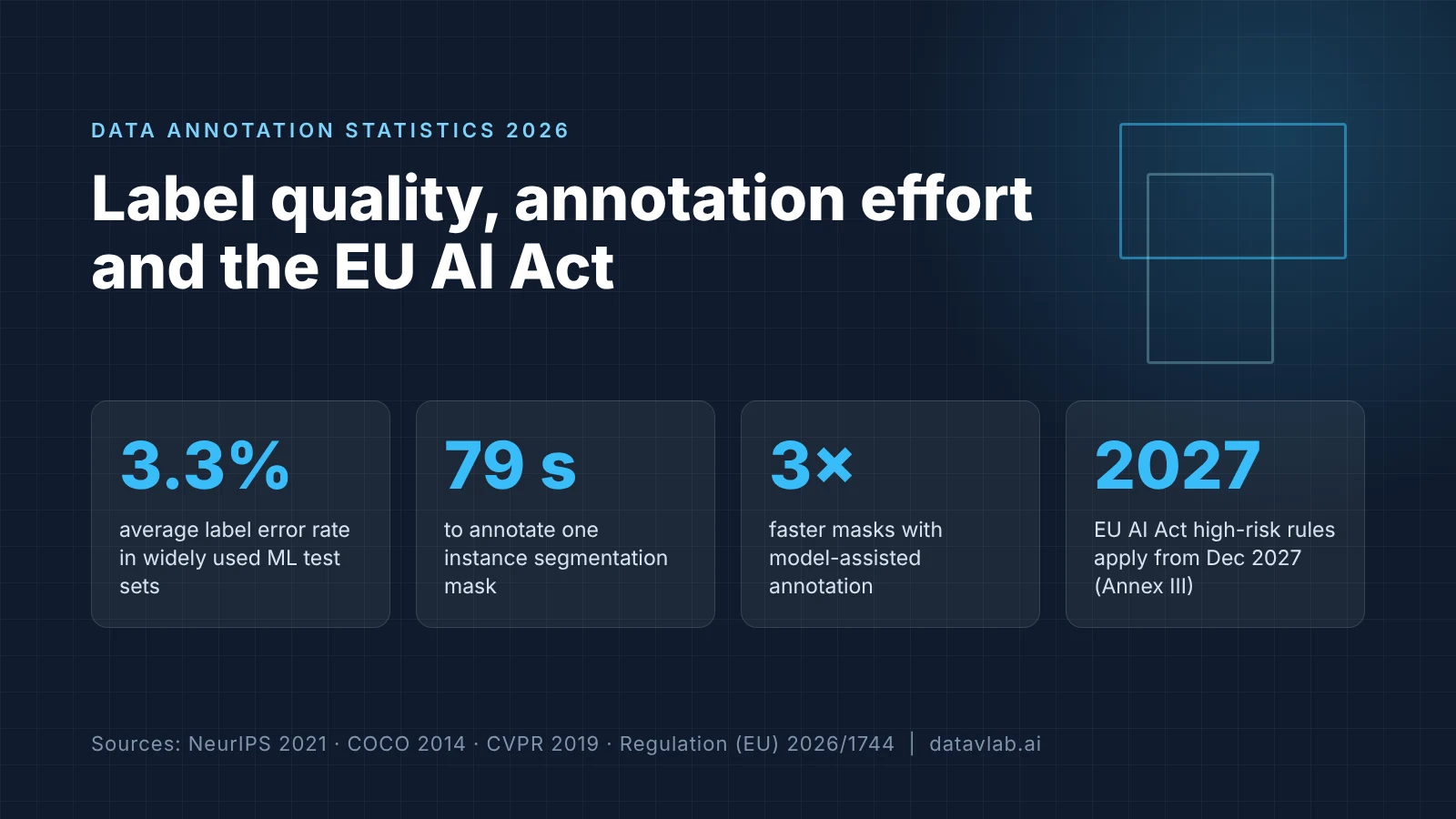
Verified, sourced figures on data annotation: how often labels are wrong, how long boxes, masks and segmentation take, what speeds annotation up, and what the EU AI Act requires of training data.
- At least 3.3% of labels are wrong on average across 10 widely used ML test sets, and at least 6% of the ImageNet validation set is mislabeled.
- A traditional bounding box takes about 35 seconds, an instance segmentation mask about 79 seconds, and full pixel-level annotation of a street scene over 1.5 hours per image.
- Model-assisted segmentation produces masks about 3 times faster than manual polygon drawing.
- EU AI Act Article 10 requires high-risk training data to be relevant, representative and as free of errors as possible; high-risk obligations apply from 2 December 2027 (Annex III) and 2 August 2028 (Annex I).
This page collects verified, sourced figures on data annotation: how often labels are wrong, how long different annotation types take, what speeds the work up, and what the EU AI Act now requires of training data. Every figure links to its original source. Figures are industry statistics, not DataVLab rates.
Label errors are common, even in benchmark datasets
At least 3.3% of labels are wrong on average across 10 of the most widely used machine learning test sets. The study covered computer vision, text and audio datasets.
At least 6% of the ImageNet validation set is mislabeled. ImageNet is one of the most cited benchmarks in computer vision.
Label quality can change which model wins
On corrected labels, ResNet-18 outperforms ResNet-50 once the share of originally mislabeled test examples rises by just 6%. In other words, a smaller model can look worse than a larger one only because the test labels are noisy.
The practical consequence: teams that choose models on unvalidated test data can pick the wrong one. Human validation of evaluation sets is as important as validation of training data.
Source: Northcutt et al., NeurIPS 2021.
How long annotation takes, by type
A high-quality bounding box takes about 35 seconds to draw the traditional way. With an optimised method called extreme clicking, the same box takes about 7 seconds, five times faster (Papadopoulos et al., ICCV 2017).
An instance segmentation mask takes about 79 seconds per object. Building the COCO dataset required over 22 worker hours per 1,000 segmentations (Lin et al., Microsoft COCO, 2014). That is more than twice the time of a traditionally drawn box, and over ten times an optimised one.
Full pixel-level annotation of a street scene takes more than 1.5 hours per image, including quality control. Coarse annotation of the same scenes took under 7 minutes per image, more than 12 times faster (Cordts et al., The Cityscapes Dataset, CVPR 2016).
The takeaway for project planning: the annotation type, not the number of images, drives effort. The same 10,000 images can represent a few days or several months of work depending on whether they need boxes, masks or dense segmentation. Our guide to data annotation pricing explains how this translates into cost.
Where the time goes, and what speeds it up
Data professionals spend about 38% of their time on data preparation and cleansing, according to a survey of 3,493 respondents in 133 countries (Anaconda, State of Data Science 2022).
Model-assisted segmentation produces masks about 3 times faster than manual polygon drawing: around 34 seconds per object versus an estimated 108 seconds for polygons, measured over 2.5 million masks (Benenson, Popov and Ferrari, "Large-scale interactive object segmentation with human annotators", CVPR 2019). Estimates of manual polygon time vary between studies, from about 79 to 108 seconds per object, depending on object complexity.
This is why modern annotation pipelines combine automated pre-annotation with human correction and validation: the model does the first pass, and people focus on the judgement calls and errors that models miss.
What the EU AI Act requires of training data
Article 10 of the EU AI Act requires training, validation and testing datasets for high-risk AI systems to be "relevant, sufficiently representative, and to the best extent possible, free of errors and complete in view of the intended purpose".
The article explicitly names "annotation, labelling" among the data-preparation operations that must be covered by appropriate data governance practices. Providers must also examine datasets for possible biases and take measures to detect, prevent and mitigate them, and identify data gaps that prevent compliance.
Source: European Commission AI Act Service Desk, Article 10. For a practical walkthrough, see our EU AI Act compliance checklist for AI teams.
When the high-risk obligations apply
High-risk AI systems listed in Annex III must comply from 2 December 2027. High-risk AI embedded in products covered by EU product legislation (Annex I) must comply from 2 August 2028.
These dates were set by the Digital Omnibus on AI, Regulation (EU) 2026/1744, published in the Official Journal on 24 July 2026 and in force since 27 July 2026. They replace the original dates of August 2026 and August 2027. Teams building high-risk systems now have a defined window to put compliant data practices in place, including documented annotation and quality control.
Source: Regulation (EU) 2026/1744 publication summary; background on the agreement: Gibson Dunn.
How to cite this page
You are welcome to use any figure on this page. Please cite the original source linked next to it, and this page as: DataVLab, "Data Annotation Statistics 2026", https://datavlab.ai/post/data-annotation-statistics.
Turning these figures into a reliable dataset
DataVLab provides data annotation services for teams in regulated industries, combining automated pre-annotation with expert human validation. We are ISO 27001 certified and GDPR- and HIPAA-compliant. To learn more about the basics, read What Is Data Annotation?, or contact us to discuss your project.
How common are label errors in machine learning datasets?
A NeurIPS 2021 study by Northcutt et al. estimated an average of at least 3.3% label errors across 10 widely used test sets, and at least 6% of the ImageNet validation set is mislabeled.
How long does it take to draw a bounding box?
About 35 seconds for a high-quality box drawn the traditional way, and about 7 seconds with the extreme clicking method (Papadopoulos et al., ICCV 2017).
How long does image segmentation annotation take?
An instance segmentation mask takes roughly 79 seconds per object based on COCO (22+ worker hours per 1,000 masks). Full pixel-level annotation of a complex street scene took more than 1.5 hours per image in Cityscapes.
Does pre-annotation make labeling faster?
Yes. Model-assisted segmentation produced masks about 3 times faster than manual polygon drawing in a study of 2.5 million masks (Benenson et al., CVPR 2019). Human review remains necessary to catch model errors.
What does the EU AI Act say about training data annotation?
Article 10 requires datasets for high-risk AI systems to be relevant, sufficiently representative and, to the best extent possible, free of errors and complete. It explicitly lists annotation and labelling among data-preparation operations that need appropriate governance.
When do EU AI Act high-risk obligations apply?
From 2 December 2027 for Annex III high-risk systems and 2 August 2028 for Annex I systems, under the Digital Omnibus on AI (Regulation (EU) 2026/1744).