Annotation QA Protocols: Peer Review, QA Leads, and Audit Workflows Explained
.jpeg)

Quality assurance (QA) in data annotation is the backbone of successful machine learning outcomes. Whether you're building computer vision models, training OCR systems, or deploying AI for autonomous driving, poor data quality can cripple your performance. This in-depth guide explores how to build and scale effective QA workflows—including peer review protocols, the role of QA leads, and audit strategies—to ensure your annotated data is as accurate, consistent, and usable as possible.
- Quality assurance (QA) in data annotation is the backbone of successful machine learning outcomes.
- Annotated data forms the foundation for supervised machine learning, but annotation errors—like label noise, inconsistency, or incomplete objects—can severely impact model accuracy.
- In regulated or high-risk industries like Healthcare, autonomous systems, or finance, the consequences of poor annotation quality are even more pronounced.
- Increased volume and velocity: Scaling QA for high-speed annotation (e.g., Autonomous Driving, surveillance feeds) requires real-time or near-real-time review systems.
Why Annotation QA Protocols Matter More Than Ever
Artificial intelligence is only as good as the data it learns from. Annotated data forms the foundation for supervised machine learning, but annotation errors—like label noise, inconsistency, or incomplete objects—can severely impact model accuracy. In regulated or high-risk industries like Healthcare, autonomous systems, or finance, the consequences of poor annotation quality are even more pronounced.
This is why robust QA protocols are not a luxury—they are essential. Done right, annotation QA ensures:
- High data integrity and model performance
- Trust in AI predictions for critical tasks
- Regulatory compliance in domains like healthcare and finance
- Cost savings by avoiding rework or model retraining
- Scalable workflows as datasets grow larger and more complex
From peer-based review systems to dedicated QA teams, annotation QA is your insurance policy against bad data.
Building Blocks of Annotation QA: What a Strong Protocol Looks Like 🔍
At the heart of annotation QA lie three critical components:
- Peer Review
- QA Lead Oversight
- Audit Workflows
Each adds a layer of quality control, while also creating a culture of accountability and transparency among annotators. Let’s explore each in depth.
Peer Review in Annotation: Why Humans Still Beat Algorithms (Sometimes)
Peer review is the frontline of QA. It’s the practice of having annotators review each other’s work before final submission. This process offers several key benefits:
- Identifies errors early before they are sent to the client or used for model training
- Encourages mutual learning, as annotators can observe different labeling decisions
- Creates a collaborative feedback loop, especially useful when annotation guidelines evolve
- Reduces the cognitive load on QA leads, allowing them to focus on high-level pattern detection
How to Implement Peer Review Effectively
To avoid peer review turning into a bottleneck or inconsistent mess, a few rules must be followed:
- Pair annotators with similar experience levels to ensure balanced reviews
- Use review checklists tied to project guidelines (e.g., bounding box tightness, class accuracy, metadata completeness)
- Set thresholds for rejection and correction (e.g., any task with over 10% error must be flagged)
- Track peer review metrics such as reviewer agreement rate, correction rate, and false acceptances
Many teams use platforms like Labelbox, SuperAnnotate, or internal dashboards to automate reviewer assignment and feedback loops.
The Role of a QA Lead: Guardians of Data Quality 🛡️
QA Leads are experienced annotators (or domain experts) responsible for enforcing consistency, reviewing edge cases, and training the rest of the team. They act as both supervisors and arbitrators in the annotation QA lifecycle.
Core Responsibilities of a QA Lead
- Approve or reject annotations escalated from peer review
- Create escalation pipelines for ambiguous or complex edge cases
- Continuously update and communicate annotation guidelines
- Host regular feedback sessions and 1:1s with annotators
- Spot quality trends through annotation statistics and tool analytics
A great QA lead isn’t just good at spotting mistakes—they are educators, project managers, and process designers rolled into one.
Metrics QA Leads Should Monitor
To keep quality consistent, QA leads typically track:
- Annotation accuracy (vs. gold standard)
- Inter-annotator agreement (IAA)
- Review cycle times
- Escalation rate and resolution time
- Annotator-level performance over time
These indicators are vital to improve throughput without sacrificing quality.
QA Audit Workflows: Your Safety Net Against Systemic Errors
Even the best peer reviews and leads can miss things. That’s where audits come in—structured evaluations that randomly sample or target subsets of annotated data for deeper inspection. Audits help answer the big question: Is your dataset trustworthy?
Types of Annotation Audits
There’s no one-size-fits-all approach to audits, but the most common methods include:
- Random Sampling Audits: Periodically review a percentage (e.g., 5%) of tasks chosen at random
- Targeted Audits: Focus on tasks with higher error rates, edge cases, or recently onboarded annotators
- Blind Re-annotation: Have a new annotator label the same data without seeing prior labels, then compare results
- Model Feedback Audits: Use model predictions to identify possible annotation errors or outliers
Best Practices for QA Audits
- Define pass/fail thresholds per project (e.g., ≥95% match with gold standard)
- Log all audit findings and tie them back to individual annotators and reviewers
- Analyze error patterns to refine instructions or tooling
- Audit across all classes, not just the frequent ones
- Schedule audits regularly, not only when problems arise
Audit results should always feed back into training materials and QA lead reports. This ensures the annotation loop remains continuous and self-improving.
Creating a Culture of Quality: Training, Feedback, and Communication 🗣️
QA is not just about rules and protocols. It’s also about culture. Teams that deliver consistent, high-quality annotations are those that embed QA into every layer of their operation.
Here’s how to foster that culture:
- Onboard with precision: Use real-world examples, gold-standard walkthroughs, and shadow tasks
- Document everything: Version-controlled guidelines, change logs, FAQ boards
- Normalize feedback: Peer-to-peer, upward to QA leads, and downward from audits
- Recognize excellence: Reward top reviewers and most improved annotators
- Create shared definitions: Ambiguity kills quality—make sure everyone is aligned on terms and goals
Investing in your team’s growth pays compounding dividends in long-term data quality.
What Happens When QA Goes Wrong? (And How to Fix It)
Even with the most well-designed annotation systems, things can—and often do—go wrong. Whether due to miscommunication, poor tooling, unclear guidelines, or a breakdown in feedback loops, annotation quality can slip. And when it does, it doesn’t just affect your training dataset—it ripples across your models, your deliverables, and ultimately, your credibility.
Signs That QA Is Failing
Some red flags to watch for include:
- Model performance declines after dataset updates: A sudden dip in accuracy, precision, or recall metrics may stem from poor labeling in the latest dataset batch.
- Increased client rejections or revisions: If your clients or domain experts are returning deliverables with extensive comments or corrections, that’s a clear signal.
- Low inter-annotator agreement (IAA): This means annotators are labeling the same data differently—a sign of inconsistency or ambiguous instructions.
- Annotation velocity without control: Fast labeling speeds without matching QA capacity often lead to volume over quality.
- Reviewer fatigue or burnout: QA reviewers rushing through checklists or missing errors may be overwhelmed or under-supported.
These issues don’t just affect quality—they erode trust across your teams and with stakeholders. The good news? They can all be addressed.
How to Fix Annotation QA Breakdowns
Here’s how to diagnose and solve the most common QA pitfalls:
1. Revisit and Simplify Guidelines
When annotators interpret the same instructions differently, it’s often a sign that the guidelines are too vague or too complex. Use real annotated examples—both good and bad—to clarify edge cases, class boundaries, or annotation criteria.
🛠 Solution: Create visual guides or short videos for complex tasks. Use annotation checklists to reduce interpretation errors.
2. Create a Feedback Loop That Actually Works
A feedback system should not be a top-down hammer. When QA reviewers flag errors, the goal is to coach—not just correct. Review results must be transparently shared with annotators and used for performance improvement.
🛠 Solution: Hold regular review debriefs. Allow annotators to challenge QA feedback with justifications and documented evidence.
3. Check for QA Process Fatigue
If reviewers are making errors too, the issue may lie in the workload, not the workforce. Too much pressure to review quickly will compromise depth and accuracy.
🛠 Solution: Introduce rotating QA roles, mandatory breaks, and tiered sampling (e.g., prioritize high-risk samples over random review of everything).
4. Audit the Auditors
Even QA leads need quality control. Are they consistent? Are they logging decisions? Are they coaching or just policing?
🛠 Solution: Occasionally re-audit a sample of already-reviewed tasks. Include QA leads in calibration sessions and let them be reviewed anonymously too.
5. Upgrade Your QA Tech Stack
Manual QA via spreadsheets or screenshots doesn't scale. Look for annotation platforms with built-in QA workflows, change tracking, version history, and metrics dashboards.
🛠 Solution: Explore tools like Label Studio, Kili Technology, or V7 Labs that provide visual QA, task assignment automation, and reviewer analytics.
6. Embrace Proactive Error Detection
Don’t wait for clients or models to tell you something is wrong. Use model feedback, automated validation scripts, or heuristic checks to catch issues early.
🛠 Solution: Incorporate label consistency checks (e.g., no overlapping polygons for exclusive classes), class distribution monitoring, and basic statistical QA into your pipeline.
Scaling Annotation QA in Complex Projects 🧩
As annotation projects scale from thousands to millions of items—spanning multiple data types, regions, or domains—QA protocols must scale with them. What worked for a 5-person team labeling 10,000 images in two weeks won’t work for a 50-person workforce handling real-time annotation for a global AI deployment.
Without proper scaling, QA systems will collapse under volume, leading to missed deadlines, inconsistent quality, and overburdened leads.
Challenges of Scaling Annotation QA
- Diverse annotation types: A large project may require segmentation, classification, text transcription, and temporal labeling—all with distinct QA needs.
- Multiple annotation teams or vendors: Ensuring consistency across shifts, time zones, or outsourcing partners adds complexity.
- Increased volume and velocity: Scaling QA for high-speed annotation (e.g., Autonomous Driving, surveillance feeds) requires real-time or near-real-time review systems.
- Domain-specific knowledge: Medical, legal, or satellite annotation requires expert oversight that cannot be easily scaled with just workforce size.
Strategies to Scale QA Without Losing Control
🌐 Establish a Tiered QA System
A layered approach is crucial:
- Tier 1: Peer review (fast, human-eye check)
- Tier 2: QA lead review (deep, expert feedback)
- Tier 3: Spot-check audits and blind re-labels
Each tier filters issues differently and adds resilience to the process.
📊 Leverage QA Analytics and Dashboards
Scaling means automation. Build dashboards that track:
- Annotator performance trends
- Review turnaround times
- Most common annotation errors
- Class-level distribution and review rates
- Flagged outliers or inconsistencies
Automated reports empower QA leads to focus where it matters.
🤝 Standardize Cross-Team Calibration
Use calibration tasks across teams and shifts to benchmark annotators. These shared reference points ensure that everyone interprets guidelines the same way—no matter their background or timezone.
Tips:
- Use blind re-labeling on calibration sets
- Score consistency, not speed
- Update calibrations monthly or when guidelines change
🔁 Modularize Guidelines and Training
One monolithic guideline document won’t scale. Break it down:
- By task type (classification vs. segmentation)
- By object or label type (vehicles, humans, actions)
- By client or use case
Train annotators in modules, and only assign them tasks they’re certified for.
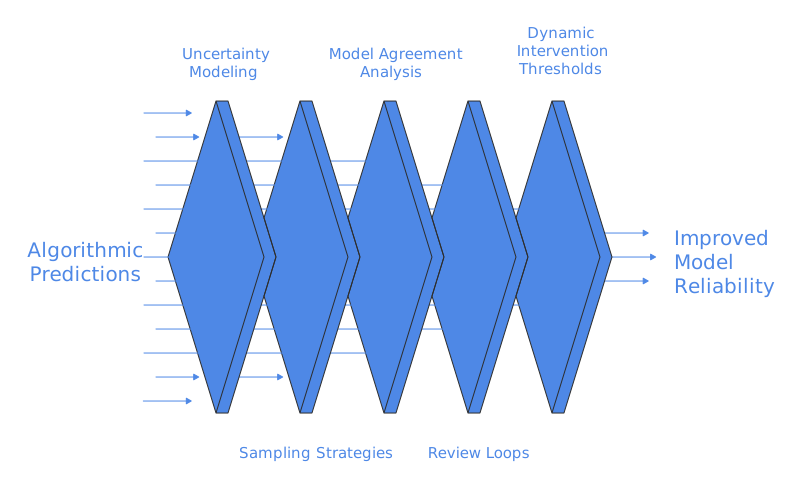
⚙️ Integrate QA with Model Feedback Loops
As your models mature, they can highlight poor-quality labels. Use:
- Confidence heatmaps
- Prediction vs. label mismatches
- Uncertainty sampling
Let models flag samples needing QA—not replace human QA.
🧑🏫 Promote QA Leads from Within
Scale your QA leadership by identifying and promoting experienced annotators. This ensures:
- Domain expertise is retained
- QA leads understand the reality of annotation
- Feedback stays grounded and empathetic
Invest in QA lead training on tooling, metrics, and coaching—not just error detection.
💡 Automate What You Can, Review What You Must
Use automation for:
- Guideline enforcement (e.g., minimum polygon size)
- Metadata validation (e.g., timestamp formatting)
- Label structure checks (e.g., correct class hierarchy)
But never skip human review for ambiguous, high-risk, or new data types.
The Future of Scalable QA Is Hybrid 🧬
At scale, the most effective annotation QA systems will combine:
- Human expertise
- Automated validation
- Machine-assisted prioritization
- Transparent metrics
Together, these allow you to achieve the holy grail: high-quality annotations, delivered at speed, with confidence in every label.
Bonus Tip: Use Model-Assisted QA (But Don't Rely on It Fully 🤖)
Pre-trained models can assist QA by flagging misclassifications, suggesting labels, or spotting anomalies. But they are not a replacement for human oversight—especially when:
- Working in new domains with limited training data
- Handling sensitive content (e.g., violence, medical)
- Dealing with nuanced labels (e.g., emotion recognition, multi-label overlap)
Instead, use model-assisted QA to prioritize reviews, not to skip them.
Some useful tools in this space include:
- Encord Active – automatic quality scoring of datasets
- Prodigy – active learning and human-in-the-loop annotation
- Lightly – sample selection and redundancy reduction in image datasets
Final Thoughts: Quality is a Moving Target—Aim to Stay Ahead 🎯
QA isn’t a box you tick once—it’s a moving, evolving process. As your dataset changes, your users grow, or your AI models mature, your QA protocols must adapt.
The most successful teams don’t just do QA—they make it a core philosophy of how they operate. They invest in people, platforms, and continuous learning.
If you're building anything that touches real-world decision-making, QA is your foundation of trust.
Ready to Upgrade Your Annotation QA?
If you're serious about delivering high-quality datasets, let’s talk. At DataVLab, we build robust QA workflows into every annotation project—whether it’s for satellite imagery, medical scans, or safety-critical AI.
💬 Need a review of your current annotation QA workflow?
Contact us now—we’re happy to help.
What is Annotation QA protocols?
Quality assurance (QA) in data annotation is the backbone of successful machine learning outcomes. Artificial intelligence is only as good as the data it learns from. Annotated data forms the foundation for supervised machine learning, but annotation errors—like label noise, inconsistency, or incomplete objects—can severely impact model accuracy.
What does the article explain about why annotation QA protocols matter more than ever?
Artificial intelligence is only as good as the data it learns from. Annotated data forms the foundation for supervised machine learning, but annotation errors—like label noise, inconsistency, or incomplete objects—can severely impact model accuracy. In regulated or high-risk industries like Healthcare, autonomous systems, or finance, the consequences of poor annotation quality are even more pronounced.
What does the article explain about how to implement peer review effectively?
Pair annotators with similar experience levels to ensure balanced reviews. Use review checklists tied to project guidelines (e.g., bounding box tightness, class accuracy, metadata completeness). Set thresholds for rejection and correction (e.g., any task with over 10% error must be flagged).
What are the main challenges of Annotation QA protocols?
Even the best peer reviews and leads can miss things. That’s where audits come in—structured evaluations that randomly sample or target subsets of annotated data for deeper inspection. Random Sampling Audits: Periodically review a percentage (e.g., 5%) of tasks chosen at random.
What is involved in creating a culture of quality: training, feedback, and communication?
Teams that deliver consistent, high-quality annotations are those that embed QA into every layer of their operation. Onboard with precision: Use real-world examples, gold-standard walkthroughs, and shadow tasks. Document everything: Version-controlled guidelines, change logs, FAQ boards.
What does the article explain about what happens when QA goes wrong? (and how to fix it)?
Even with the most well-designed annotation systems, things can—and often do—go wrong. Whether due to miscommunication, poor tooling, unclear guidelines, or a breakdown in feedback loops, annotation quality can slip. Model performance declines after dataset updates: A sudden dip in accuracy, precision, or recall metrics may stem from poor labeling in the latest dataset batch.