Terms and Conditions Datasets: How Annotated Consumer Agreements Train Legal and Policy AI Models
.jpeg)
Terms and conditions datasets provide the annotated examples that allow AI systems to interpret consumer agreements, identify policy language, and evaluate compliance requirements. This article examines how T&C datasets are constructed, what types of labels they include, and how annotation teams capture the structure and meaning of complex policy documents. It explores the unique challenges of terms and conditions analysis, including ambiguous phrasing, cross-reference structures, and varied drafting styles. Readers will gain a detailed understanding of how T&C datasets support legal AI applications in compliance, consumer protection, and automated policy review workflows.
- Terms and conditions datasets provide the annotated examples that allow AI systems to interpret consumer agreements, identify policy language, and evaluate compliance requirements.
- This article examines how T&C datasets are constructed, what types of labels they include, and how annotation teams capture the structure and meaning of complex policy documents.
- It explores the unique challenges of terms and conditions analysis, including ambiguous phrasing, cross-reference structures, and varied drafting styles.
- Readers will gain a detailed understanding of how T&C datasets support legal AI applications in compliance, consumer protection, and automated policy review workflows.
Understanding Terms and Conditions Datasets
Terms and conditions datasets contain annotated examples of consumer agreements, platform policies, service rules, and contractual terms presented by businesses to users. These datasets are used to train AI models that interpret policy language, detect obligations, identify limitations, and classify clause types. Because terms and conditions documents govern how users interact with digital services, financial products, or physical goods, accurate interpretation is essential for compliance and transparency. Publicly accessible resources maintained by the Federal Trade Commission provide context for how consumer agreements impact policy oversight and why structured datasets help organizations analyze large volumes of T&C documents.
Why T&C Documents Require Structured Annotation
Unlike traditional legal contracts, terms and conditions documents are designed for broad audiences, often combining legal language with informal explanations. This blend of styles introduces complexity that AI models must learn to interpret. Annotated T&C datasets help models understand which parts of the document represent obligations, which describe service conditions, and which outline user rights or restrictions. Structured annotation allows AI systems to separate operational details from legal commitments and evaluate how policies apply to different user scenarios. Without consistent labels, models struggle to distinguish between informational text and enforceable terms.
The Growing Importance of T&C Analysis in Digital Services
Digital services, SaaS platforms, and online marketplaces rely heavily on terms and conditions to govern user interactions. As these services grow, organizations must review and compare T&C documents more frequently. AI models trained on annotated T&C datasets support automated monitoring, version comparison, and compliance workflows. They help identify policy changes, track obligations, and ensure that documents align with regulatory expectations. Because T&C documents often evolve quickly, datasets must be updated regularly to reflect new requirements and emerging industry norms.
What Terms and Conditions Datasets Contain
T&C datasets include annotated samples of agreements from a wide range of industries and service providers. These datasets capture clause boundaries, semantic categories, definitions, disclaimers, and specific operational rules. Annotators label each component to help models interpret how obligations and permissions are expressed.
Clause-Level Annotation
Clause-level annotation identifies discrete units of meaning within a T&C document. Annotators label clauses related to topics such as payment terms, account management, user obligations, liability limitations, intellectual property rights, or dispute resolution. Legal clause repositories such as Law Insider illustrate how commonly used T&C clauses vary across different industries and agreements. These examples provide valuable context for annotators and help models learn the variations of policy expression.
Definitions and Reference Sections
Terms and conditions documents often include a definitions section that clarifies key concepts such as “user content,” “service provider,” or “account information.” Annotating these definitions helps models interpret references correctly across the remainder of the document. Definitions serve as anchor points that link terminology to specific obligations or permissions.
Policy Scope and Applicability
Datasets also include labels related to the scope of the agreement, such as which users the policy applies to, what services are covered, and how the terms interact with external regulations. Annotating policy scope teaches models to recognize context-setting language that influences downstream interpretation. This helps AI tools perform more accurate comparisons when analyzing multiple T&C documents from different providers.
Challenges in Annotating Terms and Conditions
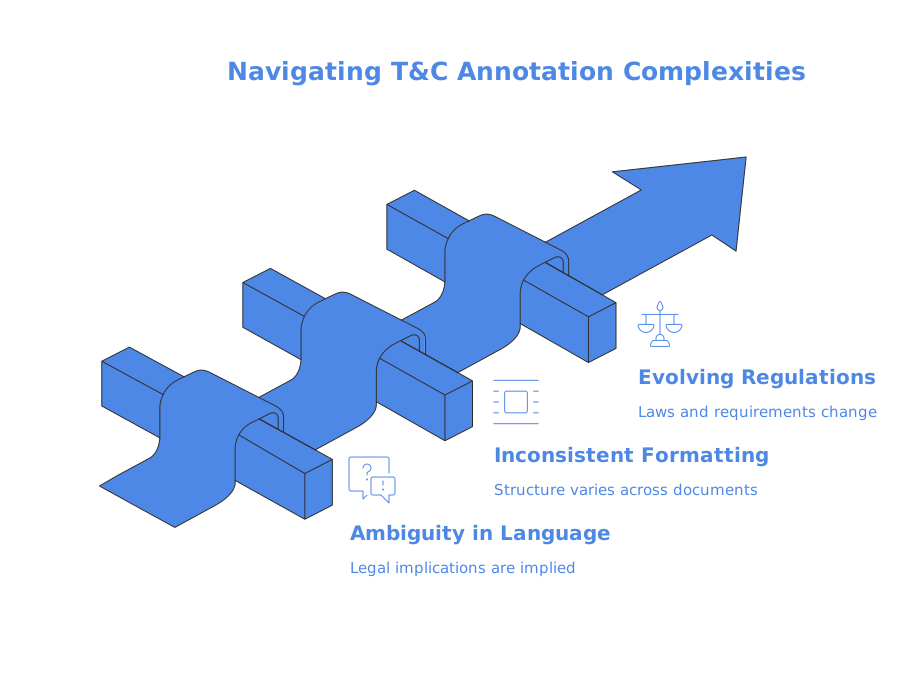
Annotating T&C datasets presents unique challenges due to the mixture of legal language, brand-specific terminology, and user-facing explanations. Annotators must follow detailed guidelines to ensure consistent interpretation across a diverse set of policy documents.
Ambiguity in Consumer-Oriented Language
Terms and conditions documents often use plain language to make policies accessible to users. While this improves readability, it introduces ambiguity because legal implications may be implied rather than stated directly. Annotators must interpret these passages accurately and classify them based on legal effect, not just surface wording. This requires domain training and careful guideline design.
Inconsistent Formatting Across Industries
Unlike formal contracts, T&C documents may vary significantly in structure, layout, and design. Some appear as web pages with collapsible sections, while others appear as PDFs with a more traditional format. Annotators must identify boundaries, interpret headings, and extract meaningful segments despite formatting inconsistencies. This complexity underscores the need for standardized annotation instructions that address common layout variations.
Evolving Regulatory Context
Privacy regulations, consumer protection laws, and service requirements evolve regularly. Privacy guidelines published by government institutions, such as those from the California Attorney General, illustrate how updates influence T&C structure and content. Annotators must stay informed about regulatory trends because these developments affect how clauses should be classified and interpreted.
Designing Annotation Guidelines for T&C Datasets
Annotation guidelines help annotators label clauses consistently across diverse T&C documents. These guidelines must define categories clearly, describe how to treat ambiguous or multifunctional clauses, and offer examples that illustrate proper classification.
Defining Functional Categories
Categories may reflect clause functions such as liability, privacy, user obligations, service limitations, or termination conditions. Guidelines must explain how these categories are defined, including examples of borderline cases. For instance, a clause describing service availability might overlap with both operational details and disclaimers, and annotators must understand how to classify such hybrid passages.
Treatment of Mixed Content
Some T&C segments include both explanatory text and enforceable conditions. Guidelines should specify how to separate these elements or how to classify them when separation is not feasible. Clear instructions help annotators distinguish between informational content and legally binding terms, ensuring that models learn the correct interpretation of mixed passages.
How Models Learn From T&C Datasets
AI models trained on T&C datasets use labeled examples to recognize clause types, interpret obligations, and analyze policy implications. These models rely on supervised learning techniques to identify patterns in legal and consumer-facing language.
Recognizing Legal and Operational Signals
Models learn features that reflect legal concepts such as rights, obligations, limitations, and definitions. They also learn operational signals such as service descriptions or account management rules. By analyzing annotated text, models build internal representations that support tasks such as classification, extraction, or comparison.
Handling Structural Elements
Terms and conditions documents often contain headers, bullet points, references, and cross-links. Models trained on well-annotated datasets learn how structural signals influence interpretation. Segment boundaries, section titles, and formatting cues help models differentiate between clause types and improve classification accuracy.
Evaluating Terms and Conditions Datasets
Evaluating T&C datasets involves assessing annotation precision, category coverage, representational diversity, and alignment with model objectives. Evaluation ensures that datasets support accurate and reliable AI outputs.
Assessing Annotation Consistency
To ensure consistency, reviewers compare labeled samples across annotators. They verify that similar clauses receive similar labels and that ambiguous passages are treated according to guideline standards. This consistency is essential for building models that generalize well across unseen T&C documents.
Evaluating Domain Coverage
Datasets must reflect a broad range of industries, service types, and drafting styles. Evaluation teams assess whether all relevant categories appear in sufficient quantity and whether the dataset includes both long-form and web-based T&C formats. This diversity reduces model bias and improves robustness in production systems. Government-published templates, such as those maintained by the UK Government, provide structured examples that help benchmark dataset coverage.
Applications of T&C Datasets
Annotated T&C datasets support a variety of applications across compliance, legal operations, content moderation, and service management. These applications depend on reliable classification and accurate interpretation of policy language.
Compliance Monitoring and Policy Comparison
Organizations use T&C models to compare policy versions, identify changes, and evaluate compliance with legal requirements. Annotated datasets help models detect obligations, privacy statements, and risk-related clauses. This supports internal auditing and improves transparency across digital services.
Automated Contracting and Service Operations
T&C datasets support automated workflows that review, classify, and interpret service terms for platforms managing large volumes of third-party vendors or user agreements. Classification models assist with routing T&C documents for human review when anomalies or potential policy conflicts arise.
Future Directions in T&C Dataset Development
As digital services expand, T&C datasets will evolve to include richer metadata, multimodal signals, and new annotation strategies. These improvements will enhance the quality and flexibility of future models.
Multimodal Integration
Future datasets may include both text and interface-based context, such as how T&C documents appear in-app or on websites. This multimodal approach can help models understand how presentation influences interpretation and user comprehension. Integrating layout metadata will require updated annotation guidelines and new dataset schemas.
Assisted Annotation Techniques
Machine-assisted annotation will support large-scale T&C dataset creation by generating candidate labels that human annotators refine. This hybrid approach helps maintain accuracy while increasing production efficiency. As models become more advanced, they will assist annotators in detecting clause boundaries, suggesting categories, and identifying potential misclassifications.
If You Are Creating T&C or Policy Datasets
Developing reliable terms and conditions datasets requires careful annotation, diverse document sampling, and detailed guidelines that capture both legal and operational nuance. If you are preparing datasets for policy interpretation, compliance monitoring, or T&C analysis, the DataVLab team can help design workflows that strengthen model performance. Share your objectives, and we can explore how to support your legal AI initiatives with high-quality annotated data.
What are Terms and conditions datasets?
Terms and conditions datasets provide the annotated examples that allow AI systems to interpret consumer agreements, identify policy language, and evaluate compliance requirements. This article examines how T&C datasets are constructed, what types of labels they include, and how annotation teams capture the structure and meaning of complex policy documents.
What does the article explain about what terms and conditions datasets contain?
T&C datasets include annotated samples of agreements from a wide range of industries and service providers. These datasets capture clause boundaries, semantic categories, definitions, disclaimers, and specific operational rules. Annotators label each component to help models interpret how obligations and permissions are expressed.
What are the main challenges of Terms and conditions datasets?
Annotating T&C datasets presents unique challenges due to the mixture of legal language, brand-specific terminology, and user-facing explanations. Annotators must follow detailed guidelines to ensure consistent interpretation across a diverse set of policy documents. Terms and conditions documents often use plain language to make policies accessible to users.
What is involved in designing annotation guidelines for T&C datasets?
Annotation guidelines help annotators label clauses consistently across diverse T&C documents. These guidelines must define categories clearly, describe how to treat ambiguous or multifunctional clauses, and offer examples that illustrate proper classification. Categories may reflect clause functions such as liability, privacy, user obligations, service limitations, or termination conditions.
What does the article explain about how models learn from T&C datasets?
AI models trained on T&C datasets use labeled examples to recognize clause types, interpret obligations, and analyze policy implications. These models rely on supervised learning techniques to identify patterns in legal and consumer-facing language. Models learn features that reflect legal concepts such as rights, obligations, limitations, and definitions.
What are the main use cases for Terms and conditions datasets?
Annotated T&C datasets support a variety of applications across compliance, legal operations, content moderation, and service management. These applications depend on reliable classification and accurate interpretation of policy language. Organizations use T&C models to compare policy versions, identify changes, and evaluate compliance with legal requirements.