Legal Dataset : How Annotated Documents Power AI Models for Law, Compliance, and Governance
.jpeg)

Legal datasets provide the foundation for training AI systems that interpret contracts, analyze regulatory documents, and support compliance workflows. This article explains what legal datasets contain, how they are structured, and why high-quality annotation is essential for accurate model performance. It explores document diversity, annotation methodologies, and the challenges of preparing legal text for machine learning. Readers will also learn how dataset design affects downstream applications such as retrieval, summarization, and automated review. By examining end-to-end considerations, the article offers a detailed look at how legal datasets underpin modern Legal AI.
- Legal datasets provide the foundation for training AI systems that interpret contracts, analyze regulatory documents, and support compliance workflows.
- This article explains what legal datasets contain, how they are structured, and why high-quality annotation is essential for accurate model performance.
- Readers will also learn how dataset design affects downstream applications such as retrieval, summarization, and automated review.
- Legal datasets are structured collections of legal documents, annotated text passages, and metadata used to train machine learning models that support legal and regulatory workflows.
Understanding a Legal Dataset
Legal datasets are structured collections of legal documents, annotated text passages, and metadata used to train machine learning models that support legal and regulatory workflows. These datasets serve as the foundation for systems that automate document review, extract contractual obligations, interpret regulatory standards, and analyze case law. They are composed of diverse document types drawn from government archives, judicial repositories, regulatory databases, and corporate legal collections. The Library of Congress maintains extensive digital archives that mirror the document diversity seen in real-world legal workflows and exemplify the range of materials that legal datasets must incorporate. For model developers, the structure and consistency of these datasets determine the effectiveness of Legal AI applications.
Why Legal Dataset Matter
Modern legal operations rely on large quantities of text that require review, interpretation, and classification. Legal datasets allow AI models to learn the language patterns, structural cues, and contextual signals embedded in these documents. Without well-designed datasets, models struggle to interpret clauses, understand legal terminology, or differentiate between document types. High-quality data ensures that AI systems produce reliable outputs that can be validated and audited. Because legal decisions often have significant business or regulatory implications, datasets must reflect accuracy, consistency, and domain-specific nuances.
The Role of Document Diversity
Legal datasets benefit from a wide variety of document types, including court decisions, statutes, regulatory notices, contracts, corporate policies, and governmental publications. This diversity exposes AI models to different writing styles, logical structures, and contextual frameworks. Collections such as those published by the United Nations Security Council demonstrate how global legal documents vary in format and structure while addressing comparable themes of governance and compliance. Incorporating such diversity into a dataset enhances model adaptability, reducing overfitting and improving performance across real-world tasks.
Types of Documents Included in a Legal Dataset
A comprehensive legal dataset spans multiple categories of legal and regulatory documentation. These include primary legal texts, secondary analytical materials, and administrative documents relevant to governance and compliance workflows. Annotators work with each category to ensure consistent labeling and structured representation.
Primary Legal Documents
Primary documents include statutes, regulations, judicial opinions, and official rulings. These materials define legal obligations and govern how institutions must operate. Annotating these documents requires precise identification of structural elements such as sections, subsections, definitions, and provisions. This structure helps models understand the hierarchy of legal text and interpret dependencies between clauses. Repositories maintained by judicial institutions, such as state court opinion databases, provide examples of standardized primary legal materials that frequently serve as dataset sources.
Corporate and Commercial Documents
Corporate legal documents include contracts, service agreements, compliance policies, governance guidelines, and internal procedural manuals. These documents vary significantly in layout and drafting style. Annotating them requires recognizing clause boundaries, obligations, rights, restrictions, and business context. The variation across industries means that datasets must include examples from multiple sectors to ensure robust model performance.
Regulatory and Administrative Materials
Regulatory documents issued by governmental bodies form another core component of legal datasets. These documents provide instructions, guidelines, and expectations for compliance across industries. Institutions such as the European Commission publish extensive regulatory content that contributes to an understanding of complex policy frameworks. Annotating these materials helps models interpret standards, identify compliance requirements, and support regulatory impact assessments.
Annotation in Legal Datasets
Annotation is a critical step in preparing legal datasets. It involves labeling text segments, identifying logical structures, and tagging relationships within documents. Because legal language is precise and context-dependent, annotation teams must follow detailed guidelines to ensure consistency and reliability across large datasets.
Structural Annotation
Structural annotation identifies sections, headings, definitions, references, and hierarchical relationships within legal documents. These labels help machine learning models understand the underlying document architecture. This structure is particularly important for tasks such as document navigation, segmentation, and retrieval, where models must interpret how different elements relate to one another. Consistent structural annotation supports downstream tasks such as summarization and clause extraction.
Semantic Annotation
Semantic annotation captures meaning, intent, and contextual relationships. Annotators identify obligations, permissions, rights, conditions, and exceptions. These elements are essential for models that must interpret contractual language or analyze regulatory implications. Because semantic elements vary widely depending on document type, guidelines must describe how to treat ambiguous or multifunctional clauses. These annotations allow AI systems to parse legal meanings with greater nuance.
Challenges in Developing Legal Datasets
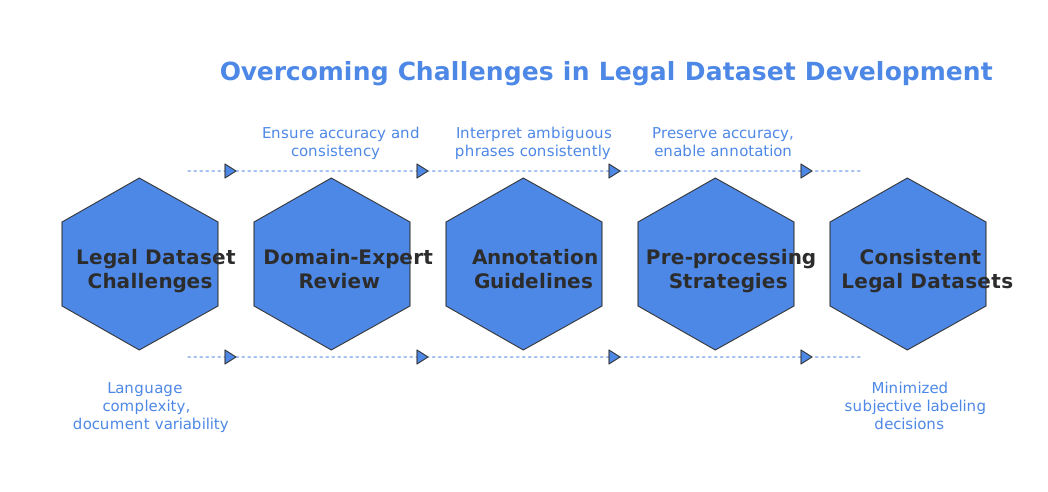
Developing legal datasets presents significant challenges due to language complexity, document variability, and domain specificity. Annotators must work with intricate text that often contains specialized terminology, cross-references, and nested logic. Addressing these challenges requires detailed planning and domain-expert review cycles.
Ambiguity in Legal Language
Legal text frequently contains phrases that carry specific interpretations depending on context. Ambiguous language complicates annotation tasks because certain clauses may serve multiple functions or affect multiple parties. Annotators must refer to guidelines that outline how to interpret and categorize ambiguous phrases. These guidelines help maintain dataset consistency and minimize subjective labeling decisions.
Format Variability
Legal documents appear in multiple formats, including PDFs, scanned copies, structured text, and legacy templates. Each format introduces unique annotation complexities, especially in extraction-oriented tasks. Documents may include footnotes, embedded tables, sidebars, or references to external regulations. Managing these variations requires pre-processing strategies that preserve textual accuracy while enabling effective annotation.
Building Annotation Guidelines for a Legal Dataset
Clear annotation guidelines are essential for producing high-quality legal datasets. These guidelines define annotation categories, specify how annotators should treat edge cases, and explain how to apply labels consistently. They also serve as training references for large annotation teams working across diverse document types.
Defining Annotation Categories
Annotation categories must reflect the objectives of the dataset. Categories may include clause types, definitional elements, obligations, exceptions, and cross-references. For regulatory documents, categories may represent compliance themes or procedural requirements. Clear category definitions reduce ambiguity and help annotators align labels with model goals. Guidelines often include curated examples drawn from public legal repositories to illustrate proper classification.
Ensuring Annotation Consistency
Annotation consistency is maintained through review cycles, calibration sessions, and quality checks. Multi-layered review ensures that labels adhere to established guidelines and reflect domain-specific nuances. Quality assurance processes validate that annotated samples meet accuracy standards and correct errors before training. These steps ensure that the dataset remains reliable, even as new documents or categories are introduced.
How Legal AI Models Use Legal Datasets
Legal AI models use annotated datasets to perform a wide range of tasks, from document classification to clause extraction and semantic interpretation. The underlying dataset determines how effectively the model can generalize across different document types and legal contexts.
Document Understanding and Classification
Annotated legal datasets support models that classify documents by type, topic, jurisdiction, or purpose. These models help organizations sort legal archives, route documents to the correct teams, and index content for retrieval. Collections such as those in the OECD digital library provide structured examples of policy and legal materials that can support training for classification-oriented systems.
Semantic Interpretation and Clause Analysis
AI models trained on well-annotated datasets learn to interpret contractual clauses, detect obligations, and identify compliance-related language. These models support tasks such as risk assessment, due-diligence review, and policy comparison. Their performance depends heavily on the quality and consistency of semantic annotations applied during dataset construction. Models that rely on these datasets provide structured insights that assist legal professionals in decision-making.
Evaluating a Legal Dataset
Evaluating a legal dataset involves assessing completeness, annotation quality, diversity, and relevance to model objectives. Evaluation procedures help identify gaps in category coverage, representation issues, or annotation inconsistencies. This ensures that the dataset supports reliable and explainable AI models.
Diversity and Representational Coverage
A strong legal dataset must reflect a wide range of document types, jurisdictions, industries, and drafting styles. Diverse representation reduces the risk of model bias and improves generalization. Evaluation teams review dataset samples to confirm that relevant categories appear in sufficient quantity and diversity. They also ensure that the dataset includes edge cases and unusual document formats that models may encounter in real-world use.
Alignment With Model Objectives
Datasets must align with the system’s intended use. For example, a dataset designed for retrieval-based tasks requires accurate structural annotations, while a dataset for risk analysis requires detailed semantic labeling. Evaluators assess whether the dataset’s labels, coverage, and examples support the intended task. This alignment ensures that models do not underperform due to mismatched training data.
Applications of Legal Datasets
Legal datasets support a variety of real-world applications across legal operations, compliance, governance, and enterprise document management. These applications rely on structured datasets to ensure consistent model outputs.
Contract Review and Analysis
Annotated legal datasets support contract analysis systems that identify clauses, extract key information, and compare agreements across versions. These systems streamline review procedures and help legal teams focus on negotiation strategy and risk assessment. Contract review models depend on semantic labels that clarify the intent and function of contractual language.
Regulatory and Compliance Workflows
Organizations use legal datasets to build systems that interpret regulatory documents, monitor policy changes, and evaluate compliance obligations. These systems help track regulatory developments and identify relevant requirements across multiple jurisdictions. Annotated regulatory documents support automated workflows that reduce manual research time and ensure alignment with evolving standards.
Future Directions in Legal Dataset Development
As legal AI evolves, so will the methodologies for constructing legal datasets. New approaches in annotation, multimodal integration, and model training will influence future workflows.
Multimodal Datasets
Future legal datasets may integrate text with metadata, audio transcripts, or structured data from legal databases. This multimodal structure enables more advanced tasks such as predictive modeling, contextual search, or complex reasoning over combined inputs. Integrating multiple data sources requires updated annotation guidelines and careful handling of cross-modal relationships.
Hybrid and Assisted Annotation
Hybrid annotation workflows combine human input with machine-generated suggestions to increase scalability. Assisted annotation tools help annotators label repetitive structures or identify probable clause types. Human oversight remains essential, but machine assistance accelerates dataset creation and improves consistency across large volumes of documents.
If You Are Preparing Legal AI Datasets
High-quality legal datasets are essential for building reliable legal and regulatory AI systems. If you are designing a dataset for contracts, regulatory documents, or enterprise legal workflows, the DataVLab team can help structure annotation pipelines that ensure accuracy and consistency. Share your goals, and we can explore how to support your legal AI initiatives with precisely annotated documents.
What is Legal dataset?
Legal datasets provide the foundation for training AI systems that interpret contracts, analyze regulatory documents, and support compliance workflows. This article explains what legal datasets contain, how they are structured, and why high-quality annotation is essential for accurate model performance.
What does the article explain about why legal dataset matter?
Modern legal operations rely on large quantities of text that require review, interpretation, and classification. Legal datasets allow AI models to learn the language patterns, structural cues, and contextual signals embedded in these documents. Without well-designed datasets, models struggle to interpret clauses, understand legal terminology, or differentiate between document types.
What are the main challenges of Legal dataset?
Developing legal datasets presents significant challenges due to language complexity, document variability, and domain specificity. Annotators must work with intricate text that often contains specialized terminology, cross-references, and nested logic. Addressing these challenges requires detailed planning and domain-expert review cycles.
What is involved in building annotation guidelines for a legal dataset?
Clear annotation guidelines are essential for producing high-quality legal datasets. These guidelines define annotation categories, specify how annotators should treat edge cases, and explain how to apply labels consistently. They also serve as training references for large annotation teams working across diverse document types.
What does the article explain about how legal AI models use legal datasets?
Legal AI models use annotated datasets to perform a wide range of tasks, from document classification to clause extraction and semantic interpretation. The underlying dataset determines how effectively the model can generalize across different document types and legal contexts.
What is the future of Legal dataset?
As legal AI evolves, so will the methodologies for constructing legal datasets. New approaches in annotation, multimodal integration, and model training will influence future workflows. Future legal datasets may integrate text with metadata, audio transcripts, or structured data from legal databases.